


Understanding Biculturalism: Definitions and Differences

When exploring what it means to live between two cultures, the 2 important aspects of biculturalism stand out:
- Cultural Practices and Behaviours: This refers to the visible ways you engage with both cultures, from the languages you speak and the food you eat to your social interactions and media preferences. It’s about seamlessly navigating daily life with elements from both your heritage and host cultures.
- Cultural Values and Identity: This digs deeper into your internal sense of self, encompassing your beliefs, identifications, and how you integrate both cultural streams into your core identity. It’s about feeling comfortable and proficient in both worlds, reconciling their values, and shaping a unique “third” cultural identity.
Ever felt like you belong to two worlds at once? For many internationals in Barcelona, Valencia, or Málaga, this experience is a daily reality. The constant interplay between your heritage culture and your new surroundings shapes not just your routine, but also your very sense of self. This guide explores what it truly means to be bicultural, why it matters for your well-being, and how it profoundly impacts your identity.
It’s about much more than just living in a new country; it’s about integrating distinct cultural practices, values, and identifications into a rich, complex personal mix.
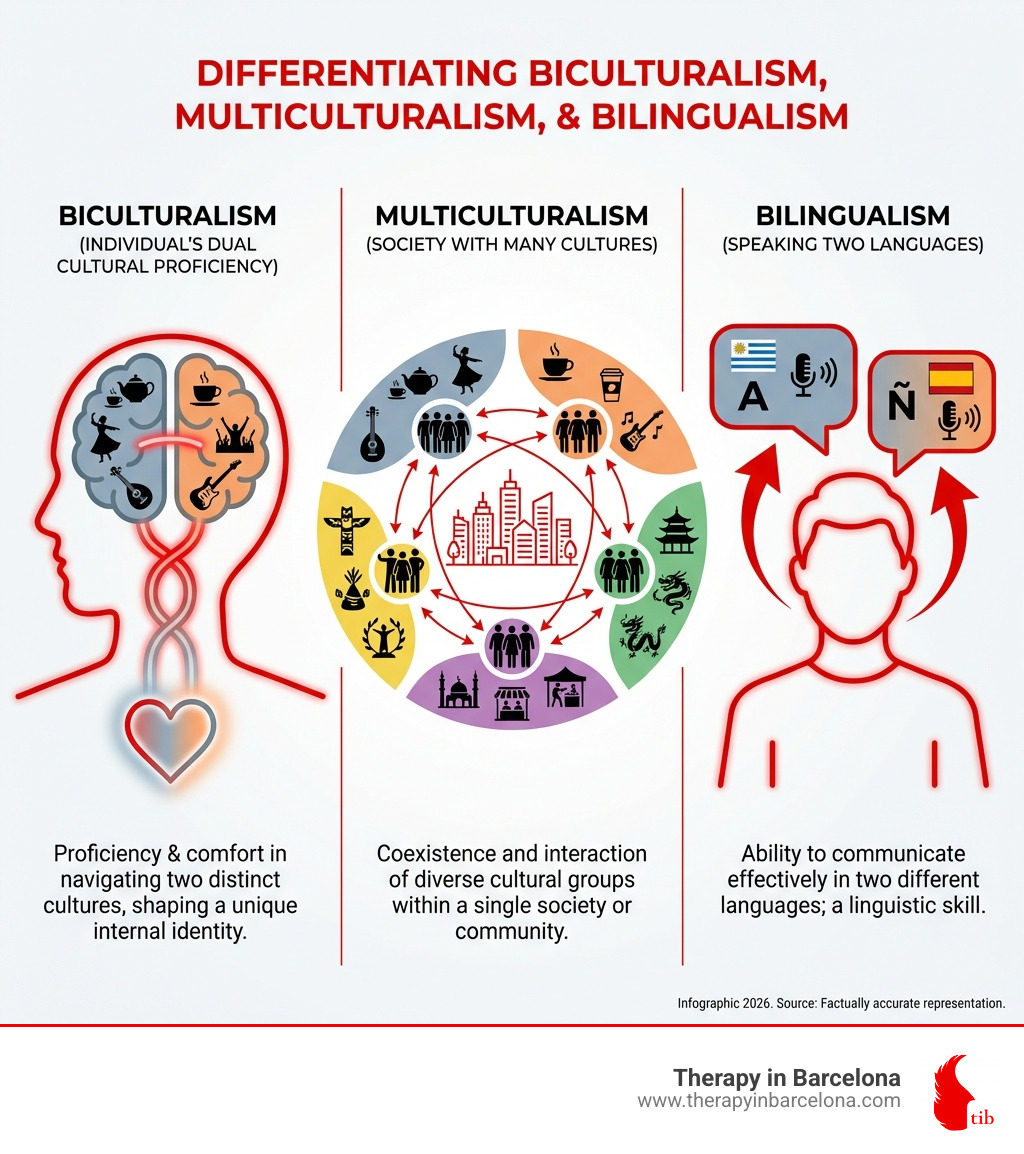

At its core, biculturalism is the state of belonging to and being proficient in two different cultures. Cecilia Montes-Alcalá, an associate professor at Georgia Tech’s School of Modern Languages, explains that biculturalism occurs when one person steers the values, customs, and traditions of two distinct cultures simultaneously.
This isn’t just a surface-level adjustment. It represents a fundamental shift in how you view the world. When you are monocultural, you often assume that your way of doing things is the “standard” for everyone. Biculturalism breaks this illusion. It allows you to appreciate that there is more than one way to live, and that both sets of norms have inherent value.
Distinguishing Biculturalism from Bilingualism
People often treat bilingualism and biculturalism as if they mean the same thing, but they do not. Bilingualism is about language ability, such as speaking, reading, or understanding two languages. Biculturalism goes further. It includes knowing how to move between two sets of values, habits, social rules, and ways of interpreting the world. A person can be bilingual without feeling at home in two cultures, and bicultural without being fully fluent in two languages.
Ideally, learning a new language should lead to learning the culture associated with it. When you learn vocabulary and grammar, you are also exposed to a new set of cultural norms. However, some people may speak a second language fluently but remain culturally distant from the people who speak it. Conversely, you might be deeply bicultural — understanding the nuances of a second culture through family or immersion — while only being fluent in one language.
Biculturalism vs. Multiculturalism
The difference here lies in the scale. Multiculturalism is a sociological term used to describe a society or a country that houses many different cultural groups. It is about diversity at a community or national level.
Biculturalism is an individual experience. It describes how a single person manages the internal and external reality of two cultural streams. While a city like London or Barcelona is multicultural, the person living within it who steers their Italian heritage alongside their new Spanish life is experiencing biculturalism.
The 2 Important Aspects of Biculturalism: Practices and Identity
To understand biculturalism fully, we must look at what researchers call the “bidimensional” model. This model highlights the 2 important aspects of biculturalism: cultural practices and cultural identity.
Balancing the 2 Important Aspects of Biculturalism in a New City
The first aspect is Cultural Practices. These are the behavioural components of your life. If you move to Valencia or Málaga, your practices might include:
- Language Use: Switching between your native tongue at home and Spanish at work.
- Media Preferences: Watching news from your home country while enjoying local Spanish cinema.
- Social Circles: Having a mix of friends from your heritage culture and the local community.
- Daily Habits: Maintaining a traditional breakfast from home but adopting the Spanish siesta or late-night dinner culture.
The second aspect is Cultural Identity. This is the internal, psychological side. It involves your values and identifications. It’s not just about what you do, but who you feel you are. According to research on Bicultural Identity Integration (BII), individuals with high BII see their two identities as compatible and complementary. They don’t feel they have to choose one over the other; they feel like a unified “third culture” individual.
Why the 2 Important Aspects of Biculturalism Matter for Mental Health
Understanding these 2 important aspects of biculturalism is vital for your mental health. Research shows that biculturalism is often the most adaptive approach to moving to a new country. When you can comfortably steer both worlds, you develop a broader range of coping strategies.
Individuals who successfully integrate both practices and identity tend to experience:
- Improved Cognitive Flexibility: The ability to switch between different cultural “frames” of mind.
- Lower Acculturative Stress: Feeling competent in both environments reduces the anxiety of “not fitting in.”
- Stronger Social Support: By engaging with both communities, you have a wider net of relationships to rely on.
Development and Adaptiveness in Global Hubs
Biculturalism doesn’t develop in a vacuum. It is a product of environmental and familial forces. Schwartz and Unger point out that biculturalism is most likely to emerge when an individual is embedded in a community that values both the heritage and the local culture.
Biculturalism in Spanish Hubs
Spain’s major cities are perfect examples of environments where biculturalism thrives:
- Barcelona: A gateway for digital nomads and internationals where the blend of Catalan, Spanish, and international cultures creates a rich, bicultural playground.
- Madrid: The cosmopolitan heart of Spain where diverse international communities integrate into a , traditional yet modern Spanish lifestyle.
- Málaga and Alicante: These hubs offer a more relaxed, family-friendly vibe where many expats find it easier to retain their heritage while adopting local coastal traditions.
When Biculturalism is Most Beneficial
Biculturalism is most adaptive in “gateway cities” like New York, London, Paris, and Sydney. In these places, being able to steer multiple cultures is a distinct social and professional advantage. However, in very monocultural or rural areas, being bicultural can sometimes feel like a disadvantage if the local environment expects total assimilation.
Navigating Challenges and Identity Integration
While biculturalism has many benefits, it is not without its problems. Navigating two cultures can lead to internal conflict, especially if the cultures have very different values.
For example, a person from a collectivist Asian culture living in an individualistic Western society might struggle with the conflict between “saving face” and “speaking one’s mind.” LaFromboise and colleagues have noted that the psychological impact of biculturalism depends heavily on how an individual manages this tension.
Cultural Frame Switching and Double Consciousness
Bicultural individuals often engage in “Cultural Frame Switching” (CFS). This is the ability to switch between different cultural systems in response to environmental cues. If you are speaking English with a friend, your brain might prime Western values; if you switch to Spanish with a neighbor, your brain might shift toward more local social norms.
This “double consciousness” is a sophisticated cognitive tool, but it can be exhausting. It requires constant mental energy to monitor which “version” of yourself is most appropriate for the current setting.
Comparing Acculturation Strategies
When moving to a new culture, people generally adopt one of four strategies:
- Biculturalism (Integration): You maintain your heritage while embracing the new culture. This is linked to the best mental health outcomes and highest life satisfaction.
- Assimilation: You adopt the new culture fully and let go of your heritage. While this can make social interactions easier in monocultural areas, it often leads to a sense of loss or “identity thinning.”
- Separation: You hold onto your heritage culture and avoid the new one. This can lead to isolation and difficulty navigating the practicalities of life in a new country.
- Marginalisation: You feel disconnected from both. This is the most difficult state for mental health, often resulting in feelings of loneliness and displacement.
Biculturalism in Practice: Global and Social Contexts
Biculturalism looks different depending on where you are. In the United Kingdom, it is often seen in immigrant communities who maintain strong ties to their heritage while integrating into British life.
In New Zealand, biculturalism has a specific legal and national meaning. It refers to the partnership between the Māori (the indigenous people) and the Crown (non-Māori). This relationship, based on the Treaty of Waitangi, influences everything from government names to public holidays like Matariki.
Language as a Cultural Anchor
Language is more than just a tool for communication; it’s a cultural anchor. Maintaining your native language helps preserve cultural memories and values. However, as many expats in Berlin or Barcelona find, you can participate in a culture and feel a sense of belonging even before you are fully fluent in the local tongue.
Implications for Education and the Workplace
In the workplace, bicultural individuals are often “bridge builders.” They possess high “integrative complexity,” meaning they can see multiple sides of a problem and forge links between different perspectives. This makes them excellent in international business, diplomacy, and diverse team settings.
However, bicultural individuals may also face “stereotype threat”—the fear of confirming negative stereotypes about their cultural group. This can impact academic performance and social confidence if the environment is not inclusive.
Support for the Bicultural Journey
At Therapy in Barcelona, we understand that living between two worlds is both a gift and a challenge. Whether you are an expat professional in Madrid, a digital nomad in Gran Canaria, or a student in Barcelona, navigating your dual identity can sometimes feel messy.
Our team of psychology-trained therapists are expats themselves. We have lived the journey of cultural adjustment, language barriers, and the “liminal space” of not quite being from “here” or “there.” We offer a compassionate sanctuary where you can explore your identity without judgment.
Choosing the Right Support
Therapy is not one-size-fits-all. We pride ourselves on our personalised therapist matching. We don’t just give you the next person on the list. We take the time to understand your unique needs—whether you’re dealing with homesickness, relationship strain, or the stresses of a bicultural marriage—and match you with a therapist who truly “gets” it.
Our founder, Leigh Matthews, is an Australian Psychologist who has lived in Barcelona since 2011. She founded the practice to offer therapy services that truly speak to the international community. Today, we support internationals across Spain and around the world as they navigate life changes, identity, and belonging.
Acknowledging Alternatives
While we offer a specialised, private-pay service for the international community, there are other options available:
- Public Health System (CatSalut): This is available to residents in Catalonia, though wait times can be long and services are rarely in English.
- Large Online Platforms: These offer convenience but often lack the personalised matching and deep cultural expertise required for the expat experience.
- Local Spanish Practices: Excellent for those fluent in Spanish, but they may not always understand the specific nuances of the international “outsider” experience.
We focus on high-quality, culturally sensitive care with strict privacy—we never sell your data.
Frequently Asked Questions about Biculturalism
Can you be bicultural without being bilingual?
Absolutely. Biculturalism is about your comfort with the traditions, social norms, and values of two cultures. While language is a major part of culture, you can be deeply immersed in the “way of life” of a second culture—through marriage, long-term residency, or heritage—even if you aren’t fluent in the language.
What are the cognitive benefits of biculturalism?
Bicultural individuals often show higher levels of “integrative complexity.” Because they are used to navigating two different sets of rules, their brains are better at problem-solving, creative thinking, and tolerating ambiguity. They are often more open-minded and less prone to “black-and-white” thinking.
How does biculturalism affect personality?
It can make you more adaptable and “chameleon-like” in social situations. However, if your Bicultural Identity Integration (BII) is low, you might feel more anxious or uncertain about your place in the world. Therapy can help you move toward a more cohesive sense of self.
Conclusion
Living a bicultural life is a transformative journey. It reshapes your sense of self and expands your world in ways you never imagined. While the 2 important aspects of biculturalism—practices and identity—can sometimes pull you in different directions, they also offer a unique opportunity for growth.
If you’re feeling lost in the “in-between” or struggling to integrate your two worlds, you don’t have to steer it alone. Whether you are in Barcelona, Sevilla, or Zaragoza, support is available.
If you’d like support with your bicultural journey, book a Free Discovery Call. We offer sessions in our Barcelona office and online worldwide (including the USA and Canada). Let us help you feel at home in both of your worlds.
