


Connecting with Expats in Alicante: Top Groups and Communities

Building a supportive social circle is one of the most effective ways to ease into life on the Costa Blanca. Alicante is home to a dynamic mix of remote workers, retirees, and international families. Because the city is compact, finding your footing does not take long once you start showing up in international spaces.
Large platforms offer an immediate entry point. The local InterNations network connects 13,793 community members across 173 nationalities. The community hosts around 7 monthly events managed by 13 event hosts, spanning 9 interest-based groups. These gatherings range from casual rooftop drinks and seaside dinners to cultural walks around Mount Benacantil.
Networking Clubs and Social Meetups for Expats in Alicante
For casual weekend gatherings, social clubs offer an easy way to strike up conversations without professional networking pressure. The Alicante Expats & Locals Social Meetup group counts 1,968 members and organises relaxed daytime coffee meetups at spots like Cafetería Barq in Plaza Dr. Gómez Ulla.
These daytime meetups usually draw manageable groups of 6 to 12 people. That smaller size makes it easier to chat naturally in English or practice basic Spanish. Regular language exchanges also take place in central cafes near the marina, giving newcomers a chance to connect with local Spaniards who want to practise English.
Online Forums, Social Media, and Expat Meetup Hubs
Community forums and social media channels serve as practical resources for day-to-day advice. Active regional groups like Valencia Expats and Costa Blanca groups share updates on apartment rentals, local healthcare practitioners, and weekend activities.
Coworking spaces throughout the city centre also provide reliable desks and community events for digital nomads. Joining WhatsApp community subgroups—often focused on padel tennis, hiking, or dining out—allows you to find weekend plans quickly. For broader advice on maintaining wellbeing while setting up your life abroad, The Complete Guide to Expat Mental Health Support Resources offers clear strategies for handling cross-border transitions.
Best Neighborhoods to Settle and Meet International Residents
Choosing where to live sets the tone for your daily routine in Alicante. The city is flat, walkable, and connected by a modern tram network. Whether you prefer bustling historic streets or quiet beachside promenades, there is a neighbourhood suited to your lifestyle.
Everyday Life and Housing for Expats in Alicante
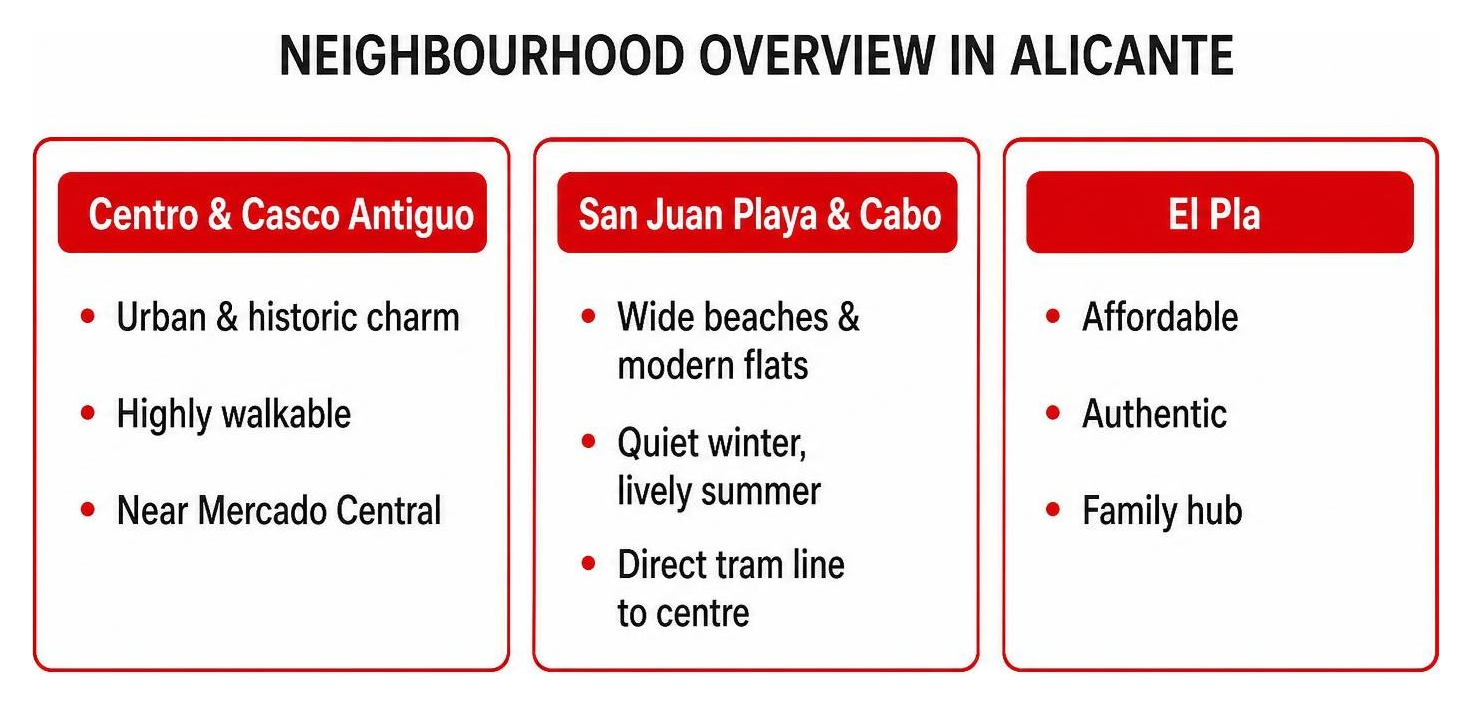
Living in Alicante Centro, the Casco Antiguo, or Santa Cruz places you right in the heart of local culture. The historic centre sits beneath the medieval Castillo de Santa Bárbara, offering winding cobblestone lanes and colourful facades.
Living centrally means you can do your daily shopping on foot at the Mercado Central. Furnished apartments in good central locations generally range from US$500 to $925 per month, depending on size and renovation quality. For practical checklists on securing accommodation and organising paperwork, consult Spain Awaits: A Comprehensive Guide to Your Move.
Coastal and Suburban Hubs: San Juan Playa and Albufereta
If you prefer open sea views, modern residential complexes, and wide avenues, the northern coastal districts are ideal:
- Playa de San Juan: Known for its long stretch of Blue Flag sandy beach, modern apartments with communal swimming pools, and active summer lifestyle.
- Cabo de las Huertas: A quieter residential headland featuring scenic rocky coves, popular for snorkelling, jogging, and peaceful coastal living.
- Albufereta: A sheltered coastal bay located closer to the city centre, offering a calm atmosphere and direct tram access.
- El Pla del Bon Repós: A traditional, budget-friendly neighbourhood just north of the centre, close to the Archaeological Museum (MARQ).
These coastal suburbs are well connected to central Alicante by five tram lines spanning 71 stations. They are especially popular with families seeking proximity to international schools and open parks.
Cost of Living, Healthcare, and Relocation Essentials
Alicante remains one of Spain’s most affordable coastal provincial capitals. It offers high living standards without the steep price tags found in Madrid or northern European cities.

Monthly Expenses, Housing Costs, and Public Transit
A couple can live comfortably in Alicante on an estimated budget of US$2,235 per month. This figure includes central apartment rent, utilities, groceries, high-speed internet, and regular meals out at some of the city’s 600+ restaurants.
Day-to-day transit is straightforward and economical. A single city bus fare is €1.50, while the C-6 airport bus connects directly to the terminal for around €4. High-speed AVE trains reach Madrid in just over two hours, making domestic travel fast and convenient.
Healthcare Access, Private Insurance, and Residency Visas
Spain’s healthcare system ranked seventh in the World Health Organization’s global assessment. Legal residents contributing to social security receive comprehensive public medical coverage. Non-working residents can access public care through the Convenio Especial pay-in scheme (around US$65 per month for those under 65, and $170 per month for seniors).
Private health insurance policies from major Spanish providers start from approximately US$100 to $300 per month, depending on age and medical history. As documented in American retiree experiences in Alicante, private cover provides direct access to specialist consultations and English-speaking doctors.
Following the end of Spain’s real estate Golden Visa program in April 2025, non-EU nationals primarily move using the Non-Lucrative Visa (NLV) for retirees or the Digital Nomad Visa for remote employees and contractors.
Overcoming Moving Hurdles: Bureaucracy, Language, and Emotional Wellbeing
Relocating across borders brings logistical challenges alongside the excitement of coastal living. Adapting to local administrative procedures and daily rhythms requires patience.
Consider the experience of a fictional composite couple representing common expat challenges. After arriving from abroad, they found themselves overwhelmed by municipal appointments (empadronamiento) and adjusting to afternoon shop closures during the 2:00 PM to 5:00 PM siesta. One felt isolated while working remotely, while the other struggled with conversational Spanish. Once they established a predictable morning routine and joined a local language class, their stress levels settled.

Managing Spanish Red Tape and Language Realities
Spanish administrative steps—including obtaining your NIE (tax number), TIE (foreigner identity card), and town hall registration (padrón)—often move at a measured pace.
While many professionals in tourism and hospitality speak English, daily life runs in Spanish (Castellano). Street signs and official regional communications in the Valencian Community also feature Valenciano. Enrolling in an intensive local language academy helps you navigate everyday tasks like speaking with tradespeople or banking staff.
Building Emotional Resilience and Finding Local Support
Cultural transition fatigue, homesickness, and relationship stress are common during the first year abroad. When facing relocation challenges, different support avenues exist:
- Public System Clinicians: Accessible through local health centres (Centros de Salud), though consultations are conducted in Spanish and wait times for specialist mental health referrals can be lengthy.
- Large Global Telehealth Apps: Convenient for basic digital access, but often lack familiarity with Spanish residency systems, local cultural nuances, or expat-specific dynamics.
- Independent Local English-Speaking Practitioners: Helpful for private in-person care along the coast.
For specialised psychological care, Costa Blanca Therapy & Counselling and Online Therapy Alicante offer key differentiators: bespoke therapist matching, strict privacy without data selling, and culturally sensitive support in the client’s native language. Private-pay practices maintain dedicated attention and use evidence-based frameworks like Cognitive Behavioural Therapy (CBT) and Acceptance and Commitment Therapy (ACT) to help individuals and couples navigate major life transitions.
(Note: If you are experiencing a mental health emergency, please contact Spain’s national emergency number at 112 or the suicide prevention helpline at 024 for immediate crisis intervention.)
Frequently Asked Questions about Living in Alicante
How does living in Alicante compare to Valencia or Barcelona?
Alicante is a mid-sized coastal city with roughly 350,000 residents, offering a more compact footprint than Valencia or Barcelona. It provides immediate beach access, flatter terrain, and lower average rental rates. While larger cities offer more extensive rail networks and bigger corporate job markets, Alicante offers a calmer lifestyle with less urban congestion.
Is Alicante safe for solo expats and families?
Yes. Alicante holds a safety index of 68.25 and a low crime index of 31.75 according to Numbeo data, ranking it safer than major European capitals like London, Rome, and Brussels. Standard precautions regarding pickpocketing apply in crowded tourist areas and during busy summer festivals.
Can digital nomads and retirees work or live comfortably in Alicante?
Alicante is well equipped for remote work and retirement. The city features modern fibre-optic internet, multiple shared workspaces, and direct flights across Europe from Alicante-Elche Miguel Hernández Airport. Spain’s Digital Nomad and Non-Lucrative visa frameworks provide established legal pathways for long-term residency.
Embracing Your Mediterranean Journey
Settling into Alicante offers an exceptional balance of sunny weather, coastal outdoor living, and an open international community. Adapting to a new country takes time, but establishing consistent routines, learning the language, and building genuine social connections will help you feel at home.
Therapy in Barcelona is a trusted group practice in Spain established in 2011 by founder Leigh Matthews, an Australian Psychologist in Barcelona since 2011 experienced in supporting international clients. The practice offers psychology-trained multilingual care in English, German, French, Spanish, Afrikaans, Portuguese, Austrian-German, and Swiss-German.
They work online with clients worldwide (including the USA and Canada) and offer face-to-face therapy sessions at their office in Barcelona, providing careful personalised matching for adults, couples, adolescents, and families. While therapy is a private-pay service, some practitioners offer sliding scale fees for those with financial need upon inquiry.
What small step can you take today to make your new Mediterranean home feel more connected? If you’d like support, book a Free Discovery Call.
