


Moving to Spain with Family: What You Actually Need to Know First

Moving to Spain with your family is one of the most exciting decisions you can make — and one of the most overwhelming to actually execute. Sunshine, slower pace, world-class food, and some of the safest streets in Europe for children to grow up on.
It sounds straightforward. But between visas, school applications, healthcare cover, tax obligations, and the emotional weight of uprooting everyone you love, the reality lands differently than the dream.
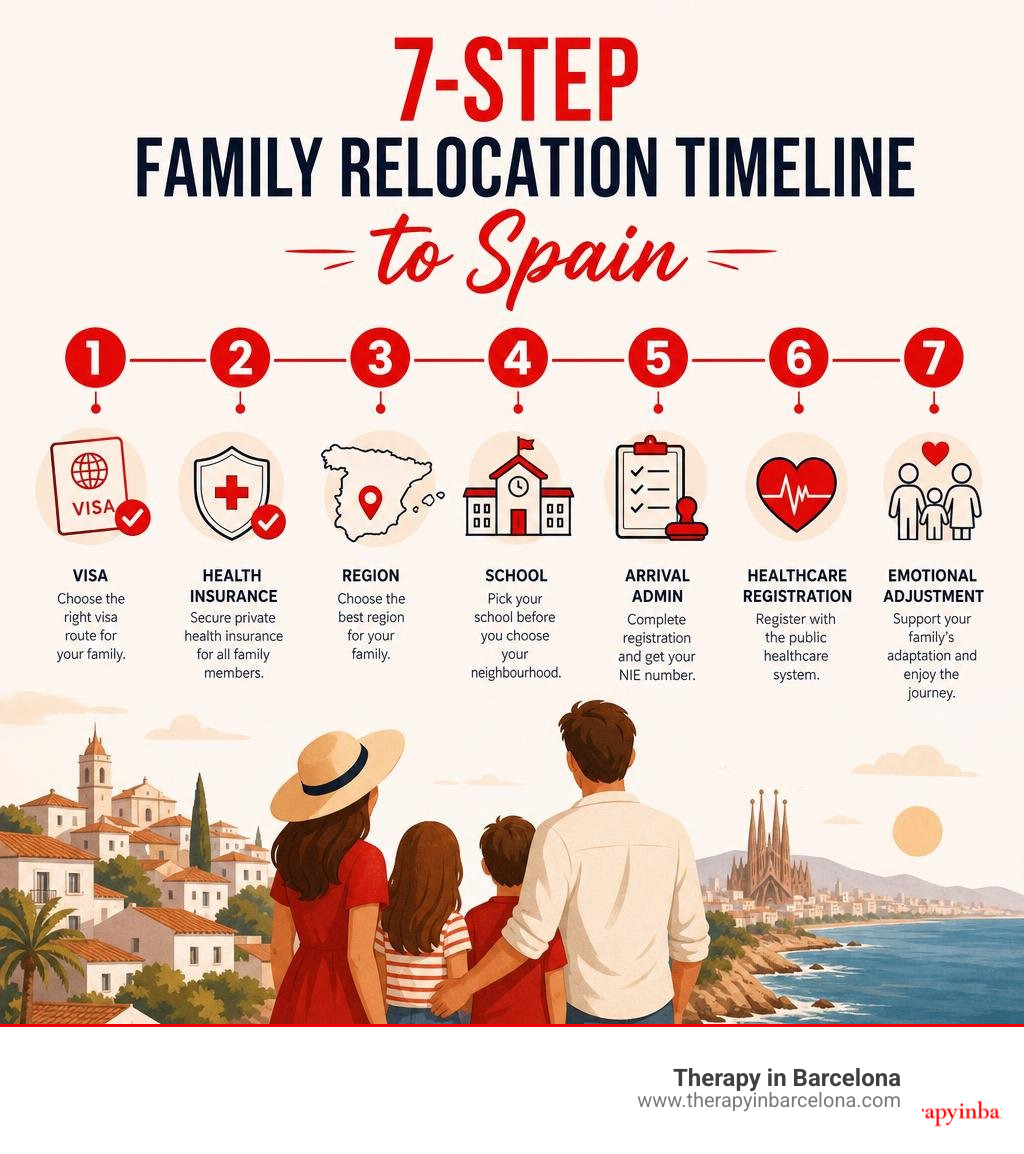
Here is a quick overview of the key steps most families need to work through:
- Choose your visa route — the Non-Lucrative Visa (NLV) suits families with passive income; the Digital Nomad Visa fits remote workers; a Work Visa applies if you have a Spanish employer.
- Meet income requirements — the NLV baseline is around €2,400/month, plus approximately €600 for each additional family member.
- Secure private health insurance — all family members need cover with no copayments before your visa is approved.
- Choose your region — Barcelona, Valencia, Madrid, Málaga, and the Costa del Sol all offer strong international school networks and expat communities.
- Pick your school before your neighbourhood — the school you want should determine where you live, not the other way around.
- Register on arrival — empadronamiento (municipal registration) and your NIE number are the first administrative steps once you land.
- Plan for the emotional transition — culture shock, identity shifts, and children’s adaptation are real, and they take time.
Most families spend months researching the logistics and very little time preparing for what the move actually feels like once the boxes are unpacked. One forum contributor who made the move put it plainly: life in Spain will not simply be better — it will be different, with its own frustrations alongside its very real rewards. That honest framing is worth holding onto from the start.
This guide covers the full picture — visas, schools, regions, healthcare, costs, and the emotional side of family relocation that rarely makes it into the official checklists.
The Logistics of Moving to Spain with Family
Sorting out the legal paperwork is the first major hurdle. Spain has several visa pathways, but non-EU families generally rely on two primary options: the Non-Lucrative Visa (NLV) or the Digital Nomad Visa (DNV).
The Non-Lucrative Visa is designed for families who do not plan to work in Spain. It requires you to prove you have sufficient passive income or savings to support your family without relying on local employment.
The baseline income requirement for the main applicant is €2,400 per month, with an additional €600 per month required for each family member. These funds must be steady, verifiable, and ideally held in accessible bank accounts.
The Digital Nomad Visa is the go-to option for remote workers, freelancers, or business owners with clients outside of Spain. In July 2026, the minimum gross income requirement for a single applicant is €2,849 per month (€34,188 per year), with additional amounts required for spouses and children.
If you are a remote employee, you must show that your employer allows you to work from Spain and provide a certificate of coverage from your home country’s social security administration.
Both visas require private health insurance that meets Spanish consulate requirements, including no copayments, no waiting periods, and cover equivalent to the public healthcare system. This also gives you access to Spain’s excellent private clinics and many English-speaking doctors.
Tax planning is another critical step. Spain’s tax system is highly decentralised, meaning rates vary significantly between regions. You may qualify for the “Beckham Law,” which allows certain expats moving for work to pay a flat 24% tax rate on income up to €600,000 for their first six years.
However, you must apply within six months of registering with social security. It is highly recommended to speak with a cross-border tax specialist to understand double taxation agreements and wealth tax implications before making the move.
Once you land, the administrative clock starts ticking. You will need to obtain your NIE (foreign identity number), register your address at the local town hall (empadronamiento), and apply for your physical residency card (TIE). Treating this process as a structured project with clear deadlines will save you endless stress.
For a comprehensive breakdown of the logistical steps for UK families, you can read Moving to Spain with a Family: The Complete UK Expat Guide (2026) – British Life in Spain. If you are coming from North America, check out Bringing the Family to Spain: An American’s Guide to a Smooth Move to help prepare for the transition.
Choosing the Right School and Region for Your Children
Spain is incredibly diverse, and choosing where to settle depends heavily on your family’s lifestyle and educational needs. The most popular hubs for expat families include Barcelona, Valencia, Madrid, Málaga, Alicante, and Marbella.
For a vibrant, international lifestyle, Barcelona and Madrid offer excellent public transport, rich culture, and a wide choice of international schools, though they also have higher living costs and competitive rental markets.
For families seeking a more relaxed, coastal lifestyle, Valencia and Málaga (including the surrounding Costa del Sol towns like Marbella) are highly popular. Valencia offers a perfect balance of city life, green spaces like the Turia park, and beach access, all with a slightly lower cost of living.
Málaga and the Costa del Sol boast a warm climate, over 300 days of sunshine, and a very established English-speaking community, making the initial social transition much smoother for children. Alicante offers another fantastic, family-friendly coastal option with a highly accessible international airport.

A common mistake families make is choosing a home before researching schools. In Spain, school placement often dictates your daily routine. Long commutes can quickly drain your energy and strain family dynamics. It is far better to identify your target schools first, and then look for housing within a reasonable distance.
To explore how other families have made these decisions, you can read Moving to Spain With a Young Family: Where to Start in 2026. If you are leaning towards Catalonia, our guide on Choosing Schools in Barcelona offers practical local insights.
Schooling Options for Moving to Spain with Family
Understanding the school system is vital to ensuring your children transition smoothly. Spain offers three main schooling structures, each with its own benefits and challenges.
Public Schools (Colegios Públicos)
Public schools are free and taught in the local language, such as Spanish, Catalan, or Valencian. They offer an excellent path to local integration, and younger children often become bilingual surprisingly quickly.
Most public schools offer an aula d’acollida (welcome class) to support non-native speakers. However, they offer less academic flexibility and fewer resources for children with specific learning differences.
State-Subsidised Schools (Colegios Concertados)
Concertado schools are semi-private institutions, often historically linked to religious organisations, though many are secular today. They are partly subsidised by the government, keeping monthly fees low (typically between €150 and €300 per month).
They offer a middle ground between public integration and private resources, often with a stronger emphasis on bilingual English-Spanish curricula.
International Schools
International schools follow foreign curricula (most commonly British, American, or International Baccalaureate) and teach primarily in English, with Spanish taught as a second language. Tuition fees range from €6,000 to €20,000 per year, per child.
These schools are ideal if you plan to stay in Spain temporarily (one to three years), if you have teenagers who need curriculum continuity, or if your children would struggle with immediate language immersion.
Choosing the right fit depends on your children’s ages, personalities, and how long you plan to stay in Spain. For a deeper look at balancing these family dynamics, read Married Plus Four: Navigating Expat Life with Children.
The Emotional Reality: Managing Culture Shock and Expat Stress
While the logistical checklists are demanding, the emotional transition is often where families find themselves struggling. Relocating to a new country disrupts every familiar routine, which can trigger stress, feelings of being overwhelmed, and relationship strain.
Consider this fictional composite example, which reflects the experiences of many expat families. After moving from the UK to Valencia, the first few months felt like an extended holiday, but as autumn arrived, the initial excitement began to fade.
The language barrier made everyday school conversations difficult, the loss of a support network led to isolation, and one child began missing friends back home. Meanwhile, a partner working long hours remotely left much of the family’s daily adjustment to one parent.
This stage of relocation is completely normal. While young children often adapt quickly, older children, teenagers, and accompanying partners may struggle with loss, identity changes, and adjusting to a new life.
Recognising these feelings and giving your family permission to experience them is the first step toward healing. For more guidance on supporting your family through this emotional landscape, read Family Matters Overseas: How Expat Family Therapy Can Help.
Mental Health Support When Moving to Spain with Family
When expat stress or family conflict begins to impact your daily life, seeking professional support can help you find your footing. In Spain, you have several options for mental health care, and it is helpful to understand how they compare:
- Public System Clinicians: Spain’s public healthcare system offers free mental health care with a GP referral, but waiting lists can be long, and finding an English-speaking therapist with expertise in expat issues can be difficult.
- Large Online Platforms: These global platforms are highly convenient and accessible. However, they frequently lack local expat context, offer inconsistent quality control, and raise data privacy concerns, as some platforms have been known to share user data.
- Local General Practices: While excellent for physical health and standard medical referrals, local clinics rarely specialise in the complex psychological dynamics of bicultural families, identity loss, or cultural adaptation.
- Therapy in Barcelona: Established in 2011, we are a trusted group practice specialising in mental health support for the international community. We offer personalised therapist matching, a private-pay service with a strong focus on confidentiality, and therapists who understand the expat journey firsthand.
If you are navigating the transition to Catalonia, you can find more specialised support through By Your Side BCN: Help for International Families in Barcelona.
Frequently Asked Questions about Relocating to Spain
What are the income requirements for the Non-Lucrative Visa?
The Non-Lucrative Visa income requirements are tied to Spain’s IPREM index. The main applicant must demonstrate a monthly passive income of at least 400% of the IPREM (approximately €2,400 per month), plus an additional 100% of the IPREM (approximately €600 per month) for each dependent.
Alternatively, you can show a corresponding annual lump sum in a bank account. This income must come from passive sources, such as pensions, investments, or rental properties, as working in Spain is not permitted on this visa.
How do we access healthcare and private health insurance in Spain?
To obtain your visa, you must secure a private health insurance policy with a Spanish insurer that offers full coverage, zero copayments, and no waiting periods.
Once you are legally resident and registered with the Spanish social security system (either through employment, self-employment, or paying into the convenio especial after one year on the padrón), you can access the public healthcare system.
Many expat families choose to maintain their private insurance alongside the public system to ensure fast access to English-speaking specialists.
Is it better to choose a public, state-subsidised Schools, or international school?
The best choice depends on your children’s ages and your long-term plans. If your children are under eight and you plan to live in Spain for more than three years, a public or a state-subsidised school is excellent for rapid language integration and community building.
If you have teenagers, plan to stay in Spain for only a year or two, or want your children to continue their education in their home country’s system, an international school is usually the most stable and supportive option.
Next Steps
Moving to Spain with your family is a profound adventure that can bring you closer together, but it requires prioritising your family’s mental well-being alongside the logistical checklists. The administrative hurdles will pass, but the emotional work of building a new home together takes patience, open communication, and time.
Founded in 2011 by Australian psychologist Leigh Matthews, Therapy in Barcelona was created to provide culturally sensitive support for the international community. Today, our team of expat therapists helps individuals, teens, couples, and families navigate the challenges of living abroad.
If you are feeling overwhelmed by the transition, you do not have to navigate this journey alone. We offer sessions at our warm, welcoming offices in Barcelona, as well as online therapy to expats worldwide. While we are a private-pay service, some of our therapists offer sliding scale fees for those with financial need.
If you’d like support, book a Free Discovery Call today to find the right therapist match for your family.
