


What Person-Centred Therapy Actually Is (And Why It Might Be What You Need)

Person-centred therapy is a humanistic, non-directive approach that puts you at the centre of the healing process, helping you explore your feelings, understand your experiences, and move toward the life you want.
Here is a quick overview of what it involves:
- Developed by: Carl Rogers in the 1940s, also known as Rogerian or client-centred therapy
- Core idea: You are the expert on your own life; the therapist’s role is to support, not direct
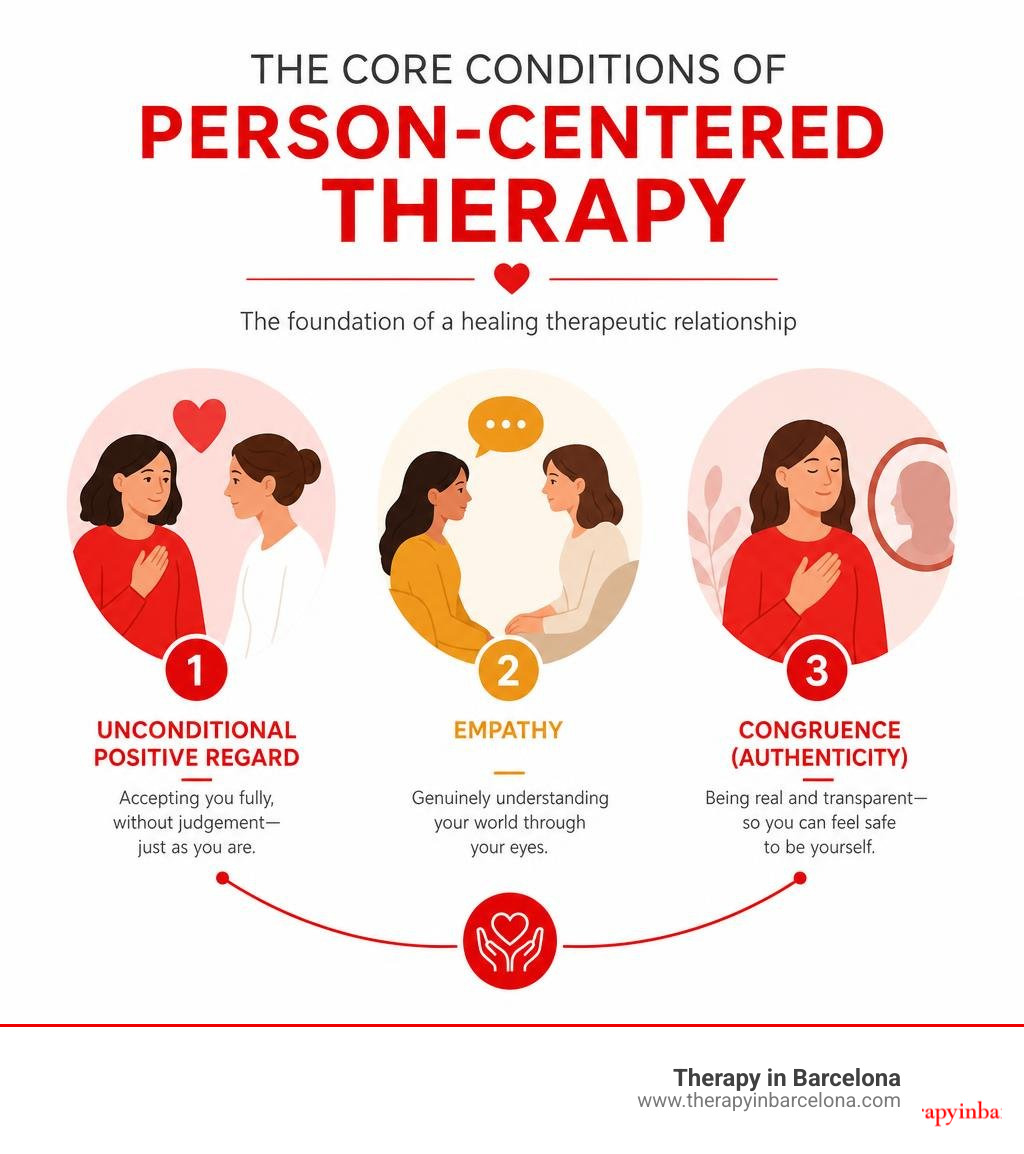
- Three key conditions: Unconditional positive regard (total acceptance), empathy (genuine understanding), and congruence (therapist authenticity)
- Best suited for: Feeling overwhelmed, persistently down, anxious, grieving, experiencing low self-esteem, relationship difficulties, identity questions, and life transitions
- What sessions feel like: Calm, client-led conversations with no agenda, no homework, and no judgement
- Evidence base: It is comparable to CBT for feeling persistently down at six months and effective for anxiety, trauma responses, and self-esteem across multiple controlled trials
For many people, especially those navigating life in a new country, the experience of feeling truly heard — without advice, without judgement, without someone telling you what to do — can itself be transformative.
Moving abroad can bring isolation, uncertainty, and a loss of connection. Rather than someone to fix you, person-centred therapy offers a space where you can feel understood.
Person-centred therapy is built on the belief that we all have the capacity to grow. Rather than offering advice or techniques, it provides a genuine, supportive relationship where that growth can happen.
This guide explores how person-centred therapy works, what the research says, and how it compares to other approaches. Whether you are considering therapy for the first time or wondering whether your current approach is the right fit, you will find clear, honest answers here.
What is Person-Centred Therapy?
To understand person-centred therapy, it helps to look at the landscape of psychology in the 1940s. At the time, therapy was dominated by two main schools: psychoanalysis, which searched for hidden conflicts in the unconscious mind, and behaviourism, which focused on modifying observable actions.
Both models shared a common assumption: the therapist was the absolute expert who knew how to fix the client.
Carl Rogers turned this hierarchy upside down. He proposed that the answers to a person’s difficulties lie within themselves, not in the diagnostic manual of a clinician.
Rogers coined the term “counselling” because psychologists in the United States were not legally permitted to practise “psychotherapy” at the time, but his work quickly grew into a foundational pillar of humanistic psychology. He was also the first researcher to systematically record and study actual therapy sessions to understand what truly heals.
At the heart of person-centered therapy are a few key concepts:
- The Actualising Tendency: This is the innate human drive to maintain, enhance, and develop ourselves to our full potential. Rogers compared humans to a plant in a dark corner; even in poor conditions, the plant will bend toward the light. In a supportive environment, this growth happens naturally.
- The Self-Concept: This is the internal picture you have of yourself, shaped by your experiences and the perceptions of those around you. It includes who you think you are, who you think you should be, and who you would like to be.
- Incongruence: When there’s a gap between how you see yourself and how you really feel, emotional distress can arise. Person-centred therapy helps you explore and reduce this disconnect.
- Self-Actualisation: This is the process of aligning your experiences with your self-concept, allowing you to live authentically and move toward becoming a “fully functioning person.”
Rogers believed that psychological distress does not stem from an inherent illness, but rather from blockages to this natural growth process. When you are forced to hide your true feelings to win the approval of others, your self-actualising process stalls. The goal of therapy is to remove these blocks.
The Core Principles of the Rogerian Approach
In person-centered therapy, the healing does not come from clever techniques or homework assignments. It comes entirely from the quality of the therapeutic relationship. Rogers argued that if a therapist could provide a specific relational climate, the client would naturally use that climate to heal themselves.
This approach shifts the therapist’s role from an authoritative expert to a compassionate companion who walks beside you. The relationship is built on several key elements:
- Active Listening: The therapist listens deeply, not just to the words you say, but to the emotions underneath them. They will often reflect back what they hear to help you clarify your own thoughts.
- Non-Directive Facilitation: The therapist does not set the agenda, choose the topics, or offer advice. You decide what to talk about and how deep you want to go.
- Genuine Presence: The therapist is fully present in the room with you, bringing their authentic humanity to the session rather than hiding behind a professional mask.
- Client Autonomy: You are trusted to make your own decisions and find your own answers. The therapist believes that you are the only one who truly knows what is best for you.
Unconditional Positive Regard in Person Centered Therapy
One of the most powerful aspects of this approach is unconditional positive regard. This means the therapist accepts you exactly as you are, without judgment, approval, or disapproval.
In everyday life, acceptance is often conditional. Parents, partners, and employers frequently offer warmth only when we meet their expectations. We learn to hide our mistakes, our shame, and our vulnerabilities to keep their approval. Rogers called these expectations “conditions of worth.”
When you step into a session with a therapist who offers unconditional positive regard, those conditions disappear. You are free to express anger, sadness, confusion, or guilt without fear of rejection. This creates a psychological sanctuary.
When you experience complete acceptance from someone else, you slowly learn to accept yourself. To learn more about this philosophy, you can explore the principles detailed by The Person Centred Association.
Congruence and Empathy: The Therapist’s Role
For unconditional positive regard to work, it must be paired with two other essential qualities: congruence and accurate empathy.
- Congruence (Genuineness): The therapist is genuine and authentic, creating a relationship built on trust, honesty, and openness.
- Accurate Empathy: Empathy means understanding your experience from your perspective, helping you feel deeply heard and understood.
- Client Perception: It is not enough for the therapist to feel empathic and accepting; you must perceive this to some degree. The therapeutic change begins when you start to feel that your therapist genuinely understands and accepts you.
How Person Centered Therapy Compares to Other Modalities
When deciding on a therapeutic approach, it helps to understand how different models operate. While some therapies are highly structured and focused on changing specific patterns, others prioritize self-exploration.
To see how these philosophies translate into practice, you can read about how therapy works in our overview of the therapeutic experience.
Here is how person-centered therapy compares to other common modalities:
- Psychoanalysis and Psychodynamic Therapy: Unlike psychoanalysis, person-centred therapy focuses on your present experience rather than interpreting your past or unconscious mind.
- Cognitive Behavioural Therapy (CBT): Unlike CBT, person-centred therapy is non-directive, with no homework or set agenda. Instead, sessions follow your pace and focus on what matters most to you.
- Solution-Focused Brief Therapy (SFBT): SFBT is a goal-oriented approach that focuses on finding immediate practical solutions to current problems. While both approaches respect client autonomy, SFBT is highly focused on future goals, whereas person-centred therapy prioritizes emotional depth and self-exploration.
The Process of Change in Person Centered Therapy
How does change actually happen when there is no structured plan? Rogers identified seven distinct stages that clients progress through during the therapeutic journey.
This process involves a gradual softening of rigid beliefs, a deeper connection to emotions, and a shift toward trusting one’s own experiences. To understand what to expect as you move through these phases, you can read our guide on what the therapy process looks like.
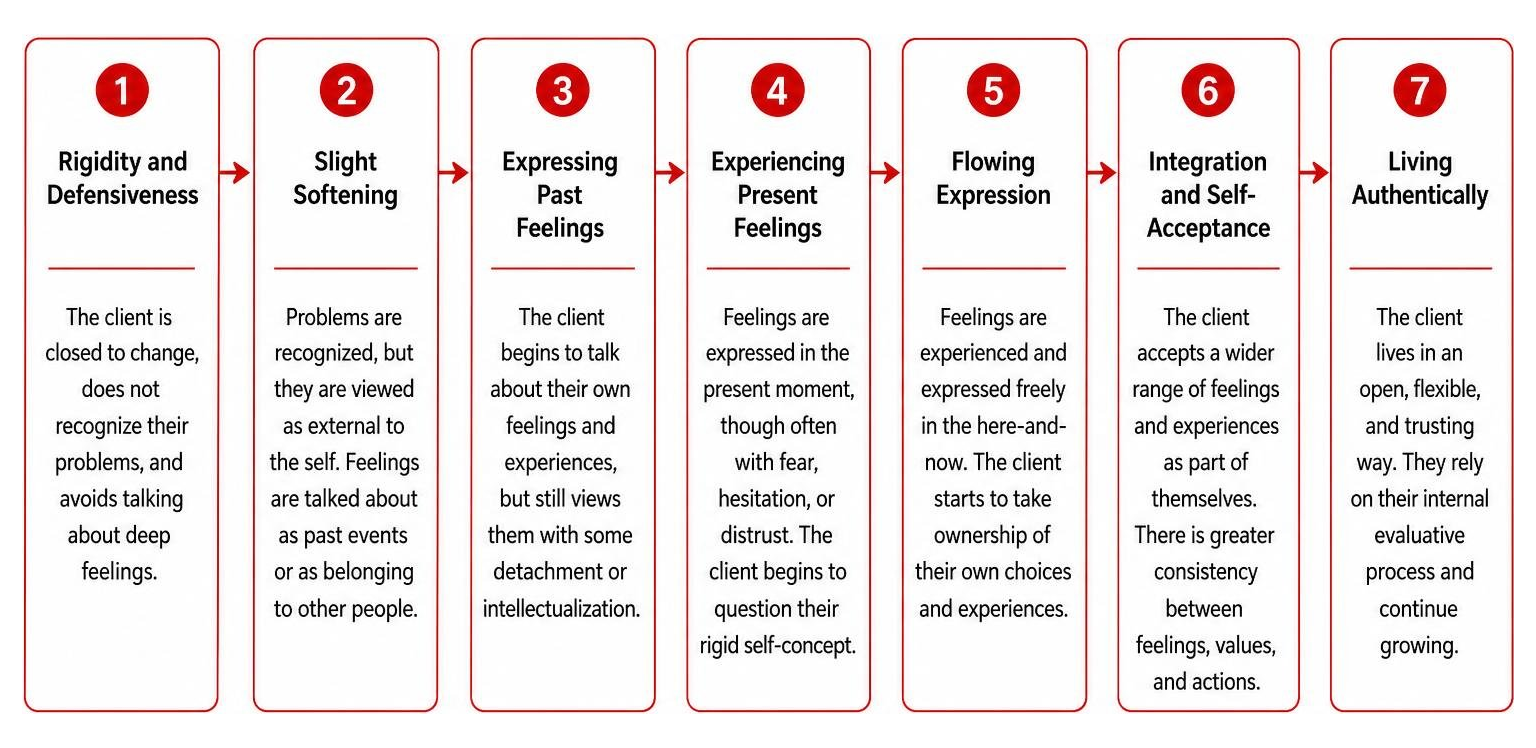
- Stage 1: Rigidity and Defensiveness: The client is closed to change, does not recognize their problems, and avoids talking about deep feelings.
- Stage 2: Slight Softening: Problems are recognized, but they are viewed as external to the self. Feelings are talked about as past events or as belonging to other people.
- Stage 3: Expressing Past Feelings: The client begins to talk about their own feelings and experiences, but still views them with some detachment or intellectualization.
- Stage 4: Experiencing Present Feelings: Feelings are expressed in the present moment, though often with fear, hesitation, or distrust. The client begins to question their rigid self-concept.
- Stage 5: Flowing Expression: Feelings are experienced and expressed freely in the here-and-now. The client starts to take ownership of their own choices and experiences.
- Stage 6: Integration and Release: The client experiences complete self-acceptance of previously denied feelings. The incongruence between self-concept and actual experience drops significantly.
- Stage 7: Trust in Self: The client leaves therapy as a fully functioning person who trusts their own internal compass, embraces change, and lives open to new experiences.
Efficacy, Strengths, and Limitations in Modern Mental Health
Is a non-directive approach actually effective? Decades of clinical research show that person centred therapy is highly effective for a wide range of mental health concerns.
According to the clinical overview provided by StatPearls – NCBI Bookshelf, the therapeutic alliance is one of the strongest predictors of positive outcomes in all of psychotherapy, regardless of the specific modality used.
What the Research Says
- Feeling Persistently Down: Research shows that person-centred therapy can be as effective as CBT for many people, with both approaches significantly reducing symptoms.
- Anxiety and Postpartum Distress: Research shows that person-centred therapy is an effective treatment for depression and anxiety, with outcomes comparable to many other evidence-based therapies.
- Trauma Responses: Person-centred therapy also has lower dropout rates than many highly structured therapies, making it a sustainable option for long-term recovery.
- Self-Esteem in Older Adults: A randomised controlled trial published in *Age and Ageing* showed that person-centred therapy significantly improved self-esteem in older adults, with the benefits fully maintained at a 12-month follow-up.

Strengths and Benefits
- Empowerment: Because the therapist does not give advice, you learn to trust your own judgement and find your own solutions.
- Reduced Shame: Experiencing unconditional positive regard helps you let go of self-criticism and accept your vulnerabilities.
- Improved Communication: Learning to express your feelings openly in therapy translates to healthier, more authentic relationships in your daily life.
- Lower Dropout Rates: The gentle, non-authoritative pace of Rogerian therapy feels safe and respectful, making clients less likely to leave prematurely.
Limitations and Criticisms
- Lack of Structure: Some clients, especially those in acute crisis or those who prefer concrete strategies and homework, may find the non-directive nature of the sessions frustrating or slow.
- Cultural Considerations: Person-centred therapy may be less suited to those who prefer a more directive approach or come from cultures that place greater emphasis on family or community than individual needs.
- Severe Psychological Distress: For conditions that involve altered perceptions of reality, a non-directive approach may need to be adapted or integrated with more structured, directive psychiatric care.
Choosing the Right Support for Your Expat Journey
Living as an international in Spain is an exciting adventure, but it also brings unique challenges. Relocating, adjusting to a new culture, navigating Spanish family dynamics, or managing the isolation of working as a digital nomad in Málaga or Madrid can amplify existing emotional struggles.
When you decide to seek support, it is important to understand the different options available to you.
Understanding Your Options
- Public Healthcare System:
- The Reality: Accessible to residents, but it often involves long waiting lists, strict limits on session frequency, and a lack of English-speaking or culturally trained therapists.
- Large Online Platforms:
- The Reality: Highly automated and convenient, but these platforms often lack personalized matching, carry privacy concerns regarding how your personal data is used, and can suffer from high therapist turnover.
- Local Private Practices:
- The Reality: Offers dedicated, high-quality private-pay care with strict privacy standards, but services vary widely in their specific understanding of the expat experience.
The Therapy in Barcelona Difference
At Therapy in Barcelona, we do things differently. Founded in 2011 by Leigh Matthews — an Australian Psychologist, expat in Barcelona since 2011, and specialist in supporting internationals — our practice is built on empathy, professional excellence, and enduring support for the international community.
- Bespoke Therapist Matching: We carefully match you with a therapist based on your needs, personality, and goals, helping you get the most from therapy from the very first session.
- Expat-Specific Cultural Sensitivity: Our qualified, psychology-trained therapists understand expat life firsthand and offer therapy in English, German, French, Spanish, Portuguese, and other languages.
- Strict Privacy and High Standards: We provide high-quality private-pay care with absolute confidentiality. We never sell your data, and we engage in regular clinical supervision and peer intervision to ensure the highest standards of care.
- Flexible Access: We offer in-person therapy in central Barcelona and online sessions for expats worldwide. Sliding scale fees are available with some therapists—please ask for details.

Frequently Asked Questions about Humanistic Therapy
Is person-centred therapy effective for severe feelings of being persistently down?
Yes. Research shows that person-centred therapy is effective for depression and can be especially helpful for long-term emotional distress. For more complex needs, it can also be combined with other evidence-based approaches.
How does this approach differ from Cognitive Behavioural Therapy (CBT)?
While CBT is structured, directive, and focused on teaching you specific skills to change your thoughts and behaviours, person centred therapy is non-directive. It prioritises emotional safety, self-discovery, and client autonomy, allowing you to explore your feelings at your own pace without homework or structured exercises.
Can person-centred therapy be delivered online?
Absolutely. Because the core of this approach is the genuine connection between therapist and client, it translates beautifully to online video sessions. This allows expats and digital nomads across Spain and worldwide to access consistent, culturally sensitive support from the comfort of their own homes.
Finding Your Way Forward
At its core, person centred therapy is an invitation to come home to yourself. It is a gentle reminder that you do not need to be fixed, diagnosed, or managed; you simply need the right conditions to heal, grow, and step into your own authentic life.
If you are ready to take that step and want to find a therapist who truly understands your journey, we are here to walk beside you.
If you’d like support, book a Free Discovery Call today.
