


When Your Mind Goes Blank: What to Talk About in Therapy This Week

Figuring out what to talk about in therapy this week is one of the most common struggles clients face — and it happens even to people who have been in therapy for months. You sit down, your therapist asks what’s on your mind, and suddenly everything you’ve been carrying all week just… disappears.
That blank feeling is not a sign you’re doing it wrong. It’s actually one of the most human things about therapy.
Before we go further, here are the most helpful starting points if you’re stuck right now:
- Something small that annoyed or unsettled you this week — even if it seems trivial
- A moment you overreacted, then replayed in your head — those reactions almost always point to something deeper
- A thought or worry you can’t seem to switch off — especially one you’ve been carrying for days
- Something you’ve been avoiding — an email, a conversation, a decision
- A relationship pattern you keep noticing — with a partner, a colleague, a friend, or family
- How you’ve been feeling physically — tension, fatigue, sleep changes, or a knot in your stomach
- The fact that you have nothing to say — that itself is a valid starting point, and a good therapist will know exactly what to do with it
If you’re an expat building a life in Barcelona, Valencia, Madrid, or elsewhere in Spain, there’s often an extra layer to contend with. Cultural adjustment, language fatigue, isolation, and the pressure to appear fine in a new country can leave you genuinely unsure what the problem even is — let alone how to put it into words.
People often forget much of what is discussed shortly after a therapy session ends. That means even valuable insights can fade quickly. The real benefits of therapy often come from what you reflect on, practise, and notice between sessions.
So if you walk in feeling blank, or walk out feeling like you can’t quite hold onto what just happened, you’re not failing at therapy. You’re experiencing something nearly universal.
This guide will give you practical, low-pressure ways to show up to your next session with something real to say — whether you’re in your first week or your fiftieth.
Why It Is Normal to Have Nothing to Say in Therapy
Walking into a session with a blank mind is rarely because nothing is wrong. More often, it reflects stress, mental overload, or emotional fatigue. Forgetting what you wanted to discuss can be the mind’s way of taking a break from processing too much at once.
This experience is particularly intense for those living abroad. Expat life brings a constant stream of micro-stressors: deciphering local bureaucracy, managing language barriers, and adjusting to unfamiliar cultural norms.
By the time an individual sits down for therapy, their cognitive bandwidth is often completely drained. The brain prioritises immediate survival and adaptation, leaving little energy for self-reflection.
Many people arrive at therapy feeling blank, even when they are struggling. Often, there is a quiet pressure to explain things perfectly. When the right words do not come, it can feel as though there is nothing important to say, even when there is.
When clients experience this kind of block, it is helpful to remember that therapy does not require a structured agenda. The very feeling of being stuck or unable to speak is valuable therapeutic material.
Exploring why it feels difficult to open up can lead to significant breakthroughs regarding how a person handles vulnerability and stress in daily life. For those seeking structured ways to break through this initial hesitation, reviewing 7 Proven Ways to Decide What to Discuss in Therapy can provide an excellent starting framework.
What to Talk About in Therapy This Week: 5 Practical Starting Points
When a major life crisis is not occurring, finding a focus for the week can feel challenging. However, therapy does not require a dramatic event to be highly effective. Often, the most profound progress comes from examining the quiet, repetitive patterns of daily life.

To help identify what to talk about in therapy, consider these five practical areas of focus, which are also highlighted in What to Talk About in Therapy: A Guide to Finding Your Focus — Healthline:
- Micro-moments: The small, fleeting irritations or overreactions that occurred during the week.
- Relationship patterns: The ways communication loops, boundary issues, or feelings of isolation manifest in daily interactions.
- Physical sensations: How stress, anxiety, or sadness show up in the body as tension, fatigue, or restless sleep.
- Avoided thoughts: The tasks, emails, or conversations that are being actively postponed.
- Decision paralysis: The choices, large or small, that feel impossible to make.
Micro-Moments and What to Talk About in Therapy
The small daily occurrences that trigger an unexpectedly strong emotional reaction are rarely just about the event itself. A minor disagreement with a local shopkeeper, a delayed response to a text message, or a sudden wave of irritation over a small change in plans can serve as entry points to deeper beliefs.
These micro-moments function as emotional clues. When an individual overreacts to a minor inconvenience, it often signals an underlying, unmet need or a historical pattern of feeling unsupported. Bringing these specific moments to a session allows the therapist to help trace the reaction back to its core origin.
To prepare for this kind of exploration, clients can use Mind Over Matter: Essential Therapeutic Check-In Questions for Your Next Session to help identify and track these daily triggers before their appointment.
Relationship Patterns and What to Talk About in Therapy This Week
Relationships are often where internal struggles become most visible. For internationals, managing relationships involves unique complexities, such as maintaining long-distance connections with family back home while simultaneously trying to build a new social circle from scratch.
Discussing communication loops, difficulties setting boundaries, or a persistent feeling of loneliness can reveal how an individual relates to others. Common topics include:
- Feeling resentful after saying yes to a request when wanting to say no.
- Experiencing anxiety when waiting for a partner or friend to reply to a message.
- Sensing a growing emotional distance from family members who do not understand the expat experience.
Exploring these dynamics helps build healthier interpersonal habits. For those who want to examine these patterns more deeply, reviewing the exercises in Explore Your Inner World with 100 Therapy Questions can offer helpful clarity.
How to Prepare for Your Session and Maintain Continuity
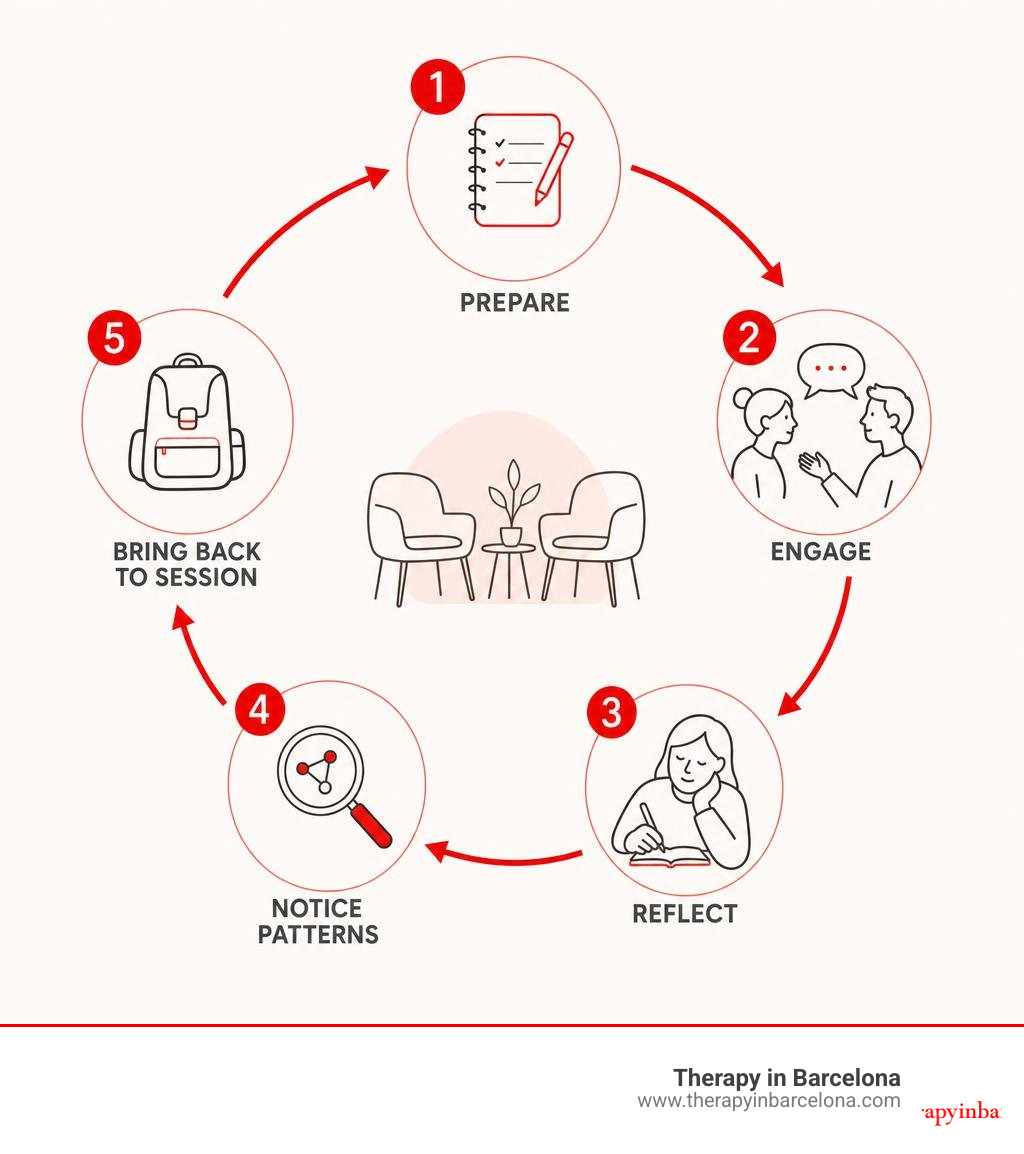
Much of the benefit of therapy comes from what happens between sessions. Reflection, self-awareness, and applying new insights in daily life all play an important role in creating meaningful change.

Because people often forget much of what was discussed shortly after a session, creating a simple routine to stay connected to key insights can be incredibly helpful. Using a structured approach can prevent valuable insights from fading:
- The Post-Session Recap (Within 2 Hours): Spend five minutes writing down the main theme of the session, the most important insight gained, any agreed-upon homework, and any thoughts that remained unfinished.
- The Mid-Week Check-In: Notice where the session’s themes show up in daily life. Keep a brief, unpolished log of moments where old habits or emotional triggers occurred.
- The Pre-Session Prep (15 Minutes Before): Review the previous week’s notes. Ask: What has taken up the most mental space this week? What am I most hesitant to bring up today?
This simple loop keeps the therapeutic process alive and active, transforming weekly appointments into a continuous journey of growth. For additional guidance on structuring this preparation, the resources in How to Decide What to Talk About in Therapy — Verywell Mind can help streamline the process.
Getting Through the First 30 Days of Therapy
The first month of therapy is often the most challenging, and many people consider stopping during the early stages. Understanding what to expect week by week can help you stay committed through this important adjustment period.
- Week 1: The Intake and Background. This session is primarily focused on gathering history, establishing goals, and understanding what brought the client to therapy. It is a collaborative assessment, not an immediate cure.
- Week 2: The “Feeling Worse” Phase. As therapy begins to touch on avoided emotions and memories, a temporary increase in distress is common. This emotional activation can lead to feeling unusually tired, irritable, or emotional. This is a normal part of the process and often precedes significant psychological progress.
- Week 3: The Integration. The focus shifts toward noticing patterns in daily life and beginning to apply basic coping or grounding strategies outside the session.
- Week 4: The 30-Day Fit Check. This is the time to evaluate the therapeutic relationship. A client should ask: Do I feel heard? Is the work addressing my specific concerns? Do I notice a shift in my self-awareness?
Getting through these early stages requires patience and open communication. To understand this initial phase more clearly, clients can read Starting Therapy: 10 Honest Questions You Might Be Asking and Deserve Straight Answers To.
Choosing the Right Support: Comparing Your Options (Mobile-Friendly Format)
When seeking therapy in Spain, individuals have several distinct paths to choose from. Understanding how these options compare can help in making an informed decision that aligns with personal needs.
Option 1: Public Healthcare
- What it is: State-funded psychological support provided through the public medical system.
- The reality: While entirely free of charge, the public system is often characterised by exceptionally long waiting lists, brief and infrequent sessions, and a significant lack of English-speaking or culturally sensitive specialists.
Option 2: Large Online Platforms
- What it is: Global, high-volume online directories and subscription apps.
- The reality: These platforms are highly convenient and often cheaper. However, they generally lack personalised matching, experience high therapist turnover, and raise serious data privacy concerns, including the potential sharing or selling of sensitive user information.
Option 3: Local Generalist Practices
- What it is: Standard private mental health clinics operating within Spain.
- The reality: These clinics offer consistent face-to-face sessions, but their clinicians may lack specialised training in expat-specific issues, third-culture identity, bicultural relationship dynamics, or multilingual care.
Option 4: Therapy in Barcelona (Bespoke Private Practice)
- What it is: A trusted private practice established in Spain since 2011, providing face-to-face sessions in Barcelona and online therapy to expats worldwide.
- Our edge: We offer highly personalised, bespoke therapist matching based on your specific needs rather than simple availability. Our team consists of qualified, psychology-trained expat professionals who provide culturally sensitive support in your native language. We operate as a private-pay service, maintain strict data privacy with a guarantee of no data selling, and offer sliding scale fees for those with demonstrated financial need.
Frequently Asked Questions About Therapy Sessions
Is it normal to cry in therapy?
Crying is a completely natural and healthy response to processing deep emotions. The therapy room is designed to be a safe, non-judgemental space where clients do not need to suppress their feelings or apologise for showing vulnerability.
What if I don’t feel connected to my therapist?
The therapeutic alliance is the single most important factor in achieving positive outcomes. If a connection does not feel right after a few sessions, it is entirely appropriate to address this. A professional therapist will welcome this feedback and help explore adjustments or facilitate a smooth transition to a colleague who may be a better fit.
Can I talk about the therapy process itself?
Discussing the therapy process during a session is highly encouraged. Sharing how the sessions feel, what strategies are working, or expressing discomfort with the current pace helps strengthen the therapeutic relationship and ensures the support remains tailored to individual goals.
Finding Your Way Forward
Life in a foreign country can bring unique challenges that leave people feeling disconnected or overwhelmed. Therapy is not about having the right words—it is about showing up as you are, even when your mind feels blank.
Therapy in Barcelona provides specialised, culturally sensitive mental health support to the international community. The practice offers in-person sessions at their central office in Barcelona as well as online therapy for expats worldwide.
Founded by Leigh Matthews, an Australian Psychologist living in Barcelona since 2011, Therapy in Barcelona was created to provide high-quality, empathetic support for English-speaking internationals. Today, Leigh leads a diverse team of psychology-trained therapists dedicated to helping expats heal, adapt, and grow.
If you’d like support, book a Free Discovery Call.
