


The Real Price of Moving to Spain from the US (And What Most Guides Miss)

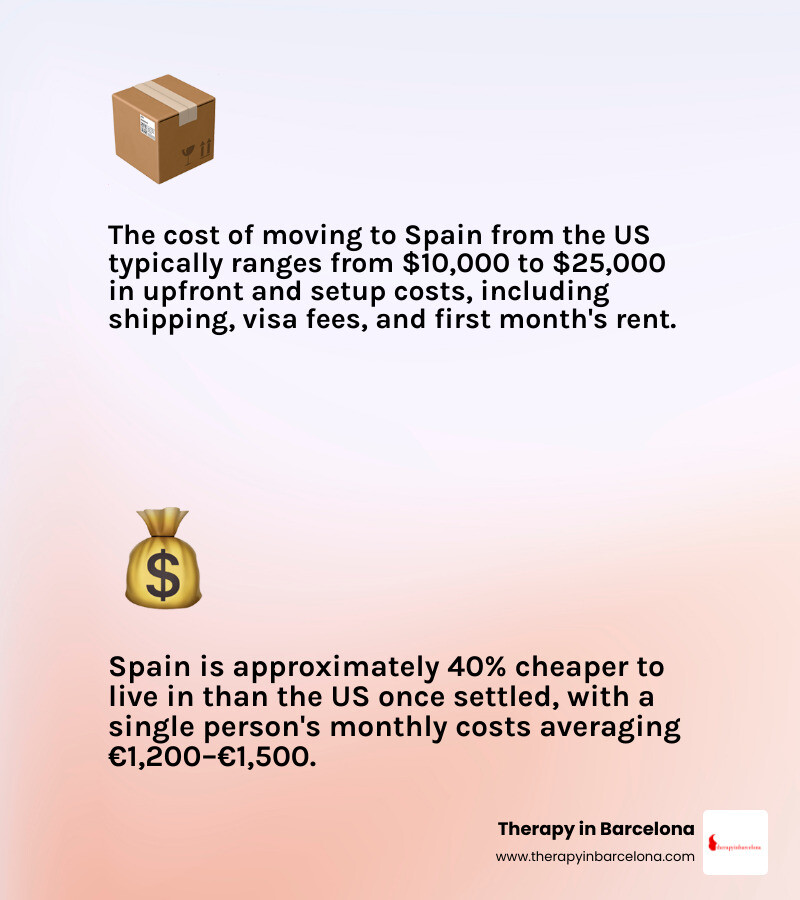
The cost of moving to Spain from the US typically ranges from $10,000 to $25,000 in upfront and setup costs, depending on how much you ship, which visa you apply for, and where in Spain you settle. Here is a quick breakdown of what that covers:
- Shipping household goods: $2,450–$35,000+ depending on volume and method (sea vs. air freight)
- Visa application and documents: $500–$2,000+ (including apostilles, translations, background checks)
- Private health insurance: $50–$150 per month (required for most visa types)
- First month’s rent plus deposit: €1,200–$4,000+ depending on city
- Flights and initial travel: $500–$2,000 per person
- Tax and legal advice: $1,500–$3,500 for cross-border tax preparation
- Monthly living costs once settled: roughly €1,200–€1,500 for a single person; €2,600+ for a family of four
Spain is approximately 40% cheaper to live in than the US once you are settled, but the upfront cost of getting there is real and worth planning for carefully.
More than 40,000 US citizens were registered as residents of Spain in 2024, and that number has been climbing. The appeal is obvious: a slower pace of life, excellent food, reliable sunshine, affordable healthcare, and a cost of living that makes a modest income feel genuinely comfortable.
A retired couple living on $60,000 a year in the US might stretch that same budget across a far richer lifestyle in Málaga or Valencia.
But the move itself has a price tag that surprises many people. Between visa paperwork, international shipping, health insurance requirements, and the administrative maze of Spanish bureaucracy, the first few months can feel expensive and overwhelming before the savings kick in.
There is also a cost that rarely appears in any moving guide: the emotional one. Relocating across an ocean — away from your support network, your familiar routines, and the culture you grew up in — takes a real toll. That part of the journey deserves as much planning as the logistics.
This guide covers all of it: the shipping costs, the visa fees, the monthly living expenses by city, the tax implications for US citizens, and the mental health realities that often catch people off guard.
Whether you are a remote worker eyeing the Digital Nomad Visa, a retiree considering the Non-Lucrative Visa, or a family making a longer-term move, the goal here is to give you a clear, honest picture of what your Spanish dream will actually cost — and how to prepare for every part of it.
Breakdown: The Total Cost of Moving to Spain from US

Relocating across the Atlantic is a major project. To avoid depleting your savings, you need to separate your relocation budget into two distinct categories: the physical move itself (getting your body and your belongings to Spain) and the administrative setup costs.
Having a robust financial buffer is essential. Many expats find that unexpected expenses — like temporary accommodation while searching for a long-term rental, or additional security deposits required because they do not yet have a Spanish credit history — can easily add several thousand dollars to their initial outlay.
Container Shipping: The Logistical Cost of Moving to Spain from US
When it comes to shipping your belongings, you have two primary options: sea freight and air freight.
Sea freight is the most common and economical choice for larger shipments. For a smaller move, such as a one-bedroom apartment, Less Than Container Load (LCL) shipping allows you to pay only for the space you use in a shared container. This typically costs between $2,450 and $5,100.
If you are moving a larger family home, a Full Container Load (FCL) is more practical. A 20-foot container costs approximately $4,200 to $7,000, while a 40-foot container ranges from $7,000 to $11,000.
Most transatlantic moves departing the US go through the Port of Miami due to direct shipping lanes to major Spanish ports like Barcelona and Valencia. For instance, shipping a 20-foot container from New York City to Barcelona averages $2,692 and takes between 29 and 38 days.
Air freight is significantly faster but costs 10 to 15 times more than ocean transport. Shipping a small 220-pound box from Los Angeles to Madrid via air freight costs roughly $699 and takes 6 to 10 days, but shipping an entire household this way is financially impractical for most.
To keep costs down, many expats choose to sell their furniture in the US and buy new or used items locally in Spain. American appliances running on 110V are generally not worth shipping because Spain operates on 220V, and using heavy transformers is both inconvenient and inefficient.
You can learn more about detailed shipping rates in this Cost of Removals to Spain: Price Guide for US Movers 2026 | Official Site.
If you are planning to ship a vehicle, expect to pay between $1,500 and $4,000 in ocean freight alone. However, the true cost lies in importing it. Unless you qualify for tax exemptions, you will face EU import duties (typically 10% for cars) and Spanish VAT (IVA) at 21% of the vehicle’s value, plus the cost of modifying the car to meet European safety and emissions standards.
To avoid paying heavy customs duties on your household goods, you must apply for the Franquicia de Mudanza (Transfer of Residence relief) through the Spanish consulate before leaving the US.
To qualify, you must prove you have lived outside the EU for at least 12 consecutive months and have owned and used your household items for at least six months. Without this exemption, Spanish customs will charge between 24% and 26% of the shipment’s total assessed value.
Visas and Insurance: The Administrative Cost of Moving to Spain from US
Your visa is your ticket to Spain, and each pathway comes with its own strict financial thresholds.
The Non-Lucrative Visa (NLV) is designed for retirees and self-funded movers who do not plan to work in Spain. To qualify, you must prove passive income equal to 400% of the Spanish Public Multiple Effects Income Indicator (IPREM).
In 2026, this translates to an annual passive income of approximately €28,800 to €33,600 for the main applicant, plus an additional €7,200 for each dependent.
The Digital Nomad Visa (DNV) is tailored for remote workers and freelancers employed by non-Spanish companies. You must prove an income of at least 200% of the Spanish minimum wage (SMI). With the 2026 minimum wage set at €1,221 per month (distributed in 14 payments), the minimum monthly income requirement is approximately €2,442 to €2,849 (around $3,300).
You can read about the application process in our guide on Spains Digital Nomad Visa Live and Work Remotely in the Sun.
Both visas require Spanish private health insurance with no co-payments or annual limits, offering public-system-equivalent coverage. Expect to pay €50–€150 per month, depending on age and health.
Finally, factor in paperwork costs: an FBI background check, state apostilles, and certified Spanish translations, typically costing $50–$100 per page.
Cost of Living and Taxes: How Spain Compares to the United States
Once the initial hurdle of relocating is behind you, daily life in Spain is remarkably affordable. On average, the cost of living in Spain is 32.5% to 41% lower than in the US, and rental prices are roughly 70% cheaper nationwide.
However, your monthly expenses will depend heavily on where you choose to live.
Housing and Rental Costs by City Tier
- Tier 1 (Madrid and Barcelona): These are the most expensive cities. A one-bedroom apartment in the city centre of Barcelona averages $1,349 per month, compared to over $2,400 in a city like Los Angeles.
- Tier 2 (Valencia, Málaga, Alicante, and Sevilla): These cities offer an exceptional balance of coastal lifestyle, rich culture, and affordability. Rent for a comfortable two-bedroom flat here typically ranges from $800 to $1,400 per month.
- Tier 3 (Gran Canaria, Zaragoza, and Marbella): Outside the major metropolitan areas, housing costs drop significantly. In cities like Zaragoza or parts of Gran Canaria, you can find charming apartments starting as low as $500 to $700 per month.
Daily Expenses: Food, Utilities, and Transport
Daily micro-costs in Spain are highly manageable. A couple can easily eat well on a grocery budget of $60 per week by shopping at local markets and avoiding expensive imported American brands.
Dining out is also very reasonable; a three-course menú del día (menu of the day) at a mid-range restaurant typically costs between €12 and €18 per person.
Public transportation is excellent and highly subsidised. While single transit tickets can be relatively expensive, monthly passes are incredibly cheap. In Barcelona, a monthly unlimited travel pass costs around $22.96, compared to $80 or more in major US cities.
Basic utilities (electricity, water, and gas) average around $145 per month, while high-speed internet and mobile plans are significantly cheaper than in the US, often costing less than $40 per month.
Taxes: The Expats’ Financial Reality
US citizens are subject to citizenship-based taxation, meaning you must file a US tax return every year regardless of where you live. You must also file an FBAR (Foreign Bank Account Report) if the combined balance of your foreign accounts exceeds $10,000 at any point during the calendar year.
The US-Spain tax treaty helps prevent double taxation. Foreign tax credits can often offset US tax, potentially reducing your IRS liability significantly.
For high-earning professionals and remote workers, the Beckham Law is a highly attractive option. This tax regime allows qualifying expats to pay a flat 24% tax rate on Spanish-sourced income up to €600,000 for their first six years, rather than the standard progressive rates.
Understanding how these rules apply to your specific situation is crucial. You can read more about mapping out your financial transition in our guide on Your American Dream in Spain a Relocation Roadmap.
You can explore more about the physical and administrative logistics of moving in this Moving to Spain from the US: Complete Relocation Guide (2026) | ExpatWires.
The Emotional Cost of Relocation: Managing Expat Stress
While budgeting for shipping containers and visa applications is essential, the emotional cost of moving abroad is often the most overlooked part of the relocation budget.
Adjusting to a new country is a profound life transition. The initial excitement of the “honeymoon phase” often gives way to culture shock, intense isolation, language barriers, and a sense of feeling lost.
Consider a fictional composite example of a 35-year-old remote worker from Chicago who moved to Valencia on a Digital Nomad Visa.
Despite dreaming of sunny afternoons and coastal living, navigating Spanish bureaucracy without fluent Spanish and losing their usual social circle left them feeling isolated, struggling with expat depression, work, and enjoying their new surroundings.
When seeking support for these very normal human struggles, expats in Spain generally have three main pathways:
- The Public Healthcare System (Seguridad Social): Spain’s public mental health system is overstretched, with long waits, brief sessions, and limited choice of English-speaking therapists.
- Large Corporate Online Platforms: Global subscription platforms are convenient but can feel transactional, lack local cultural understanding, and raise data privacy concerns.
- Local Private Practices: Finding an independent local therapist is a popular option, but it can be difficult to verify credentials, and not all local practitioners are familiar with the specific psychological challenges of transatlantic relocation.
Therapy in Barcelona was founded in 2011 by Australian psychologist and expat Leigh Matthews, who recognised the need for culturally sensitive mental health support for Barcelona’s international community.
Today, Therapy in Barcelona is a trusted group practice of highly qualified, psychology-trained therapists who are expats themselves. They understand the unique challenges of building a life in a foreign country.
They offer personalised therapist matching, evidence-based approaches, and confidential private-pay care for adults, couples, teens, and families—with no data selling.
Sessions are available face-to-face at their comfortable offices in the heart of Barcelona’s Eixample district, as well as online for clients worldwide. If you are feeling overwhelmed by your move, you can read more about navigating these challenges in our guide on Therapy in Spain What American Expats Need to Know.
Frequently Asked Questions About Moving to Spain
How much money do you need to move to Spain?
We recommend $10,000–$15,000 in savings for upfront costs, plus a three-to-six-month living buffer. Monthly expenses typically range from €1,200–€1,500 for one person and €2,600+ for a family of four, excluding rent.
Is the Golden Visa still available in 2026?
No. The Spanish Golden Visa program, which allowed foreigners to obtain residency by investing €500,000 in real estate, was officially abolished on April 3, 2025, by Ley Orgánica 1/2025. Expats looking to relocate must now use alternative pathways, such as the Digital Nomad Visa, the Non-Lucrative Visa, or the Entrepreneur Visa.
Can I drive in Spain with a US driver’s licence?
You can drive using your US driver’s licence (accompanied by an International Driving Permit) for your first six months after obtaining residency.
After this period, you must obtain a Spanish driving licence. Because there is no reciprocity agreement between the US and Spain, this requires enrolling in a Spanish driving school, passing a written theory exam, and passing a practical road test — both of which are conducted in Spanish.
Conclusion
Relocating from the US to Spain is a beautiful, life-changing adventure, but it requires careful preparation. Balancing the physical costs of shipping containers, visas, and rent with a realistic plan for your taxes is only half the equation.
Protecting your mental well-being as you navigate culture shock and build a new support network is just as vital to making your Spanish dream a lasting success.
If you are planning your move or have recently arrived and are finding the transition challenging, you do not have to navigate this journey alone. Our team of experienced, international therapists is here to support you.
If you would like support, book a Free Discovery Call today to find your ideal therapist match.
