


Why We Struggle: The Anatomy of Marital Miscommunication

Effective communication in marriage is one of the hardest skills most couples never receive any formal training in — and yet, according to research published in the Journal of Family Psychology, 70% of people consider it the single most important factor in a happy marriage. The painful irony is that a lack of communication is the second leading cause of divorce, trailing only infidelity.
Here is a quick overview of what effective marital communication actually involves:
- Listen to understand — not to defend or reply
- Use “I” statements — express feelings without blaming (“I feel overwhelmed when…” instead of “You always…”)
- Validate your partner’s emotions — acknowledgement does not mean agreement
- Watch your timing and tone — when and how you say something matters as much as what you say
- Repair after conflict — small gestures of reconnection matter enormously
- Create regular space for connection — daily check-ins and weekly conversations build resilience over time
- Recognise when you need support — a couples therapist can help when patterns feel stuck
If you have ever sat across from your partner and felt completely alone — even mid-conversation — you are not alone. For many couples, the pressures of relocating to a new country, navigating career transitions, and managing the daily friction of shared life can quietly erode communication.
Conversations become minefields. The arguments are not about the big things. They are about everything — and neither partner quite understands how it got this way.
That experience is remarkably common. Communication breakdowns are often accompanied by persistent feelings of being overwhelmed, anxious, or emotionally drained. Poor communication rarely arrives all at once. It tends to creep in — through small misunderstandings left unaddressed, through patterns that quietly become entrenched over time.
The good news is that communication is a learnable skill. It is not a fixed trait you either have or you do not. With the right tools and, when needed, the right professional support, couples genuinely can change how they talk — and more importantly, how they hear each other.
This guide walks you through exactly how to do that.
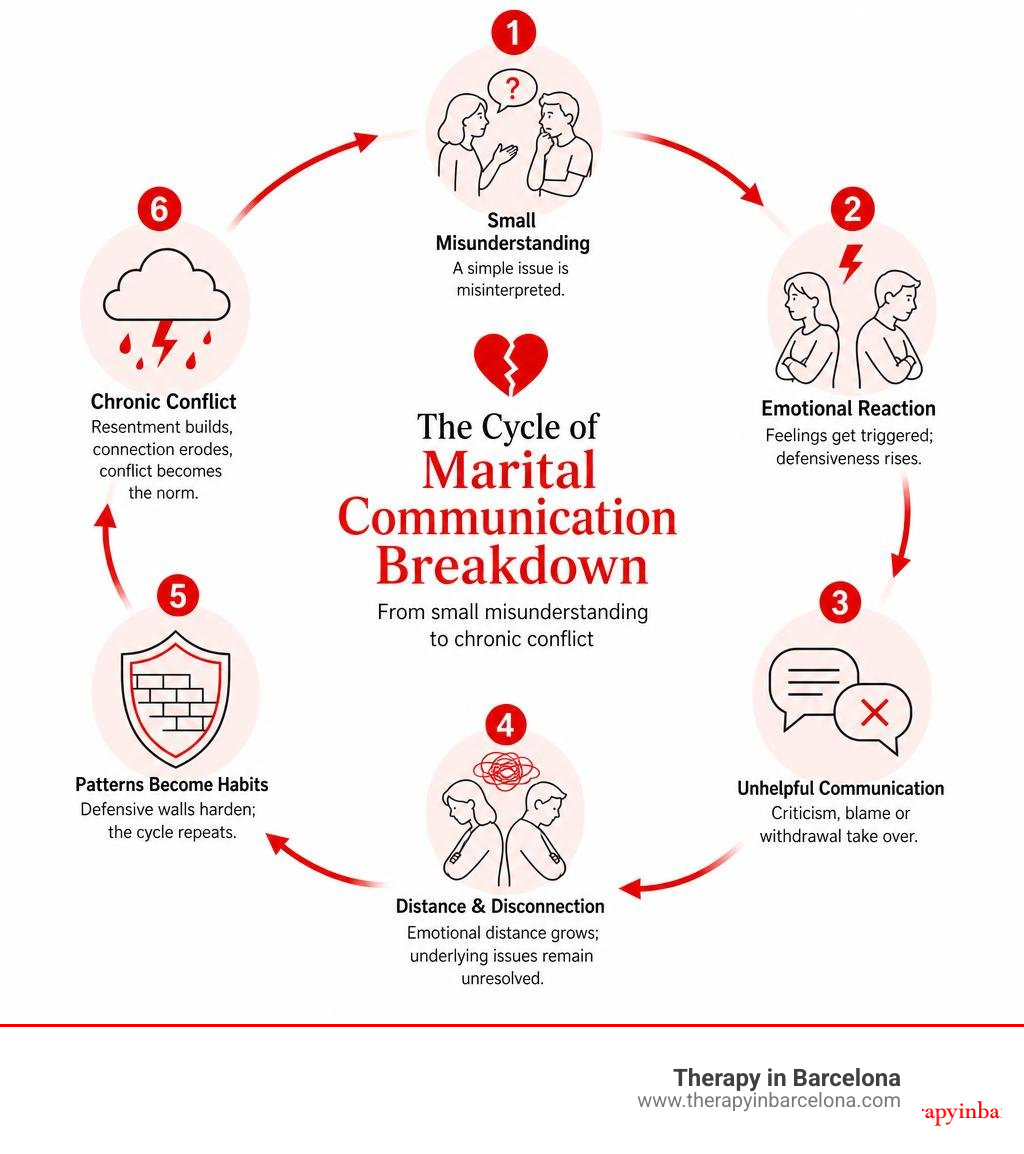
When communication begins to break down, it rarely happens because of a single catastrophic argument. Instead, it is a slow, quiet erosion. Couples often slide into destructive habits without realising it, transforming simple discussions into battlegrounds.
According to pioneering relationship research by the Gottman Institute, there are four specific communication patterns that predict relationship failure with startling accuracy. Known as the “Four Horsemen of the Apocalypse,” these behaviours are highly destructive:
- Criticism: Unlike a specific complaint, criticism attacks your partner’s core character. Saying “You forgot to buy groceries” is a complaint; saying “You never think about anyone but yourself” is criticism.
- Defensiveness: This is a natural reaction to criticism, but it blocks resolution. When you defend yourself by making excuses or cross-complaining, you tell your partner that their feelings do not matter.
- Stonewalling: This occurs when one partner completely withdraws from the conversation, shutting down, tuning out, or physically leaving the room. It is often a response to feeling emotionally flooded.
- Contempt: The most toxic of the four, contempt involves speaking from a position of superiority. It shows up as sarcasm, name-calling, eye-rolling, and hostile mockery.
Gottman’s research indicates that the presence of contempt alone is a 92% predictor of divorce. When these patterns become chronic, they trigger a high-stress environment. Over time, research on marital distress shows that 82% of couples experiencing these communication breakdowns also report elevated stress that correlates with feeling persistently anxious or down.
To understand how to reverse these patterns, couples can explore evidence-based strategies. A great starting point is learning how to stop the cycle of blame by exploring 5 ways to improve communication in relationships | Gottman Institute .
One of the most effective ways to disarm defensiveness is by changing how you start a sentence. Instead of pointing fingers, shifting to constructive expressions of your own experience is vital. You can learn how to do this in our guide on How and When to Use I Statements.
The Core Pillars of Effective Communication in Marriage
At its heart, effective communication in marriage is about need fulfillment. Partners constantly attach meaning to each other’s actions, interpreting them as signs of how well their communal and individual needs will be met. When communication is healthy, it signals that both partners are safe, valued, and on the same team.
To build this safety, couples must cultivate four core pillars:
- Active Listening: This means listening to understand your partner’s inner world, rather than listening to plan your rebuttal.
- Validation: This is the act of letting your partner know that their emotions make sense, even if you do not agree with their perspective or version of the facts.
- Empathy: Stepping into your partner’s shoes to feel what they are feeling.
- Emotional Intelligence: The ability to identify, manage, and express your own emotions while remaining sensitive to your partner’s emotional state.
Interestingly, words only do a fraction of the work. Research on nonverbal communication shows that roughly 65% to 90% of emotional meaning is conveyed nonverbally. A sigh, a gentle touch, or keeping your eyes on your phone while your partner speaks can communicate far more than the actual sentences spoken.

To explore these dynamics further, you can read the Psych Central guide to marital communication. If you find that your daily attempts at conversation keep turning into arguments, it might be time to shift from simple chatting to structured dialogue. Learn more about this transition in our resource, From Misunderstandings to Meaningful Conversations: A Guide to Couples Communication Therapy.
Additionally, scientific insights show that positive communication directly impacts relationship satisfaction. To understand the underlying psychology of how these habits build a stronger bond, see How Couples’ Communication Influences Relationship Quality | Psychology Today Canada .
Active Listening vs. Passive Hearing: A Mobile-Friendly Comparison
To help you identify where your daily interactions fall, here is a clear breakdown of the differences between active listening and passive hearing.
Focus and Attention
- Active Listening: Requires your full, undivided presence. This means putting away phones, closing laptops, making consistent eye contact, and leaning in physically to show engagement.
- Passive Hearing: Involves listening while distracted. You might be nodding along while scrolling through social media, watching television, or replying to work emails, leaving your partner feeling ignored.
Goal of Interaction
- Active Listening: The primary goal is to understand and validate your partner’s internal experience. You ask open-ended questions and hold space for their feelings without trying to immediately “fix” the problem.
- Passive Hearing: The goal is often to reply, defend yourself, or offer unsolicited advice. It frequently leads to interrupting your partner to prove a point or shut down the conversation.
Nonverbal Engagement
- Active Listening: Marked by open, relaxed body language, gentle nodding, mirroring your partner’s emotional tone, and reassuring physical touch.
- Passive Hearing: Characterised by closed posture, crossed arms, looking away, sighing, or eye-rolling, which signals irritation or boredom.
The Power of Timing and Tone in Effective Communication in Marriage
Have you ever brought up a difficult topic the moment your partner walked through the door after a long day? Or tried to resolve a budget dispute at midnight when you were both exhausted?
If so, you already know that timing and tone dictate the outcome of a conversation. A gentle, respectful tone — known as a “softened start-up” — prevents your partner’s nervous system from going into fight-or-flight mode. If a conversation begins with a harsh tone, it is highly likely to end with defensiveness or stonewalling.
To protect your communication, try implementing these three strategies:
- Acknowledge Stress Levels: Before bringing up a sensitive topic, ask: “Is this a good time to talk about something that’s been on my mind, or do you need some time to decompress first?”
- Use Strategic Timeouts: If a discussion begins to escalate and you feel your heart rate rising, call a timeout. Agree on a neutral word or signal, take a 20-minute break to calm down, and commit to returning to the topic within 24 hours.
- Apply the 10-Minute Rule: Spend at least 10 minutes every single day talking about something other than work, chores, finances, or family logistics. Focus on dreams, lighthearted memories, or curious questions.

For a deeper look at balancing your daily conversations, check out Four Types of Communication to Strengthen Your Marriage .
Practical Exercises for Daily Connection and Effective Communication in Marriage
Improving your communication requires consistent, intentional practice. Here are three highly effective exercises you can integrate into your relationship starting today:
- The Speaker-Listener Technique: This structured exercise ensures both partners feel heard. One partner holds a physical object (like a remote control or a coaster) and acts as the speaker, expressing their thoughts using “I” statements. The other partner is the listener, who must paraphrase what they heard before responding. Once the speaker feels understood, you swap the object.
- The 20-Second Hug: Physical touch is a powerful communication tool. A 20-second hug can lower blood pressure by up to 10 points. This physical connection triggers the release of oxytocin, reducing stress and reinforcing emotional safety.
- The Weekly Marriage Meeting: Set aside 30 minutes every Sunday evening. Use this structured time to share appreciations, coordinate the upcoming week’s schedule, discuss household needs, and address any lingering feelings from the week.
To discover more structured ways to build your relational habits, explore The Ultimate Guide to Couples Therapy Exercises for a Stronger Bond.
Repairing After Conflict and Rebuilding Trust
Arguments are an inevitable part of any long-term partnership. What matters most is not avoiding conflict, but how you repair the connection afterward. A repair attempt is any statement or action — a silly face, an apology, a gentle touch, or a shared joke — that prevents negativity from spiralling out of control.
To repair effectively, aim to maintain a 5:1 ratio of positive to negative interactions during conflict. This means that even when you are disagreeing, you still show respect, validate your partner’s feelings, and acknowledge their positive traits.
Once the dust has settled, schedule a post-conflict debrief. Talk about what triggered you, take responsibility for your part in the escalation, and discuss how you can handle the situation differently next time. A genuine apology does not focus on defending your intentions; it focuses on acknowledging the impact of your words on your partner.
For practical advice on de-escalation, read Why Gottman Exercises for Couples Transform Relationships. To learn more about repairing trust and breaking old cycles, see How To Communicate Better in a Marriage (How to Improve Communication With Your Spouse) | by Brooke Samara | Medium .
Knowing When to Seek Professional Support
Sometimes, despite your best intentions, you find yourselves stuck in the same painful loop. Certain topics become completely undiscussable, chronic resentment sets in, or you begin to feel more like roommates than romantic partners. These are clear red flags that it is time to seek professional guidance.
When looking for help, couples in Spain have several options:
- Public Health System: While public healthcare is accessible, it often involves long waiting lists, limited sessions, and generalist clinicians who may not have specific training in couples therapy or expat-related issues.
- Large Online Platforms: These services offer convenience, but they often lack personalised therapist matching and may raise privacy concerns regarding data handling.
- Local Practices: Local clinics can be excellent, but they may not offer native-level English or understand the unique, complex realities of the international expat experience.
At Therapy in Barcelona, we offer a highly personalised, private-pay service designed specifically for the international community. Founded in 2011 by Leigh Matthews — an Australian Psychologist and expat who has spent over 14 years supporting internationals in Barcelona — our practice provides culturally sensitive, multilingual care.
We do not just match you with the next available slot; we take the time to carefully pair you with a psychology-trained therapist who fits your unique needs.
To understand what to expect from this process, read our guide on The Art of Healing: How Couples Therapy Works.
Frequently Asked Questions about Marital Communication
What if my partner refuses to participate in communication exercises?
You do not need both partners to start making changes. When you shift your own communication style — such as using “I” statements instead of pointing fingers, or responding with a softened start-up — you naturally change the dynamic of the relationship. Often, when one partner stops reacting defensively, the other partner feels safer and eventually becomes more willing to participate.
How do we handle disagreements when we remember the “facts” differently?
In conflict, arguing over the facts is often a trap. Instead, focus on validating your partner’s emotional experience. You don’t have to agree on every detail to acknowledge how they felt: “I understand you felt abandoned when I stayed late at work.”
How does living abroad as expats affect our communication?
Relocating to a new city can place extra pressure on a relationship. Without your usual support network, partners often become each other’s main source of emotional support, making misunderstandings more likely—especially in bicultural or multilingual relationships.
Moving Forward Together
Building a strong, communicative marriage takes time, patience, and a willingness to learn. By practising active listening, choosing the right moments to speak, and focusing on repair after conflict, you can transform your relationship into a safe, connected sanctuary.
If you are experiencing the unique challenges of expat life in Spain and want to strengthen your relationship, we are here to support you. At Therapy in Barcelona, we provide personalised therapist matching for couples, offering both in-person sessions at our central Barcelona office and online therapy worldwide (including the USA and Canada).
Let us help you find the right path forward together. If you’d like support, Book your Free Discovery Call today.
