


Understanding Cultural Adjustment Therapy: A Path to Thriving Abroad
Cultural adjustment therapy is a specialized therapeutic approach that helps individuals steer the emotional and psychological challenges of adapting to a new culture. It combines traditional therapy techniques with culturally-sensitive practices to support people experiencing culture shock, identity confusion, and adjustment difficulties.
| What is Cultural Adjustment Therapy? |
|---|
| • A therapeutic approach focused on helping individuals adapt to new cultural environments |
| • Combines talk therapy with culturally-adapted techniques |
| • Addresses symptoms of culture shock, homesickness, and cultural identity struggles |
| • Typically involves 4-12 sessions, depending on individual needs |
| • Can be conducted individually or in groups |
Moving to a new country can be both exciting and overwhelming. Whether you’re an expat in Barcelona, an international student, or someone who has relocated for work or love, the process of adapting to a new culture brings unique psychological challenges. According to a 2025 global mobility report, approximately 70% of individuals experience some form of culture shock when adjusting to a new culture, making this a common yet often misunderstood phenomenon.
Cultural adjustment typically follows four distinct phases: the honeymoon phase (initial excitement), the crisis phase (culture shock), the recovery phase (gradual adaptation), and finally, the adjustment phase (feeling at home). Each phase presents its own emotional problems and opportunities for growth.
As one expatriate noted, “Moving to another place can be really invigorating, but difficulties can also arise.” These difficulties might include language barriers, social isolation, identity confusion, and feeling caught between your home culture and your new environment.
Cultural adjustment therapy provides a safe space to process these complex emotions and develop practical strategies for building a fulfilling life in your new home. Through this specialized form of therapy, you can transform cultural challenges into opportunities for personal growth and deeper cross-cultural understanding.
Understanding Cultural Adjustment
Moving to a new country is like stepping into an entirely different world – one that can be both thrilling and overwhelming. Cultural adjustment refers to the process of adapting to a different culture’s expectations, values, and environment. While this journey can be incredibly rewarding, it also presents unique challenges that can significantly affect your psychological wellbeing and sense of identity.
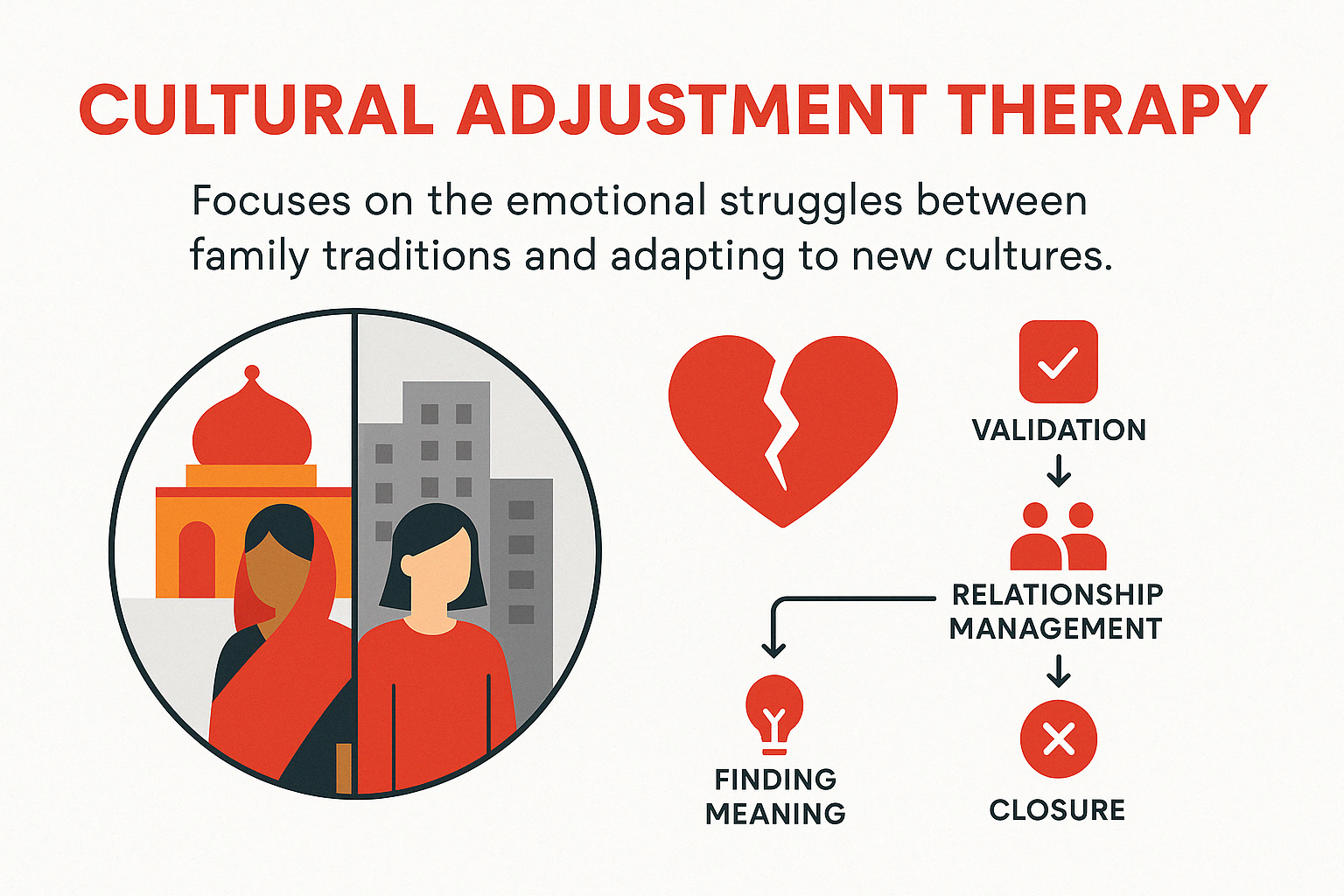
As Leigh Matthews, founder of Therapy in Barcelona and an Australian psychologist who moved to Barcelona in 2011, explains: “Cultural adjustment goes beyond learning new customs or language. It can bring up deep emotional struggles, particularly when you feel caught between family traditions and the need to adapt to a new culture.”
What Is Cultural Adjustment?
Cultural adjustment is the process through which individuals adapt to living in a cultural environment different from their own. This journey involves more than just learning to order coffee in a new language – it means understanding new social norms, communication styles, values, and daily practices while navigating unfamiliar systems.
The importance of successfully navigating this adjustment cannot be overstated. Research from WithTherapy’s 2025 mental health resources shows that effective cultural adaptation is linked to better mental health outcomes, higher life satisfaction, and greater professional success for expatriates. On the flip side, difficulties with cultural adjustment can lead to isolation, depression, anxiety, and sometimes even premature return to one’s home country.
When you first arrive in a new country, even simple tasks can become surprisingly challenging. As one international student described: “When you first get off the plane it can be surprising just to hear a different language being spoken everywhere.” These small moments of disorientation might seem minor individually, but they accumulate and can create significant stress over time.
The Stages of Cultural Adjustment
Cultural adjustment isn’t a straight path but typically unfolds in four recognizable stages:
- Honeymoon Phase: During these first few weeks, everything seems fascinating and exotic. You’re excited about all the new experiences, focusing on the positive aspects and similarities with your home culture. Barcelona’s beautiful architecture and vibrant street life might feel like a dream come true.
- Crisis Phase (Culture Shock): After a few months, the novelty wears off. Differences become more apparent and frustrating. You might feel homesick, anxious, or irritable. Simple tasks become exhausting due to language barriers and unfamiliar systems. Perhaps navigating Spanish bureaucracy or feeling excluded from conversations starts to wear you down.
- Recovery Phase: Gradually, you begin developing routines and better understanding cultural norms. Your language skills improve, and you start building meaningful connections. You gain a more balanced perspective on both the positives and negatives of your new environment.
- Adjustment Phase: Between 6-12 months (though this varies widely), you begin to feel at home in the new culture. You’ve developed effective coping strategies and can steer daily life with confidence. You may even begin to adopt some values and practices from your host culture, perhaps finding yourself embracing the Spanish mealtime schedule or Catalan traditions.
As Linda Louw, a missionary in Senegal, noted: “I thought culture shock was something that you got through, and it was done, but it just keeps coming.” This observation highlights that cultural adjustment is often cyclical rather than linear, with individuals revisiting earlier stages as they encounter new challenges.
Understanding these stages can normalize your experience and help you recognize that difficulties are a natural part of the adjustment process, not a personal failure. As one resource from Brown University’s 2025 study abroad guide states, cultural adjustment is “a normal part of the study abroad experience” that everyone goes through to some degree.
Recognizing where you are in this journey can provide comfort and perspective, helping you steer the ups and downs of adapting to life in Barcelona or any new cultural environment with greater self-compassion and awareness.
Culture Shock and Mental Health
That feeling of disorientation when you first arrive in a new country goes beyond simple homesickness—it can profoundly impact your psychological wellbeing. Understanding the symptoms of culture shock and its effects on mental health is the first step toward finding appropriate support and developing effective coping strategies.
Symptoms of Culture Shock
Culture shock manifests in many ways, affecting not just your mind but your entire being. You might notice changes in how you feel emotionally, think about yourself, and even in your physical health.
When it comes to your emotional and psychological state, homesickness often strikes first—that persistent longing for familiar faces, places, and routines. You might experience unexpected sadness or loneliness even when surrounded by people, or find yourself dealing with heightened anxiety about everyday tasks that would have seemed simple back home.
Many expats describe feeling unusually irritable or frustrated by minor inconveniences. As one cultural exchange participant shared: “I was constantly tired, couldn’t sleep properly, and felt irritable about things that normally wouldn’t bother me. I didn’t recognize these as symptoms of culture shock until my counselor pointed it out.”
Your body often responds to cultural adjustment stress too. Changes in eating patterns might manifest as loss of appetite or comfort eating. According to WithTherapy’s 2025 research on eating disorders, these changes can sometimes develop into more serious issues if not addressed. Sleep disruptions are extremely common, whether that’s insomnia or sleeping more than usual. Many people experience persistent fatigue, unexplained digestive issues, or frequent headaches as their bodies process the stress of adaptation.
Impact on Mental Health
The continuous stress of navigating unfamiliar environments can take a serious toll on your mental wellbeing:
Anxiety often intensifies when you’re constantly faced with uncertainty. Even routine activities like grocery shopping become potential sources of stress when conducted in a different language or cultural context.
Depression affects approximately 40% of expatriates during their first year abroad, according to 2025 expatriate mental health statistics. The combination of isolation, loss of support networks, and grief over leaving your previous life creates the perfect conditions for depressive symptoms to emerge.
An identity crisis often develops as you find yourself caught between cultures. This is particularly challenging for Third Culture Kids (TCKs) and long-term expatriates who may begin questioning where they truly belong.
The constant strain of misunderstandings and language barriers can significantly damage your self-esteem. Professional skills that were valued in your home country might not translate well in your new environment, leaving you questioning your capabilities and worth. WithTherapy’s 2025 resources on self-esteem highlight how cultural transitions can particularly impact one’s sense of competence and belonging.
Some people turn to substance use as a way to cope with the discomfort and isolation of adjustment, which can create additional problems over time.
Understanding Reverse Culture Shock
Perhaps the most unexpected challenge comes when you return to your home country after living abroad. Reverse culture shock—the difficulty readjusting to your original culture—can be equally if not more challenging than the initial adjustment to a foreign country.
“Will my home still be there? Will my country still be there?” These questions reflect the uncertainty many feel when returning after significant time abroad.
Reverse culture shock typically involves several challenges:
First comes disillusionment as your home country fails to match your idealized memories or has changed during your absence. You may experience alienation when friends and family cannot relate to your international experiences, leading to feelings of disconnection even among loved ones.
Your identity has likely integrated aspects of your host culture, making it difficult to readjust to your original cultural context. You might also develop a more critical perspective of your home culture after experiencing alternatives, causing friction with those who haven’t had similar experiences.
A 60-year-old former “missionary kid” described his experience returning to his home country: “I felt like a foreigner in my own country. People couldn’t understand why I was struggling—after all, I was ‘home’—but everything felt strange and uncomfortable.”
The U.S. Department of State’s 2025 guide on reverse culture shock emphasizes that this experience is normal and provides strategies for coping with the transition back home.
At Therapy in Barcelona, we understand these challenges deeply because we’ve experienced them ourselves. Cultural adjustment therapy provides a space to process these complex emotions with someone who truly understands the unique stresses of expatriate life and can help you develop strategies to steer both culture shock and reverse culture shock effectively.
The Role of Cultural Adjustment Therapy
When you’re building a new life abroad, the psychological challenges can feel overwhelming. Cultural adjustment therapy provides a lifeline for expats, international students, and immigrants who are struggling to steer the complex emotions and stressors that come with cultural transition.
As an expat myself, I understand that these challenges aren’t simply “homesickness”—they’re profound psychological processes that affect your entire sense of self and security in the world. That’s why at Therapy in Barcelona, we’ve developed approaches specifically designed to address the unique needs of internationals.
How Cultural Adjustment Therapy Helps
Cultural adjustment therapy offers a safe haven where you can explore and process the complex emotions that arise during cultural transitions. When you’re feeling caught between two worlds, therapy provides the space to express your confusion, frustration, grief, and identity questions without judgment.
Through emotional processing, you can acknowledge and work through feelings of loss and disorientation that often accompany a major move. Your therapist will help you identify and challenge negative thought patterns that may have developed—like catastrophizing minor cultural missteps or making sweeping generalizations about cultural differences.
Beyond emotional support, therapy equips you with practical skills for cross-cultural communication and effective coping strategies for culture shock. You’ll develop realistic expectations about your adjustment journey and explore how cultural transition affects your sense of self.
“When working with expatriates,” explains Leigh Matthews of Therapy in Barcelona, “we recognize that cultural adjustment challenges aren’t simply ‘homesickness’ but complex psychological processes that affect one’s entire sense of self and security in the world.”
If you’re feeling overwhelmed by cultural differences, reaching out to a mental health provider can be a crucial step toward finding your footing in your new home. WithTherapy’s 2025 mental health resources offer additional guidance on finding appropriate support during cultural transitions.
Benefits of Culturally Adapted Therapies like CBT
Traditional therapeutic approaches can be wonderfully effective when thoughtfully adapted to address cultural adjustment challenges. Cognitive Behavioral Therapy (CBT), for instance, shows remarkable results when culturally custom.
Research published by the National Center for Biotechnology Information in 2025 confirms that culturally adapted CBT involves “adjustments to the therapy process and techniques” that make it more relevant and accessible to individuals from diverse backgrounds. This adaptation is crucial—one study from India reported that 82% of psychology students felt that standard CBT principles conflicted with their cultural values.
When therapy acknowledges cultural factors, you’re more likely to fully engage in the process. A culturally sensitive therapist might:
- Use examples and metaphors that resonate with your cultural background
- Include family members when appropriate (especially in cultures with strong family orientation)
- Modify homework assignments to align with your cultural norms
- Adjust communication styles to match your expectations and comfort level

Navigating Cross-Cultural Relationships Through Therapy
Cross-cultural relationships—whether romantic partnerships, friendships, or professional connections—bring their own unique set of challenges. Cultural adjustment therapy provides tools to bridge these differences and build stronger connections.
Communication styles vary dramatically across cultures. If you come from a direct communication culture (like many Western countries) but your partner is from a high-context culture that values indirect communication, misunderstandings are almost inevitable. Therapy helps you both recognize these differences and develop strategies to bridge the gap.
Cultural values around family obligations, gender roles, or work-life balance can create tension in relationships. Through therapy, you’ll learn to negotiate these differences respectfully, finding compromises that honor both cultural perspectives.
Power imbalances often emerge when one partner is more familiar with the local culture and language. This dynamic can be especially challenging for trailing spouses or partners who have given up careers to support a move abroad. Therapy provides a framework for addressing these imbalances and building more equitable relationships.
Extended family relationships can be particularly tricky in intercultural partnerships. As highlighted in our article on “Navigating the Intricacies of Managing In-Laws in Intercultural Relationships in Spain,” balancing different expectations around family involvement requires special attention and skills.
One client shared: “My partner and I were constantly misunderstanding each other’s expectations around family obligations. Our therapist helped us see how our different cultural backgrounds were shaping our expectations and gave us tools to communicate more effectively.”
Through cultural adjustment therapy, you can transform cultural differences from sources of conflict into opportunities for deeper understanding and connection.
Coping Strategies for Cultural Adjustment
Moving to a new country isn’t just about finding an apartment or learning a few phrases in a new language—it’s about rebuilding your entire life. While cultural adjustment therapy can provide invaluable support during this transition, there are also many practical strategies you can implement in your daily life to steer the challenges of cultural adjustment.
Practical Coping Strategies
Adapting to a new culture is a journey that requires both patience and intention. As one expatriate in Barcelona shared, “Be kind to yourself by acknowledging that anxiety is a natural part of adaptation. And be patient—cultural adjustment is a marathon, not a sprint.”
Accept curiosity rather than judgment when encountering cultural differences. Instead of thinking “that’s weird” or “that’s wrong,” try asking yourself “I wonder why they do things this way?” This simple shift in perspective can transform frustrating cultural encounters into opportunities for learning and connection.
Creating daily routines can provide a sense of stability during times of change. Whether it’s finding a favorite café for your morning coffee or establishing a regular exercise routine, these familiar touchpoints can anchor you when everything else feels new and unpredictable.
Setting realistic expectations is crucial for your mental wellbeing. Adaptation typically takes 6-12 months for most people, and the process isn’t linear. There will be good days and challenging days—this is normal and doesn’t mean you’re failing at adapting.
Developing language skills, even at a basic level, can significantly improve your experience. As one client at Therapy in Barcelona noted, “Just being able to order my coffee in Spanish gave me a small sense of achievement each morning. These tiny victories add up.” Language apps, community classes, or language exchanges can help you progress while also connecting you with others.
Creating a comfortable living space that includes elements from your home culture can provide a sanctuary when cultural fatigue sets in. Display meaningful objects, cook familiar foods, or maintain traditions that connect you to your roots. This isn’t resisting integration—it’s giving yourself the emotional resources to engage more fully with your new environment.

The Importance of Social Support
Human connection is perhaps the most powerful resource during cultural adjustment. Research consistently shows that social isolation significantly increases the risk of mental health problems during cultural transition, making it crucial “not to isolate yourself” as noted in a 2025 study from the National Center for Biotechnology Information.
Building a diverse support network that includes both locals and other internationals provides different types of support. Fellow expatriates can validate your experience and share practical tips, while local friends can help you understand cultural nuances and feel more connected to your new home.
Leigh Matthews of Therapy in Barcelona observes, “Many expatriates make the mistake of only connecting with other internationals or only trying to befriend locals. The most resilient individuals typically build bridges to both communities.”
Maintaining connections with home remains important, though finding the right balance can be tricky. Schedule regular video calls with family and friends, but be mindful not to use these connections as a way to avoid engaging with your new environment. Share your experiences while also staying involved in their lives.
Structured support through cultural adjustment groups, language exchanges, or professional networks can provide both social connection and practical assistance. In Barcelona, some organizations offer specialized support groups for expatriates navigating cultural adjustment challenges.

Balancing Cultural Heritage and Adaptation
Finding the sweet spot between honoring your cultural roots and embracing your new environment is perhaps the most nuanced aspect of cultural adjustment. This isn’t about choosing sides but creating a rich, integrated identity.
Identifying your core values while remaining flexible about practices can help you steer this balance. For example, you might maintain your fundamental values around family or ethics while adapting to local customs regarding social interactions or work-life balance.
Developing cultural frame-switching skills allows you to move fluidly between cultural contexts. As one bicultural client described: “At work, I’m more direct and time-focused, like my Spanish colleagues. With my American friends, I slip back into a more casual, chatty style. I don’t feel fake—I feel adaptable.”
Creating synthesis rather than choosing sides can lead to a richer life experience. Look for creative ways to blend elements from both cultures. A British expat in Barcelona shared how she combined her traditional Sunday roast dinner with local Catalan ingredients, creating a new tradition that honored both cultures.
As Leigh Matthews observes: “The goal isn’t to abandon your cultural heritage or to completely assimilate—it’s to develop a rich, integrated identity that honours your roots while allowing you to thrive in your new environment.”
Actively celebrating your heritage by cooking traditional foods, observing important holidays, or sharing aspects of your culture with new friends can help maintain your cultural identity while also creating connection points with locals who may be curious about your background.
The American Psychological Association’s 2025 resources on resilience emphasize that healthy lifestyle choices and maintaining cultural practices can significantly improve your ability to cope with the challenges of cultural adjustment.

Navigating cultural adjustment is challenging, but with intentional strategies and support, it can become a profound journey of growth and self-findy. As one client at Therapy in Barcelona reflected, “Looking back after two years here, I realize that the most difficult parts of adjusting to life in Barcelona were also the experiences that taught me the most about myself. I wouldn’t trade that growth for anything.”
Frequently Asked Questions about Cultural Adjustment Therapy
What Is Cultural Adjustment Therapy?
Cultural adjustment therapy is a specialized approach designed specifically for individuals navigating the complex psychological terrain of adapting to a new cultural environment. Unlike general therapy, this approach recognizes that cultural transition brings unique challenges that require custom support.
When you’re struggling with cultural adjustment, you need more than standard therapeutic techniques. You need someone who understands the particular stressors of cultural transition – the frustration of language barriers, the ache of missing your support network, the exhaustion of navigating unfamiliar systems, and the internal conflict that comes from reconciling different cultural values.
A typical cultural adjustment therapy journey involves working closely with a therapist who will:
- Assess your specific cultural adjustment challenges
- Develop personalized coping strategies that work for your situation
- Help you process the grief and loss that often comes with leaving your home culture
- Build your cross-cultural communication skills
- Support you in developing a healthy bicultural or multicultural identity
This specialized approach acknowledges that cultural transition isn’t just about practical challenges – it’s about your very sense of self and how you relate to the world around you.
How Does Cultural Adjustment Therapy Help with Culture Shock?
Culture shock can feel overwhelming and isolating, but cultural adjustment therapy can make a significant difference in how you experience and move through this challenging phase.
One of the most powerful aspects of therapy is simply having your experience normalized. Many of my clients express immense relief when they learn that approximately 70% of people experience some form of culture shock when adjusting to a new culture. This validation helps them understand that their struggles aren’t a personal failure or weakness – they’re a normal response to an extraordinary life change.
Often, people don’t even recognize their symptoms as culture shock. They know they’re feeling irritable, having trouble sleeping, experiencing anxiety, or withdrawing socially, but they don’t connect these symptoms to the cultural adjustment process. A therapist can help you make these connections, which is the first step toward addressing them effectively.
The therapy room becomes a safe haven – a place where you can express your frustration, confusion, or grief without judgment. Many clients share that they feel uncomfortable expressing these emotions elsewhere, worried they’ll seem ungrateful for the opportunity to live abroad or that others won’t understand.
Your therapist will work with you to develop personalized strategies for managing culture shock symptoms. These might include practical approaches like establishing routines in your new environment, as well as psychological techniques like cognitive reframing to help you interpret cultural differences in less threatening ways.
As one client shared: “My therapist helped me see that what I was experiencing wasn’t a personal failure but a normal part of cultural transition. That understanding alone reduced my anxiety significantly.”
Can Cultural Adjustment Therapy Assist with Reverse Culture Shock?
Yes, cultural adjustment therapy is equally valuable for addressing reverse culture shock – that often unexpected struggle of readjusting to your home culture after living abroad.
Reverse culture shock can be particularly challenging because it catches many people off guard. There’s an assumption that returning “home” should be easy – after all, you’re going back to the familiar. But the reality is often quite different. You’ve changed during your time abroad, but your home environment expects you to be the same person who left. Friends and family may not understand or validate your struggle, making you feel even more isolated.
Cultural adjustment therapy helps with reverse culture shock by first validating that this experience can be just as challenging as initial culture shock. Your therapist acknowledges the real difficulty of this transition, helping you feel understood when others around you might not get it.
Therapy provides a supportive space to explore how living abroad has changed your identity, values, and worldview. Many returnees struggle with integrating these changes into their life back home, feeling caught between who they were before and who they’ve become. Your therapist can help you steer this complex identity journey.
Managing relationships can be particularly tricky during repatriation. Your therapist can help you steer relationships with friends and family who may not understand or relate to your international experiences, finding ways to share your experiences without alienating others.
For many, therapy helps create healthy closure with their international experience while opening new chapters at home. It supports you in finding meaning in your time abroad and finding ways to incorporate what you’ve learned into your life moving forward.
One returnee described it perfectly: “Coming back was harder than leaving. My therapist helped me recognize that I was grieving the loss of my life abroad while simultaneously trying to rebuild my life at home—a complex emotional process that needed time and care.”
Whether you’re struggling with the initial adjustment to a new culture or the unexpected challenges of returning home, cultural adjustment therapy offers specialized support to help you steer these complex transitions with greater ease and understanding.
Conclusion
Cultural adjustment therapy isn’t just about learning new customs or adapting to a different environment—it’s a profound journey that transforms both how you interact with your new surroundings and how you understand yourself. Throughout this guide, we’ve explored how this specialized form of therapy offers vital support for navigating the complex emotional landscape of cultural transition, addressing both practical challenges and deeper psychological aspects of moving abroad.
Whether you’re riding the initial wave of excitement during the honeymoon phase, struggling through the frustration of culture shock, or feeling disoriented by reverse culture shock upon returning home, these reactions are entirely normal. They represent human responses to significant life changes that touch the very core of your identity and sense of belonging.
As Leigh Matthews, founder of Therapy in Barcelona and an Australian psychologist who relocated to Barcelona in 2011, often reminds her clients: “Cultural adjustment goes beyond learning new customs or language. It can bring up deep emotional struggles, particularly when you feel caught between family traditions and the need to adapt to a new culture.”
At Therapy in Barcelona, we understand these challenges intimately. Our team of multilingual therapists—many of whom are expatriates themselves—brings both professional expertise and personal experience to supporting the international community. We’ve walked in your shoes, felt the disorientation, and steerd the complex emotions that come with building a life in a new country.
We provide culturally sensitive therapy that acknowledges the unique aspects of the expatriate experience, helping you not just survive but truly thrive in your new environment. Our approach isn’t about abandoning your cultural heritage or completely assimilating into your new culture. Rather, we help you develop a rich, integrated identity that draws strength from both worlds.
With the right support and strategies, the challenges of cultural adjustment can transform into opportunities for profound personal growth, an expanded worldview, and deeper cross-cultural understanding. Many of our clients find that what initially felt like painful disconnection eventually leads to a more authentic and fulfilling sense of self.
If you’re navigating the complexities of cultural adjustment in Barcelona or beyond, you don’t have to do it alone. Therapy in Barcelona offers both in-person sessions at our welcoming office in Barcelona (Calle Paris 162-164, 3o, 1a, 08036) and online therapy for expatriates worldwide (except USA and Canada). Our warm, experienced team is ready to support you in changing cultural challenges into opportunities for growth and fulfillment.
For more information about expat therapy in Barcelona and how we can support your cultural adjustment journey, visit our expat therapy resources or contact us for a free findy call to find the right therapist for your specific needs.
