


What Is Self Esteem Therapy and Can It Actually Help You?

Self esteem therapy is a structured, evidence-based approach to helping you understand and shift the way you see yourself — and yes, research strongly supports that it works. If you’re wondering whether it’s right for you, here’s a quick overview:
- What it is: A form of professional counselling that targets negative self-beliefs, builds self-compassion, and helps you develop a more accurate, kinder view of yourself.
- Who it helps: Anyone experiencing persistent self-doubt, low confidence, people-pleasing, perfectionism, or feelings of worthlessness — whether or not you have been given a specific label for your struggles.
- How it works: Therapists use approaches like Cognitive Behavioural Therapy (CBT), Acceptance and Commitment Therapy (ACT), and psychodynamic methods to uncover the roots of low self-esteem and build new patterns.
- How long it takes: Many people notice early shifts within three to six weeks when they practise skills consistently. Deeper change typically develops over a few months.
- Where to start: Booking a Free Discovery Call is a good first step. This is a private-pay service, and some therapists offer sliding scale fees for those with financial need.
Most of us have moments of self-doubt. You second-guess an email you sent, replay a conversation from last week, or quietly wonder whether you’re really good enough for the job you just landed. That’s normal. But when that inner voice becomes a constant companion — one that chips away at your confidence day after day — it stops being a passing feeling and starts shaping your entire life.
Low self-esteem is not always obvious. It can affect high achievers who feel like frauds, expats who lose confidence after relocating, or people who constantly apologise or hold themselves back from opportunities.
As Oscar Wilde once wrote, “To love oneself is the beginning of a lifelong romance.” It’s a witty line — but for many people, that relationship with themselves is the hardest one to build. The good news is that self-esteem is not fixed. It’s a pattern, and patterns can change.
This guide walks you through how self esteem therapy works, what the evidence says, and what practical steps — both inside and outside the therapy room — can help you build a more grounded, compassionate relationship with yourself.
Understanding Self-Esteem and Its Impact on Your Life
At its simplest, self-esteem is the opinion we hold about ourselves. When it is healthy, we tend to feel positive about life and our ability to deal with the curveballs it throws. We value our own worth and recognise the characteristics of strong mental health in our daily habits.
However, when self-esteem is low, that internal “opinion” becomes skewed. You might find yourself focusing almost entirely on your perceived flaws or mistakes, while dismissing your achievements as luck or timing. This isn’t just about “feeling a bit down”; it is a foundational element of your well-being.
According to the Mayo Clinic, building self-esteem is an important part of self-care, as it influences how you navigate relationships, your career, and even your physical health.

The Roots of Low Self-Esteem
For many of us, the “volume” of our inner critic was set long ago. Low self-esteem often begins in childhood. It might stem from negative messages received from parents, teachers, or peers, or from a feeling that you didn’t quite meet the expectations of those around you. These early experiences create “core beliefs” — deep-seated ideas about who we are that we often mistake for facts.
If you grew up hearing that you were “difficult” or “not as smart as your sibling,” you might carry an internalised version of that voice into adulthood. This leads to chronic self-esteem, self-doubt, and self-criticism that feels like an objective truth rather than a learned perspective. In therapy, we work to uncover these roots, not to dwell on the past, but to understand why your brain defaults to certain negative patterns today.
How Low Confidence Affects Daily Life
Low self-esteem is rarely contained to just one area of life. It ripples outward, often leading to:
- Avoidance Behaviours: You might stop yourself from applying for a dream job in Madrid or joining a social group in Málaga because you’re convinced you won’t fit in or will fail.
- Relationship Dynamics: You might find it hard to set boundaries, fearing that saying “no” will make people leave you.
- Workplace Struggles: This frequently manifests as Imposter Syndrome, where you live in constant fear that your colleagues will “find out” you aren’t actually capable.
- Social Apprehension: Replaying every word of a conversation to check if you sounded “stupid” or “boring.”
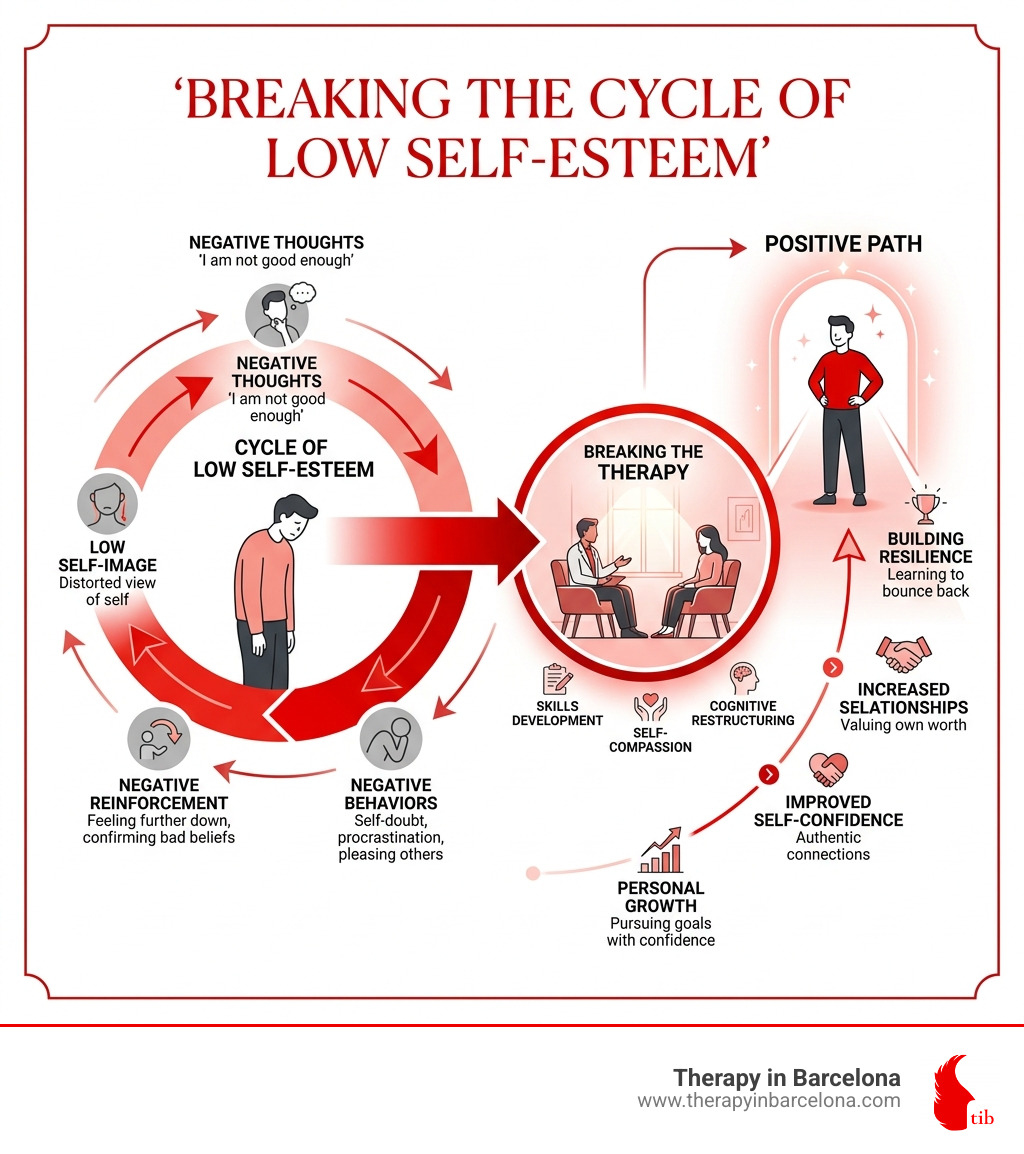
By avoiding challenges, we inadvertently reinforce the belief that we can’t handle them. Self esteem therapy aims to break this cycle by providing the tools to face these situations with a new mindset.
Evidence-Based Approaches in Self Esteem Therapy
When you decide to seek support, it’s helpful to know that modern therapy isn’t just about “talking through your feelings.” It involves specific, evidence-based techniques designed to change how your brain processes self-related information. Whether you choose individual therapy in Barcelona or online sessions, your therapist will likely use a combination of several proven modalities.
How CBT for Self Esteem Therapy Rewires Your Mind
Cognitive Behavioural Therapy (CBT) is one of the most effective tools for raising self-worth. It operates on a simple premise: your thoughts, feelings, and behaviours are all linked. If you can change the way you think, you can change the way you feel and act.
In self esteem therapy, CBT helps you identify “cognitive distortions” — those pesky thinking traps like “all-or-nothing thinking” (e.g., “If I’m not perfect, I’m a failure”) or “mental filtering” (ignoring all the good things and focusing only on one mistake).
A key part of this process is Cognitive Behavioural Therapy (CBT), which involves:
- Identifying Triggers: Noticing the situations that make your self-esteem plummet.
- Thought Records: Writing down negative thoughts and then looking for evidence for and against them.
- Cognitive Restructuring: Learning to think better to live better by replacing harsh judgments with more accurate, balanced statements.
The Mayo Clinic suggests that taking steps to feel better about yourself through CBT can lead to significant improvements in as little as a few weeks. It’s about moving from “I’m useless” to “I made a mistake on this report, but I’ve successfully completed many others.”
Acceptance and Commitment (ACT) as a Tool for Self Esteem Therapy
While CBT focuses on changing thoughts, Acceptance and Commitment Therapy (ACT) teaches you how to change your relationship with them.
Instead of fighting your inner critic, ACT uses mindfulness to help you observe those thoughts without letting them drive your actions. You might learn “cognitive defusion” techniques, such as saying, “I’m having the thought that I’m a failure,” rather than “I am a failure.” This creates a small, vital space between you and your self-criticism.
ACT also focuses heavily on Value Alignment. When you live in accordance with what truly matters to you — whether that’s creativity, kindness, or adventure — your self-esteem naturally begins to stabilise. You stop measuring your worth based on external approval and start measuring it based on your own integrity.
Practical Exercises to Build Confidence Daily
Therapy provides the blueprint, but the “building” happens in your daily life. Here are some evidence-based exercises you can start today to support your journey.
Challenging the Inner Critic
The way you talk to yourself matters. Most of us say things to ourselves that we would never dream of saying to a friend. To change this, try Socratic Questioning. When a negative thought arises, ask yourself:
- Is there actual evidence for this thought?
- Is this a fact or just a feeling?
- Would I say this to someone I love?
This is about dialling down the internal critic and moving toward “accurate thinking.” It’s not about forced positivity; it’s about being fair to yourself. The NHS provides a helpful self-esteem self-help guide that suggests keeping a “positive qualities” list. Write down five things you like about yourself — even small things like “I’m a good listener” or “I make a great coffee” — and review it daily.
Behavioural Experiments and Goal Setting
Confidence often follows action, not the other way around. One of the best ways to build self-worth is through Behavioural Experiments. This involves testing your fears in a controlled way.
If you’re afraid of being judged for speaking up in a meeting, your experiment might be to ask just one question. When the “catastrophe” you feared doesn’t happen, your brain starts to receive new evidence that you are capable and safe.
Pairing these experiments with a self-compassion break is vital. If things don’t go perfectly, instead of spiralling into shame, you practice treating yourself with the same kindness you’d offer a friend who tried something new.
Navigating Your Options for Support
If you’ve decided to seek professional help for self esteem therapy, you might be overwhelmed by the choices. It’s important to find a system that fits your specific needs, especially if you are living as an expat in Spain.
Comparing Support Systems
When looking for mental health care, you generally have three main paths. Here is how they compare:
Public Health Systems In many regions, public clinicians are the first port of call. While they are often highly qualified, the systems are frequently overstretched. This can lead to very long waiting lists and a “generalist” approach where you may only see a therapist once every few weeks for a limited number of sessions.
Large Online Platforms These high-volume apps offer convenience and lower price points. However, there are often concerns regarding data privacy and the variable quality of therapists. Matching is usually done by an algorithm, which can feel impersonal and may not account for the cultural nuances of your life.
Specialised Private Practice Practices like Therapy in Barcelona offer a more bespoke experience. We focus on personalised therapist matching — we don’t just give you the next person on the list. We look at your specific personality, your struggles (like fears of failure or perfectionism), and your cultural background. As a private-pay service, we offer higher quality, consistent care with strict privacy standards.
The Expat Experience and Self-Worth
Living abroad adds a unique layer to self-esteem. You might have been a confident professional in your home country, but moving to a city like Barcelona, Valencia, or Málaga can make you feel like a beginner again. Language barriers, cultural misunderstandings, and the loss of your traditional support network can make your self-worth feel incredibly fragile.
This is why Therapy in Barcelona was founded. Leigh Matthews, an Australian Psychologist who has lived in Barcelona since 2011, recognised that expats need more than just “therapy” — they need a culturally sensitive therapist who understands the specific “messiness” of international life.
Whether you are a digital nomad in Gran Canaria or a student in Seville, having a therapist who “gets” the expat journey is a vital part of the healing process.
Frequently Asked Questions about Self-Esteem
How long does it take for therapy to improve self-esteem?
While everyone’s journey is different, CBT therapy is known for being relatively efficient. Many clients notice early changes in their thought patterns within three to six weeks. However, for deep-seated beliefs formed in childhood, a few months of consistent work is usually required to make those changes stick long-term.
When should I seek professional help for low self-esteem?
If your self-doubt is stopping you from doing things you love, impacting your relationships, or causing persistent feelings of anxiety or sadness, it is time to seek help. You don’t need to be in a “crisis” to deserve support. If you feel stuck, that is reason enough to discover the best psychotherapy options near you.
Can online therapy be as effective as in-person sessions?
Absolutely. Research shows that online therapy is just as effective as in-person sessions for most mental health challenges, including self-esteem. It offers incredible accessibility for digital nomads, those living in more remote parts of Spain, or anyone with a busy schedule. We offer online therapy worldwide.
Reclaiming Your Worth
Improving your self-esteem is one of the most significant investments you can make in your future. It changes everything: how you show up at work, how you love your partner, and most importantly, how you feel when you are alone with your own thoughts.
At Therapy in Barcelona, we believe that self-esteem is an achievement — something that the world may have picked away at, but that you have the power to reclaim. Our team of psychology-trained therapists is here to provide a safe, non-judgmental sanctuary where you can begin that work. We speak English, and many of our team also offer therapy in French, German, Spanish, Afrikaans, and more.
If you’re ready to start unlocking your inner world and building a life that feels authentic and confident, we invite you to take the first step.
Book your Free Discovery Call today and let us help you find the right therapist for your journey.
