


The Clinical Role of Inquiry in Depression Treatment

Therapy questions are far more than everyday conversation starters. When addressing persistent low mood, a clinician uses intentional inquiry to transform a fog of emotional heaviness into concrete, workable components. Rather than interrogating or offering quick fixes, structured questions build therapeutic rapport and invite you into a collaborative exploration of your internal world.
Questions also serve as helpful barometers. They help track subtle fluctuations in daily rhythms, emotional regulation, and behavioural patterns over time. Persistent low mood often convinces people that they have always felt down and will always feel down. Carefully crafted inquiry shines a light on exceptions, triggers, and automatic thought patterns that might otherwise go unnoticed.
Empirical studies demonstrate that how a therapist asks questions directly impacts recovery. For instance, Clinical research on Socratic questioning in depression indicates that guided questioning promotes immediate, in-session cognitive shifts. These shifts mediate symptom reduction from one session to the next, especially for clients with fewer baseline coping tools.
Open-Ended Exploratory Questions Used in Intake Assessments
During an initial intake assessment, clinicians avoid simple yes-or-no queries. Open-ended questions allow you to tell your story in your own words while giving the practitioner a clear view of your overall functioning. Intake assessments often explore sleep changes, appetite fluctuations, energy levels, and anhedonia (the loss of pleasure in activities you once enjoyed).
Standard clinical frameworks, such as the 55 Depression Screening Questions to Ask Clients, frequently incorporate prompts such as:
- “How would you describe your general mood across a typical week?”
- “What does your morning routine feel like, and which part of the day feels heaviest?”
- “How have your sleeping patterns and appetite shifted recently?”
- “In what ways have you noticed yourself pulling away from hobbies or social connections?”
These questions help separate situational stress from persistent feelings of being overwhelmed or down. They also explore overlapping challenges such as ongoing worry or tension.
How Outcome-Focused Discrimination Questions Break Depressive Paralysis
Low mood frequently locks the mind into a “global cognitive style,” where every problem feels massive, permanent, and personal. A person might think, “Everything in my life is ruined,” or “I cannot handle anything.” Outcome-focused therapy breaks this paralysis by asking precise “How” questions rather than abstract “Why” questions.
As outlined in the Framework for outcome-focused discrimination questions, asking “Why am I like this?” usually leads to endless intellectualising and self-blame. In contrast, asking “How do you decide whether a situation is within your control or not?” teaches discrimination skills.
An expat struggling with a new job may blame themselves for difficulties adapting to the local work culture. Rather than focusing on the past, a therapist might ask, “How do you distinguish between what is realistically your responsibility at work and what belongs to company communication hurdles?” This can help separate facts from feelings and identify clearer, more practical boundaries.
Core Types of Therapeutic Questions for Depression
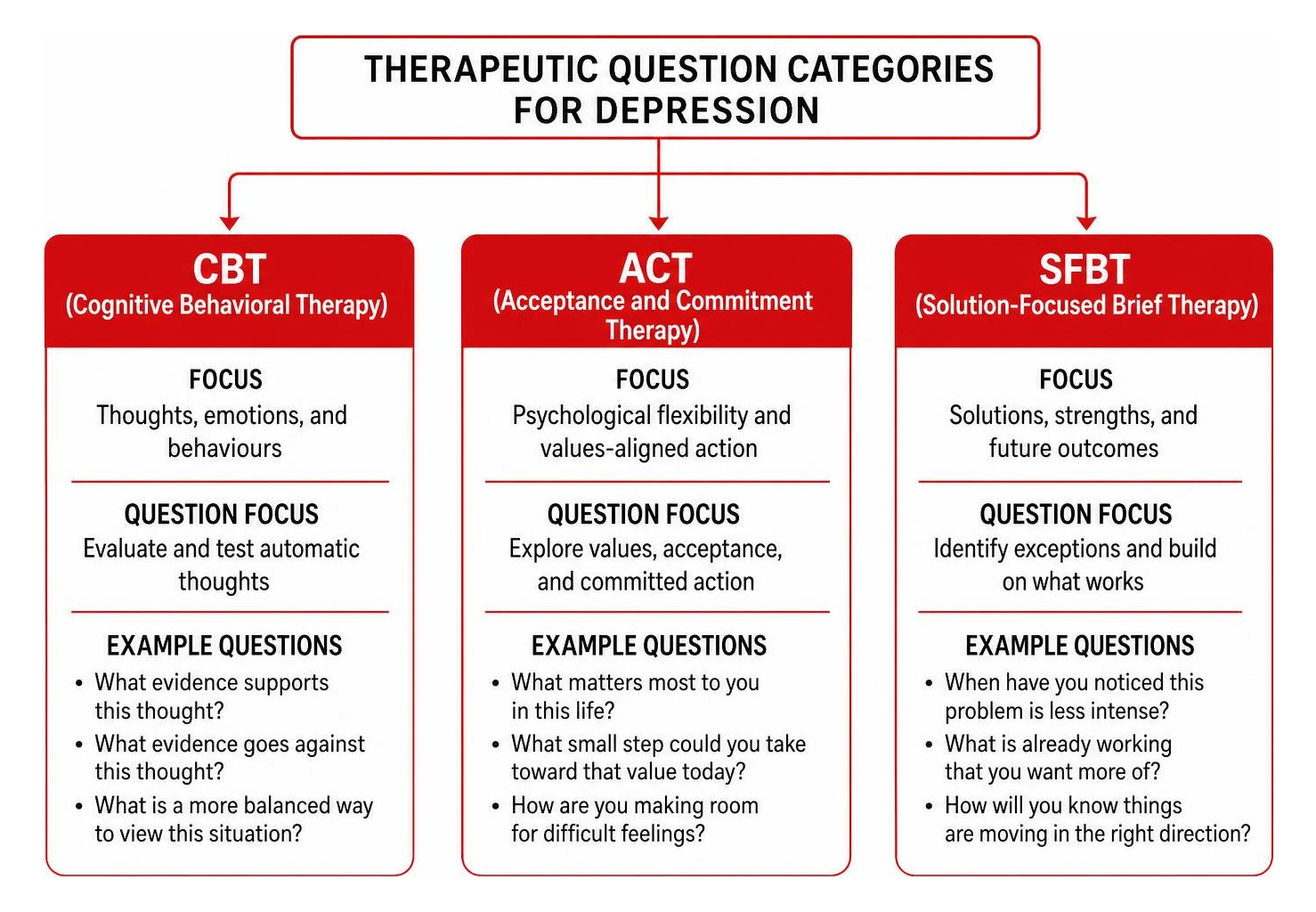
Different therapeutic modalities utilise distinct questioning frameworks to facilitate psychological flexibility, emotional processing, and behavioural activation.
Cognitive-Behavioural and Socratic Therapeutic Questions for Depression
Cognitive Behavioural Therapy (CBT) focuses on the relationship between thoughts, emotions, and behaviours. Therapists use the Antecedents, Behaviour, Consequences (ABC) model alongside Socratic questioning to evaluate automatic thoughts. Rather than arguing with you, the therapist asks questions that help you test the evidence for your beliefs.
In tailored individual therapy, CBT questions often include:
- Identifying the thought: “What was going through your mind right before you felt that drop in your mood?”
- Examining the evidence: “What factual evidence supports this thought, and what evidence contradicts it?”
- Decatastrophising: “If the worst-case scenario did happen, how would you cope with it?”
- Finding balance: “What would you tell a dear friend who was experiencing the exact same situation?”
By answering these questions, you learn to spot cognitive distortions like all-or-nothing thinking and catastrophising, replacing them with balanced perspectives.
Solution-Focused and Experiential Therapeutic Questions for Depression
Other evidence-based models, such as Solution-Focused Brief Therapy (SFBT) and Acceptance and Commitment Therapy (ACT), shift the focus toward personal strengths, future goals, and core values.
SFBT uses the well-known “miracle question” to help clients imagine life beyond their current challenges: “Suppose tonight, while you sleep, a miracle happens and this heavy fog lifts. When you wake up tomorrow, what is the very first small thing you would notice that tells you something is different?”
This prompt bypasses hopelessness and helps establish clear, achievable goals. SFBT also uses scaling questions: “On a scale of 0 to 10, where 0 is the lowest you have felt and 10 is your goal, where are you today? Why didn’t you pick a lower number?”
ACT and experiential therapies encourage acceptance of difficult feelings rather than constant struggle. As demonstrated in Clinical inquiry methods and depression worksheets, therapists may ask clients to externalise their emotional pain. A therapist might ask: “If this heavy feeling had a shape, colour, and weight, what would it look like?” or “What matters so much to you that you would be willing to make room for this discomfort to pursue it?”
Essential Questions Clients Should Ask Their Therapist
Therapy is a collaborative partnership. You have every right to evaluate whether a practitioner’s approach, communication style, and clinical background fit your needs during your initial sessions.
Evaluating Treatment Modalities and Tracking Clinical Progress
Ask your therapist how they track progress. Effective practitioners do not rely solely on guesswork; they evaluate improvements in your daily functioning, sleep quality, and engagement in life. They might use validated tools like the PHQ-9 questionnaire alongside subjective scaling and behavioural check-ins.
Understanding how your therapist approaches setbacks is equally important. Depression recovery is rarely linear. Knowing upfront that your therapist views setbacks as normal opportunities for learning helps remove shame when difficult weeks occur.
How to Prepare Mindfully for Therapy Sessions
You will get the most out of your sessions when you take a few quiet moments to prepare beforehand. You do not need an exhaustive presentation, but reflecting on your week helps prevent session recency bias (only talking about how you feel on that specific morning).
Helpful preparation habits include:
- Keep a brief between-session journal: Note moments where your mood shifted significantly or when you felt unexpected relief.
- Review homework or reflections: Take five minutes before logging into online therapy or entering the office to review what you discussed in the previous session.
- Identify avoidance: Ask yourself, “Is there an uncomfortable topic I felt tempted to skip today?”
- Clarify your immediate focus: Decide on one or two key themes you want to prioritise during your 50 minutes.
Ethical Considerations, Question Pacing, and Crisis Protocols
Therapists must navigate questioning with clinical care, ethical boundaries, and cultural humility. Pushing a client to recount deep trauma before establishing safety and emotional grounding can lead to distress. Ethical practice requires matching the depth of inquiry to the client’s current emotional stability.
Cultural sensitivity is especially vital when working with international communities. Mental health concepts, family expectations, and emotional expression differ widely across cultures. An ethical therapist avoids imposing assumptions and respects how a client’s cultural background shapes their understanding of low mood.
Therapy spaces uphold strict confidentiality, though legal and ethical limits apply when there is imminent risk of harm to yourself or others.
If you or someone you know is experiencing severe distress or thoughts of self-harm, please reach out for immediate professional support. In Spain, you can dial 112 for general emergencies or contact the national mental health crisis helpline at 024. In the UK, call 111 or 999. In the US, dial or text 988.
Frequently Asked Questions about Depression Therapy Questions
What is the miracle question and how does it help with depression?
The miracle question is a Solution-Focused Brief Therapy technique. It asks you to imagine waking up to find your depression magically resolved. By describing concrete changes in your environment and actions, you identify your core values, clarify your goals, and break down recovery into manageable micro-steps.
How do CBT and ACT questions differ when treating depression?
CBT questions primarily focus on cognitive restructuring—examining the accuracy of your automatic thoughts and finding balanced evidence. ACT questions focus on psychological acceptance and values—helping you drop the struggle against painful internal sensations while committing to meaningful, value-aligned life choices.
What should I do if answering therapy questions feels overwhelming?
Therapy moves at your pace. You can always tell your therapist that a question feels too intense or that you need to pause. A skilled practitioner will slow the session down, introduce grounding exercises, and adjust the pacing so you remain within your window of tolerance.
Conclusion
Therapeutic questioning is not an interrogation; it is an empowering, collaborative path toward self-discovery and lasting relief.
While public health systems, large online platforms, and local clinics provide various options, finding the right fit matters. Therapy in Barcelona is a trusted private practice established in 2011 by Leigh Matthews, an Australian Psychologist who has extensive experience supporting international clients. We provide psychology-trained, culturally sensitive multilingual care in English, German, French, Spanish, Afrikaans, Portuguese, Austrian-German, and Swiss-German.
Operating as a private-pay service (with some therapists offering sliding scale options for those with financial need), we offer careful, bespoke matching for adults, couples, teens, and families. Whether you prefer face-to-face sessions at our Barcelona office in Eixample or online therapy worldwide (including the USA and Canada), our expat-led team ensures strict privacy without data selling.
If you’d like support, book a Free Discovery Call today to find a therapist who understands your journey. What is one small, kind step you can take for yourself right now?
