


Understanding the Unseen Burden: What Does Loneliness Feel Like?

Many of us, particularly those living far from home in vibrant cities like Barcelona or Valencia, have asked ourselves: what does loneliness feel like? It is a complex human emotion, often described as a distressing experience that occurs when our social relationships feel less in quantity, and especially in quality, than desired.
Here is a quick look at what loneliness often feels like:
- A deep craving for connection: Much like hunger, it’s a profound need for social interaction that isn’t being met.
- Feeling misunderstood or invisible: You might feel disconnected from others, even when surrounded by them.
- A sense of emptiness or coldness: Loneliness can manifest as a void inside, sometimes accompanied by a physical chill.
- Persistent sadness or anxiety: These feelings can appear without a clear external reason, especially when you are by yourself.
- A lack of meaningful relationships: You might feel you have no one to confide in or spend quality time with.
Loneliness is a normal human signal, like hunger or thirst: it tells you your need for meaningful connection isn’t being met. For many internationals, it can feel sharper because moving countries adds culture shock, language friction, and the loss of familiar support. Imagine “Emily,” a fictional UK expat in Barcelona, who’s surrounded by people yet still feels disconnected. And because loneliness is subjective, it can look and feel different for everyone.
Understanding what loneliness feels like is the first step towards addressing it. This guide will explore the nuances of this emotion, helping you recognise its signs, understand its impact, and find pathways to feeling more connected and supported.
The Emotional and Physical Sensations: What Does Loneliness Feel Like?
The experience of loneliness is far from just a fleeting thought; it deeply permeates both our emotional state and our physical well-being. It is a signal, much like pain, that something fundamental is missing – a deep, meaningful social connection.

The Emotional Landscape of Loneliness
When someone asks what does loneliness feel like, the answers often paint a picture of profound emotional distress. It is frequently described as feeling invisible or misunderstood, even when surrounded by people. One individual articulated this as being “completely disconnected from others and the world. No one understands you or can understand you.” This can lead to a pervasive sense of emptiness, a “hole inside one’s chest that expands and implodes simultaneously,” as one blog post vividly described.
This emotional void can trigger deep sadness and a gnawing sense of worry. There is a desperate hunger for connection, a craving for attention that can manifest as constantly checking a phone for messages that never arrive. For many, this translates into feeling disconnected in a crowd, a sense of alienation even amidst a busy market in Sevilla or a vibrant festival in Valencia. It is the paradox of being surrounded by life yet feeling utterly alone within oneself.
This emotional isolation can be particularly challenging for expats, who may already be struggling with cultural adjustment and language barriers. The absence of a shared cultural context can intensify feelings of being misunderstood, making it harder to forge the deep connections that alleviate loneliness. Is isolation fueling your depression? What you need to know digs deeper into how this emotional state can intertwine with mental health.
How Loneliness Shows Up in the Body
The impact of loneliness extends beyond the mind, manifesting in tangible physical sensations. Perhaps one of the most striking is physical coldness. Research has shown that merely the idea or memory of social exclusion is enough to make a person’s body temperature drop, giving them a literal chill. This suggests a profound mind-body connection where emotional warmth is intertwined with physical sensation.
Chronic loneliness can also take a real toll on your body. It often keeps stress hormones elevated, leaving you stuck in a low-level fight-or-flight state that makes it harder to unwind. Over time, that can show up as sleep problems and persistent fatigue, even if you technically get enough hours. This ongoing strain may also weaken immune function and increase long-term inflammation, which is linked to a higher risk of certain health conditions. For some people, the burden lands as vague physical discomforts too, like headaches, muscle tension, or aches that don’t have an obvious cause.
This physiological response highlights that loneliness is not just a feeling; it is a biological state that impacts every system in the body. You can explore the fascinating connection between social exclusion and body temperature further in this scientific research on social exclusion and body temperature.
Alone vs. Lonely: Unpacking the Key Differences and Causes
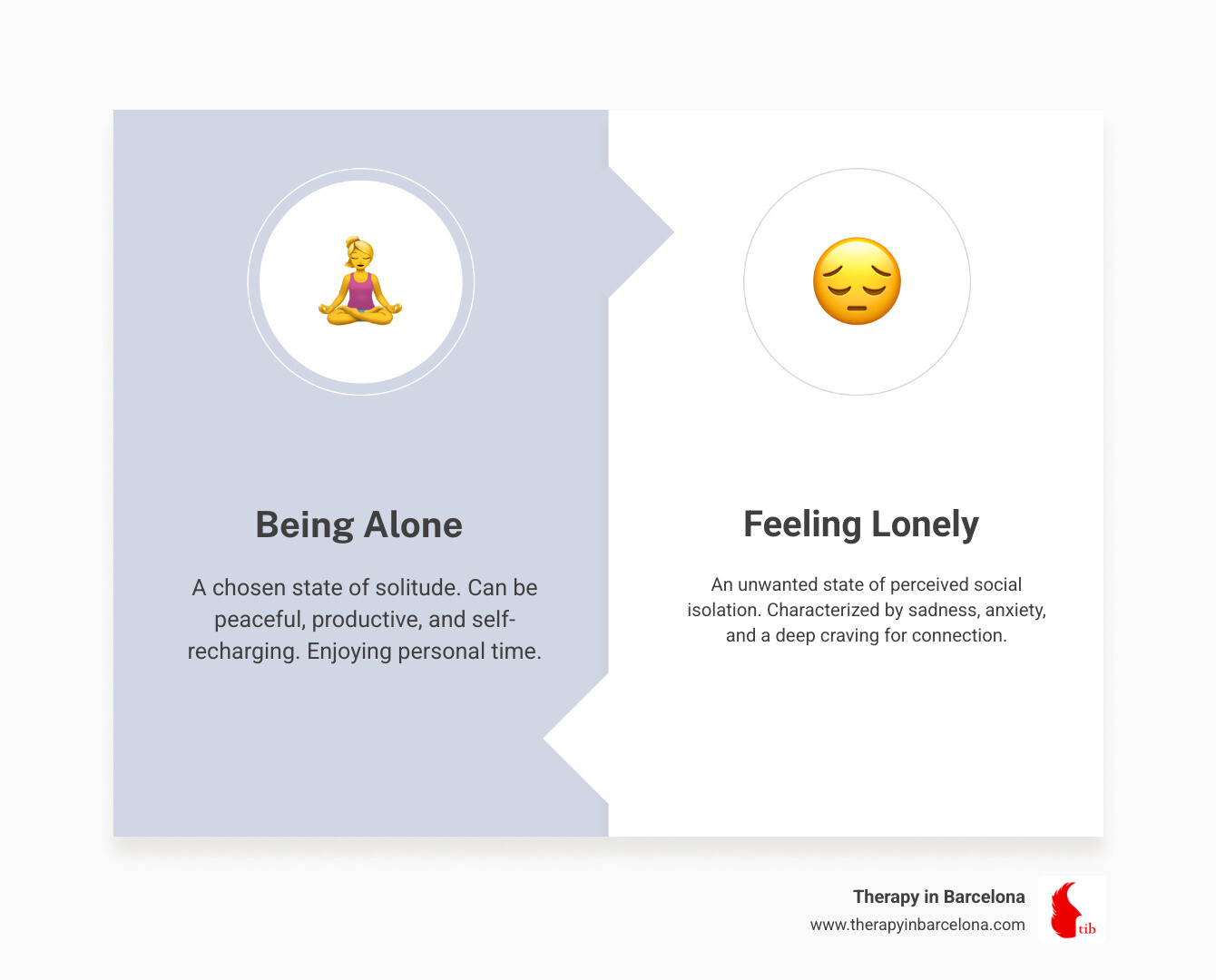
It is a common misconception that being alone automatically equates to feeling lonely. However, these two states are fundamentally different, and understanding this distinction is crucial to addressing feelings of isolation.
The Crucial Difference Between Solitude and Loneliness
Solitude is a choice; it is the intentional act of being by oneself, often for reflection, relaxation, or creative pursuits. Many people find peace and rejuvenation in solitude, enjoying their own company and using the time for personal growth. An individual can be alone without feeling lonely, experiencing contentment and even joy in their quiet moments. For instance, a digital nomad working from a quiet cafe in Gran Canaria might be physically alone but feel deeply connected to their work and online community.
Loneliness is a feeling: the painful gap between the connection you want and the connection you feel you have (especially in terms of quality). That’s why you can feel lonely in a crowded room or at a social event in Spain where language or cultural differences keep conversations surface-level. You can even feel lonely in a relationship if you feel unseen, misunderstood, or emotionally disconnected. If you want to spot other clues, 10 things you’re feeling lonely is a helpful list.
Common Triggers for Loneliness, Especially for Expats
Loneliness does not discriminate; it can affect anyone, regardless of age, gender, relationship status, or social standing. However, certain life events and circumstances act as significant triggers, and these are often amplified for expats.
Take Emily, a fictional composite example representing common expat challenges. As a 34-year-old from the UK who moved to Málaga for adventure, she found herself struggling with unexpected loneliness. Her story, while not real, mirrors the experiences of many internationals.
Common triggers for loneliness include:
- Moving to a new country: This is often the biggest trigger for expats. Uprooting your life to move to a new city like Alicante, Zaragoza, or Barcelona means leaving behind familiar routines, family, and the social network that used to “catch you” on hard days. Starting over socially while adapting to a new culture (and sometimes a new language) can be surprisingly exhausting and isolating.
- Major life transitions: Starting university, beginning a new job, retirement, or becoming a parent can all disrupt existing friendships and create new support needs that aren’t immediately met. A large BBC loneliness survey found younger people (including those aged 16 to 24) were among the most affected groups, highlighting how destabilising these transition years can be.
- Relationship breakups or bereavement: Losing a partner, close friend, or family member can create a sudden, painful gap. For expats, grief can hit harder when your usual comfort people are far away or in a different time zone.
- Lack of a support system: If you don’t yet have “your people” locally, everyday stressors can feel heavier. Work schedules, remote working, caring responsibilities, or social anxiety can also make it harder to form new connections.
- Cultural barriers and language challenges: Even in friendly places like Barcelona, cultural norms can affect how easy it feels to move from small talk to genuine friendship. If you’re not fully confident in Spanish (or Catalan), it can be harder to express humor, emotion, and nuance, which are often the building blocks of closeness.
- Financial constraints: Money pressure can reduce your ability to join social activities, travel to see loved ones, or even say “yes” to casual plans, shrinking your world over time.
- Discrimination or marginalisation: Experiencing racism, homophobia, transphobia, ableism, or other forms of exclusion can lead to self-protection through withdrawal, making loneliness both more likely and more intense.
These factors can combine to create a perfect storm for loneliness. I feel so lonely: Why is it so hard to make new friends abroad? explores these challenges in more detail.
The Deeper Impact: Loneliness and Your Overall Health
Loneliness is not merely an unpleasant feeling; it is a serious public health concern with significant implications for both mental and physical health. The U.S. Surgeon General has even referred to loneliness as an “epidemic,” underscoring its widespread and detrimental effects.
The Link Between Chronic Loneliness, Depression, and Anxiety
Chronic loneliness and mental health often reinforce each other. Feeling lonely can increase persistent sadness and anxiety, and those symptoms can make it harder to connect, creating a loop. Anxiety, for instance, can feel like an invisible barrier: you want closeness, but reaching out feels risky or exhausting. So you withdraw, get fewer meaningful interactions, and the loneliness deepens. This is also common at a population level: even before COVID-19, about half of U.S. adults reported measurable levels of loneliness.
It is important to distinguish between temporary and chronic loneliness. Temporary loneliness is a brief, situational experience, perhaps after a move or a breakup. Chronic loneliness, however, is a deep, long-lasting feeling of isolation that persists even in social settings. This persistent state is where the most significant health risks lie. Understanding this connection is vital for seeking appropriate support. Learn more about this intricate relationship in Loneliness and Depression: What’s the Connection?.
Long-Term Physical Health Risks of Loneliness
The physical toll of chronic loneliness is staggering. Research has found that the health risks of prolonged loneliness can be equivalent to smoking 15 cigarettes a day.
Here are some of the long-term physical health risks associated with chronic loneliness:
- Weakened immune system: The elevated stress hormones and fight-or-flight response associated with loneliness can suppress the immune system, making individuals more vulnerable to infections and diseases.
- Increased inflammation: The body’s inflammatory response can become dysregulated, leading to chronic inflammation, which is a known factor in many long-term health conditions.
- Higher risk of heart disease and stroke: Chronic loneliness can lead to elevated blood pressure and other cardiovascular issues, significantly increasing the risk of heart disease and stroke.
- Increased risk of dementia and Alzheimer’s: Research suggests a concerning link between chronic loneliness and an increased risk of developing neurodegenerative diseases like dementia and Alzheimer’s.
- Type 2 diabetes: Social isolation and loneliness have been linked to an increased risk of developing type 2 diabetes.
The cumulative effect of these physical health problems can significantly impact mortality rates. The Health Effects of Social Isolation and Loneliness from the CDC provides further information on these critical health impacts.
These severe consequences underscore why addressing loneliness is not just about emotional comfort but about safeguarding overall health. The Health Effects of Social Isolation and Loneliness from the CDC provides further information on these critical health impacts.
Practical Steps to Reconnect and Build Community
While the depths of loneliness can feel overwhelming, there are practical, actionable steps one can take to manage these feelings and foster a greater sense of connection. The journey often begins with small, intentional actions and a dose of self-compassion.
How to Cope When You Feel Lonely
- Acknowledge your feelings: The first step is to recognise and validate your experience. It is okay to feel lonely; it is a normal human emotion. Understanding what does loneliness feel like for you personally is powerful. As one insight suggests, “If you feel lonely, you are, in fact, lonely.”
- Start small: You do not need to overhaul your entire social life overnight. Begin with small, manageable interactions. Smile at a neighbour in your building in Barcelona, strike up a conversation with the barista in your local café in Málaga, or reach out to an old friend via message.
- Join a club or class: Engaging in activities based on shared interests can be a natural way to meet like-minded people. Whether it is a language exchange group in Valencia, a hiking club in Gran Canaria, a cooking class in Sevilla, or a book club, these settings provide a low-pressure environment for connection. For expats, this is particularly valuable for building new networks.
- Volunteer: Contributing to a cause you care about not only provides a sense of purpose but also offers opportunities to connect with others. Many organisations, including local charities, welcome volunteers.
- Focus on quality interactions: It is not about the number of friends you have, but the depth of your connections. Prioritise interactions where you feel seen, heard, and understood. Even a short, meaningful conversation can be more impactful than a large, superficial gathering. Research shows that putting feelings into words and sharing them with a friend can bring emotional relief.
- Practise self-compassion: Be kind to yourself. When you are feeling lonely, it is easy to fall into a trap of self-criticism. Instead, treat yourself with the same empathy you would offer a friend.
- Engage in physical activity: Exercise is a powerful antidote to many negative emotions. It boosts mood, reduces stress, and can even be a social activity. Joining a gym, a dance class, or simply going for a jog in a park in Alicante can make a difference. Harvard Health Publishing notes that exercise is an all-natural treatment to fight depression.
- Practise mindfulness: Mindfulness can help you stay present and observe your feelings without judgment. Meditation or simply focusing on your breath can provide a sense of calm and self-awareness, helping you manage the emotional discomfort of loneliness.
For more strategies on building connections, refer to Coping with isolation: Strategies for a connected life.
How to Support a Friend Experiencing Loneliness
If you notice a friend or family member struggling, your support can make a significant difference.
- Listen without judgment: Create a safe space for them to share their feelings. Avoid dismissing their loneliness or offering quick fixes. Sometimes, just being heard is immensely powerful.
- Be present and patient: Loneliness can make people withdraw. Continue to reach out, even if they decline invitations initially. Your persistence shows you care.
- Extend invitations: Ask them to join you for activities you enjoy, whether it is a quiet coffee, a walk in a park, or a local event in Marbella. Make it clear that their company is valued.
- Avoid giving unsolicited advice: While well-intentioned, telling someone “just go out more” can feel invalidating. Instead, ask what might help them feel more connected.
- Gently suggest professional support: If their loneliness seems chronic or is significantly impacting their well-being, suggest talking to a therapist or counsellor. Frame it as a way to gain tools and strategies, not as a sign of failure.
For internationals, building a strong community is vital. Creating a sense of belonging as an international: Tips for building community abroad offers valuable guidance.
Finding the Right Support for Loneliness as an Expat
Working through loneliness, especially as an expat, can feel like a difficult journey. The unique challenges of living abroad—cultural adjustment, language barriers, and the absence of a familiar support system—often intensify these feelings. Thankfully, there are various avenues for support, and choosing the right one can make all the difference.
What Are Your Support Options in Spain?
Public Health System In Spain, some mental health support is available through the public health system. However, for internationals, this option can come with challenges. Waiting times for appointments can be long, and language barriers can often hinder effective communication, especially when discussing nuanced emotional experiences. Accessing culturally sensitive care that understands the expat experience may also be limited.
Large Online Platforms Numerous global online therapy platforms connect individuals with therapists worldwide. While convenient, these platforms may not always offer therapists with local knowledge or specific experience in supporting expats in Spain. The therapeutic relationship might lack the depth that comes from a shared understanding of the challenges of living in a foreign country, and their privacy policies may not be as strict.
Local Private Practices Therapy in Barcelona is a group practice of psychology-trained therapists, offering personalised matching and culturally sensitive care for internationals. Our team comprises expat professionals who profoundly understand the unique struggles of living abroad because we have lived them ourselves. We offer our services both online with clients worldwide and through in-person sessions at our welcoming office in Barcelona.
Why Choose a Culturally-Sensitive, Expat-Focused Approach?
Choosing a therapy service that understands the expat journey offers distinct advantages, particularly when struggling with feelings of loneliness:
- Bespoke Therapist Matching: At Therapy in Barcelona, we believe therapy is not one-size-fits-all. We pride ourselves on our careful, personalised matching process, ensuring you are paired with a therapist whose specialisations, approach, and personality best fit your unique needs. This commitment to finding the right fit significantly improves the probability of positive therapeutic outcomes.
- Therapists Who Are Also Expats: Our team members are psychology-trained therapists who have experienced life abroad. This shared experience means they bring a deep, empathetic understanding of cultural adjustment, identity shifts, and the complexities of building a life away from home. They know what does loneliness feel like when you are far from familiar faces.
- Understanding Cultural Nuances: Our culturally informed care acknowledges the complexities of expat life in vibrant cities like Barcelona, Madrid, or Valencia, where cultural shock, relocation stress, and homesickness can intensify challenges. This sensitivity ensures that your experiences are understood within their unique context.
- High-Quality, Confidential Care: As a trusted practice in Spain since 2011, Therapy in Barcelona is committed to professional excellence and strict privacy. You can trust that your journey towards healing and growth is supported by qualified professionals who uphold the highest standards of care.
- A Holistic Approach: We offer a diverse range of therapeutic modalities, including Cognitive Behavioural Therapy (CBT), Acceptance and Commitment Therapy (ACT), and many others, custom to your individual journey. This ensures that you receive comprehensive support that addresses your unique needs.
If you’re feeling lonely and looking for support from professionals who understand your unique circumstances, explore our therapy services to see how we can help you feel more connected and supported.
Frequently Asked Questions about Feeling Lonely
It is natural to have questions about loneliness, especially given its complex and often misunderstood nature. Here, we address some common queries to shed more light on this universal human experience.
Can you feel lonely even if you’re in a relationship or have friends?
Yes. Loneliness is about how connected you feel, not how many people are around you. You can have a partner, friends, or a busy social life and still feel lonely if you feel unseen, misunderstood, or emotionally disconnected. That “alone in a crowd” feeling usually points to a lack of meaningful, safe connection.
Is loneliness a sign of weakness?
No, not at all. Loneliness is a normal human signal, much like hunger or thirst. It is your brain and body telling you that a fundamental need for meaningful social connection is unmet. It is a common experience, affecting people from all walks of life, regardless of their personality, strength, or achievements. Viewing loneliness as a sign of weakness only adds to the stigma and makes it harder for individuals to reach out for support. Recognising and acknowledging loneliness is, in fact, a sign of self-awareness and strength.
Are certain age groups more prone to loneliness?
While anyone can feel lonely, some groups are more vulnerable during big life changes. Young adults (around 16 to mid-20s) often feel it when leaving home, starting university, or beginning a new job and identity. Older adults may struggle after bereavement, retirement, illness, or living alone, which can shrink day-to-day social contact. Expats of any age can be especially at risk because relocation disrupts routines and support networks, and language or cultural gaps can make it harder to form close, meaningful connections.
You Don’t Have to Face Loneliness Alone
Feeling lonely is a painful but universal part of the human experience, especially when adapting to a new life abroad. It’s a sign that you need connection, not that something is wrong with you. Reaching out is a sign of strength. If you’re an international in Spain or beyond and these feelings resonate, you don’t have to face them by yourself. Our team understands the expat journey because we’ve lived it too. If you’d like support, book a Free Discovery Call to start your path toward connection; Therapy in Barcelona.
