


Therapeutic Questions for Couples That Lead to Better Conversations

Therapeutic questions for couples are open, practical prompts that help partners move away from proving who is right and towards understanding what is happening between them.
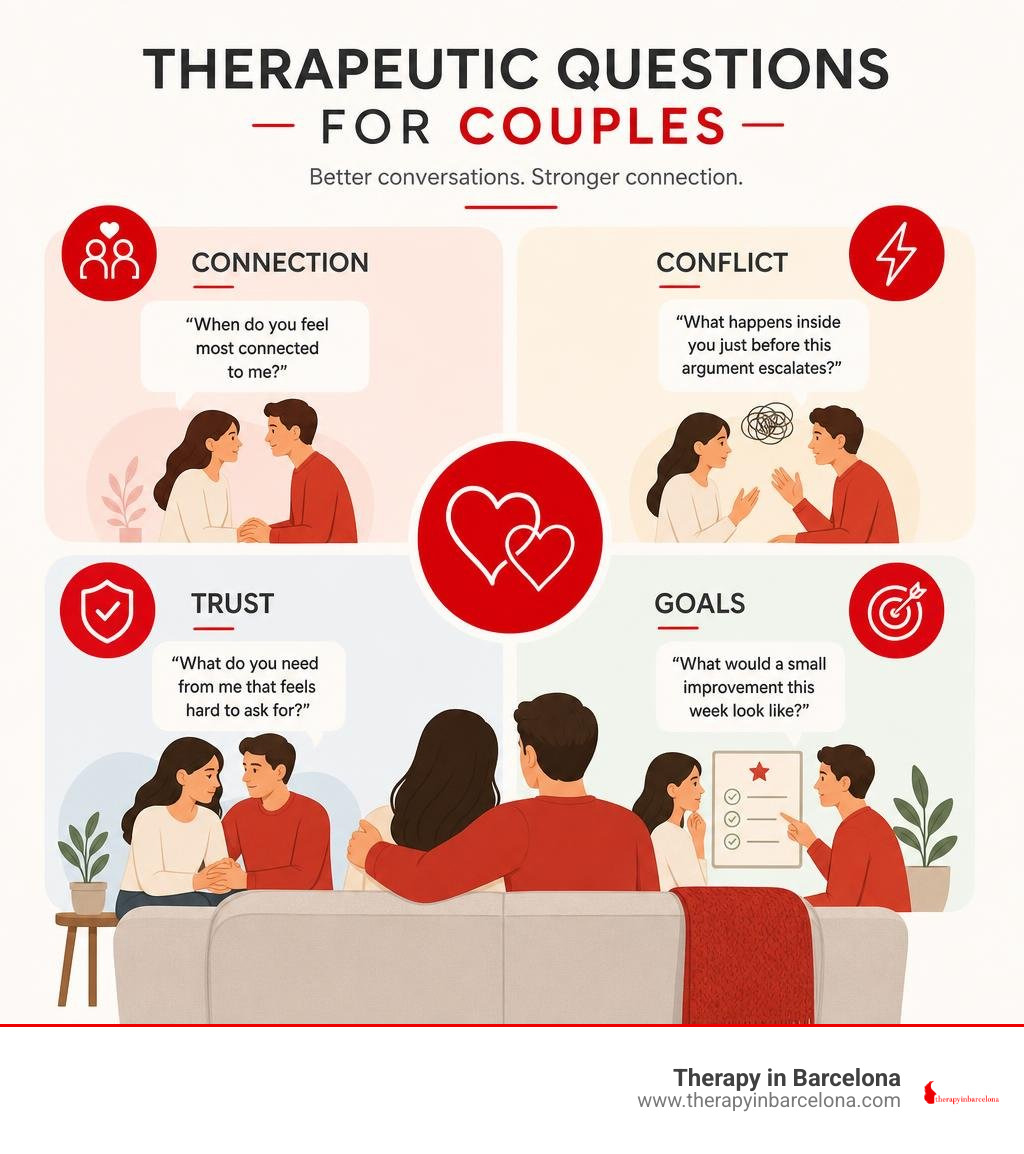
- “What happens inside you just before this argument escalates?”
- “What do you need from me that feels hard to ask for?”
- “When do you feel most connected to me?”
- “What would a small improvement this week look like?”
- “How can we treat this problem as something we face together?”
These questions matter because most recurring arguments are not really about the dishes, a late message, or a family plan. They often reveal a deeper worry about being heard, valued, supported, or accepted. Research from the Gottman Institute suggests that the way couples handle conflict matters more for relationship stability than whether they disagree at all.
For couples living abroad, everyday pressure can add another layer. Different languages, family expectations, work demands, homesickness, and unequal adjustment to life in Barcelona can turn small misunderstandings into familiar, draining patterns. The 25 questions in this guide are designed to help you slow those patterns down, communicate with more care, and identify practical next steps.
These prompts are not a substitute for support where there is fear, control, threats, or violence in a relationship. If you are in immediate danger in Spain, call 112; for confidential support related to gender-based violence, contact 016. If you’d like support, book a Free Discovery Call.
Before the Couch: Self-Assessment and Vetting Questions
Deciding to start couples counselling is a major step. Taking time to reflect before your first appointment ensures that both partners enter the room with realistic expectations and clear intentions.
Essential therapeutic questions for couples to ask before booking therapy
Before booking an appointment, sit down during a calm moment and explore these foundational reflection prompts:
“What is the primary problem we are trying to solve, and how am I contributing to it?”
It is easy to arrive at therapy with a long list of grievances about your partner. However, research into interactional dynamics shows that roughly half the change in a relationship loop happens when one partner shifts their own steps in the cycle. Asking what you bring to the dynamic fosters personal accountability from day one.“Are we seeking couples therapy to rebuild our relationship, or are individual concerns getting masked as relationship issues?”
Sometimes relational distress stems from unaddressed individual challenges, such as feeling anxious, burnout, persistent low mood, or past personal trauma. Understanding whether you need couples work, individual therapy, or a combination helps you avoid spending months in the wrong setting. You can explore Evaluating readiness for individual vs couples therapy to understand which path suits your current situation.“What does a successful outcome in therapy look like for each of us?”
One partner might define success as arguing less, while the other defines it as deeper physical intimacy or clearer financial boundaries. Uncovering these expectations early aligns your goals before session one. Reviewing essential couples counseling questions can provide further inspiration on how to frame these discussions.“Are both of us genuinely open to making changes, even if those changes feel uncomfortable at first?”
Therapy requires a willingness to drop defensive habits and try new communication habits. Asking this question openly highlights whether both partners are ready to engage in the work collaboratively.
Questions to ask your couples therapist to ensure a good fit
Finding the right clinician is critical for effective relational care. Whether you are seeking therapy in Barcelona, looking for couples therapy in Madrid, or considering couples therapy in Valencia, asking targeted vetting questions helps establish confidence in your provider:
- “What therapeutic modalities do you integrate in your practice (e.g., Emotionally Focused Therapy, Gottman Method, CBT, or Systemic Therapy)?”
- “How do you work with expat, international, or cross-cultural dynamics?”
- “What is your policy on confidentiality and individual communications outside joint sessions?”
When evaluating options, partners often look at public health system providers (such as CatSalut in Catalonia), large international directory platforms, or local private practices. While public healthcare offers vital medical infrastructure, specialised mental health support for international couples can be limited by long waitlists and language constraints. Large directory platforms offer volume, but often lack personalised practitioner vetting.
A dedicated private practice prioritises bespoke therapist matching, strict privacy without data commercialisation, and culturally sensitive care delivered by psychology-trained professionals who understand international living firsthand. Read our complete guide on choosing a couples therapist in Spain for more tips on finding an ideal match.
Intake and Safety: What Therapists Ask in Early Sessions
The initial phase of couples therapy establishes clarity, builds safety, and sets a baseline for your therapeutic journey.
First session therapeutic questions for couples
During the intake session, a clinician focuses on gathering background context, exploring relationship history, and understanding your primary distress. Therapists often draw from established intake frameworks, such as these 25 common intake questions:
“How did you two first meet, and what initially drew you to one another?”
Revisiting early memories activates positive attachment responses and reminds partners of the foundation beneath their current conflict.“What specific patterns or events brought you to seek therapy at this precise moment?”
This prompt helps identify recent triggers versus long-standing historical ruptures.“How did conflict and emotional expression look in your family of origin while growing up?”
Our childhood environments shape our adult conflict responses. One partner may have learned to withdraw during arguments, while the other learned to raise their voice to be heard.“When you attempt to reconnect after a disagreement, what typically happens?”
Examining repair attempts highlights where communication breakdowns occur and where emotional safety needs reinforcement.
Assessing safety, attachment, and deep interactional loops
Beyond gathering history, a therapist assesses emotional safety and relational cycles. Clinical standards require screening for Intimate Partner Violence (IPV) and coercion during separate individual intake assessments. If physical safety is compromised or ongoing abuse is present, joint couples therapy is contraindicated, and clinical priority shifts to individual safety planning and crisis management.
When emotional safety is established, clinicians map interactional cycles—such as the classic pursue-withdraw or criticise-defend loops. These reactive cycles are often driven by unspoken attachment fears.
For example, when one partner criticises, their body is often asking, “Are you there for me?” When the other partner shuts down or walks away, their body is often asking, “Am I good enough for you?” Identifying this cycle shifts the perspective from “you are the problem” to “the cycle is our shared challenge.”
Communication, Conflict Resolution, and Intimacy: 25 Essential Therapeutic Questions for Couples
At the heart of couples therapy are targeted prompts that break reactive habits and build emotional closeness.
Questions that shift blame to collaboration and de-escalate conflict
When arguments escalate, secondary reactions like anger or sarcasm often hide softer, primary emotions like fear, sadness, or loneliness. Using principles from Nonviolent Communication (NVC) and Emotionally Focused Therapy (EFT), these therapeutic questions for couples reduce defensiveness:
“What just happened inside your body right before you reacted?”
This prompt moves focus away from external blame and towards internal nervous system responses, such as chest tightness or a racing heart.“If your partner could not fail or reject you right now, what would you want them to know about your feelings?”
Removing the fear of failure allows partners to share underlying vulnerabilities safely.“What is one concrete thing I can do right now to help you feel supported in this conversation?”
This transforms abstract frustration into an actionable, positive request.“Can we pause for fifteen minutes to cool down, and agree to return to this topic at 7:00 PM?”
Taking structured, timed breaks prevents emotional flooding while assuring both partners that the issue will not be swept under the rug.“How can we reframe this issue so it becomes ‘us versus the problem’ instead of ‘you versus me’?”
This question aligns partners as a team tackling a shared objective.
For further practical strategies on transforming your daily dialogue, consult our detailed guide to couples communication therapy.
Navigating values, finances, and intimacy in therapy
Long-term stability requires alignment across core life domains, including values, financial management, and physical intimacy.
“What does financial security mean to you personally, and how does that shape your view on spending and saving?”
Money disputes are rarely about numbers alone; they often reflect deeper values regarding safety, freedom, or family upbringing.“How do our cultural beliefs and family traditions influence the way we make decisions together?”
This is especially vital for cross-cultural partners balancing different customs and familial expectations.“What does intimacy mean to you right now, and what helps you feel emotionally safe enough to be physically close?”
Intimacy encompasses emotional, intellectual, and physical connection. Exploring these dimensions openly fosters mutual understanding.“How can we create dedicated screen-free time each week to focus entirely on each other?”
Establishing clear boundaries around daily distractions protects your connection.
Couples looking to deepen their physical and emotional bond can explore couples intimacy therapy options or try structured exercises like the interactive Therapist Aid relationship exploration activity.
At-Home Connection, Goal-Setting, and Measuring Progress
Therapy provides tools, but real relational growth happens through consistent practice at home.
Questions couples can use at home to rebuild trust
Rebuilding trust after small ruptures or major betrayals requires daily micro-commitments and structured check-ins:
“What are three specific things you did today that I felt grateful for?”
Expressing daily appreciation strengthens positive sentiment and helps counter habitual criticism.“Is there an unspoken worry or need you have been carrying this week that we haven’t discussed yet?”
Regular check-ins prevent small concerns from compounding into major resentment.“What is one small way I can make your day easier tomorrow?”
Simple acts of service demonstrate reliable care and consideration.“What connection ritual (such as a 20-second morning hug or evening walk) can we practice consistently this week?”
Consistent daily connection rituals regulate the nervous system and build emotional safety.
Discover additional practical tools in our guide on exercises to build trust.
Goal-setting, measuring progress, and solution-focused interventions
Tracking progress keeps therapy structured and outcome-focused. Solution-Focused Brief Therapy (SFBT) utilizes specific questioning techniques to clarify future goals, such as those detailed in this SFBT Questions Guide:
“Suppose a miracle happens tonight while we sleep, and our primary relationship challenge is resolved. When we wake up tomorrow, what is the very first small detail that tells us things are different?”
Known as the Miracle Question, this prompt helps partners visualise practical, positive behavioural changes rather than dwelling on past grievances. You can learn more in this Miracle Question worksheet guide.“On a scale of 0 to 10, where 0 is total distance and 10 is complete connection, where are we today, and what would move us up by half a point?”
Scaling questions make abstract emotions measurable and help identify manageable action steps.“What positive changes have we noticed in our interaction dynamic since our last session?”
Focusing on small wins reinforces effective communication habits.“What specific agreement or homework commitment are we making to each other before our next appointment?”
Clear commitments ensure accountability between sessions.
Navigating Intercultural and Expat Relationship Dynamics
Living as an expatriate or navigating an intercultural relationship presents distinct opportunities and stressors.

Navigating cross-cultural communication and relocation stress
Consider Elena and Marc (fictional composite example representing common expat challenges, not a real client). Elena moved to Spain from Germany to join Marc, a Spanish national. While Marc returned to his familiar professional network and extended family in Barcelona, Elena faced career adjustments, language barriers, and homesickness.
Over time, Elena felt isolated and misunderstood, while Marc felt overwhelmed by Elena’s reliance on him for emotional support. In couples therapy, they learned to address these relocation pressures directly:
- Addressing unequally shared adjustment: One partner often adapts faster to a new country than the other. Openly discussing these differences prevents feelings of resentment or guilt.
- Managing family expectations: Intercultural couples frequently navigate contrasting views on in-law involvement, holiday traditions, and child-rearing styles.
- Bridging language and communication nuances: Communicating in a second or third language can lead to misunderstandings during emotional discussions.
Whether living in Catalonia, seeking Couples Counseling Marbella, or settling anywhere across Spain, international partners benefit from support tailored to cross-cultural life. For comprehensive insights, read our full expat and intercultural couples therapy guide.
Frequently Asked Questions about Couples Therapy
How long does it usually take for couples therapy to show results?
Research in Emotionally Focused Therapy (EFT) shows that most couples notice a positive shift in their conflict cycle within 4 to 8 sessions (however, it varies). Achieving deeper emotional repair and establishing lasting long-term communication habits typically takes between six months to two years of consistent work.
What should we do if one partner is hesitant to start couples therapy?
Reluctance is common. It often stems from a fear of being blamed or gang-pressed by the therapist. Research shows that when one partner shifts their own steps in the interactional loop—often through individual therapy—roughly half the dynamic changes. This positive shift frequently encourages the hesitant partner to join sessions later.
Is couples therapy effective for intercultural or expat couples?
Yes. Therapy designed for internationals explicitly addresses cross-cultural communication styles, relocation stress, and language barriers. Working with a culturally sensitive clinician ensures these unique contextual factors are understood and supported.
Conclusion
Using therapeutic questions for couples offers a structured, non-judgemental way to slow down reactive arguments, express unspoken emotional needs, and rebuild genuine trust. Whether you are addressing daily communication habits or navigating the unique adjustments of international life in Spain, asking better questions opens the door to deeper connection.
Therapy in Barcelona was founded in 2011 by Leigh Matthews, an Australian Psychologist and expat who experienced the unique challenges of building a life and relationship abroad. From over 20 years of psychological expertise – and 14 years dedicated to international clients – Leigh created a trusted group practice in Spain to provide compassionate, high-quality mental health support for the international community.
Today, Therapy in Barcelona is an established team offering psychology-trained, multilingual care in English, German, French, Spanish, Afrikaans, Portuguese, Austrian-German, and Swiss-German. The practice offers face-to-face therapy sessions at their central office in Barcelona as well as online therapy for clients worldwide.
Through careful personalised matching, Therapy in Barcelona provides tailored support for adults, couples, teens, and families. Explore our specialised couples counselling options to learn how we can support your relationship journey.
What is one small question you can ask your partner tonight to foster curiosity and care? If you’d like support, book a Free Discovery Call.
