


The Unique Mental Health Landscape for Americans in Spain

Therapy for Americans Living In Spain can feel complex. You moved for adventure, work, or love, but life abroad often includes unexpected loneliness, bureaucratic frustration, and a sense of not quite belonging. The good news is that you have options, and finding the right support doesn’t have to be complicated.
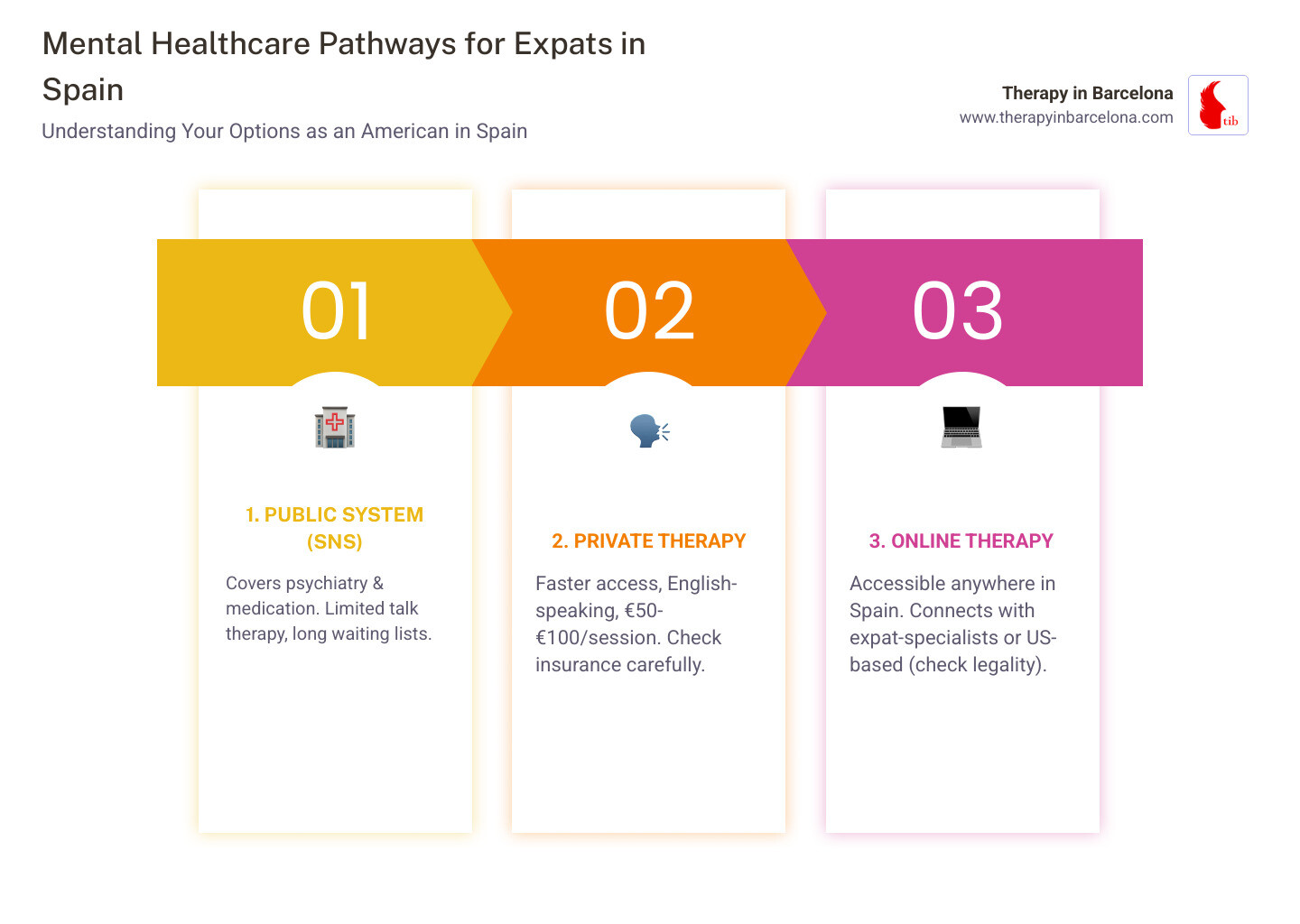
Here’s what you need to know:
- Public healthcare (SNS) covers psychiatry and medication, but talk therapy access is limited and waiting lists can be long.
- Private therapy is usually the fastest route, with more choice and English-speaking options, often costing around €50–€100 per session.
- Online therapy can be a practical option anywhere in Spain, and may also let you continue with a US-based therapist (depending on licensing and legal factors).
- Key resources include professional directories and local expat communities for recommendations and referrals.
Living in Spain as an American can be exciting and still emotionally demanding. For example, research shared by Aetna International reports that 61% of expats felt their mental health had worsened since moving abroad and offers practical guidance on mental wellbeing. Feeling unsettled, lonely, or more anxious in your first months (or even years) abroad isn’t a personal failing. It’s a common, human response to a big life change: new language, new norms, and a support system that suddenly feels far away.
The Spanish mental healthcare landscape differs significantly from the US. Spain allocates a small portion of its GDP to mental healthcare, well below the European average and has a low ratio of psychiatrists per capita . This means the public system, while available, often falls short for expats seeking regular talk therapy. Meanwhile, cultural attitudes towards mental health in Spain are evolving, especially in urban hubs like Barcelona, Madrid, and Valencia, but traditional stigma still exists.
This guide walks you through your options—from understanding the public versus private systems to finding an English-speaking therapist who gets the expat experience. Whether you’re in Barcelona, settling into life in Málaga, or adjusting to a smaller Spanish town, the right support exists.
Moving to Spain is often pictured as an idyllic dream, but the reality for many Americans is also a complex emotional journey. This journey can include what some call “Expat Syndrome”—a cluster of emotional and psychological struggles arising from cultural dislocation. It’s a natural response to being uprooted.
Imagine Sarah, a 30-year-old American who moved to Madrid for work. She expected quick friendships and an easy rhythm of life. Instead, paperwork, language slip-ups, and subtle cultural differences left her feeling isolated and constantly on edge. Over time, her confidence dipped and everyday tasks started to feel overwhelming. Sarah is a fictional composite, reflecting what many internationals experience in Spain. Individual therapy can help you make sense of the stress, rebuild stability, and feel more like yourself again.

Common Challenges for American Expats
Life abroad, while exciting, often brings a unique set of mental health challenges that can impact daily life and well-being.
- Isolation: Even in social, busy places, it is surprisingly easy to feel alone when your closest friends, family, and familiar routines are an ocean away. The early “honeymoon phase” of moving abroad can fade, and what’s left is the quiet reality of rebuilding your support system from scratch.
- Heightened Stress and Worry: Many American expats notice a higher baseline of stress than back home. It can show up as persistent worry about paperwork, finances, work stability, language confidence, or the mental load of doing everyday tasks in a new system.
- Feeling Down or Trapped: Homesickness isn’t just missing people; it can include grief, guilt, and the feeling that you “should” be enjoying this move more than you are. When the adjustment period drags on, sadness and hopelessness can start to feel sticky.
- Identity Shifts: Living in a different culture can shake up your sense of self. You may question who you are without your usual roles, social status, or cultural cues, which can be disorienting even when life is going “well.”
- Career Pressure: Different workplace norms, communication styles, and expectations can add stress fast, especially if your residency or financial security is tied to your job.
- Relationship Strain: Distance can stretch close relationships back home, while building new friendships takes time and emotional energy. Couples may also feel the strain when both partners are adapting at different speeds.
Navigating Cultural Differences and Stigma
American expats in Spain also encounter distinct cultural attitudes towards mental health. Traditionally, Spanish society has approached psychological struggles with a degree of stigma, viewing them as private family matters rather than medical conditions. This can be a difficult adjustment for Americans accustomed to a more open dialogue.
However, attitudes are changing, especially in cosmopolitan cities like Barcelona, Madrid, and Valencia. There’s a growing acceptance of mental health care, particularly among younger generations. The Mediterranean lifestyle itself, with its emphasis on social connection and balance, can also be a protective factor, encouraging self-care strategies.
Despite this shift, some machismo attitudes can still contribute to stigma, particularly for men seeking support. Understanding these cultural nuances can help you choose a therapist who is culturally sensitive. For couples, these differences can create friction, making couples counselling a valuable resource for managing intercultural dynamics.
Navigating Spain’s Healthcare System: Public vs. Private Options
When you move to Spain, understanding the healthcare system is essential, especially for Americans accustomed to a different model. For Therapy for Americans Living In Spain, there are two main pathways: the public system and the private system. Knowing how both work is key to finding the help you need.
The Public System (Sistema Nacional de Salud – SNS)
Spain’s public healthcare system, the Sistema Nacional de Salud, provides broad care to residents. However, when it comes to mental health support, it comes with some specific limitations.
To access it, you must be a legal resident, be registered on your local padrón (town hall census), and have a public health card (tarjeta sanitaria). Your first step is always your assigned General Practitioner, or GP (médico de cabecera). They can then refer you to a specialist within the public system.
The public system generally covers psychiatrist appointments and prescribed medication, with subsidised costs. The main challenge is access to talk therapy. Public psychologists are very limited, usually reserved for severe cases, and you may face long waiting lists. Individual talk therapy is not always available; you might be offered group therapy or a referral to a social worker instead.
Spain’s public mental healthcare system is widely considered stretched thin, with limited funding compared to many other European countries. On top of that, there are relatively few psychiatrists available per person. In practice, this often means waiting several weeks or even months for an appointment, especially for non-urgent cases. If you’re looking for regular, ongoing psychotherapy (talk therapy), the public route can be hard to rely on. And if you specifically need support in English, availability in the public system may be even more limited.
The Private System: Faster, More Bespoke Care
Many Americans and other internationals in Spain find their solution in the private healthcare system. It offers a more direct route to timely help with English-speaking professionals.
You can book directly with a private therapist or psychiatrist without a GP referral, which means less bureaucracy and faster access. This is often the preferred choice for expats seeking immediate, culturally sensitive support in cities like Barcelona, Madrid, or Valencia.
Coverage and costs come down to your private health insurance plan, so read the fine print. Many international policies cap mental health benefits (often 5-10 sessions a year) or exclude therapy unless you upgrade. Common expat insurers include Cigna, Allianz, and Sanitas. For a clearer overview, see this guide to private health insurance for expats.
Private care is usually the fastest route: you can choose your therapist, book sessions that fit your schedule, and avoid long public waitlists. Expect €50–€100 per therapy session and roughly €80–€150 for a private psychiatrist consult. It costs more, but you’re paying for quicker access and a better fit, especially if you want support in English and someone who understands the expat experience.
Finding the Right Support: Therapy for Americans Living In Spain
Finding the right mental health professional is a personal journey. For Americans in Spain, it often means looking for someone who speaks your language, understands your cultural background, and is familiar with the challenges of expat life.

How to Find an English-Speaking Therapist in Spain
As international communities grow across Spain, finding English-speaking support is becoming easier. Whether you’re in Madrid, Málaga, or Valencia, options are available. Here’s how to start your search:
Start with online directories like Psychology Today or the International Therapist Directory. Both let you filter by location, language, and specialty, which is a huge time-saver when you are searching from abroad. You can also look at professional associations in Spain that list licensed practitioners (and help you sense-check credentials). For very current, city-specific leads, try expat Facebook groups in places like Malaga or Alicante, where people often share recent recommendations. And do not underestimate word-of-mouth referrals from colleagues, friends, or international communities you trust.
At Therapy in Barcelona, we understand that the right fit is paramount. Our team of qualified, English-speaking therapists comes from diverse cultural backgrounds, and many have their own expat experiences. We take the time to make the best match between therapist and client, aiming for positive outcomes from the start. We find someone who truly gets you.
The Value of an Expat-Specialist Therapist for Americans Living In Spain
Choosing a therapist who specialises in expat issues offers a distinct advantage. It goes beyond speaking the same language to a deeper level of understanding.
An expat-specialist therapist understands the nuances of cultural adjustment, identity shifts, and the unique stressors of living in a new country. This cultural understanding means less time explaining your world and more time focusing on solutions. Many expat therapists are expats themselves. Leigh Matthews, the founder of Therapy in Barcelona, is an Australian psychologist who moved to Barcelona in 2011. Her personal journey of adapting to a new culture motivated her to create a service she wished had existed for her. This lived experience fosters a deeper level of empathy.
An expat-specialist therapist can make therapy feel immediately safer and more useful because they treat culture shock, homesickness, and “who am I here?” questions as normal (not dramatic). They’re used to working with identity, belonging, and rebuilding routine and relationships in a new country. Just as important, that shared context often strengthens the therapeutic alliance, so you spend less time explaining and more time making progress.
Online Therapy (Teletherapy): A Lifeline for Americans Living In Spain
Online therapy provides invaluable access to mental health support for Americans in Spain, addressing many practical challenges, especially for those outside major hubs like Barcelona or Madrid.
One of the biggest benefits is accessibility from anywhere in Spain. Whether you’re in a city or a remote village, online therapy removes geographical barriers. It also offers continuity of care. If you relocate within Spain—from Madrid to Valencia, for example—you can maintain sessions with the same therapist. Teletherapy also gives you a greater choice of therapists who match your needs, regardless of their physical location.
Continuing with a US-based therapist may be possible via online sessions, but it’s not automatic. Licensing rules often depend on where you are physically located during the appointment, not where your therapist is. As Person Centered Tech notes, “location at the time of service” can determine whether your therapist can legally see you while you’re in Spain. Talk this through with your therapist before you continue. If you’d prefer a Spain-based option, Therapy in Barcelona offers online therapy for expats worldwide.
Understanding Professional Titles in Spain
Knowing the distinctions between professional titles in Spain’s mental health field is key to finding the right support.
A Psychologist (Psicólogo/a) holds a university degree in psychology. They provide psychotherapy (talk therapy), conduct assessments, and diagnose mental health conditions, but they cannot prescribe medication.
A Psychotherapist (Psicoterapeuta) is a professional, typically a psychologist or psychiatrist, who has completed additional specialised training in a specific therapeutic modality.
A Psychiatrist (Psiquiatra) is a medical doctor who has specialised in psychiatry. They can diagnose mental health conditions, prescribe medication, and manage biological treatments.
The term “therapist” (terapeuta) is not legally regulated in Spain, so anyone can use it. When seeking support, always look for professionals who are officially licensed psychologists (psicólogos), psychiatrists (psiquiatras), or accredited psychotherapists. Verify their qualifications to ensure you receive care from a competent and ethical practitioner.
Practical Resources and Support for Your Wellbeing
Beyond professional therapy, a holistic approach to your mental well-being in Spain means knowing where to turn in a crisis, finding support for your family, and building a strong community. These practical steps are vital for feeling rooted and supported in your new life.
Crisis and Emergency Support in Spain
Knowing how to access immediate help is important, especially when you’re far from home. Spain has general emergency services and specific mental health crisis lines.
For any life-threatening emergency, call 112. This is the pan-European emergency number, and operators can often assist in English. For a medical emergency, you can also dial 061.
For immediate emotional support in English, Samaritans in Spain offers free, confidential help at 900 525 100 (daily, 10 am to 10 pm). If you are comfortable speaking Spanish, El Teléfono de la Esperanza provides 24/7 crisis support on 717 003 717. There is also a dedicated suicide prevention line at 911 385 385. In any urgent situation, you can also call Spain’s emergency number 112 for immediate assistance. Larger cities like Barcelona may have regional crisis centres. Please don’t hesitate to reach out if you or someone you know is struggling.
Support for American Children and Families in Spain
Moving to Spain is a significant change for the whole family. Children of expats are often called Third Culture Kids (TCKs). They grow up in a culture different from their parents’ home country. While TCKs often develop a broad worldview and adaptability, they can also face challenges like identity confusion and a feeling of rootlessness.
Finding the right support for your children is paramount. The public system (SNS) can refer to child psychologists, but waiting times can be long. For private options, many international schools have counsellors or can recommend specialists. Expat family groups on social media are also great sources for recommendations in cities like Barcelona, Madrid, or Valencia. At Therapy in Barcelona, our team includes specialists in adolescent therapy, who understand the unique developmental and cultural issues young expats face.
Family therapy can be incredibly beneficial for the entire family unit. It offers a safe space to address communication breakdowns and ensure everyone feels supported during the transition.
Self-Care and Building a Community
While professional help is a powerful step, daily self-care and a strong community network are equally important for your mental well-being.
One of the most crucial elements is building a support network with both expats and locals. Volunteering for a cause you care about can provide a sense of purpose and is a wonderful way to meet like-minded people. For instance, some expats find that joining local community projects helps them build a social circle.
Joining expat groups is another fantastic way to connect. Online communities like Spain’s Help Group for Expats on Facebook are invaluable for sharing experiences and finding local meetups in cities from Valencia to Sevilla. You could also explore language exchanges (intercambios) to improve your Spanish and meet locals.
Don’t forget the power of hobbies and routines. Maintaining activities you enjoyed back home or finding new ones can provide stability. The Mediterranean lifestyle itself, with its emphasis on balance and social connection, naturally encourages activities like daily walks and leisurely meals. Building these connections and prioritising self-care are essential for a fulfilling expat life.
Frequently Asked Questions about Therapy for Americans Living In Spain
Living abroad brings up new questions, especially about something as personal as mental health care. Here, we answer some common questions from American expats about Therapy for Americans Living In Spain.
Can I use my US health insurance for therapy in Spain?
It is highly unlikely. Most US health insurance plans are designed for services within the United States and typically do not extend to international healthcare. This means you will probably need to pay for private therapy out-of-pocket.
It’s always a good idea to check directly with your US insurance provider to avoid unexpected costs. Our services are private-pay, meaning clients cover the cost directly. We understand that finances can be a concern, and some therapists may offer sliding scale fees, so it’s always worth inquiring about this during a Free Discovery Call.
What is the difference between a psychologist and a psychiatrist in Spain?
Understanding the roles of mental health professionals in Spain is crucial for finding the right support.
A psychiatrist (psiquiatra) is a medical doctor who has specialised in psychiatry. They are qualified to diagnose mental health conditions and prescribe medication. If you think you might need medication, a psychiatrist is the professional to see.
A psychologist (psicólogo), on the other hand, holds a university degree in psychology. They provide talk therapy (psychotherapy) and can diagnose mental health conditions, but they cannot prescribe medication. For issues like adjusting to life in Valencia, dealing with homesickness in Málaga, or managing relationship challenges in Barcelona, starting with a psychologist is often the right first step.
Can I continue therapy with my US-based therapist while living in Spain?
Yes, you can often continue therapy with your US-based therapist through online sessions. However, it is not always straightforward, as legality depends on a few key factors.
First, consider your therapist’s professional licence and their state’s regulations regarding telehealth. Many US states have specific rules about whether a therapist can provide services to clients physically located outside their state or country. The primary concern often lies with the therapist’s licensing jurisdiction.
It is crucial to have an open conversation with your therapist about these logistical and ethical considerations. They should be able to clarify if their licence permits them to continue working with you while you are in a city like Madrid or a smaller town in Alicante. Ensuring your therapist is legally compliant is paramount to good, ethical care.
Your Path to Wellbeing in Spain
Moving to Spain is an incredible adventure, but even the most exciting journeys have their challenges. It’s completely normal to need extra support along the way. You have explored the options, from Spain’s public healthcare system to large online platforms and local private practices. The most powerful step you can take is reaching out. It takes courage to acknowledge when you need help, and you deserve to feel settled and happy in your Spanish home.
This is where Therapy in Barcelona can help. We are not just a team of highly qualified, psychology-trained therapists; many of us are expats ourselves. Our founder, Leigh Matthews, an Australian psychologist, moved to Barcelona in 2011 and built this practice because she understood the need for culturally sensitive support for internationals. We get it because we’ve been there.
We specialise in providing personalised, culturally informed care. Unlike many large online platforms, we offer bespoke therapist matching and guarantee strict client privacy—your data is never sold. Our commitment is to create a safe and compassionate environment where you can explore the journey of living abroad, with a focus on delivering effective mental health care bespoke to you.
If you’re an American living in Spain and looking for understanding and expert guidance, you don’t have to face these challenges alone. Let us help you find the right support. Book a Free Discovery Call today to take that important next step towards your wellbeing.
