


Build a Daily Expat Self-Care Routine That Fits Your Life

Start with three small steps: keep a regular wake time, save local healthcare contacts, and arrange a brief check-in with someone you trust. Make room for daylight, movement, or a familiar meal when you can. If worry or loneliness keeps getting in the way of daily life, speaking with a therapist can be part of caring for yourself. Expat therapy self care works best when it is built around the realities of your new environment rather than copied from your old routine.
Moving abroad can unsettle routines that once worked without much thought. Therapy in Barcelona is a trusted psychology practice in Spain, established in 2011, that offers personalised matching for adults, couples, teens and families. Its psychology-trained therapists practise in Spain and offer face-to-face sessions in Barcelona and online therapy worldwide. Sessions are primarily in English; some therapists also offer German, French, Spanish, Afrikaans, Portuguese, Austrian-German and Swiss-German.
Why Self-Care Abroad Is Fundamentally Different: Rebuilding Lost Foundations
At home, self-care is often about maintenance. You take an evening bath, go for a run along a familiar path, or meet a lifelong friend for coffee when work feels heavy. When you relocate to a new country, self-care shifts from simple maintenance to complete reconstruction.
Everyday life in a new environment places a steady cognitive load on your brain. Navigating a foreign supermarket, deciphering public transport signs, and conducting basic errands in a second language trigger what psychologists call foreign language fatigue. Your nervous system stays in a subtle state of alertness because nothing is automated yet. Even high-performing professionals often find themselves completely drained by mid-afternoon without understanding why.
Research highlights why high-functioning expats need rest and recovery, as sustained environmental novelty and continuous decision-making rapidly deplete emotional reserves. While Spain consistently ranks high in international quality-of-life surveys, emotional adjustment does not happen automatically just because the sun is shining. Relocation can leave expats feeling overwhelmed, unmotivated, or persistently down as they adjust to new surroundings. Setting up intentional routines helps protect your physical well-being, restore healthy sleep hygiene, and prevent burnout before it starts.
The Five Invisible Support Systems Disrupted by Relocation
When you unpack your bags in a new city, five essential pillars of everyday life quietly disappear:
- Familiar Healthcare Navigation: You lose your trusted family doctor, your regular dentist, and your instinctive understanding of how to get a prescription filled.
- Effortless Community Scaffolding: Spontaneous chats with neighbours, casual catch-ups with colleagues who share your cultural shorthand, and lifelong friendships are suddenly out of reach.
- Native Language Ease: Operating all day in a local language requires constant active concentration, stripping away the mental rest of effortless communication.
- Comfort Food Predictability: Your staple grocery items and comfort meals vanish from supermarket shelves, turning cooking into a problem-solving chore.
- Daily Environmental Predictability: Basic routines—from understanding recycling rules to banking systems—require active mental energy rather than running on autopilot.
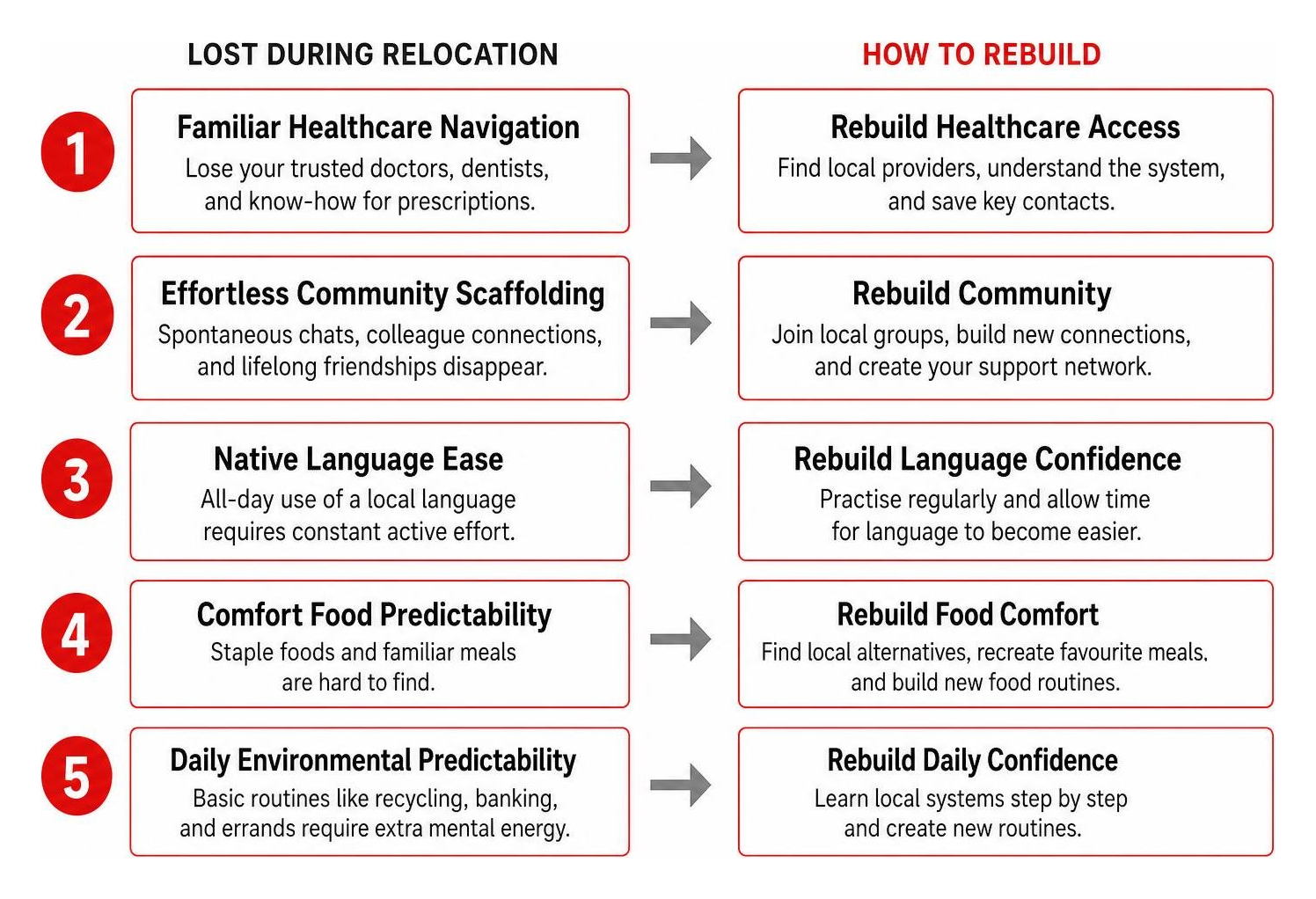
Rebuilding these systems takes time, self-compassion, and practical intention.
Proactive First-Week Strategies to Protect Well-Being
Taking small, protective steps during your initial weeks abroad prevents minor stressors from turning into an emotional crisis:
- Register with a local healthcare provider early: Locate your nearest health centre (centre d’atenció primària in Catalonia or centro de salud across Spain) before you fall ill.
- Store emergency numbers: Save local emergency contacts (112 in Spain) directly into your mobile phone.
- Anchor your morning routine: Maintain a consistent wake-up time and spend 10 to 15 minutes getting natural daylight outside.
- Create a native language sanctuary: Give your brain a break by listening to podcasts, reading books, or watching media in your mother tongue each evening.
- Keep your medication steady: Ensure you have an adequate supply of necessary prescriptions and identify local generic equivalents immediately.
- Reach out to one familiar person daily: Send a short text message or voice note to a close friend or family member as an intentional health habit.
Tailoring Well-Being Across Diverse Expat Experiences
International life is not one-size-fits-all. A digital nomad working remotely in Valencia, an engineer relocated to Madrid, and an accompanying partner managing a household in Alicante face very different emotional landscapes.
According to a mixed methods systematic review on migrant self-care, psychological strategies, social connection, and cultural ties act as vital buffers against emotional distress. The World Health Organization’s review of migrant mental health also points out that foundational security—such as housing stability, legal status, and predictable income—underpins all psychological well-being. Acknowledging your specific structural realities helps you choose self-care practices that genuinely support your situation.
Supporting Trailing Spouses, Families, and Mobile Workers
Accompanying partners often carry an invisible emotional burden. While the working partner has an instant community and professional structure, the non-working partner frequently deals with a sudden loss of professional identity, career pauses, and daily isolation.
Consider this fictional composite profile: Elena, a 34-year-old marketing manager, moved to Málaga to support her partner’s corporate relocation. Back home, her identity was anchored in her career and tight-knit social circle. In Spain, she found herself spending days managing apartment repairs and navigating residency paperwork alone, leading to feelings of resentment and loss of purpose.
When family transitions feel rocky, specialised couples counseling can help partners address unspoken imbalances, adapt communication patterns, and support Third Culture Kids through cross-cultural adjustments together.
Building a Practical Expat Therapy Self Care Plan on a Limited Budget
Meaningful self-care does not require expensive spa days or private memberships. When time and finances are stretched, integrating small micro-habits into your day creates an effective foundation for expat therapy self care:
- Five-minute physiological sighing: Inhale deeply through your nose, take a second short sip of air, and exhale slowly through your mouth to reset your nervous system.
- Progressive muscle relaxation: Spend three minutes before sleep tensing and releasing muscle groups from your toes to your forehead.
- Nature walks without screens: Explore local urban parks like Barcelona’s Parc de la Ciutadella or Madrid’s El Retiro without listening to podcasts or checking work emails.
- Free cultural and language exchanges: Attend local library meetups or community exchange groups to make low-pressure social connections.
- Firm digital boundaries: Set a curfew for browsing social media to avoid constant comparisons with friends back home.
Why Expat Therapy Self Care Transforms Everyday Life Overseas
Relocating across borders challenges your internal compass. Integrating professional guidance with daily self-care gives you a safe space to unpack culture shock, process identity transitions, and build emotional resilience. Working with a clinician through individual therapy in Barcelona provides evidence-based frameworks—such as Acceptance and Commitment Therapy (ACT), Cognitive Behavioural Therapy (CBT), and somatic regulation—tailored directly to cross-cultural life.
Why Shared Cultural Experience Enhances Expat Therapy
Local public healthcare practitioners and traditional clinics do vital work, yet they may not always have lived experience of international displacement. When your therapist is an expat who has personally navigated visas, cultural misunderstandings, and cross-border transitions, you do not have to spend half your session explaining the logistics of expat life.
This shared background creates instant emotional shorthand. You can discuss the grief of missing a family milestone back home or the frustration of bureaucratic hurdles without fear of being told to “just go home if it’s too difficult.”
Nuanced Mental Health Challenges Local Providers Often Miss
- The pressure to appear grateful: Expats often feel guilty for struggling while living in sunny destinations like Marbella, Gran Canaria, or Sevilla, worrying they have no right to feel down.
- Hyper-independence: Living without a nearby family safety net can lead people to shoulder every crisis entirely on their own until they burn out.
- Ambiguous loss: Grieving the everyday closeness of old friendships and familiar streets, even though those places and people still exist.
- Intercultural relationship friction: Misunderstandings over differing cultural norms around family boundaries, money, and social obligations.
- Cross-border grief: The unique, complex sorrow of losing a loved one back home while being stranded across international borders.
Navigating Professional Mental Health Support Abroad
Finding the right support in a new country can feel daunting. Alternative options such as public system clinicians, large online platforms, and local practices provide different avenues of care, but internationals often benefit from independent practices that focus on bespoke matching, strict confidentiality, and cross-cultural experience. Therapy in Barcelona differs by offering personalised therapist matching, expat-specific cultural sensitivity, strict privacy with no data selling, and high-quality private-pay care.
Comparing In-Person and Online Therapy Formats
Accessibility Online sessions eliminate travel time and fit easily around busy work schedules from anywhere in Spain, including Zaragoza or Bilbao. In-person therapy at our dedicated Barcelona office offers a peaceful physical sanctuary away from your home or workspace.
Emotional connection Face-to-face therapy provides subtle physical presence and body-language cues in a quiet room. Online sessions allow you to speak from the comfort of your own living space, which many people find helps them open up more easily.
Scheduling flexibility Online appointments make it simple to schedule sessions during lunch breaks or around family care commitments. In-person appointments provide a clear, intentional boundary between your therapy hour and your working day.
Cross-border continuity If you travel frequently for work or relocate to another city, online therapy allows you to keep working with the same trusted therapist without starting over from scratch.
When Expat Therapy Self Care Needs to Be Paired with Professional Therapy
Self-care habits are essential, but they cannot replace clinical support when emotional distress deepens. It is time to reach out to a professional therapist if you notice:
- Ongoing low mood, frequent crying, or persistent emotional numbness lasting more than two weeks.
- Intrusive worry or panic that interferes with work, sleep, or daily tasks.
- Withdrawing completely from social contact and feeling unable to leave your flat.
- Turning to alcohol, substances, or compulsive habits to numb emotional discomfort.
- Lingering thoughts that life is meaningless or that your loved ones would be better off without you.
Note: Therapy in Barcelona is a private-pay practice offering planned psychological support and does not provide immediate crisis intervention.
Emergency and Crisis Resources:
- Spain Emergency Services: Call 112 (available in multiple languages).
- 024 Suicide Prevention Helpline (Spain): Free, confidential, 24/7 support.
- Teléfono de la Esperanza (Spain): Call 717 003 717.
- International Crisis Support: Visit Befrienders Worldwide or Find A Helpline to find immediate, confidential assistance in your country.
Frequently Asked Questions About Expat Mental Well-Being
What makes self-care abroad different from self-care at home?
Relocating removes the familiar social scaffolding, healthcare navigation, language ease, and daily predictability you used to rely on without thinking. Self-care abroad requires deliberately rebuilding these everyday support systems from the ground up while your brain manages the ongoing cognitive load of a new culture.
How do I know when self-care alone is not enough?
When low mood, overwhelming worry, sleep disruption, or feelings of isolation persist for weeks and stop you from functioning normally, daily wellness habits are no longer enough. Seeking professional therapy is a healthy, proactive step to understand what is happening and regain your footing.
Why is it beneficial to work with a therapist who is also an expat?
An expat therapist understands the cultural displacement, bureaucratic exhaustion, and identity shifts of life overseas firsthand. This shared context builds trust quickly, ensures subtle cultural nuances are understood, and saves you from having to explain the realities of relocation during your sessions.
Conclusion
Building a healthy daily rhythm abroad does not happen overnight. It is an ongoing practice of balancing gentle routines, realistic expectations, and regular self-compassion.
Therapy in Barcelona is a trusted psychology practice in Spain established in 2011. Founded by Leigh Matthews, an Australian Psychologist who has lived in Barcelona since 2011 and has extensive experience supporting internationals, our practice provides culturally sensitive, personalised care for adults, couples, teens, and families. Whether you prefer face-to-face appointments in Barcelona or virtual sessions from elsewhere, our international team is here to support your journey.
What small step can you take today to make your life abroad feel a little more grounded?
If you’d like support, book a Free Discovery Call. Online therapy is available worldwide.
