


What Are Full Therapeutic Disclosure Questions — and Why Do They Matter?
Full therapeutic disclosure questions are the structured, carefully prepared questions a partner who has experienced broken trust submits to their therapist before a formal disclosure session — the planned, professionally guided process in which a partner who has caused harm gives a complete and honest account of their secret behaviour.
If you’re trying to understand what to ask, here is a clear starting point:
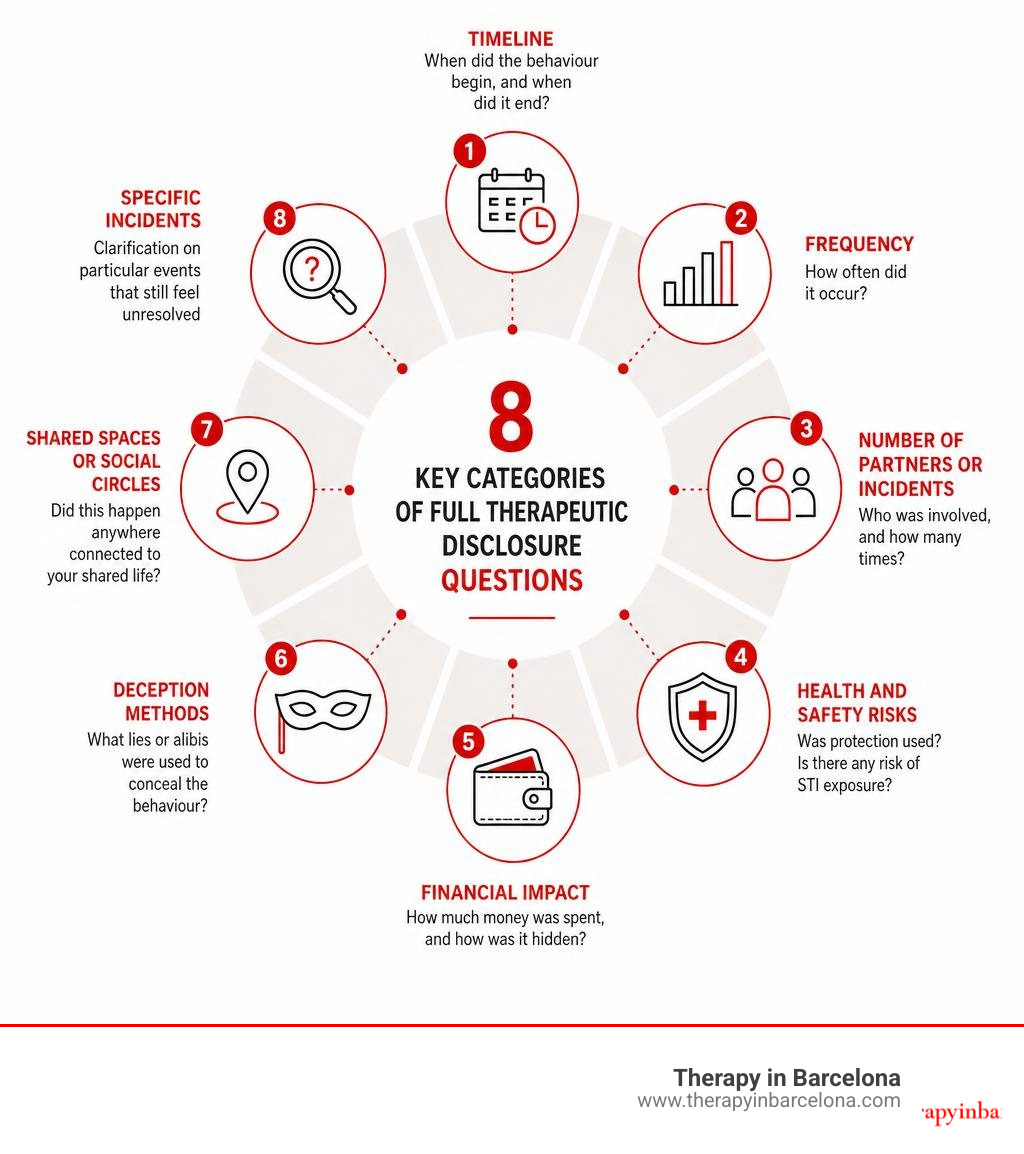
The most important full therapeutic disclosure questions cover:
- Timeline — When did the behaviour begin, and when did it end?
- Frequency — How often did it occur?
- Number of partners or incidents — Who was involved, and how many times?
- Health and safety risks — Was protection used? Is there any risk of STI exposure?
- Financial impact — How much money was spent, and how was it hidden?
- Deception methods — What lies or alibis were used to conceal the behaviour?
- Shared spaces or social circles — Did this happen anywhere connected to your shared life?
- Specific incidents — Clarification on particular events that still feel unresolved
Therapists generally recommend limiting questions to 8 to 10 priority concerns, selected with the support of your own therapist.
If you’ve just found out your partner has been hiding something from you, the urge to know everything — immediately — is completely understandable. Many people describe those first days as a kind of freefall: the version of reality they thought they were living in no longer holds.
What often follows is what therapists call trickle truth — fragments of information released over time, each one reopening the wound. Experience consistently shows this piecemeal approach prolongs distress and deepens mistrust. A structured disclosure process exists precisely to replace that chaos with a single, contained, supported truth-telling event.
This guide walks through everything you need to know about the process: how to prepare your questions, what the disclosure document should contain, when couples are ready to proceed, and what safety planning looks like before, during, and after the session.
What is a Full Therapeutic Disclosure?
A full therapeutic disclosure is a highly structured, professionally guided process designed to lay out the complete truth of a partner’s hidden behaviours. It is not an informal chat or an emotional argument over the kitchen table. Instead, it is a formal therapeutic process used primarily in cases of sexual infidelity, compulsive pornography use, financial deception, or hidden substance use.
The goal of this process is to provide the partner who has experienced the betrayal with a clear, honest, and complete account of the past. This allows them to make informed decisions about their own life and the future of the relationship. It is also an essential step for the disclosing partner to step out of the shadow of secrets and take genuine accountability.
Preparing for a disclosure is a deliberate process. It often takes several months of individual therapy before a couple is ready to sit down together. This timeline can feel frustratingly slow for a partner desperately seeking answers.
However, as outlined in this guide on Why Disclosure Takes So Long, this time is necessary. The partner who hid their behaviour must undergo a thorough therapeutic preparation, overcome initial denial, and allow hidden memories to surface so they can deliver the complete truth once and for all.
Why Spontaneous Confessions and Trickle Truth Fail
When betrayal is first discovered, the immediate reaction is often a series of chaotic, late-night confrontations. The betraying partner, driven by panic and shame, may offer a spontaneous confession. Alternatively, they might engage in “trickle truth” — revealing only what they think they have to, hoping the rest remains buried.
This piecemeal approach is incredibly damaging. Every time a new detail emerges weeks or months later, it resets the painful emotional distress for the partner, completely shattering any fragile attempts to rebuild trust.
To understand why a formal process is necessary, it helps to look at how these two approaches differ:
Spontaneous Confessions
- Timing: Unplanned, chaotic, and often occurs late at night or during an argument.
- Accuracy: Highly unreliable. Details are often minimized, altered, or withheld due to panic and shame.
- Support: No professional guidance, leaving both partners to deal with intense emotional distress alone.
- Impact: High risk of escalating distress, leaving the partner feeling disoriented and unsafe.
Therapeutic Disclosure
- Timing: Carefully planned weeks in advance, allowing both partners time to prepare emotionally.
- Accuracy: Thorough and verified. The disclosing partner writes a detailed chronological statement reviewed by a therapist.
- Support: Facilitated by trained therapists who manage the room, support both parties, and ensure emotional safety.
- Impact: Contains the distress, validates the partner’s reality, and establishes a single, solid foundation of truth.
The Clinical Necessity of a Formal Process
Many betraying partners ask, “If I have already told the whole truth, why do we need to do a formal disclosure?”
The reality is that without a structured process, it is almost impossible for a partner to trust that they have the full story. Deception breeds deep-seated doubt. A formal therapeutic disclosure acts like a thorough assessment. Just as a professional cannot address an issue without a clear and accurate understanding, a couple cannot heal a relationship without knowing exactly what needs to be repaired.
Furthermore, a competent adult has a fundamental right to know the truth of their own life. In the medical field, the doctrine of “therapeutic privilege” — withholding distressing information from a patient — is highly restricted because it undermines a person’s autonomy. This ethical principle is explored in depth in The legal and ethical implications of therapeutic privilege.
In the context of relationship betrayal, withholding facts under the guise of “protecting” the partner is simply another form of manipulation. True healing can only begin when the partner is given the complete, unvarnished facts, allowing them to exercise their own agency and make informed choices about their future.
Preparing Your Full Therapeutic Disclosure Questions

Preparing the questions you want answered is a vital part of reclaiming your sense of reality. When you have been lied to, your brain naturally tries to fill in the blanks, often imagining scenarios that are even more distressing than the actual truth. Writing down your questions helps bring structure to this mental chaos.
As you begin this process, it can be helpful to explore The Ultimate List of Therapeutic Questions for Self-Awareness to ground yourself and understand your own emotional boundaries before formulating questions for your partner.
What Makes a Constructive Question?
A constructive disclosure question is one that helps you make decisions about your physical and emotional safety, validates your past suspicions, and helps you reconstruct a coherent timeline of your life.
- Constructive Questions: These focus on objective facts, timelines, health risks, and the scope of the deception. They aim to clear up confusion and allow you to trust your own instincts again.
- Highly Distressing Questions: These ask for graphic physical details, comparisons, or emotional justifications (e.g., “Was she more attractive than me?” or “What exactly did you do in bed?”). While the urge to ask these is natural, experience shows that the answers to graphic questions do not aid recovery. Instead, they create vivid mental images that can trigger severe, long-term emotional distress.
Formulating Your Full Therapeutic Disclosure Questions
When preparing your list, it is best to carry a notebook or keep a secure document on your phone. Questions will pop up at unexpected times — while you are working, walking, or trying to sleep. Jot them down as they arise.
Once you have a list, work closely with your therapist to refine them. Therapists strongly recommend narrowing the final list down to 8 to 10 priority questions. This keeps the disclosure session focused and manageable, preventing emotional overwhelm.
Once finalised, these questions are submitted to the therapists weeks before the session. The disclosing partner will then integrate the answers directly into their written statement, ensuring there are no surprises or on-the-spot interrogations during the actual meeting.
Examples of Constructive Full Therapeutic Disclosure Questions
To help you get started, here are examples of constructive, well-framed questions:
- Timeline & Scope:
- “When did this behaviour first begin, and was it continuous or did it happen in phases?”
- “Did you act out during our holiday to Málaga in 2024, or on your business trips to Madrid?”
- Health & Safety:
- “Did you use protection during these encounters, and have you been tested for STIs since the last incident?”
- “Were any of these behaviours conducted in our shared home or family spaces?”
- Financial & Deception:
- “How much money was spent on these behaviours in total, and what accounts or methods were used to hide these expenses?”
- “What specific alibis or lies did you tell me to cover up your whereabouts on the nights you were away?”
- Social Circles:
- “Do any of our mutual friends, family members, or colleagues know about these behaviours?”
The Anatomy of the Disclosure Document

The cornerstone of the disclosure session is a written document prepared by the disclosing partner. This document is written in a clear, narrative style and is drafted over several weeks under the strict guidance of a therapist who specialises in supporting couples through broken trust and compulsive behaviours.
According to professional guidelines in the Recommendations for Therapeutic Disclosures, the document must be read aloud verbatim by the disclosing partner during the session, without softening the language, making excuses, or improvising.
What to Include in the Written Statement
A thorough disclosure document must be honest, direct, and factual. It typically includes:
- A complete chronological history of the hidden behaviours.
- The specific types of behaviours, their overall frequency, and the general timeline.
- The number of partners or incidents involved.
- A clear estimation of the money spent to facilitate these behaviours.
- The specific methods, lies, and alibis used to conceal the truth from the partner.
- Direct, factual answers to the 8 to 10 priority questions submitted by the partner.
What Must Be Explicitly Excluded
To protect both partners and prevent unnecessary distress, certain details must be strictly left out of the written document:
- Graphic details: Explicit descriptions of sexual acts, physical anatomy, or specific sexual positions.
- Fantasies and preferences: Descriptions of sexual fantasies, internal desires, or comparisons between the partner and others.
- Identifying details of unknown partners: Names, specific locations (unless they occurred in shared spaces), or emotional descriptions of affair partners, unless directly relevant to the partner’s safety.
- Defensive language: Any attempts to justify, blame, or explain why the behaviour happened. The disclosure is about what happened, not an opportunity to rationalise the behaviour.
Therapeutic Readiness and the Two-Therapist Gold Standard
A therapeutic disclosure is a powerful process, but it can be highly destructive if attempted too early. Both partners must be assessed for readiness before scheduling the session.
If you are facing these challenges within a family system, exploring the structured support offered through Online Family Therapy can help stabilise the family unit during this intense preparation phase.
Assessing Readiness and Contraindications
Before proceeding, the therapists will look for specific indicators of readiness:
- The Disclosing Partner: Must have achieved a significant period of continuous abstinence from the hidden behaviours. They must also demonstrate genuine empathy and a willingness to tell the truth without coercion.
- The Partner: Must have stable support systems in place and have developed basic coping strategies to manage the intense emotional wave that follows disclosure.
- Contraindications: The disclosure must be postponed or avoided entirely if there is active domestic abuse, severe mental health crises in either partner, unmanaged substance withdrawal, or if the couple has already firmly decided to permanently separate.
Why the Two-Therapist Model is Essential
The gold standard for facilitating a therapeutic disclosure is a two-therapist model. In this setup, each partner has their own dedicated therapist.
A single-therapist model creates an impossible conflict of interest. One therapist cannot simultaneously prepare a client to deliver painful truths while adequately protecting and advocating for the partner receiving those truths.
With two therapists, the roles are clear:
- The Discloser’s Therapist (often a therapist specialising in compulsive behaviours) helps their client overcome denial, draft the disclosure document, and prepare to deliver the truth with compassion.
- The Partner’s Therapist (often a therapist specialising in supporting partners after betrayal) acts as a dedicated advocate, helping the partner formulate their questions, build a safety plan, and process the disclosure safely.
The Role of Polygraph Testing
In many therapeutic disclosures, polygraph testing (a lie detector test) is discussed as a verification tool.
- Pros: For some partners, a polygraph can provide a sense of relief, helping them feel confident that no more “surprises” are waiting to be revealed. It can help quiet the constant, exhausting cycle of doubt.
- Cons: Polygraphs are not entirely reliable and can produce false positives due to high anxiety. They are also highly controversial and not admissible in most courts.
- The Therapeutic View: A polygraph should never replace relational work or be viewed as a magic solution. The most reliable verification of truth is consistent, transparent, and empathetic behaviour change over many months.
Logistical and Safety Planning
A successful disclosure session requires meticulous logistical planning. Nothing should be left to chance.
- Before the Session: Both partners must complete full STI screenings, and the results should be shared before the disclosure meeting.
- During the Session: The meeting typically lasts for a few hours, with planned, structured breaks to allow both parties to breathe, check in with their therapists, and regulate their nervous systems.
- Immediately After: The couple should agree to a stabilisation window of a couple of days. During this time, they should plan to stay in separate lodging (such as a hotel or with supportive friends) and have minimal or highly structured contact. This prevents immediate, highly charged arguments and gives both individuals space to process the information safely with their support networks.
Frequently Asked Questions about Therapeutic Disclosure
How long does a therapeutic disclosure session typically last?
A formal therapeutic disclosure session typically lasts for a few hours. This allows enough time for the written document to be read slowly, for the pre-submitted questions to be answered, and for structured breaks to help both partners manage their emotional regulation.
Should the partner keep a copy of the written disclosure?
Therapeutic guidelines strongly recommend that the partner does not keep a physical or digital copy of the disclosure document. Having constant access to the written narrative often triggers obsessive reading, rumination, and prolonged distress.
Instead, the document is kept securely in the files of the therapists, where the partner can access or review it during structured therapy sessions if needed.
Can therapeutic disclosure be done online?
Yes. With the rise of secure, professional online therapy, therapeutic disclosures can be facilitated via video sessions.
This is particularly valuable for expat couples, international students, and digital nomads living in Spain — whether in major hubs like Madrid, Valencia, Málaga, or Alicante — who may find it challenging to find local, English-speaking specialists in supporting couples through broken trust. Online facilitation allows both partners and their respective therapists to connect safely from different locations.
Rebuilding on a Foundation of Truth
Dealing with the aftermath of betrayal is one of the most painful experiences a person can go through. While the temptation to rush through a confession or avoid the details is strong, real healing cannot occur on a foundation of half-truths.
A structured, therapeutic disclosure provides a safe, contained path to bring the secrets into the light, allowing both partners to finally stand on solid ground.
If you are looking for support, it is important to know that you do not have to walk this path alone. While public health systems often have long waiting lists and large online platforms frequently lack specialised, culturally sensitive care and may sell your personal data, there are dedicated, secure resources available.
At Therapy in Barcelona, founded in 2011 by Australian Psychologist Leigh Matthews, we specialise in supporting the international community. We understand the unique challenges of managing relationship struggles and personal growth while living abroad in Spain.
Our team of highly qualified, psychology-trained therapists offers bespoke therapist matching to ensure you are paired with the professional best suited to your specific needs, providing culturally sensitive support in your native language.
We operate as a private-pay service to guarantee strict privacy with absolutely no data selling, and some of our therapists offer sliding scale fees for those with financial need. We provide both in-person sessions at our welcoming office in Barcelona and online therapy for clients across Spain — including Valencia, Madrid, Málaga, and Alicante — and worldwide.
If you would like to explore how we can support you, book a Free Discovery Call with us today.
