


Understanding Your Relationship Blueprint

Attachment styles therapist aid is the professional support therapists use to help you understand and transform your relational patterns. This involves:
- Education on the four attachment styles (secure, anxious, avoidant, and disorganised).
- Identifying how early experiences shape your current relationships.
- Using tools like worksheets for self-reflection.
- Employing techniques like CBT to heal insecure patterns.
- Building a safe therapeutic relationship as a model for secure connection.
Our earliest relationships wire our brains, creating a blueprint for how we connect with others throughout life. This attachment style influences how we seek intimacy, handle conflict, and balance independence.
While these patterns are set in childhood, they are not set in stone. With the right support, people with insecure attachment styles can develop more security. Understanding your style is the first step towards building healthier relationships, and a therapist can be your guide on this journey.
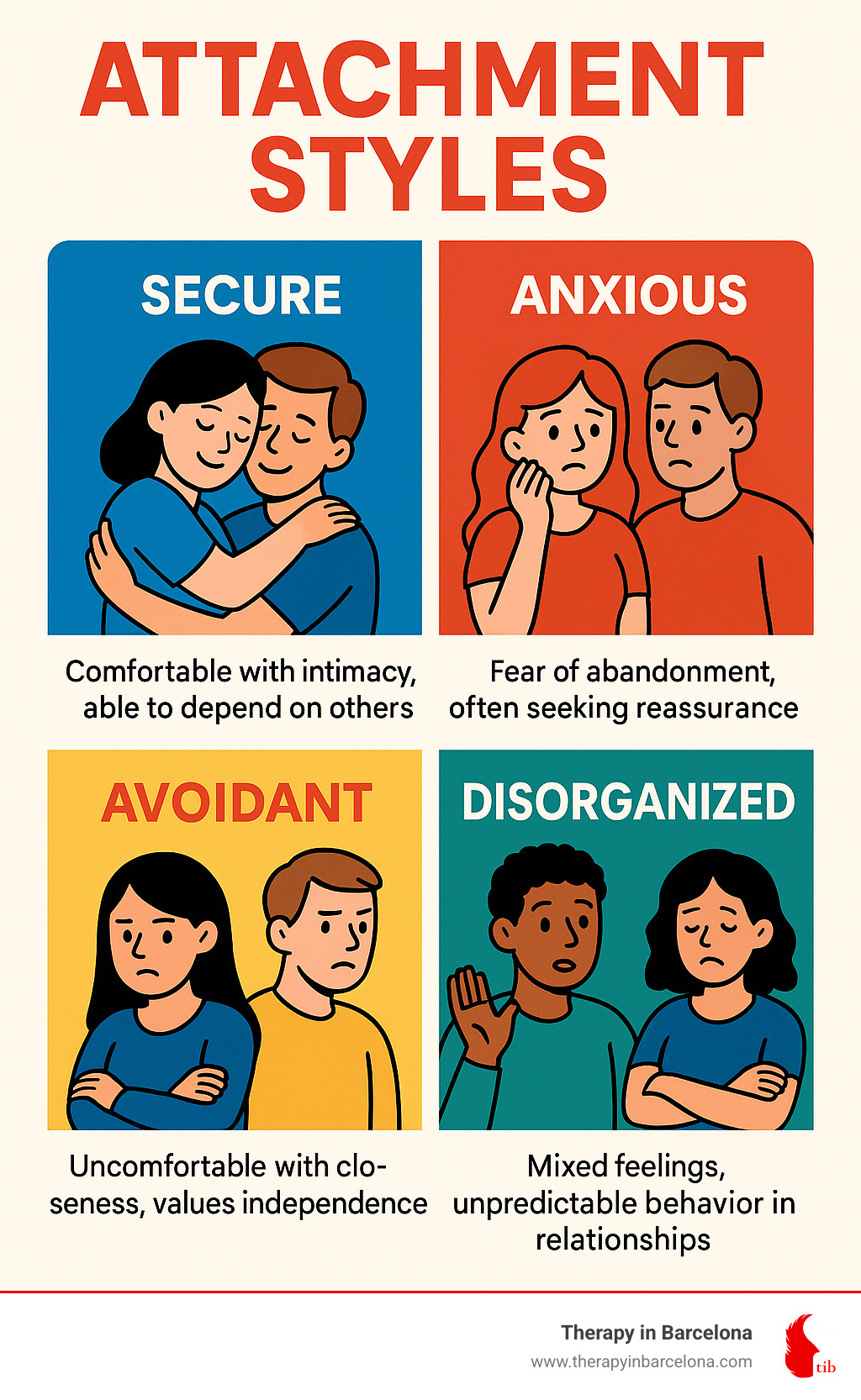
The Four Main Attachment Styles Explained
Understanding attachment styles therapist aid begins with recognising these deeply ingrained patterns. They are your relationship blueprint, an unconscious guide influencing how you connect with others, especially romantically. These patterns develop early but continue to shape our adult relationships, affecting communication and our comfort with intimacy. The encouraging news is they are not permanent. Let’s explore the four primary attachment styles.
Secure Attachment

People with a secure attachment style find it relatively easy to connect with others. They trust that relationships can be safe and reliable. This doesn’t mean their relationships are perfect, but they have the emotional tools to steer challenges. They are comfortable with both intimacy and independence, can set healthy boundaries, and communicate their needs effectively. Their resilience allows them to bounce back from disagreements, fostering an atmosphere of mutual support.
Anxious Attachment (Preoccupied)
If you constantly worry about your partner’s feelings or fear abandonment, you might recognise an anxious attachment style. This pattern often develops from inconsistent caregiving in childhood. In adulthood, it can manifest as a strong need for reassurance, jealousy, or people-pleasing behaviours to maintain closeness. While these actions are meant to secure love, they can sometimes push partners away. Recognising these patterns is the first step toward developing self-soothing skills and building a stronger sense of self. More info about dealing with anxiety.
Avoidant Attachment (Dismissive)

Avoidant attachment often stems from early experiences where emotional needs were dismissed. As a result, these individuals learn that self-reliance is safer than depending on others. In relationships, they may maintain emotional distance, suppress their feelings, and prioritise independence over closeness. Their fear isn’t of love itself, but of the vulnerability that deep connection requires. Therapy can help individuals with this style learn that expressing emotion is safe and can strengthen relationships.
Disorganised Attachment (Fearful-Avoidant)
This is the most complex pattern, often resulting from childhood experiences where a caregiver was a source of both comfort and fear. This creates an internal conflict, leading to contradictory behaviour in adult relationships—a simultaneous desire for and fear of closeness. Relationships can feel like an emotional rollercoaster. This style is often linked to trauma and neglect, and healing typically requires professional, trauma-informed support to address the underlying wounds and regulate the nervous system. Understanding the impact of early trauma can provide additional insights into this complex attachment style.
How Attachment Styles Develop from Childhood
Ever wondered why some relationships feel easy while others are a constant struggle? The answer often lies in our attachment style, a pattern woven during our early childhood experiences with caregivers. These interactions shape our nervous system development, teaching us what to expect from others and influencing our sense of safety and security in all future relationships. Difficult early experiences can even lead to what’s known as attachment trauma.
To understand these formative experiences, Mary Ainsworth’s groundbreaking “Strange Situation” study shed light on how infants respond to their caregivers. You can learn more here: More on Mary Ainsworth’s Strange Situation study.
The Role of Early Caregivers
A secure attachment is built on consistent and responsive care. When a caregiver reliably soothes a child, the child learns that their needs are valid and that people can be trusted. This emotional attunement builds a secure base. Conversely, inconsistent or neglectful parenting can lead to insecure patterns. Anxious attachment may arise from unpredictable care, while avoidant attachment can develop if emotional expression is discouraged. In cases of abuse or frightening behaviour, a disorganised attachment can form, where the caregiver is a source of both comfort and fear.
These early patterns continue to shape our adult relationships, and for expats, distance from family can bring these dynamics into sharper focus. You can dive deeper here: Better with an Ocean Between Us: Family of Origin and Attachment Issues in Expats.
Can Attachment Styles Change in Adulthood?
The good news is that attachment styles can change. Our brains have a remarkable ability to adapt, a quality known as neuroplasticity. This means we can develop an “earned secure attachment” in adulthood. This change happens by consciously adopting new beliefs and behaviours and challenging old patterns. The influence of partners can also be transformative; a secure partner can provide a corrective emotional experience. Therapeutic growth is a powerful catalyst, offering a safe space to process early experiences and practise healthier ways of connecting with the help of attachment styles therapist aid.
The Role of Therapy: A Guide to Attachment Styles Therapist Aid
Therapy offers a powerful path to changing your attachment patterns. Attachment-based psychotherapy helps you explore how early experiences shaped your view of relationships. The therapeutic relationship itself becomes a model of healthy connection—a ‘secure base’ where you can explore vulnerability without judgement. This provides a ‘corrective emotional experience,’ showing you that secure connection is possible.

How Therapy Helps Identify and Heal Attachment Wounds
A key part of attachment styles therapist aid is building self-awareness. A therapist helps you trace relationship patterns back to their childhood origins, not to assign blame, but to understand your current behaviours. Therapy provides tools to process early experiences, build emotional regulation, and challenge unhelpful beliefs about your self-worth or fear of abandonment. You’ll also develop new relational skills, like effective communication and conflict resolution. This is especially powerful in couples therapy, where partners can heal together. Curious about how it works? The Art of Healing: How Couples Therapy Works.
Using Worksheets as an Attachment Styles Therapist Aid
Therapeutic worksheets are practical tools for reflection between sessions. As part of your attachment styles therapist aid, they can help you clarify your needs, map your emotions, and challenge unhelpful beliefs. For example, a worksheet might help you perform an ‘avoidance stock take’ to see when you pull away, or guide you in examining old beliefs about relationships. Resources like the Creating Secure Attachment worksheet offer research-backed tips for your journey.
Therapeutic Approaches for Insecure Attachment
Therapists use various evidence-based approaches for insecure attachment. Cognitive Behavioural Therapy (CBT) helps change negative thought patterns, while Dialectical Behavior Therapy (DBT) teaches mindfulness and emotion regulation skills. For couples, Emotionally Focused Therapy (EFT) reshapes negative interaction cycles to foster a secure bond. For disorganised attachment, Trauma-informed care (including methods like EMDR) is essential to process painful memories. Unlike the one-size-fits-all approach of some large online platforms, a dedicated therapist at Therapy in Barcelona tailors these methods to you, drawing from a wide range of approaches to ensure a personalised fit. You can find more about our diverse therapeutic approaches here: More info about our therapeutic approaches.
Practical Strategies for Building Secure Attachment
Developing a more secure attachment style is a journey of self-awareness and practice. It’s about recalibrating your internal relationship compass. Whether you’re working with a therapist or on your own, these practical steps can help you build healthier connections.
For Anxious Attachment: Cultivating Independence
If you have an anxious style, your path involves nurturing your independence to reduce reliance on external validation. Practice self-soothing with mindfulness or deep breathing. Develop hobbies and friendships outside your romantic relationship to build self-esteem. Learn to set boundaries to honour your needs, and gently challenge yourself to tolerate space, building confidence that you are whole on your own.
For Avoidant Attachment: Embracing Vulnerability
If your attachment style leans towards avoidant, your journey is about gently embracing vulnerability. It’s about learning that vulnerability can be a strength, not a weakness.

Start by initiating intimacy in small ways, like sharing a personal thought. Practice expressing your needs and sharing emotions, even if it feels uncomfortable at first. A therapist can be a great attachment styles therapist aid in this process. Gradually learn to tolerate closeness without withdrawing, building your capacity for deeper connection.
For All Styles: Improving Communication and Connection
Regardless of your style, strong communication is fundamental. Cultivate empathetic listening to truly understand your partner. Use “I” statements to express your feelings without blame. Learn conflict resolution skills to steer disagreements constructively. Most importantly, learn to repair after arguments. Ruptures are inevitable; what builds security is the ability to apologise and reconnect. Developing emotional awareness of your own feelings will also increase your empathy for your partner’s.
Couples therapy can be an excellent resource for this, providing a safe space to steer these dynamics together. You can learn more about how it can help here: How Couples Therapy can help.
Frequently Asked Questions about Attachment Styles
Can a person have more than one attachment style?
While most people have a primary attachment style, it’s normal to show traits from others. Think of it as a default setting that can be flexible. Your style might shift slightly depending on the relationship. For instance, you might feel more anxious with a distant partner but more secure with someone who is consistently reassuring. This shows that attachment styles are not rigid labels but dynamic patterns.
How do I know what my attachment style is?
Finding your attachment style begins with self-reflection. Consider your patterns in relationships. Do you seek constant reassurance? Do you prefer emotional distance? How do you react to conflict or separation? While online quizzes can be a starting point, consulting a therapist who specialises in attachment styles therapist aid provides a more accurate and nuanced understanding. They can help you identify your style, its origins, and its impact on your life.
How can I support a partner with an insecure attachment style?
Supporting a partner with an insecure attachment style requires patience, empathy, and consistency. First, educate yourself about their style to understand the fears driving their behaviour. An anxious partner may need reliable reassurance, while an avoidant partner may need their space respected alongside gentle encouragement for closeness. Create a safe space for open communication by listening without judgement. It’s also vital to maintain your own boundaries to prevent burnout. You can’t fix their wounds, but you can provide a secure presence that supports their healing. Suggesting couples therapy can also be a powerful step.
Find Your Secure Base with a Therapist in Barcelona
Understanding your attachment style is a profound step towards healthier relationships. It’s a roadmap for navigating human connection, especially for expats facing the unique challenges of life abroad in cities like Barcelona, Madrid, or Valencia. This is where the right attachment styles therapist aid becomes transformative.

At Therapy in Barcelona, we understand that expat life can be overwhelming. Our practice was founded by Leigh Matthews, an Australian Psychologist who moved to Barcelona in 2011. As an expat herself, she experienced the struggle of adapting to a new culture and couldn’t find an English-speaking therapist who truly understood. This inspired her to create a therapeutic space where cultural understanding is the foundation of healing.
Our team of qualified, English-speaking expat therapists offers culturally sensitive support for issues like culture shock, relationship strain, and past traumas. We offer both in-person sessions at our welcoming office in Barcelona’s Eixample district (C/ de París, 162-164, 3o, 1a, 08036) and online therapy to expats worldwide.
What truly sets us apart is our personalised therapist matching service. This is a world away from the impersonal algorithms of large online platforms. We take the time to understand your story and goals to find the best fit for you, because we know the therapeutic relationship is the key to success. Your journey towards secure attachment isn’t just possible—it’s waiting for you. The relationship struggles that feel impossible can heal and transform with the right support.
Book a free discovery call today to connect with a therapist who can help you build your secure base and create the relationships you truly desire.
