


Why Therapeutic Questions Matter for Your Personal Growth

Therapeutic questions for adults are powerful tools for self-findy, emotional healing, and personal growth. Whether you’re in therapy or exploring on your own, the right questions can help you understand your patterns, clarify your values, and steer life’s challenges with greater awareness.
Quick Answer: Categories of Therapeutic Questions
- Emotional Exploration – Understanding your feelings and how they show up in your body
- Thoughts & Beliefs – Examining the stories you tell yourself and challenging unhelpful patterns
- Relationships – Exploring connection, boundaries, and communication styles
- Past & History – Understanding how earlier experiences shape your present
- Behaviour & Coping – Identifying what helps you manage stress and what doesn’t
- Values & Meaning – Clarifying what matters most and aligning your life accordingly
- Trauma & Safety – Processing difficult experiences in a supported way
- Future & Goals – Envisioning the life you want and planning meaningful steps forward
Living abroad in Spain, whether in Barcelona, Valencia, or Málaga, can amplify the need for self-reflection. The cultural adjustment, language barriers, and distance from home often bring questions about identity, belonging, and purpose to the surface. You might find yourself wondering who you are in this new context, or feeling stuck in ways you didn’t expect.
Therapeutic questions can help you find your own answers. They’re not reserved for therapy sessions alone. Used thoughtfully, they become companions in your journal, prompts during quiet walks along the Mediterranean, or conversation starters with your therapist during a session at our Barcelona office or online from anywhere in the world.
The beauty of a well-crafted question is that it doesn’t tell you what to think. Instead, it opens space for you to find your own truth. A question like “What boundary do I need to set right now?” can reveal more in five minutes of honest reflection than hours of circular thinking.
At Therapy in Barcelona, our psychology-trained therapists use thoughtful questions within evidence-based approaches like CBT, ACT, Schema Therapy, and Solution-Focused Brief Therapy (SFBT). We also know private therapy is not an option for everyone. Public services and large online platforms can be helpful, but they may not always provide the same level of personalised matching or expat-aware, culturally sensitive care. If cost is a concern, ask us about sliding scale options.
This guide provides a comprehensive collection of therapeutic questions across different life areas. You can use them for personal reflection, journaling, or as a starting point for conversations with a therapist who understands your unique experience as an international.
The Foundation: Understanding the Power of Therapeutic Questions
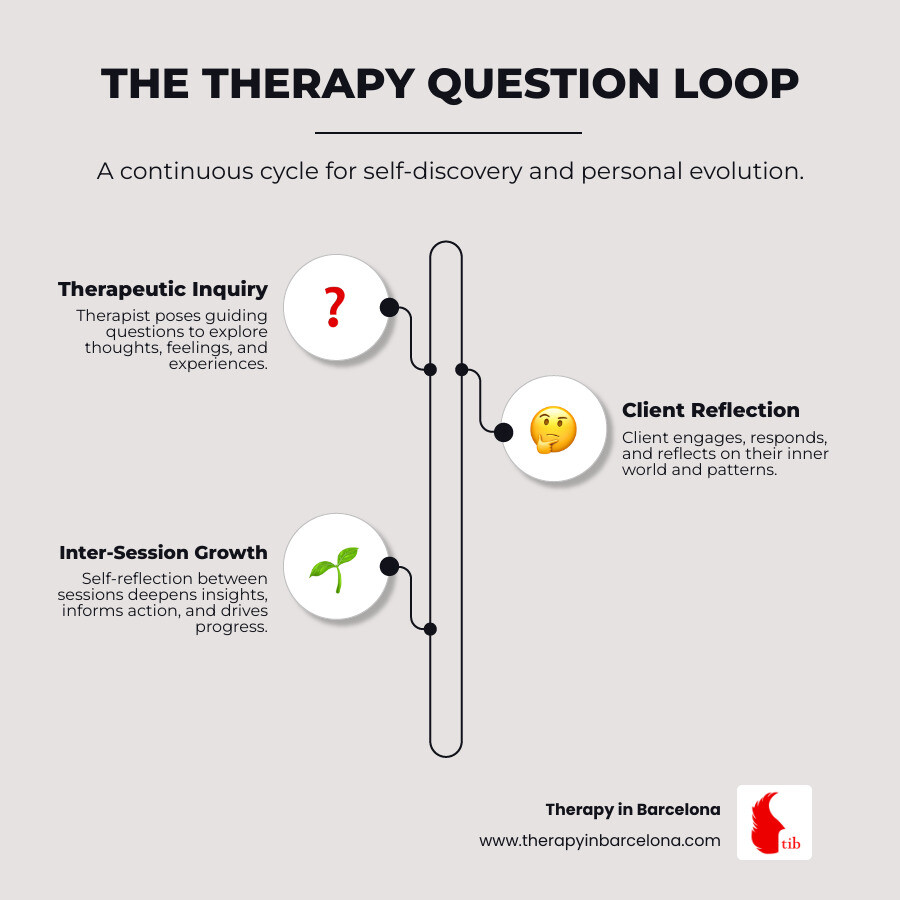
The right question at the right time can open up new perspectives. In therapy, questions are the primary tool for exploration, but their power lies in collaboration, not interrogation. It’s a process of guided curiosity where you are the expert on your own life. As one client shared, “My therapist put me at ease in my first session… it was a good first step for me.” Indeed, a therapeutic question is a probing inquiry asked by a counsellor as part of talk therapy to help move a client towards self-findy and change.
Most of what happens in talk therapy is accomplished through the skilful use of questions, second only to a lot of active listening. The quality of the therapeutic alliance – that trusting bond between you and your therapist – is heavily dependent on the relationship built. If you don’t feel heard, understood, and respected, it’s difficult to make progress.
The Art of Asking: Open-Ended vs. Closed Questions
Therapists often use Open-ended questions over closed questions because they encourage detailed reflection rather than a simple yes or no. Open-ended questions are designed to facilitate thought and increase the expression of feelings. They are also seen as less confrontational and judgemental. Think of the difference between “Did that feel bad?” (closed) and “How did that make you feel?” (open). The latter invites you to elaborate, explore, and truly dig into your emotional landscape.
Powerful questions are open-ended and do not lead to simple ‘yes’ or ‘no’ answers. They often start with ‘what’ or ‘how’, followed up with requests for examples or more detail, like “Can you tell me more about that?” This technique empowers you to explore your thoughts and feelings without being led, fostering deeper self-awareness. It’s about inviting you to share your story, rather than guiding you to a predetermined answer.
A Two-Way Street: Questions for Clients and Therapists
A common misconception is that the therapist asks all the questions. However, your questions are just as vital. Therapy works best when it’s something you co-create. Your questions, your curiosity, your clarity, and even your confusion are all part of the work. Asking your therapist about their approach, their experience, or what to expect helps build a strong, trusting relationship and ensures you are an active participant in your own healing journey.
For instance, choosing a therapist is a bit like figuring out which friend you’d trust with your deepest secrets. You want someone who makes you feel safe and understood. Questions asked by clients help them understand their therapist and shape the therapeutic relationship. If something feels off in therapy, it’s worth paying attention to.
At Therapy in Barcelona, our client journey begins with an initial conversation precisely for this reason – it’s integral to understanding and matching your needs with a therapist who has the appropriate training and experience. We don’t just match a client with the next available professional; we prioritise finding the right fit for you.
A Practical Guide to Therapeutic Questions for Adults

These therapeutic questions for adults are categorised to help you explore different areas of your life. You can use them for journaling, meditation, or as starting points for discussion in therapy. Remember to approach them with curiosity and self-compassion. Self-honesty, though sometimes challenging, is crucial for personal growth. These questions can help you identify real issues you might be avoiding and recognise solutions you might be ignoring.
Questions to Explore Your Inner World: Emotions, Thoughts, and Beliefs
These questions aim to improve your self-awareness, improve emotional intelligence, and foster cognitive flexibility. They can be particularly helpful if you’re exploring individual therapy.
- What emotion shows up most often for you, and where do you feel it in your body?
- What emotion feels most difficult to express?
- What reliably brings you joy?
- What story do you tell yourself about failure?
- If you could change one core belief about yourself, what would it be and why?
- How would you respond if a close friend shared the same negative thought you’re having?
- What evidence do you have that challenges your most persistent negative belief?
- What unhelpful thoughts appear under stress?
- What assumptions do you make about others?
- How often do you expect perfection from yourself?
- What would you say best describes the primary thoughts that cross your head every day?
Questions to Understand Your Connections: Relationships and Support Systems
Relationships are mirrors, reflecting how we connect, set boundaries, and handle vulnerability. Understanding your interpersonal dynamics, boundaries, and support networks is key, especially if you’re considering couples counselling.
- What does a healthy, supportive relationship look like to you?
- What boundary do you need to set right now, and what is holding you back?
- Who in your life replenishes your energy, and who drains it?
- How do you communicate your needs, and how do you prefer to receive love and support?
- What patterns, if any, do you notice repeating across your relationships?
- What do you want most from your closest relationships?
- Where do you feel safe to be fully yourself?
- How do you handle disagreements in a relationship?
- Tell me about the important relationships in your life.
- What does support look like in your life currently?
Questions for Action and Growth: Behaviours, Coping, and Goals
These questions focus on your coping mechanisms, goal setting, and future planning, helping you move forward with intentional behaviour change.
- What is one habit you could start tomorrow that aligns with the person you want to be?
- When you feel overwhelmed, what is your go-to coping strategy? Is it serving you in the long term?
- What would your life look like in five years if you were living in alignment with your deepest values?
- What is one small step you can take this week toward a goal that feels meaningful to you?
- What support do you need to make these changes, and how can you ask for it?
- What habits help you feel grounded?
- What have you tried so far to deal with the problem?
- What does ‘success’ in this area look like?
- What’s important to you about accomplishing this?
- What would your ideal daily schedule look like?
- What goals do you want to reach in the next 6 months?
- What supports would help you meet your goals?
How Therapists Use Questions: A Look at Different Approaches
A good therapist adapts their questions to your goals and the approach they’re using, so the work fits you (not the other way around). At Therapy in Barcelona, our psychology-trained team draws from evidence-based methods like CBT, ACT, IFS, person-centred, existential, SFBT, mindfulness, and psychodynamic therapy to keep sessions personalised and practical for each individual.
Cognitive Behavioural Therapy (CBT): Challenging Your Thoughts
In CBT, a therapist often uses Socratic questioning to help you notice, test, and reframe unhelpful thinking patterns. Instead of treating thoughts as facts, you work together to examine how accurate they are and how they affect your feelings and actions.
- Example Question: “What is the evidence for and against that thought?”
- Other CBT-style questions: “Is the thought I’m having based on fact? Does that thought help me achieve my goals? Does that thought help me feel the way I want to feel?” or “How would you feel if this alternate thought were true?”
Solution-Focused Brief Therapy (SFBT): Finding Your ‘Miracle’
Solution-focused therapy focuses on finding solutions to specific issues and concentrates on present actions rather than attempting to find the root cause of problems. It uses techniques like the “miracle question” to help you envision a future without the problem, opening up your own inherent solutions. This approach empowers clients to see possibilities and identify strengths they already possess.
- Example Question: “Suppose that one night there is a miracle and while you are sleeping, the problem that brought you to therapy is solved. What would be the first thing you’d notice that would tell you things are different?”
- Other SFBT-style questions: “What would be different in your life if your problem was solved?” or “What is one thing you have done in the past that will help make your problem better?”
Other Approaches: DBT, Psychodynamic, and Humanistic
Different therapeutic orientations utilise questions in unique ways:
- Dialectical Behaviour Therapy (DBT) questions often focus on emotional regulation, impulse control, and relationships. For example: “Can you label this feeling?” Naming emotions is a practical first step toward responding (instead of reacting).
- Psychodynamic therapy questions explore how past experiences shape your present patterns. A therapist might ask: “How did your family handle emotions or conflict when you were growing up?” or “What messages did you absorb about yourself growing up?”
- Humanistic or Gestalt therapy tends to prioritise the present moment (what you feel and notice right now), rather than analysing everything intellectually. Questions might include: “How are you feeling now?” or “How does your body feel at the present moment?”
- Motivational Interviewing helps resolve ambivalence that keeps people stuck, using collaborative, non-judgmental questions. A therapist might ask: “What personal strengths do you have that would help you successfully change?”
Navigating Your Therapy Journey: Questions for Every Stage
Your therapy journey is personal. Asking thoughtful questions at each stage, and reflecting between sessions, helps you stay focused on what you want to change. The work you do outside the room often strengthens what happens inside it. At Therapy in Barcelona, we focus on supporting the international community, with careful matching so you work with a therapist who fits your needs and goals.
Starting Therapy: Questions for Your First Session
The first session is about setting the foundation. Your therapist will likely ask open-ended questions to understand your world and to help you feel comfortable. These initial inquiries are part of a warm-up process, ensuring you feel safe before delving into more sensitive topics. This helps build rapport and sets the stage for a collaborative therapeutic relationship. You can find more information about our services, including the initial stages of therapy, on our services page.
- What brings you to therapy at this point in your life?
- What would you like to get out of our work together?
- Have you been in therapy before? What was helpful or unhelpful about that experience?
- How do you feel about your current situation?
- What have you tried so far to deal with the problem?
Deepening Your Work: Self-Reflection Questions for Adults
The real growth often happens between sessions. Using self-reflection questions, perhaps through journaling, can deepen your understanding and reinforce insights gained in therapy. This introspection is a powerful tool for personal growth, as supported by scientific research on self-reflection. If a question feels overwhelming, pause and use a grounding technique before continuing. You can always bring your reflections to your next session to unpack them with your therapist.
- When did I feel most aligned with my values this week?
- What truth about myself did I notice this week that I’m hesitant to say out loud?
- What boundary did I wish I had set, and what held me back?
- What moments drained me, and why?
- When did my body feel safe and regulated, and what conditions allowed that to happen?
- What coping strategies actually moved me forward, and which only soothed me in the moment but kept me mentally stuck?
- What ways do I have to soothe myself and calm my mind?
Finding the Right Fit: Questions to Ask Your Therapist
The “right” therapist is the one you feel safe with and who understands your goals and context. Some systems may assign the next available clinician; a personalised practice like Therapy in Barcelona focuses on matching you intentionally, especially for internationals living in Spain (including Madrid, Alicante, or Zaragoza). Use a Free Discovery Call to ask about their approach, experience with expat life, and practicalities like fees as some clinicians may offer sliding scale options.
- Do you have experience working with expats or people with my cultural background?
- What does a typical session with you look like?
- How do you measure progress, and what is your approach if a client feels stuck?
- What types of therapy do you specialise in?
- Have you worked with people experiencing the same concerns I’m coming in with?
- What’s your communication style – more reflective or more direct?
- Do you feel you genuinely understand the cultural, personal, or identity factors that shape my experiences?
Important Considerations: Safety, Trauma, and Ethics
Therapy must be a safe container, especially when discussing sensitive topics. A professional therapist is trained to steer these areas with care, respect, and a strong ethical framework. This is paramount when dealing with sensitive subjects, and our team at Therapy in Barcelona adheres to high standards of professional care.
Questions to Address Trauma and Promote Healing
Addressing trauma requires a slow, gentle, and safe approach with a qualified professional. Trauma-informed care means understanding the impact of trauma and responding with compassion and sensitivity. Our team at Therapy in Barcelona is equipped to provide this specialised support.
- What does feeling safe in your body mean to you?
- What support do you need to feel safe when talking about painful experiences?
- In what ways have you grown stronger from your past experiences?
- How does your body react when you think about a painful memory?
- What coping mechanisms did you develop in response to trauma?
- What would healing look like for you in terms of letting go of past pain?
- What boundaries do you need to maintain when discussing painful experiences?
Safety First: Questions Related to Suicide Risk
If you or someone you know is in crisis, it is vital to seek immediate help. Trained professionals use specific, direct questions to assess risk and create a safety plan. This is not for self-diagnosis but to understand the clinical process. The NIMH provides toolkits for this, like the Brief Suicide Safety Assessment for outpatient settings. These assessments are crucial because, as the World Health Organisation notes, past suicidal behaviour is the strongest risk factor for future attempts. If a detailed and feasible plan exists, it’s a reason for greater concern, requiring immediate action like securing dangerous items.
In Spain, you can call the suicide prevention hotline at 024.
For those not in immediate crisis but experiencing suicidal thoughts, therapists may ask:
- In the past few weeks, have you been thinking about killing yourself?
- Are you having thoughts of killing yourself right now?
- Do you have a plan to kill yourself? Please describe.
- What are some of the reasons you would NOT kill yourself?
These questions are asked to assess risk, ensure safety, and guide appropriate interventions, always with the utmost ethical consideration and care.
Frequently Asked Questions about Therapeutic Questions for Adults
What is the most common question a therapist asks?
One of the most common and important questions is “What brings you to therapy?” or a variation of it. It’s an open-ended invitation for you to share your story in your own words and sets the stage for the entire therapeutic process. This question is non-judgemental and allows you to articulate your immediate concerns and expectations.
Can I ask my therapist personal questions?
Yes, you can, but a therapist’s response will be guided by professional boundaries. They may answer if it’s relevant to the therapeutic relationship or if it helps normalise your experience. More often, they might explore your curiosity behind the question, bringing the focus back to you and your growth. This maintains the therapeutic frame, ensuring the space remains dedicated to your well-being.
How do I know if therapy is working?
Progress in therapy isn’t always linear, but you should generally feel a collaborative movement towards your goals. You can evaluate this by asking yourself: Do I feel safe, seen, and understood by my therapist? Am I gaining new insights or perspectives? Am I noticing small, positive changes in my thoughts, feelings, or behaviours outside of sessions? Do I feel more equipped to handle challenges? If the answer is yes to most of these, you’re likely on a positive path.
Therapeutic questions for adults are more than just words; they are keys that can open up deeper self-understanding, build resilience, and pave the way for a more authentic way of living. Whether you are living as an international in the vibrant, sometimes challenging, cities of Valencia, Málaga, or Sevilla, or are simply seeking to understand yourself better from anywhere in the world, curiosity is your greatest ally. This journey of self-findy, or ‘self-findy’ as some like to call it, is one you don’t have to take alone.
Our team of psychology-trained, expat therapists at Therapy in Barcelona understands the unique path of living abroad. Since 2011, our founder, Leigh Matthews, an Australian Psychologist and expat herself, has built a practice dedicated to providing culturally sensitive mental health services to the English-speaking international community. We offer personalised matching to ensure you connect with a therapist who truly understands your experiences, whether you’re in Barcelona, Madrid, or receiving online therapy worldwide.
If you feel ready to start your journey, we invite you to book a Free Discovery Call to see how we can help.
