


Why Sexual Wellness Matters in Therapy and Beyond

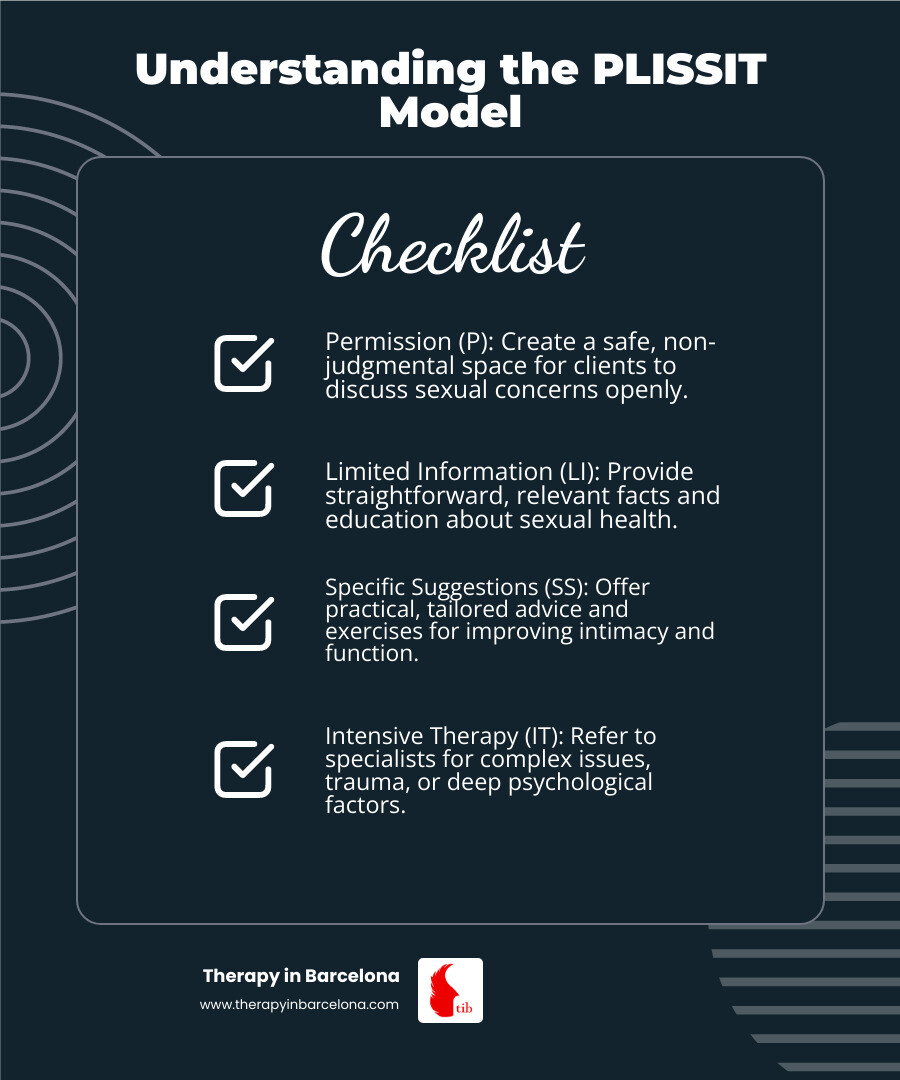
The PLISSIT model is a structured, four-level framework that helps healthcare professionals—including therapists, nurses, and doctors—talk openly about sexual health with their clients. It stands for Permission, Limited Information, Specific Suggestions, and Intensive Therapy.
Quick overview of the PLISSIT model:
- Permission (P): Create a safe, non-judgmental space for clients to discuss sexual concerns
- Limited Information (LI): Provide straightforward, relevant facts about sexual health
- Specific Suggestions (SS): Offer practical, custom advice for improving intimacy and function
- Intensive Therapy (IT): Refer to specialists for complex issues like trauma or deep psychological factors
Sexual health affects relationships, confidence, and quality of life. Yet many professionals still feel underprepared to talk about it, which means clients often stay silent too. Research on sexual healthcare needs shows why simple frameworks like PLISSIT matter: they make these conversations easier to start.
For internationals living in Barcelona, Valencia, Málaga, or other Spanish cities, talking about sex can feel even harder. Cultural differences, language barriers, and the stress of adapting to a new country often make it difficult to voice intimate concerns.
You might feel isolated, unsure where to turn, or worried about being misunderstood. The PLISSIT model offers a way forward—a clear, respectful method for opening up these conversations in therapy and beyond.
Here is how each level works and how it can support your sexual wellness. Whether you’re navigating dating challenges, adjusting to life abroad, or simply wanting to improve communication with a partner, this framework can help you feel seen and supported.
What is the PLISSIT Model? A Practical Guide for Therapy
The PLISSIT model was developed by psychologist Jack Annon in 1976. It was designed as a conceptual scheme for the behavioural treatment of sexual problems, providing a stepwise approach that allows clinicians to address sexual concerns without necessarily being “experts” in sexology at the initial stages.
This model is effective because many sexual concerns can be resolved at the first few levels, meaning that intensive, long-term therapy isn’t always required. For an expat navigating a new culture in Madrid or Barcelona, this “brief intervention” approach can be incredibly empowering, offering quick relief for common stressors.
Level 1: Permission
The first level is about giving the client “permission” to be a sexual being and to have concerns. It involves normalising sexual health as a valid part of overall wellness. In a clinical setting, this might look like a therapist asking: “Many people living abroad find that the stress of relocation affects their intimate life. Is this something you’d like to talk about?”
By asking open questions and seeking explicit consent, the provider creates a “compassionate sanctuary.” This level is often enough to resolve issues rooted in shame or guilt. When a professional signals that it is okay to talk about sex, the client feels seen and safe.
Level 2: Limited Information (LI)
Once permission is established, the provider offers specific, focused facts. This isn’t a full sex education course; it’s targeted information to bust myths. For example, a client might worry that their low libido is “abnormal,” when it is actually a common side effect of a new medication or the “cortisol spike” associated with cultural adjustment. Providing basic anatomy or physiological facts can alleviate significant anxiety.
Level 3: Specific Suggestions (SS)
At this stage, the clinician provides actionable advice. These are practical exercises tailored to the client’s unique situation. Suggestions might include:
- Mindfulness techniques to help a client stay present during intimacy.
- Communication strategies for couples to discuss desires without conflict.
- Sensate focus exercises to reduce performance pressure.
- Intimacy tools like using lubricants or changing positions to accommodate chronic pain.
Level 4: Intensive Therapy (IT)
This level is reserved for complex issues that require specialised, long-term intervention. This might include healing from past trauma, addressing deep-seated relational patterns, or managing significant psychological disorders. If a generalist clinician reaches this level, they refer the client to a specialist, such as a dedicated sex therapist or a psychologist with expertise in trauma.
The EX-PLISSIT Model: Building on the Basics
While the original model is highly effective, some practitioners found it a bit too linear. In 2006, Sally Davis and Bridget Taylor introduced the EX-PLISSIT model. This “extended” version places Permission at the very core of every interaction.
The EX-PLISSIT model is cyclical rather than a straight line. It emphasises using the extended PLISSIT model to address sexual healthcare needs by incorporating:
- Ongoing Feedback: Checking in with the client at every stage to see if the information or suggestions are actually helping.
- Professional Reflection: Encouraging the therapist to reflect on their own biases or comfort levels.
- Review: A dedicated step where the client and therapist look back at the progress made and decide if they need to move to a different level.
This approach is particularly helpful for our international community, as it allows for the flexibility needed when navigating different cultural scripts and values.
Who Can Benefit? Real-Life Examples from Barcelona, Valencia, and Beyond
The PLISSIT model is remarkably versatile. It is used across various medical and therapeutic specialties to improve sexual function, satisfaction, and quality of life.
- Chronic Illness & Oncology: Many gynecologic cancer patients report never having a physician-initiated conversation about the sexual effects of treatment. Using PLISSIT, oncology nurses can provide Limited Information about how chemotherapy may affect vaginal tissue and offer Specific Suggestions such as discussing lubricants, pelvic floor support, or medical options with a clinician.
- LGBTQ+ Individuals: For expats in the LGBTQ+ community, finding a safe space is vital. PLISSIT helps clinicians signal that diverse identities, relationship structures, and sexual practices can be discussed without shame or judgment.
- Older Adults: Sexuality does not have an expiry date. In geriatrics, the model helps address intimacy barriers like arthritis, menopause, erectile changes, or the side effects of heart medication, supporting older adults in maintaining connection and quality of life.
- Expats in Spain: For many internationals, relocation can affect desire, intimacy, and confidence. Isolation, culture shock, language stress, or the pressure to build a new life can all show up in sexual wellbeing. Through the PLISSIT model, a therapist can give Permission to talk openly, provide Limited Information about how stress affects the body, and offer Specific Suggestions for reconnecting with a partner.
Comparing Your Options for Sexual Wellness Support
When seeking help for sexual health or emotional wellbeing in Spain, you have several paths. Here is how they compare:
Public Health System (CatSalut)
CatSalut is free and accessible if you have a social security number, but waits can be long and language support limited. Sexual health may also be approached more medically, with less time for the emotional or relational side of intimacy.
Large Online Platforms
Large online therapy platforms can be convenient. But matching is often algorithm-based, therapist turnover can be high, and privacy concerns remain. They may also miss the local context of expat life in Spain.
Local Private Practices
Barcelona has many small private practices. These offer a personalised feel, but quality varies. Some may not have the team depth to offer specialised support like sex therapy, and they might not be equipped to handle the specific bicultural challenges that internationals face.
Therapy in Barcelona
We offer a high-quality, private-pay service designed specifically for the international community. Founded by Leigh Matthews, an Australian psychologist who has lived in Barcelona since 2011 and is experienced in supporting internationals, we understand the expat journey because we are on it too.
- Bespoke Matching: We don’t just give you the next available person. We take the time to match you with a therapist who fits your personality and specific needs.
- Multilingual Support: Our team speaks English, and some of our therapists speak other languages like German, French, Spanish, Afrikaans, Portuguese, Austrian-German and Swiss-German.
- Specialised Care: We offer evidence-based approaches like CBT, ACT, and dedicated sex therapy.
- Expansive Reach: Whether you need expat therapy in Valencia, support in Málaga, or are looking for a psychologist in Madrid, our online services are available worldwide (including USA and Canada).
Frequently Asked Questions about the PLISSIT Model
Is the PLISSIT model effective for improving sexual wellbeing?
Yes. Research on sexual function scores shows that PLISSIT-based interventions significantly improve sexual function and satisfaction. A recent meta-analysis found that while it may not always change “overall satisfaction” scores immediately, it significantly improves communication satisfaction—which is the bedrock of a healthy sex life.
Who can use the PLISSIT model in practice?
It is designed for a wide range of professionals. Nurses, midwives, GPs, geriatricians, and mental health professionals all use it. Because it is a “tiered” model, a GP might stay at the first two levels, while a specialised therapist at Therapy in Barcelona might work through all four.
How long does a PLISSIT-based session take?
It is very flexible. An initial assessment at the “Permission” level can take as little as 10 minutes during a routine check-up. In a dedicated therapy session, we take the time needed to move through the levels at your pace, ensuring you never feel rushed or overwhelmed.
Sexual wellness is not a luxury; it is a fundamental part of your health. For internationals in Spain, the PLISSIT model provides a clear, respectful map for navigating intimacy in a new culture. It helps break down the stigma that often surrounds these conversations and empowers you to seek the pleasure and connection you deserve.
Whether you are in Barcelona, Sevilla, or Gran Canaria, you don’t have to steer these challenges alone. At Therapy in Barcelona, our psychology-trained therapists are here to provide a safe, culturally sensitive space for your growth.
If you’d like support, book a Free Discovery Call. We offer online therapy worldwide (including USA and Canada) and in-person sessions at our office in Barcelona. While we are a private-pay service, some of our therapists offer sliding scale fees for those with financial need—please inquire about this during your call.
Note: If you are in immediate danger or experiencing a mental health crisis, please contact 112 in Spain or your local emergency services immediately.
