


What Does It Really Mean to Feel Lonely?

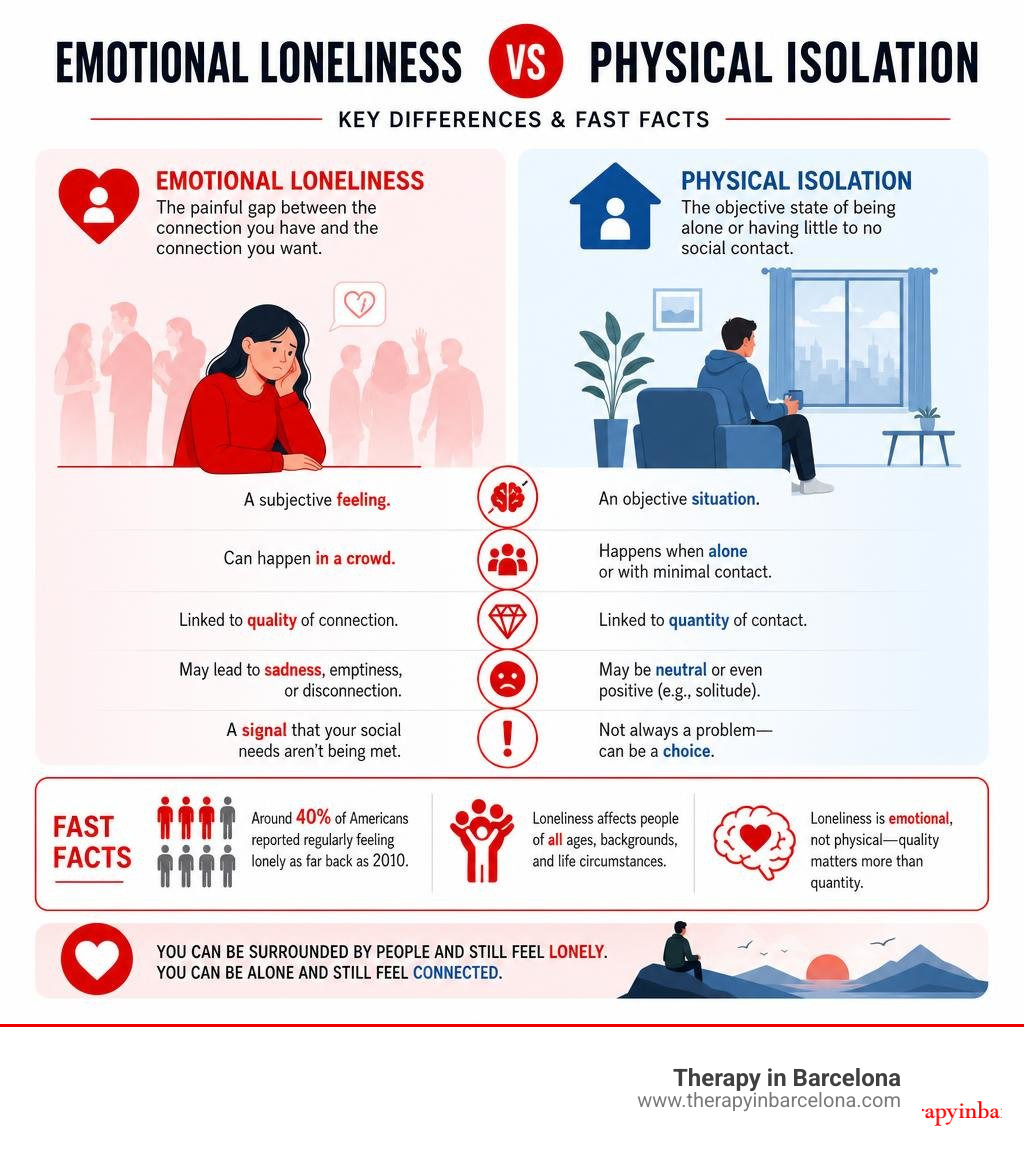
What does being lonely mean? At its core, loneliness is not about being physically alone — it is the painful gap between the social connection you have and the connection you actually want. You can feel it in a crowded room, at a dinner table with family, or in a city full of people.
Here is a quick breakdown:
- Loneliness is emotional, not physical. It is a subjective feeling of disconnection, not simply a matter of how many people are around you.
- It is different from solitude. Solitude is chosen time alone that can feel restful and restorative. Loneliness is an unwanted sense of isolation that hurts.
- It is about quality, not quantity. You can have dozens of contacts and still feel deeply unseen or unheard.
- It is a signal, not a character flaw. Like hunger, loneliness is your mind and body telling you that something important is missing.
- It affects everyone. Around 40% of adults reported regularly feeling lonely in a landmark AARP Loneliness Study, and the experience cuts across all ages, backgrounds, and life circumstances.
Many of us feel lonely at some point. But when that feeling becomes persistent — a kind of inner desert that follows you from room to room, city to city — it can quietly erode your mental and physical health in ways that are easy to overlook.
That is especially true for people who have moved abroad. Many expats arrive in Barcelona hoping for a fresh start, only to find that connection takes longer than expected. They may be surrounded by a buzzing city, have colleagues at work, and stay in touch with friends back home. And yet, many evenings still bring a hollow feeling that is hard to name. This is something many internationals in Barcelona, and across Spain from Valencia to Malaga, describe in therapy.
This guide explores what loneliness really is, why it happens, how it affects you, and what you can do about it.
What Does Being Lonely Mean?
To truly address this feeling, we have to look closely at its definition. Standard language references describe it in slightly different ways. The Cambridge Dictionary definition of lonely focuses on the unhappiness of not being with other people, while the Collins Dictionary definition of lonely highlights the sadness of lacking companionship.
Meanwhile, the Oxford Advanced Learner’s Dictionary (and its UK counterpart) points out that the word can also describe isolated places or situations that make you feel cut off.
But dictionary definitions only scratch the surface. In psychology, loneliness is defined as “social pain” — a biological warning system designed to motivate us to seek out the safety of the group. Just as physical pain protects us from bodily harm, this emotional ache is meant to protect our social bonds.
When you read about the unspoken truth about loneliness, you begin to understand that it is a deeply personal, subjective experience. It is the internal sense of being entirely on your own, feeling as though no one truly understands or cares about what you are going through.
Deciphering What Does Being Lonely Mean in a Crowded Room
It is a common paradox: you are at a lively party in Madrid, or walking through a bustling market in Valencia, yet you feel completely isolated. This happens because we experience different types of loneliness:
- Social Loneliness: This is the lack of a wider social network. It is what happens when you do not have a group of friends, colleagues, or neighbours to share activities with.
- Emotional Loneliness: This is the absence of a deep, nurturing relationship. You might have plenty of acquaintances, but you lack a close confidant or partner with whom you can share your innermost thoughts.
Feeling lonely in a crowd is often emotional loneliness. You may be around people, but if you feel unseen, guarded, or unable to be yourself, the connection can feel empty. It is not about how many people are nearby. It is about whether you feel known, accepted, and emotionally safe.
Solitude vs Loneliness: The Key Difference
Being alone and feeling lonely are entirely different states of being.
Solitude is a chosen, positive state. It is time spent alone that is restorative, peaceful, and creative. When you choose solitude, you are comfortable in your own company. It provides space to reflect, recharge, and rest.
Loneliness, on the other hand, is an unchosen, negative state. It is marked by a longing for connection and a feeling of painful isolation. According to the scientific overview on Wikipedia’s entry on Loneliness, solitude can easily turn into loneliness if the separation from others is forced upon us or lasts longer than we desire.
Learning to enjoy your own company is a skill, but as essays on why feeling lonely doesn’t mean something is wrong point out, we must also acknowledge that our need for others is an innate, healthy part of being human.

Why We Feel Lonely in a Modern World
We are more digitally connected than at any other point in human history, yet rates of loneliness continue to climb. Our modern lifestyles, while convenient, often work against our biological need for deep, face-to-face community.
The Expat Experience and Post-Migration Isolation
Moving to a new country is an exciting adventure, but it is also one of the most common triggers for chronic loneliness. When you relocate to cities like Barcelona, Málaga, Alicante, or Sevilla, you do not just leave behind your physical home; you leave behind your entire support system.
Moving abroad often means leaving behind a web of relationships built over many years. Friends who know your history, family nearby, familiar routines, and easy cultural shorthand may suddenly be gone. In Spain, many internationals find themselves starting from zero. The challenges can stack up quickly:
- The Language Barrier: Not speaking fluent Spanish or Catalan can make simple daily interactions feel exhausting and isolating.
- Cultural Differences: Navigating foreign social norms, bureaucratic systems, and local friendship circles takes an immense amount of mental energy.
- The Loss of Shared History: Making new friends takes time. It is hard to find people who “just get you” without years of shared context.
Whether you are a digital nomad working from a café in Gran Canaria, a retiree settling in Marbella, or a young professional in Zaragoza, the post-migration transition can leave you feeling untethered. This is why proactive strategies are needed for coping with isolation when adjusting to a new life abroad.
How Modern Technology and Social Media Distort Connection
We often turn to our screens to cure our isolation, but this can make the problem worse. Passive scrolling through curated feeds can trigger “comparative loneliness” — the feeling that everyone else is living a vibrant, highly connected life while you are left out.
Social media often replaces high-quality, real-world interactions with superficial digital bonds. We trade deep conversations for likes and comments. While online spaces can be helpful, the Mind guide to loneliness emphasises that the way we use technology matters. Using it to organise real-world meetups or active discussions helps, while passive consumption tends to increase feelings of isolation.
How Loneliness Affects Your Physical and Mental Health
Loneliness is not just an unpleasant mood; it is a state of chronic stress that has measurable, damaging effects on the human body and mind.
What Does Being Lonely Mean for Your Long-Term Health?
When we are lonely, our nervous system perceives the world as unsafe. This triggers a low-grade, constant “fight-or-flight” response, raising cortisol levels and causing systemic inflammation.
Research shows that chronic loneliness has severe physical consequences:
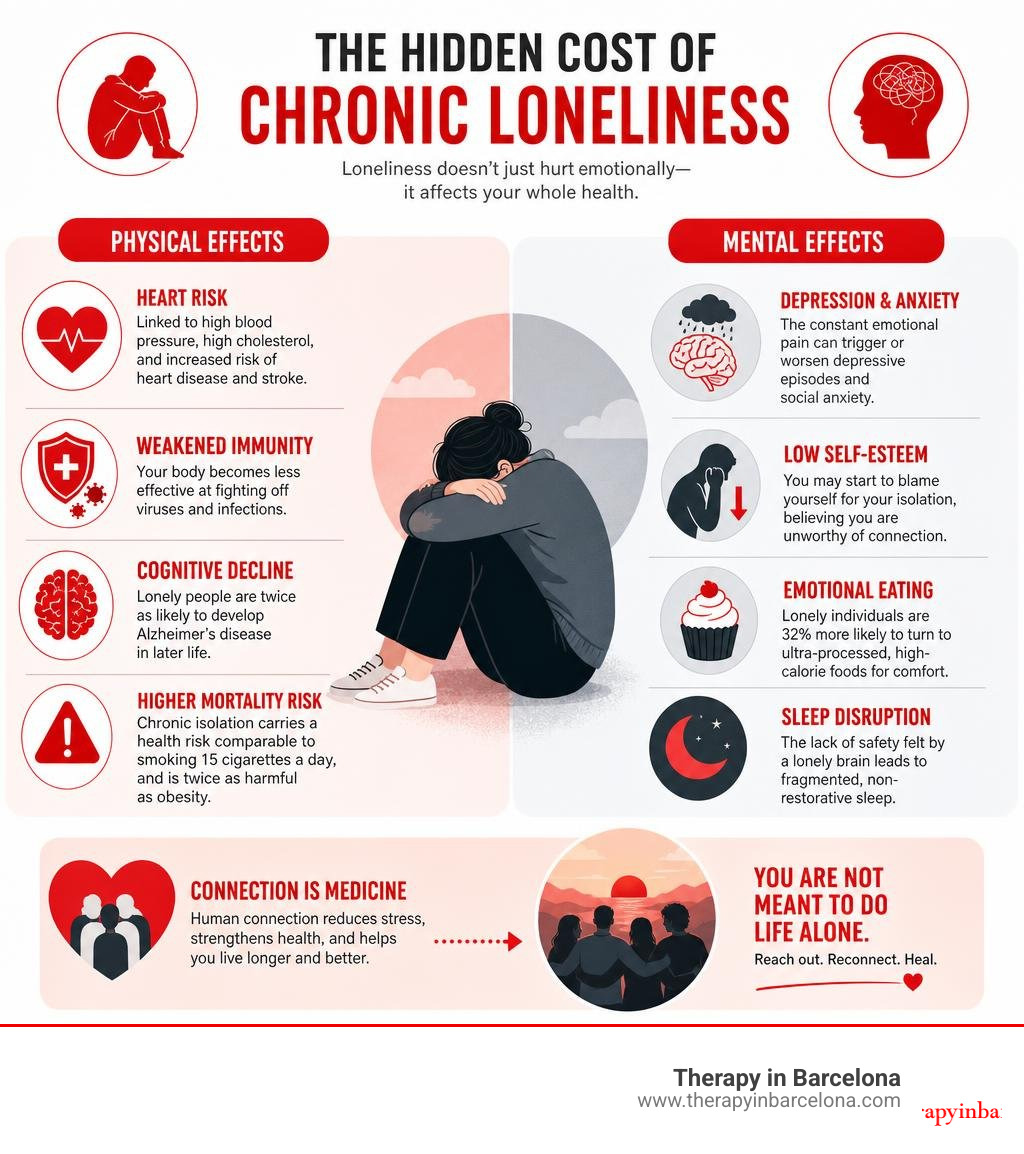
- Cardiovascular Health: Loneliness can contribute to chronic stress, which may affect blood pressure, cholesterol, and overall heart health over time.
- Weakened Immunity: When loneliness becomes long-term, your body may become less effective at fighting off viruses and infections.
- Cognitive Health: Ongoing loneliness can make it harder to stay mentally engaged, focused, and emotionally balanced, especially later in life.
- Mortality: Chronic isolation carries a health risk comparable to smoking 15 cigarettes a day, and is twice as harmful as obesity, as demonstrated in a landmark meta-analysis in PLOS Medicine.
In Europe, statistics show that 8.6% of the adult population experiences frequent loneliness, and 20.8% experiences social isolation, according to a European Commission Joint Research Centre report. These are not just numbers; they represent a major public health crisis. Recognising these physical impacts is crucial for understanding why we must address the signs of chronic loneliness early.
The Psychological Toll: Persistent Low Mood, Worry, and Self-Esteem
The mental health impacts of loneliness are equally profound. When you feel disconnected, your brain develops a “negativity bias.” You begin to perceive social interactions as threatening, expecting rejection before it even happens. This can make you withdraw further, creating a self-perpetuating cycle.
Loneliness is also closely linked to:
- Persistent Low Mood and Worry: The constant emotional pain can trigger or worsen feelings of being persistently down, unmotivated, or socially anxious.
- Low Self-Esteem: You may start to blame yourself for your isolation, believing you are unworthy of connection.
- Emotional Eating: Loneliness can make comfort foods more tempting, especially when your brain is looking for a quick way to soothe stress or emotional pain.
- Sleep Disruption: A lonely brain can feel less safe and settled, which may lead to broken, restless, or non-restorative sleep.
Breaking this cycle requires conscious effort and practical tools, such as the 7 ways to stop feeling lonely.
Steps to Reconnect and Heal
If you are currently sitting in that inner desert, know that you do not have to stay there. Connection is a skill that can be rebuilt with small, steady steps.
Cultivating Meaningful Connections Abroad
Building a new community from scratch takes time, but there are practical ways to speed up the process:
- Join Local Groups: Seek out clubs, sports, or classes centered around your hobbies. This gives you a natural, low-pressure environment to meet people.
- Use Online Communities Wisely: Platforms can help you find your feet. Look for local expat groups or interest-based forums to find like-minded people.
- Be Proactive: It takes courage to ask someone for a coffee, but most people — especially fellow expats — are also looking for connection.
For practical advice on building these bonds, read about making friends abroad and explore tips on discovering English-speaking communities in your new city. You can also read more about how online communities can help you find your feet as an international and creating a sense of belonging as an international: tips for building community abroad.
Reframing Solitude and Overcoming Negativity Bias
While you are building your social circle, it is equally important to work on your relationship with yourself.
- Practice Self-Compassion: Stop blaming yourself for feeling lonely. Acknowledge that it is a normal human response to a difficult transition.
- Reframe Alone Time: Try to view your solitary moments not as forced isolation, but as an opportunity for restorative solitude. Use this time to read, create, or explore your new city on your own terms.
- Challenge Negative Thoughts: When your brain tells you that people do not want to talk to you, gently challenge that assumption. It is often just the negativity bias talking.
For more guidance on this internal work, check out these practical tips to manage loneliness and learn what to do when loneliness strikes: your guide to finding connection.

Finding Your Path to Support
Sometimes, the feelings of isolation are too deep to navigate on your own. If loneliness has turned into a persistent feeling of being overwhelmed, unmotivated, or constantly anxious, seeking professional guidance can help you find your way back to connection.
Comparing Your Support Options in Spain
When looking for mental health support as an international in Spain, you have several paths. Here is a clear, mobile-friendly comparison of your options:
1. The Spanish Public Healthcare System (CatSalut / Seguridad Social)
- How it works: You access this through your local public health centre (CAP) by seeing a GP first.
- Pros: It is fully funded and free at the point of use.
- Cons: Wait times for mental health specialists can be extremely long. Furthermore, finding a therapist who speaks fluent English or your native language is very rare in the public system.
2. Large Online Therapy Platforms
- How it works: Global directories or apps that match you with therapists online based on a brief questionnaire.
- Pros: They are often convenient and offer quick booking.
- Cons: These platforms often lack local, cultural context. They also use automated algorithms for matching and have faced criticism regarding strict data privacy, sometimes selling user data to third parties.
3. Local Spanish-Speaking Private Practices
- How it works: Private clinics located throughout Spanish cities.
- Pros: Great for local integration if you are highly fluent in Spanish.
- Cons: If you prefer to express complex emotions in English or your native tongue, the language barrier can hinder the depth of your therapy. They may also lack understanding of the unique expat journey.
4. Therapy in Barcelona
- How it works: A specialised, trusted group practice established in 2011, providing both in-person sessions in Eixample and online therapy worldwide.
- Bespoke Matching: We do not use automated algorithms. We take the time to personally match you with the therapist best suited to your specific personality and needs.
- Expat-Specific Cultural Sensitivity: Our team consists of qualified, psychology-trained therapists who are expats themselves. We understand the unique challenges of cultural adjustment, language barriers, and post-migration isolation firsthand.
- Strict Privacy: We operate with high professional standards and strict confidentiality, with absolutely no selling of your personal data.
- High-Quality Private-Pay Care: As a private-pay service, we focus on delivering tailored, evidence-based care. For those with financial need, some of our therapists offer sliding scale fees—please enquire about this.
To understand how this journey begins, you can read about what the therapy process looks like at our practice.
Frequently Asked Questions About Loneliness
Can you actually die of loneliness?
While you cannot die directly from the feeling of loneliness, chronic loneliness significantly increases your risk of mortality. The chronic stress and systemic inflammation it causes raise your risk of heart disease, stroke, and a weakened immune system. It is also linked to higher rates of persistent low mood and suicidal thoughts, making it a serious condition that requires attention.
Why do I feel lonely when I have friends and family?
This is because loneliness is about the quality and emotional depth of your relationships, not the quantity. If you feel you cannot be your authentic self, or if your relationships lack deep, mutual understanding, you will experience emotional loneliness. True connection requires vulnerability and mutual trust.
Which age groups are most vulnerable to feeling lonely?
Loneliness can affect anyone, but young adults and older adults are often at higher risk. Big life changes, like leaving home, starting university, moving for work, retirement, bereavement, or reduced mobility, can all make meaningful connection harder to maintain.
Finding Your Way Forward
Understanding what it means to be lonely is the first step toward leaving your inner desert behind. Loneliness is not a permanent state of being, nor is it a personal failure. It is simply a human signal that you are ready for deeper, more authentic connections.
Founded by Australian psychologist Leigh Matthews, Therapy in Barcelona offers culturally sensitive support for internationals navigating life, relationships, and belonging in Spain.
If you are ready to take that first step toward connection, we are here to support you.
If you’d like support, book a Free Discovery Call.
