


Is it normal to have no friends as an adult?

What do I do if I have no friends is a question more people are asking than you might think — and there are real, practical answers.
If you’re looking for a quick overview, here’s where to start:
- Recognise it’s more common than it seems – A lot of adults go through periods with few or no close friends, even if nobody talks about it openly.
- Understand what might be behind it – Big life changes, shyness, anxiety, working long hours, or moving to a new place can all make connection harder.
- Start small and stay consistent – Try brief conversations, join groups built around shared interests, and give people time to become familiar.
- Be patient with friendship-building – Close relationships usually grow slowly through repeated contact, not one perfect conversation.
- Reframe time alone – Being alone is not always the same as being lonely; learning the difference can help you respond with more self-compassion.
- Get support if you need it – Therapy can help you work through social fears, build confidence, and make socialising feel more manageable.
You scroll through your phone on a Friday night. Everyone else seems to be at dinner with friends, laughing in group photos, making plans. Your screen stays quiet. If that feels familiar, you are not alone in feeling alone.
Loneliness is more common in adulthood than many people realize. One survey often cited in discussions about friendship found that 12% of Americans reported having no close friends. That does not mean something is wrong with you. It points to a broader pattern: many adults are finding it harder to build and keep close connections.
And yet, the silence around it can make it feel like a personal failure. Like something must be wrong with you. It rarely is.
For many people — especially those who have moved to a new city or country, changed jobs, or gone through a major life shift — friendlessness is less about who you are and more about where you are in life. Expats in cities like Barcelona, Valencia, or Madrid often describe a specific kind of loneliness: surrounded by people, in a beautiful place, and still quietly aching for someone to call.
This article is for anyone sitting with that feeling. We will look at why it happens, what you can actually do about it, and how support — including therapy — can help when the isolation feels too heavy to shift alone.
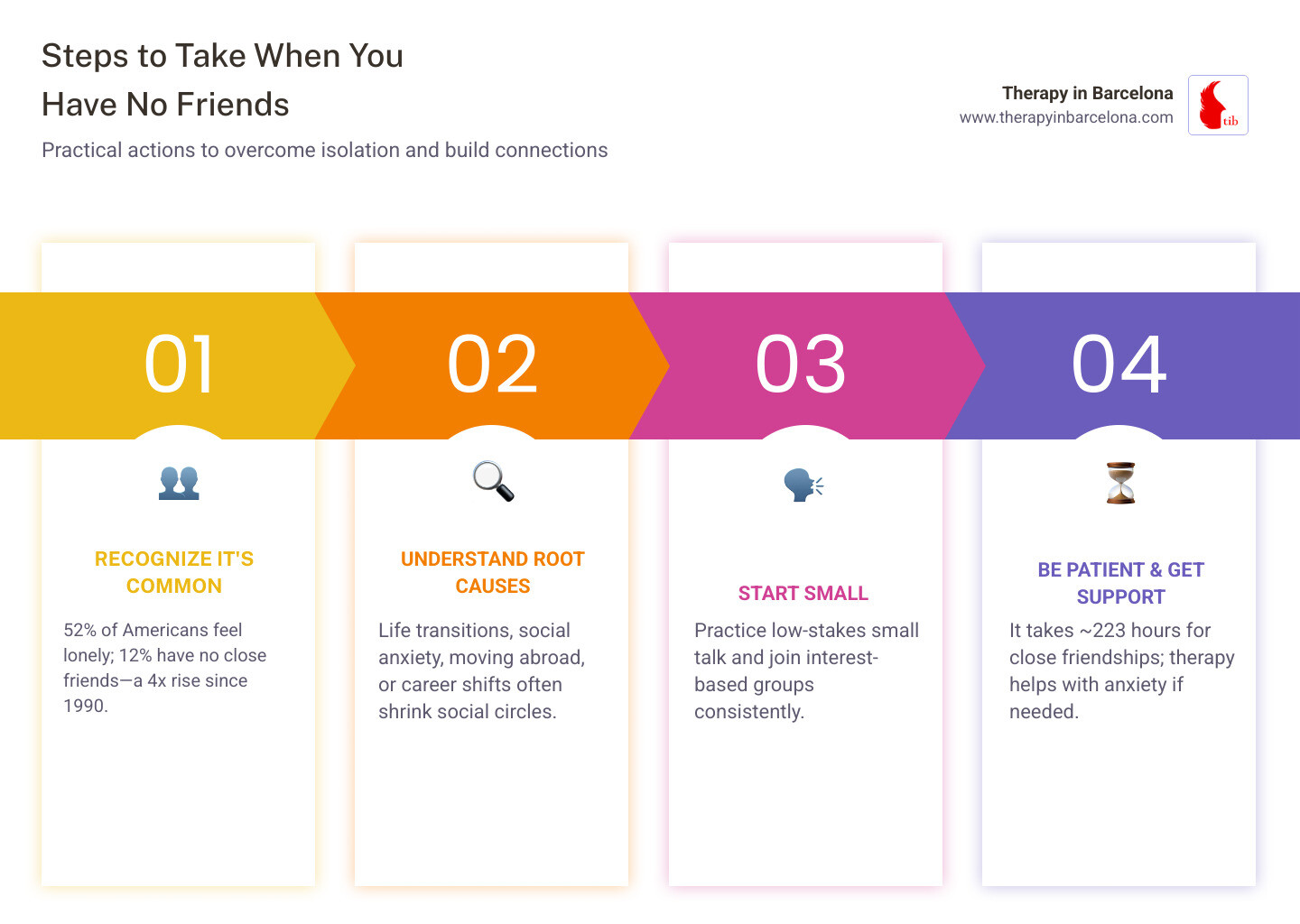
The short answer is yes. While society often projects an image of adults with sprawling, effortless social circles, the reality is far more isolated. Statistics show a sharp decline in close friendships over the last few decades. 12% of Americans report having no close friends, a fourfold increase since the 1990s.
This trend is particularly visible among millennials, with nearly 30% reporting they lack a close confidant. The “loneliness epidemic” isn’t just a buzzword; it is a documented social shift. We live in an era of high digital connectivity but low physical community.
There is a significant social stigma attached to being friendless, which often prevents people from reaching out. We worry that if we admit to being lonely, people will assume we are “broken” or “unlikable.” But the unspoken truth about loneliness is that it is often a byproduct of modern life — frequent moves, the decline of communal spaces, and the sheer exhaustion of the 40-hour work week.
It is also important to distinguish between quantity and quality. Having fifty acquaintances on social media is not the same as having one person you can call at 2:00 AM. Many adults find that their “friend list” naturally dwindles as they prioritise deeper, more meaningful connections over the surface-level groups they had in their twenties.
Why do I have no friends? Understanding the root causes
When you find yourself asking why do I have no friends, the first step is looking at the “why” without judgment. Usually, the reasons are circumstantial rather than a reflection of your character.
Life transitions are the most common culprits. Graduating from university, changing careers, or going through a breakup can suddenly dissolve the social structures that previously provided “built-in” friends. Without the shared environment of a classroom or an office, maintaining those bonds requires an intentionality that many of us weren’t taught.
Psychological factors matter too. Shyness or social anxiety can make reaching out feel exhausting, especially when small talk brings up fear of rejection. Stress can also trigger a protective “freeze” response, leaving you feeling numb, detached, or distant from other people. When that happens, connection can feel hard even if you want it.
What to do when loneliness strikes often involves identifying these internal blocks. Trust issues from past betrayals can also lead us to unconsciously push people away before they get too close. We might tell ourselves we “prefer being alone” as a way to protect ourselves from the vulnerability of being seen.
The impact of the expat experience on your social circle
For the international community in Spain, the struggle is amplified. Moving to a new city like Valencia or Madrid is an incredible adventure, but it also strips away your existing support system in one go.
Relocation stress is real. You are navigating a new language, a different bureaucracy, and a culture that may have very different social “rules” than your home country. Why it is so hard to make new friends abroad often comes down to the “closed circle” phenomenon. Locals often have established groups from childhood or university, making it feel impossible to break in.
Language barriers can also make you feel like a “flatter” version of yourself. If you can’t express your humour or your nuances in Spanish or Catalan, you might withdraw, leading to further isolation. This is why many expats find themselves stuck in a “honeymoon phase” of meeting other travellers who eventually leave, never quite building the deep, rooted connections they crave.
What do I do if I have no friends and feel like a “red flag”?
There is a persistent myth that being friendless is a sign of a defective personality. This internalised shame is often the biggest hurdle to making new connections. You might think, “If I tell someone I don’t have friends, they’ll wonder what’s wrong with me.”
In reality, most people are too busy worrying about their own social standing to judge yours. Authenticity is actually a magnet for connection. When you stop trying to “perform” having a busy social life and instead focus on genuine interaction, you become more approachable.
Mindset shifts are essential here. Instead of seeing your current situation as a permanent state, view it as a seasonal transition. 7 easy ways to stop feeling lonely include practicing self-compassion and recognising that your worth is not defined by the number of unread messages on your phone.
Practical steps to connection

Making friends as an adult is less about “spark” and more about “logistics.” One of the most powerful tools in your social arsenal is the Mere Exposure Effect. This psychological principle states that we tend to develop a preference for people simply because we see them often.
This is why “one-off” events rarely lead to deep friendships. To make it work, you need consistency. Research shows it takes 223 hours to develop a close friendship. That sounds like a lot, but it breaks down into simple habits: showing up to the same café, the same yoga class, or the same volunteer shift every week.
Practical tips for starting:
- Practice low-stakes small talk: Chat with the barista in your Eixample neighbourhood or the person next to you in line. It builds your “social muscle.”
- Focus on interest-based groups: Don’t just go to “networking” events. Join a hiking group in Málaga or a book club in Seville. When you have a shared task, the pressure to be “interesting” disappears.
- Be the one to follow up: Most people are waiting for someone else to make the first move. If you had a good 5-minute chat, say, “I really enjoyed this. Would you want to grab a coffee next Tuesday?”
How to build a social life from scratch
If you are starting from zero, digital tools can bridge the gap. Apps are common in hubs like Alicante and Barcelona. They allow you to filter for people who are explicitly looking for the same thing you are: connection.
However, don’t overlook the people already in your orbit. Coworkers are a natural starting point. While we often try to keep work and life separate, practical tips to manage loneliness and isolation suggest that “work friends” can provide the daily social “nutrition” we need to feel human.
Shared hobbies are the most effective way to bypass the awkward “interview” stage of a new friendship. Whether it’s a padel team or a pottery workshop, doing something with your hands makes conversation flow more naturally.
What do I do if I have no friends and work from home?
The rise of remote work has been a double-edged sword. While it offers freedom, it also removes the “weak tie” interactions that keep us grounded. Weak ties are the people you don’t know well — the security guard, the person at the next desk, the regular at the gym — who nonetheless provide a sense of belonging.
If you work from home, you have to engineer these interactions. Creating a sense of belonging as an international often requires joining a co-working space. Even if you don’t talk to anyone, being in a room with other people working can reduce the “echo chamber” of isolation.
Digital nomad hubs, like those in Gran Canaria, offer built-in communities. If you are struggling, consider spending a few weeks in a place designed for social interaction. Online communities can also help, provided they are a supplement to — and not a replacement for — face-to-face time.
Reframing your mindset: From lonely to comfortably alone
There is a profound difference between loneliness and solitude. Loneliness is a painful gap between the connection you have and the connection you want. Solitude is the peaceful state of being alone without being lonely.
Learning to be “comfortably alone” is a skill that actually makes you better at making friends. When you aren’t desperate for connection, you choose better friends. You become more discerning. You can practice “romanticising” your life — taking yourself on “self-dates” to a beautiful park in Madrid or a museum in Barcelona.
10 things to do when you’re feeling lonely often start with self-care. Mindfulness helps you sit with the physical sensation of loneliness without letting it spiral into catastrophic thoughts. Pets can also provide incredible companionship; the unconditional bond with a dog or cat can lower cortisol levels and provide a reason to get outside and interact with other pet owners.
Choosing the right support for your social journey
Sometimes, the weight of being alone is too much to lift with just “tips and tricks.” If isolation is fueling your depression, professional guidance can be the turning point. Therapy provides a safe space to practice social skills, dismantle the “red flag” myths you believe about yourself, and address the root causes of your withdrawal.
When looking for support in Spain, you have several options:
Public Health Systems In Spain, you can access mental health care through the state system (CatSalut in Catalonia). This is a low-cost option covered by your social security. However, be aware that there are often long waiting lists, and sessions may be infrequent. You also cannot choose your therapist, and finding an English-speaking specialist can be a significant challenge.
Large Online Platforms Apps and large-scale websites offer convenience and lower price points. While they are accessible, they often lack the personal touch. High therapist turnover is common, which can disrupt your progress. Furthermore, these platforms are often based outside of Spain and may not understand the specific cultural nuances of the expat experience here.
Specialised Private Practice (Therapy in Barcelona) Therapy in Barcelona offers more tailored support. As a group practice with expat-aware therapists, we understand how loneliness, cultural adjustment, and being far from home can affect your social life. We focus on personalised therapist matching, private care, and culturally sensitive support for concerns like social anxiety, isolation, and relationship challenges.
Frequently Asked Questions about having no friends
Does having no friends mean something is wrong with me?
No. Not having friends right now does not mean there is something wrong with you. In many cases, friendlessness comes from timing, life changes, relocation, burnout, shyness, or not yet finding people you genuinely connect with. A quiet social life is not a measure of your value. Your worth is not defined by how busy your phone is or how many plans you have this weekend. You are not broken, and you are definitely not the only person going through this.
Should I seek therapy if I am lonely?
If your loneliness is persistent, if it’s making you feel depressed, or if social anxiety is preventing you from even trying to connect, therapy can be incredibly helpful. It isn’t just for “crisis” moments; it’s a tool for managing loneliness and isolation and building the resilience you need to navigate a new social landscape.
How do I maintain friendships once I make them?
Consistency is key. Modern friendship requires reciprocity. If someone invites you out, try to say yes, even if you’re tired. Reliability builds trust. Building community abroad involves scheduling regular check-ins and being willing to be vulnerable. You don’t need a huge group; focusing on one or two quality connections is often more sustainable.
Conclusion
If you are sitting in a café in Barcelona or a flat in Valencia feeling like the only person in the world without a “squad,” please know that your situation is temporary. Loneliness is a signal, like hunger or thirst, telling you that a basic human need isn’t being met. It is not a life sentence.
Leigh Matthews, our founder and an Australian Psychologist who has lived in Barcelona since 2011, started Therapy in Barcelona because she saw how many internationals were struggling in silence. She moved here for love, faced the challenges of cultural adaptation and realised that expats need a sanctuary where their unique experiences are understood.
You don’t have to navigate this isolation alone. Whether you are a digital nomad in Gran Canaria, a student in Madrid, or a family in Alicante, we are here to help you find your footing again. We offer sessions in our Barcelona office and online therapy to expats worldwide.
If you’re ready to start building a more connected life, the first step is simple. Book a Free Discovery Call today. We will listen to your story and match you with a therapist who can help you move from “what do I do if I have no friends” to a place of genuine belonging.
