


What Anger in Relationships Is Really Telling You

Anger in relationships is one of the most common concerns couples bring to therapy — and one of the most misunderstood.
Before we go any further, here is the short answer:
Is anger in a relationship normal?
- Yes. Feeling angry with your partner is a completely normal part of being in a close relationship.
- The problem is not the anger itself — it is what happens when it goes unmanaged or gets expressed in harmful ways.
- Anger almost always signals something deeper: an unmet need, a fear, a feeling of disconnection, or an old wound that has been reopened.
- Healthy anger, expressed with respect and honesty, can actually strengthen a relationship.
- Unhealthy anger — through criticism, contempt, aggression, or stonewalling — erodes trust over time.
What anger usually points to:
- Feeling unheard or dismissed by your partner
- Unmet emotional needs or expectations
- Fear of rejection or abandonment
- A sense of disconnection or loneliness within the relationship
- Past experiences or childhood wounds being triggered in the present
Maybe you moved to Barcelona expecting connection and adventure, but find yourself snapping at your partner over small things: dishes left out, plans cancelled, silences that stretch too long. On the surface, it can look like irritability. Underneath, it may be loneliness, disconnection, and the hard-to-name feeling of not being seen.
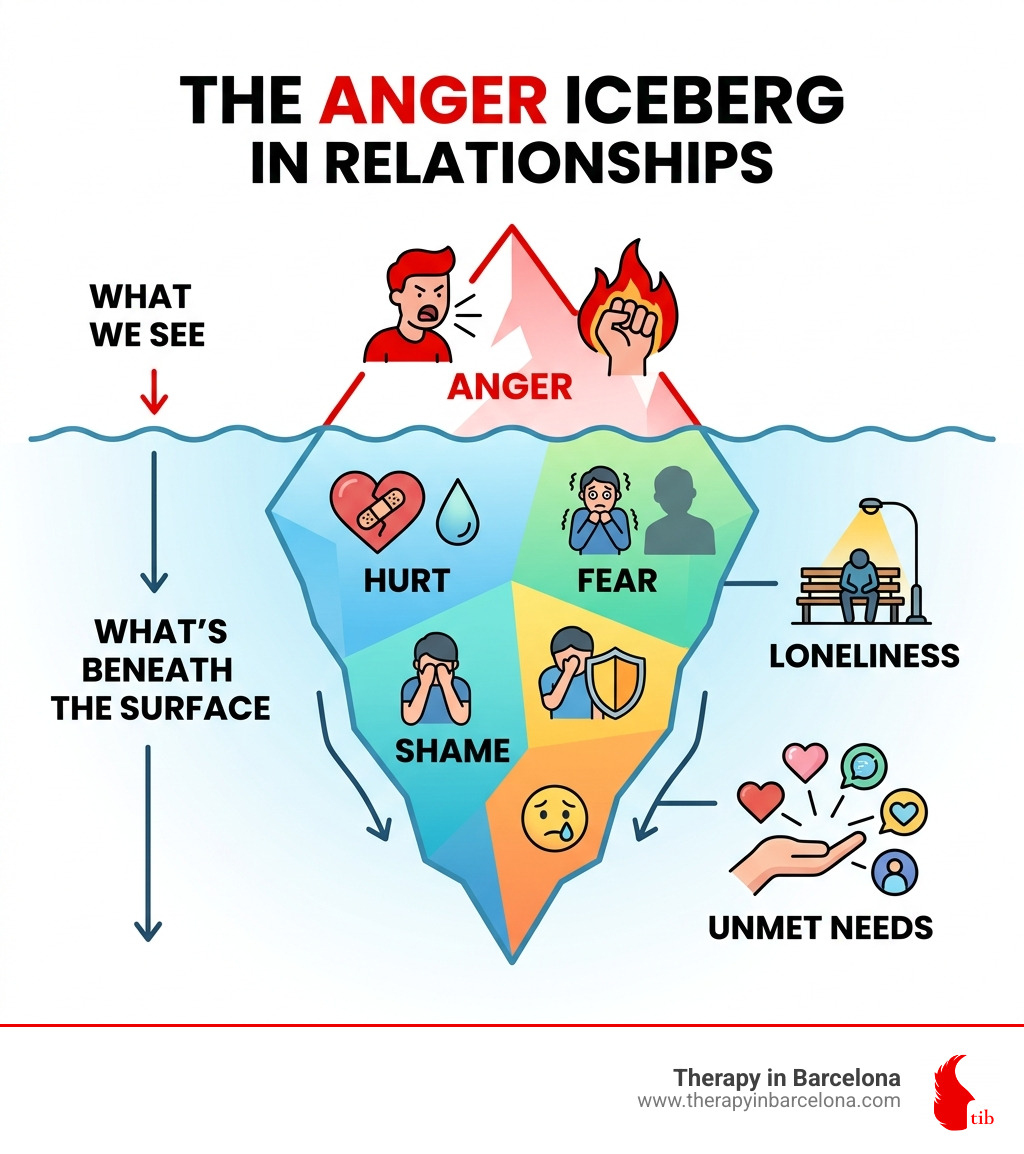
That is what makes anger so tricky. It shows up loud and visible, but what it is actually pointing to tends to be quiet and vulnerable. Researchers and therapists often describe it as an iceberg: the anger is the part above the water, but the real weight — the hurt, the fear, the shame — sits beneath the surface, out of sight.
Research consistently backs this up. Studies suggest that 89% of couples report their daily satisfaction being gradually worn down by unmanaged anger. And yet anger, when understood and handled well, is not the enemy of a good relationship. It can be a doorway into deeper honesty and connection — if you know how to work with it.
This guide will help you do exactly that.
Is Anger in Relationships Always a Red Flag?
When we feel the heat of frustration rising, it is easy to assume the relationship is in trouble. But anger itself isn’t necessarily a red flag. In fact, anger is a biological alarm system. It tells us when a boundary has been crossed or when we feel a sense of injustice.
The real distinction lies between healthy and unhealthy expressions. Healthy anger is assertive; it says, “I feel hurt because I value our time together, and I’m frustrated that we didn’t get to connect today.” It aims to solve a problem, not wound a partner. On the other hand, unhealthy anger uses criticism, contempt, or withdrawal to gain a false sense of control.
According to research from the Gottman Method, the “Masters of Relationships” do not avoid anger. They keep about five positive interactions for every negative one. Even in a heated discussion, they add enough respect, warmth, and repair to protect the bond. When that ratio slips, unmanaged anger can start to weaken the relationship’s foundation.
Understanding the “Anger Iceberg” in Your Partnership
To handle anger in relationships, we have to look at what lies beneath. If you think of anger as a “puffer-fish” emotion, it makes sense: it expands to make us look big and scary when we actually feel small and vulnerable.
Most anger is a “secondary” emotion. This means it is a protective layer covering up “primary” raw feelings like:
- Hurt: “It feels like I don’t matter to you.”
- Fear: “I’m afraid you’re pulling away from me.”
- Shame: “I feel like I’m failing as a partner.”
When we only communicate the top of the iceberg, our partner reacts to the “snap” rather than the “sorrow.” Identifying these underlying issues is the first step toward breaking the cycle. Instead of asking “Why am I so angry?”, try asking “What is my anger trying to protect?”
Healthy Expression vs Abusive Patterns
There is a clear line between a heated argument and an abusive pattern. Healthy expression involves “softened startups”—starting a conversation without blame—and using “I” statements. For example, “I feel overwhelmed when the house is messy” is far more effective than “You never help around here.”
Red flags that suggest anger has crossed into unhealthy territory include:
- Physical aggression: Any form of hitting, pushing, or breaking things.
- Stonewalling: Shutting down and refusing to speak for hours or days.
- Contempt: Using sarcasm or insults to make a partner feel inferior.
- Gaslighting: Making a partner doubt their own reality or feelings.
The Neuroscience of the “Snap”
Have you ever said something in the heat of the moment that you immediately regretted? There is a biological reason for that. When we are triggered, the amygdala—the brain’s emotional alarm centre—fires about 12 milliseconds before we are even consciously aware of it.
This creates a tiny but vital six-second intervention window. Within those first few seconds of activation, connectivity to the prefrontal cortex (the part of the brain responsible for logic and empathy) can decrease by up to 40%. You are effectively operating without your full “rational” brain online.
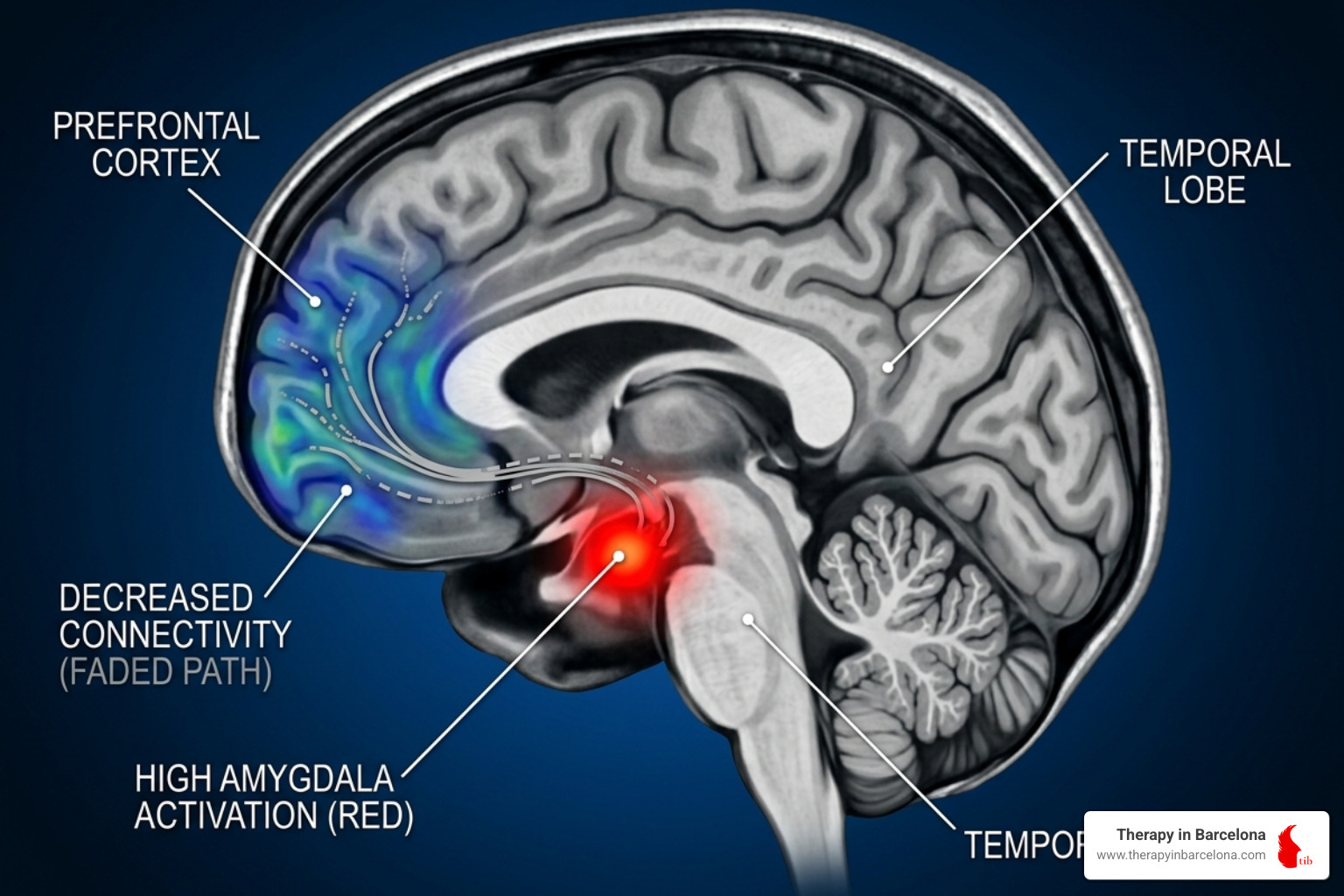
During “physiological flooding,” your heart rate can pass 100 bpm and stress hormones surge. Your body is ready to fight, not listen. The first chemical wave of anger may pass quickly, but repeated blaming or threat-focused thoughts can keep it going.
How Attachment Styles Fuel Anger in Relationships
Our early life experiences shape how we respond to conflict as adults. About 85% of recurring relationship arguments are driven by the anxious-avoidant pursuit-withdrawal cycle.
- The Anxious Partner: Often pursues the other to get reassurance. When they feel disconnected, their fear of abandonment turns into “protest anger”—a loud plea to be seen and “claimed.”
- The Avoidant Partner: Often withdraws to regulate their own overwhelm. They might see the other’s anger as an attack and shut down to protect themselves, which only fuels the anxious partner’s rage.
This cycle can feel like “emotional homicide” (the rage of the pursuer) meeting “emotional suicide” (the silence of the withdrawer). Understanding that these patterns are often rooted in childhood helps couples move from blaming each other to tackling the cycle together.
The Power of Co-regulation
Humans are wired for social connection. While self-regulation, or calming yourself down, matters, research on co-regulation shows that a calm partner’s presence can help soothe your nervous system far more effectively.
Simple acts like hand-holding can reduce the brain’s threat response by up to 34%. When one partner can remain calm and present, their “mirror neurons” help the angry partner’s nervous system return to a state of safety. This is why a partner saying, “I can see you’re hurting, and I’m here with you,” is often more powerful than a logical argument.
Practical Tools to De-escalate the Heat
To manage anger in relationships, we need tools that work in the moment, not just in theory. The goal is to catch the “snap” before the prefrontal cortex shuts down.
The STOP-BREATHE-GROUND Protocol:
- STOP: As soon as you feel your chest tighten or your voice rise, stop moving and stop speaking.
- BREATHE: Take a slow, deep breath with an extended exhale. This signals your parasympathetic nervous system to start calming down.
- GROUND: Name three things you can see and two things you can hear. This pulls you out of your “anger narrative” and back into the present moment.
If your heart rate is still high, take a 20-minute physiological break before continuing. That gives your body time to come down from stress hormones and regain perspective. During the break, do not replay the argument in your head. Do something regulating instead: walk around the block in Valencia, stretch, breathe slowly, or listen to calming music. These body-based regulation techniques help your nervous system reset so you can return to the conversation with more clarity.
Repairing the Bond After a Blow-up
The goal of a healthy relationship is not to never fight; it is to repair effectively. Repairing after an outburst is what builds long-term resilience.
One effective framework is the REACH Protocol:
- Reconnect: Initiate a “bid” for connection, even a small one.
- Empathise: Try to see the situation from your partner’s perspective.
- Acknowledge: Own your part in the escalation without “buts.”
- Communicate: Share the vulnerable need that was under the iceberg.
- Hear: Listen to your partner’s response without preparing a counter-argument.
Implementing a five-minute transition ritual—like a “check-in” when you both get home from work—can prevent daily irritations from building into a weekend explosion.
When to Seek Professional Help for Anger in Relationships
It is time to consider professional support if:
- You feel like you are “walking on eggshells” to avoid a partner’s temper.
- The same argument happens over and over without resolution.
- Anger is affecting your children or your performance at work.
- Trust has been eroded to the point where you no longer feel like a team.
Therapy isn’t just for “broken” relationships. Structured couples therapy has been shown to result in a 33% reduction in standardized anger scores over 20 weeks. It provides a safe space to unpack the “anger iceberg” and learn new communication skills before the damage becomes permanent.
Therapeutic Approaches That Work
Different couples need different tools. At Therapy in Barcelona, we match you with a therapist who uses evidence-based methods tailored to your specific dynamic:
- The Gottman Method: Focuses on eliminating the “Four Horsemen” (criticism, contempt, defensiveness, and stonewalling) and building a “Sound Relationship House.”
- Emotion-Focused Therapy (EFT): Helps couples identify the attachment fears beneath their anger and create new cycles of connection.
- Cognitive Behavioural Therapy (CBT): Targets the “anger narratives” and thinking patterns that keep people stuck in rage.
- Acceptance and Commitment Therapy (ACT): Teaches mindfulness and helps partners act according to their values rather than their impulses.
Whether you are looking for couples counselling in Barcelona or online support, these approaches offer a roadmap out of the conflict.
Navigating Your Support Options for Anger in Spain
Living as an expat adds a unique layer of stress to any relationship. Whether it’s the isolation of moving to Valencia, the cultural shock of a new job in Madrid, or navigating the bureaucracy in Sevilla, these external pressures often leak into the home. Language barriers and being away from your usual support network can make anger in relationships feel even more intense.
When looking for help, it’s important to understand the landscape of care in Spain.
Understanding Public Health Pathways (CatSalut and others)
Public healthcare, including CatSalut in Catalonia, can be helpful, but access is often limited. Non-urgent mental health support may involve long waits, brief or infrequent sessions, and a more general approach. For expats, language barriers and limited understanding of cross-cultural stress can make it harder to get the right support for relationship anger.
Exploring Large Online Therapy Platforms
Large online platforms can be convenient and affordable. But for relationship anger, they may feel generic. Therapist turnover, limited matching, and privacy concerns can make it harder to build trust or address expat-specific cultural context.
Considering Local Spanish Private Practices
There are many excellent private psychologists in cities like Málaga, Alicante, and Barcelona. However, if your primary language is English, you may still face a “cultural gap.” Even a fluent English speaker might not fully grasp the specific stress of being a “Third Culture Kid” or the unique strain of an intercultural marriage.
Our Approach: Bespoke Expat-Focused Therapy
At Therapy in Barcelona, we offer a private-pay service that bridges these gaps. Founded in 2011 by Leigh Matthews—an Australian Psychologist and expat who has lived the journey herself—we focus exclusively on the international community.
We don’t just assign you to the next available person. Our personalised matching process ensures you are paired with a psychology-trained therapist who understands your specific background. Whether you prefer in-person sessions at our Eixample office or online therapy from anywhere in the world, we provide a culturally sensitive sanctuary.
Frequently Asked Questions about Anger in Relationships
Is it normal to feel intense anger toward my partner?
Yes. Intensity often reflects how much you value the relationship. We don’t get ” angry” at people we don’t care about. The intensity is usually a sign that a core need—like the need to feel safe, respected, or loved—is being threatened.
How long does it take to change toxic anger patterns?
While every couple is different, many see a shift in 6 to 12 sessions. However, deeply ingrained patterns or “rewiring” the brain’s response to triggers can take 6 to 12 months of consistent practice. It is a journey of unlearning old habits and building new neural pathways.
What if my partner refuses to go to therapy?
You can still start individually. When one person changes their response in a relationship “dance,” the other person is forced to change their steps too. Individual therapy can help you manage your own triggers, set healthy boundaries, and decide on your next steps.
Conclusion
Anger in relationships is not a sign of failure; it is a signal that something needs to change. It is information. When you learn to look past the “snap” and see the “iceberg” underneath, you open the door to a level of intimacy that isn’t possible when everything is swept under the rug.
Remember the six-second window. Your brain is trying to protect you, even if it’s doing it in a way that pushes your partner away. Most importantly, you don’t have to navigate this alone.
Therapy in Barcelona was created by Leigh Matthews, an Australian psychologist and expat, to support internationals navigating life abroad. Our qualified therapists help couples and families turn conflict into calmer, healthier connection.
If you are ready to move past the shouting and the silence, we invite you to take the first step. We offer a Free Discovery Call to help you find the right match for your needs. Whether you are in Barcelona, Madrid, or anywhere else in the world, let’s start the conversation.
