


Why Finding the Right Mental Health Professional Matters

Mental health professionals come in many forms: psychologists, psychiatrists, counsellors, social workers. If you are living abroad, working out who does what can feel like another admin task on top of everything else. But getting the right kind of support early can save time, money, and stress.
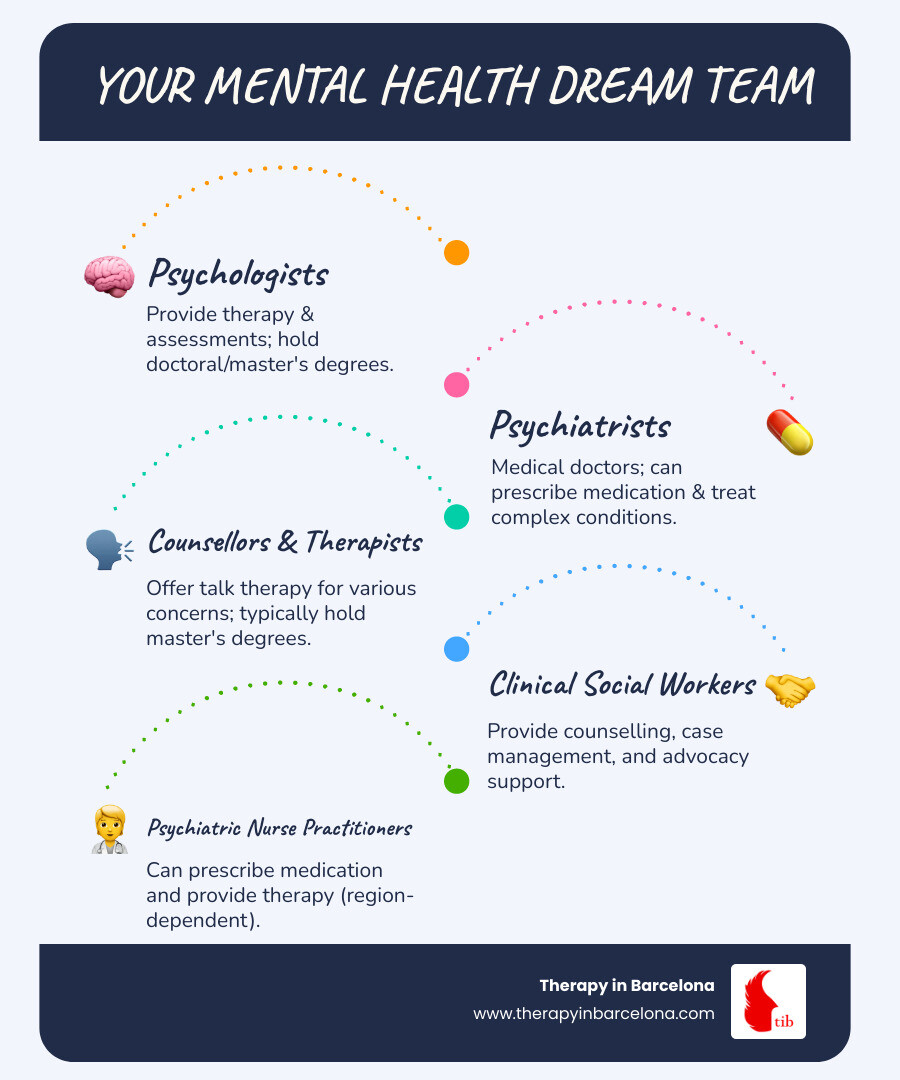
Quick guide to mental health professionals:
- Psychologists hold doctoral or master’s degrees and provide therapy, psychological testing, and evidence-based treatment
- Psychiatrists are medical doctors who can prescribe medication and treat complex mental health conditions
- Counsellors and therapists typically have master’s degrees and offer talk therapy for a wide range of concerns
- Clinical social workers provide counselling, case management, and advocacy support
- Psychiatric nurse practitioners can prescribe medication and provide therapy in some regions
About 20% of adults experience some form of mental illness, yet many people never receive treatment. One common barrier is simply not knowing where to start. For expats in Barcelona (or in Valencia, Madrid, or Málaga), that confusion can be amplified by language, unfamiliar health systems, and being far from your usual support network.
The right mental health professional is not only about credentials. It is also about fit. Feeling understood, safe, and able to be honest is one of the strongest predictors of therapy being helpful.
This guide explains the main roles, what training usually looks like, who can prescribe medication, and how to choose the best match for your needs. We will also compare common options in Spain, including the public system, large online platforms, and specialised private practices.
The Core Players: Who’s Who in Mental Health?

When you’re looking for support, it helps to know the landscape of mental health care. You’ll encounter a range of mental health professionals, each with a distinct role. Many types of mental health care professionals can help you achieve your recovery goals. They work in diverse settings, from hospitals and community clinics to schools and private practices. Understanding their specialisations helps you choose wisely.
For many, the first question is whether they need assessment, therapy, or medication. Some professionals focus on understanding your thoughts, feelings, and behaviours through conversation and structured exercises. This is often referred to as therapy or counselling. Other professionals specialise in diagnosing complex conditions and managing symptoms with medication. Often, a comprehensive approach involves a multidisciplinary team where different experts collaborate.
In Spain, as in many countries, mental health services are available through both inpatient and outpatient facilities. Outpatient care, which includes individual therapy and group sessions, is typically provided by psychologists, counsellors, and social workers. These professionals help you better understand and cope with your challenges, offering guidance and strategies to improve your ability to achieve life goals.
At Therapy in Barcelona, our focus is on providing individual therapy and other specialised services, ensuring a safe and confidential space for your personal growth. You can learn more about our approach to individual therapy at Therapy in Barcelona.
Mental health concerns are far more common than many people realize. According to the Centers for Disease Control and Prevention (CDC), about 20% of adults in the U.S. experience mental illness. That’s a strong reminder of why accessible, effective mental health support matters so much.
How Mental Health Professionals Support You
Let’s dig deeper into some key players who primarily offer assessment and therapy.
Psychologists: Usually trained at Master’s, PhD, or PsyD level, psychologists specialise in assessment, diagnosis, and therapy. They use evidence-based approaches to help with issues like anxiety, depression, trauma, and other mental health concerns.
Clinical Social Workers: Clinical social workers are typically trained at Master’s level in social work. They provide therapy, assessment, and practical support, and often help people navigate family, community, and healthcare systems alongside emotional challenges.
Counsellors (or Therapists): These professionals usually have a Master’s degree in counselling or a related field. They offer talk therapy for individuals, couples, and families, helping clients build coping skills, improve relationships, and manage everyday mental health struggles.
It may surprise you, but Mental Health America notes there are more than 200 recognised forms of mental illness. That range is one reason the right professional and the right method matter so much. At Therapy in Barcelona, our team uses evidence-based approaches such as Cognitive Behavioural Therapy (CBT) and Acceptance and Commitment Therapy (ACT), alongside other proven methods, so care can be adapted to your needs.
Why Every Therapist Has a Unique Approach
Therapy is not a one-size-fits-all solution. A core principle of effective mental health care is personalised care. This means finding a therapist whose approach, personality, and specialisations resonate with you.
The importance of the therapeutic relationship cannot be overstated. Study after study shows that the connection between you and your therapist—often called the “therapeutic alliance”—is a powerful predictor of successful outcomes. It’s about feeling heard, understood, and safe enough to explore difficult emotions. You can explore how the therapist-client relationship shapes therapy in more detail.
For expats, cultural sensitivity matters. Life in Spain can bring culture shock, loneliness, identity shifts, and the stress of being far from home. A therapist who understands expat life can better support issues like bicultural identity, language barriers, and feeling uprooted. That kind of culturally informed care often helps therapy feel safer, more relevant, and more effective.
Education and Credentials: What the Letters Mean
The path to becoming a mental health professional is rigorous, involving extensive education and training. These credentials aren’t just fancy letters; they signify a deep commitment to ethical practice and a high level of expertise.
For psychologists, this usually means a doctoral degree (a PhD or PsyD), which can take 5-7 years beyond a Bachelor’s. Psychiatrists, being medical doctors, start on an even longer journey. It typically takes 12 years of education beyond high school for psychiatrists to become fully qualified. Master’s degrees are common for counsellors and social workers, often requiring 2-3 years of postgraduate study.
In Spain, as in other countries, these professionals must also complete supervised clinical hours and pass licensing examinations to practice legally. Continuous professional development and ongoing training are mandatory to maintain licensure and stay updated with the latest research and therapeutic techniques.
At Therapy in Barcelona, our team consists of highly qualified, psychology-trained therapists from various cultural backgrounds, ensuring expertise and competence in their field. You can meet our qualified team and learn more about their backgrounds.
Psychologists: The Assessment and Therapy Experts
Psychologists are among the most common mental health professionals you’ll encounter, particularly for talk therapy and assessment. They typically hold a doctoral degree (Ph.D. or Psy.D.) in psychology. This advanced education equips them to conduct comprehensive psychological testing, which can include personality assessments, cognitive evaluations, and diagnostic interviews. These assessments help to accurately diagnose mental health conditions and inform custom treatment plans.
Once fully credentialed, psychologists can treat patients using a range of evidence-based techniques. These include Cognitive Behavioural Therapy (CBT), psychodynamic therapy, humanistic approaches, and many more. At Therapy in Barcelona, our therapists blend these scientifically supported practices, allowing clients to express themselves while providing the structure, skills, and strategies needed to create real change. Their work is deeply research-informed and based on evidence-based therapy techniques.
Counsellors and Social Workers: Your Support Network
Counsellors and social workers play a vital role in the mental health ecosystem, acting as crucial support networks.
- Licensed Clinical Social Workers (LCSWs): These professionals typically have a Master’s in Social Work (MSW) and are licensed to provide assessment, diagnosis, and psychotherapy. Beyond individual counselling, LCSWs often engage in case management, helping clients connect with community resources, steer complex systems, and advocate for their needs. They are particularly skilled at addressing the social determinants of mental health, such as housing, employment, and family dynamics.
- Licensed Professional Counsellors (LPCs): LPCs also hold a Master’s degree in counselling and provide individual, group, and family therapy. They work with a broad spectrum of mental health concerns, including anxiety, depression, grief, and relationship issues. LPCs focus on helping clients develop coping strategies, improve communication, and achieve personal growth.
While their educational paths differ from psychologists, both counsellors and social workers are trained to provide effective talk therapy. They are often the first point of contact for individuals seeking mental health support. At Therapy in Barcelona, our team includes professionals skilled in family therapy, understanding that mental health often exists within a family system. We offer specialised family therapy at Therapy in Barcelona to address these intricate dynamics.
Who Can Prescribe Medication?
One of the most significant distinctions among mental health professionals is the ability to prescribe medication. This authority is strictly regulated and generally reserved for medical doctors. In Spain, this means only psychiatrists and, in some cases, general practitioners (GPs) can prescribe psychiatric medications.
This difference is crucial when considering your treatment options. If medication is part of your treatment plan, you will need to consult with a professional who holds prescription privileges. This often involves a collaborative approach where a psychiatrist manages your medication, and a psychologist or counsellor provides psychotherapy. This integrated care ensures that both biological and psychological aspects of your mental health are addressed. Psychiatrists, for instance, play a key role in medication management.
Psychiatrists: Medical Doctors in Mental Health
Psychiatrists are unique among mental health professionals because they are medical doctors (MD or DO) who have completed medical school and then specialised in psychiatry through a residency programme. This extensive medical training means they understand the complex interplay between physical and mental health. They can conduct physical examinations, order lab tests, and consider how medical conditions might affect mental well-being.
Their specialised psychiatric education focuses on diagnosing and treating complex mental health conditions, such as bipolar disorder, schizophrenia, severe depression, and anxiety disorders. They are experts in psychopharmacology, meaning they understand how different medications affect the brain and body.
Psychiatrists can prescribe medication, manage dosages, and monitor for side effects. While they are trained in psychotherapy, their primary role often revolves around medication management, especially in public health systems. In private practice, some psychiatrists may integrate psychotherapy more extensively. The average income for a psychiatrist in the US is $275,000, reflecting their extensive training and specialised role. Their ability to integrate physical and mental health treatments is invaluable for comprehensive care.
Finding Your Fit: How to Choose a Mental Health Professional
Choosing the right mental health professional can feel surprisingly hard, especially as an expat in a new city like Barcelona, Valencia, or Málaga. It is a personal decision, and the right match often matters more than any single technique.
Start with what you want help with. Are you trying to manage anxiety, work through grief, improve relationships, or settle into life abroad? Different professionals and therapy styles suit different goals. For example, if your main struggle is your relationship, couples therapy may be the most direct fit. We offer specialised couples counselling for partners who want support with communication, trust, or recurring conflict.
Then consider approach and style. Some therapists work in a structured, skills-based way (for example CBT). Others focus more on patterns, attachment, and meaning (for example psychodynamic or existential work). Many therapists integrate approaches.
For expats, language and cultural fit are not a luxury. It can be difficult to talk about complex feelings in a second language, and it helps when your therapist understands identity shifts, homesickness, and the pressure to “make the move worth it”.
We also offer online therapy worldwide, which can be helpful if you travel often, move cities, or simply prefer remote sessions.
Practical Steps for Expats in Spain
- Know the local landscape: Barcelona, Madrid, Valencia, Málaga, Alicante, Sevilla, Marbella, Gran Canaria, and Zaragoza all have different levels of access, waiting times, and English-language availability.
- Check credentials: Make sure the professional is properly trained and regulated for the service they provide.
- Match to your needs: If you want to work on family dynamics, look for someone with that experience. We also offer therapy for adults, couples, teenagers, international students, digital nomads, and families.
- Prioritise communication: Choose someone you can speak with comfortably and directly.
Questions to Ask in a Free Findy Call
A Free Findy Call is a simple way to check fit before you commit. You can ask:
- “What is your therapeutic approach?” (For example CBT, ACT, Psychodynamic.)
- “Have you worked with internationals or expats before?”
- “What are your fees, and do you offer a sliding scale?”
- “How do sessions work?” (Length, frequency, online or in-person.)
- “How do you handle confidentiality and data privacy?”
If you do not feel comfortable after a few sessions, it is OK to say so and discuss options. Therapy should feel like a place where you can be honest, not performative.
Comparing Your Options: Public, Online, and Private Care
When seeking a mental health professional in Spain, you essentially have three main avenues: the public health system (CatSalut in Catalonia, or its equivalents in other regions), large online therapy platforms, and specialised private practices like Therapy in Barcelona. Each has its pros and cons, especially for expats. Understanding these differences is crucial for making an informed choice that suits your needs.
Public Health System (CatSalut)
- Pros:
- Low cost: Services are generally free or very low cost, as they are covered by public health insurance.
- Integrated with primary care: Mental health services are often integrated with your local health centre, making initial access straightforward through your GP.
- Cons:
- Long waiting lists: Access to specialists like psychologists or psychiatrists can involve significant waiting times, often months long.
- Limited therapist choice: You are usually assigned a professional, with little to no say in who you see or their specific therapeutic approach.
- Language barriers for non-Spanish speakers: While some professionals may speak English, it’s not guaranteed, and culturally sensitive care for expats can be rare.
Large Online Platforms
- Pros:
- Fast access: Many platforms promise quick matching with a therapist, often within days.
- Lower prices: Subscription models can sometimes make therapy appear more affordable than traditional private practice.
- Cons:
- High therapist turnover: Therapists on these platforms may change frequently, disrupting the therapeutic relationship.
- Generic matching: Matching is often algorithm-based, which may not account for the nuanced needs of expats or cultural fit.
- Data privacy concerns: Questions can arise about how your personal data is handled, especially with platforms that operate globally without strict local regulations.
- Less local cultural context: Therapists may not have experience with the specific challenges of living in Spain or as an expat.
Specialised Private Practices (Therapy in Barcelona)
- Pros:
- Personalised therapist matching: We take the time to understand your needs and carefully match you with a therapist who is the best fit, ensuring a strong therapeutic alliance from the outset.
- Culturally sensitive expat care: Our therapists are often expats themselves, bringing a deep understanding of the unique challenges of living abroad in Spain (whether in Barcelona, Madrid, or Gran Canaria).
- Multilingual support: We primarily offer therapy in English, and some of our therapists also speak other languages like German, French, and Portuguese.
- Strict privacy: We are committed to strict privacy and data protection, ensuring your sensitive information remains confidential.
- High quality private-pay service: Our focus is on providing exceptional care, using evidence-based techniques custom to your individual goals.
- Cons:
- Higher out-of-pocket cost: As a private-pay service, the cost is typically higher than public options. However, some therapists offer sliding scale fees for those with financial need.
- Not always covered by basic insurance: While some private insurance plans may offer partial reimbursement, our services are generally not covered by the public health system (CatSalut). You can learn more about our fees.
Signs It’s Time to Reach Out
Knowing when to seek help from a mental health professional can be challenging, but recognising the signs is the first step toward improving your well-being. Life as an expat in Spain, whether in the busy streets of Barcelona or the serene coasts of Alicante, can be incredibly rewarding, but it also comes with unique stressors that can impact your mental health.
Here are some common signs that it might be time to reach out for professional support:
- Withdrawing from hobbies and social activities: If you find yourself losing interest in things you once enjoyed, or if you’re isolating yourself from friends and family, it could be a sign of depression or anxiety.
- Persistent mood changes: Experiencing prolonged periods of sadness, irritability, anger, or hopelessness that interfere with your daily life.
- Significant changes in sleep or appetite: Trouble sleeping (insomnia) or sleeping too much, as well as noticeable changes in eating habits (eating too much or too little), can indicate underlying mental health issues.
- Difficulty coping with daily stressors: Feeling overwhelmed by everyday tasks, struggling to concentrate, or finding it hard to manage stress.
- Increased substance use: Relying on alcohol or drugs to cope with difficult emotions or situations.
- Intrusive thoughts or feelings: Experiencing persistent negative thoughts, flashbacks, or feelings of worthlessness.
- Thoughts of self-harm or suicide: This is a critical sign that immediate help is needed. Approximately 46% of people who die by suicide have a mental health condition. If you or someone you know is experiencing suicidal thoughts, please reach out to a crisis hotline.
Your mental health is deeply connected to your physical health. There’s a direct correlation between mental health and physical health. Prolonged poor mental health can manifest as physical symptoms like stroke or heart disease. Seeking support isn’t a sign of weakness; it’s a proactive step toward a healthier, more fulfilling life.
Frequently Asked Questions about Mental Health Professionals
What’s the difference between a psychologist and a psychiatrist?
This is one of the most common questions people ask! The key difference lies in their medical training and ability to prescribe medication. Psychiatrists are medical doctors (MDs or DOs) who have completed medical school and then specialised in mental health. Because they are physicians, they can prescribe medication to treat mental health conditions. They often focus on the biological aspects of mental illness and medication management, though many also offer psychotherapy.
Psychologists, on the other hand, typically hold a doctoral degree (PhD or PsyD) in psychology. They are experts in human behaviour, emotions, and thoughts. Their training focuses on psychological assessment, diagnosis, and providing various forms of psychotherapy (talk therapy). In Spain, psychologists do not prescribe medication.
So, while both are highly qualified mental health professionals who can diagnose and treat mental health conditions, a psychiatrist can manage medication, and a psychologist primarily focuses on therapy and psychological testing.
Can all mental health professionals prescribe medication?
No, absolutely not. In Spain, the authority to prescribe medication for mental health conditions is limited to medical doctors. This means that only psychiatrists (and in certain contexts, general practitioners) can prescribe psychiatric drugs.
Psychologists, counsellors, and social workers, while highly skilled in therapy and assessment, do not have prescription privileges in Spain. If your treatment plan requires medication, your therapist will typically refer you to a psychiatrist for evaluation and management. This collaborative approach ensures you receive comprehensive care, addressing both the psychological and biological aspects of your well-being.
How do I know if a therapist is right for me?
Finding the right therapist is less about a checklist and more about connection. The most important indicator that a therapist is right for you is the comfort and trust you feel in the relationship—what we call the “therapeutic alliance.”
It’s about feeling heard, respected, and understood. You should feel safe enough to be open and vulnerable without judgment. While credentials and experience are important, they are secondary to this relational fit. If you don’t feel comfortable after the first few sessions, it’s perfectly acceptable to discuss this with your therapist or seek a different one. Your comfort is paramount to the success of your treatment.
Conclusion
Understanding the different types of mental health professionals makes it easier to choose support that fits. Some people need therapy, some benefit from medication, and many do best with a combination.
For expats in Spain, it also helps to work with someone who understands the emotional side of living abroad: identity shifts, isolation, culture stress, relationships under pressure, and parenting far from home.
Therapy in Barcelona was founded in 2011 by Leigh Matthews, an Australian Psychologist and expat herself, to provide culturally sensitive, English-speaking therapy in Barcelona and online. We are a group practice of psychology-trained therapists, and we take time to match you with someone who fits your needs and style.
If you’d like support, book a Free Discovery Call. We offer sessions face-to-face in Barcelona and online therapy worldwide.
