


Why At-Home Couples Therapy Ideas Can Transform Your Relationship

Couples therapy at home ideas offer an accessible way to strengthen your relationship without stepping into a therapist’s office. Whether you’re navigating the challenges of expat life in Barcelona or simply wanting to deepen your connection, these evidence-based exercises can make a real difference.
Quick at-home couples therapy ideas to try today:
- Love Maps exercise – Ask each other questions about inner thoughts and feelings (15 minutes)
- Appreciation Exchange – Share three specific things you appreciate about your partner daily
- Gentle Start-Up – Use “I feel [emotion] about [situation], and I need [request]” for difficult conversations
- Stress-Reducing Conversation – Check in about each other’s day without trying to solve problems
- 6-Second Kiss – Hold a passionate kiss for six seconds to increase intimacy
- Emotion Word Game – Use three specific emotion words daily to expand emotional vocabulary
Research from Dr. John Gottman, who studied over 3,000 couples across four decades, shows that couples who regularly practice these types of exercises report higher relationship satisfaction. His work demonstrates that specific communication practices can predict relationship success with 90% accuracy.
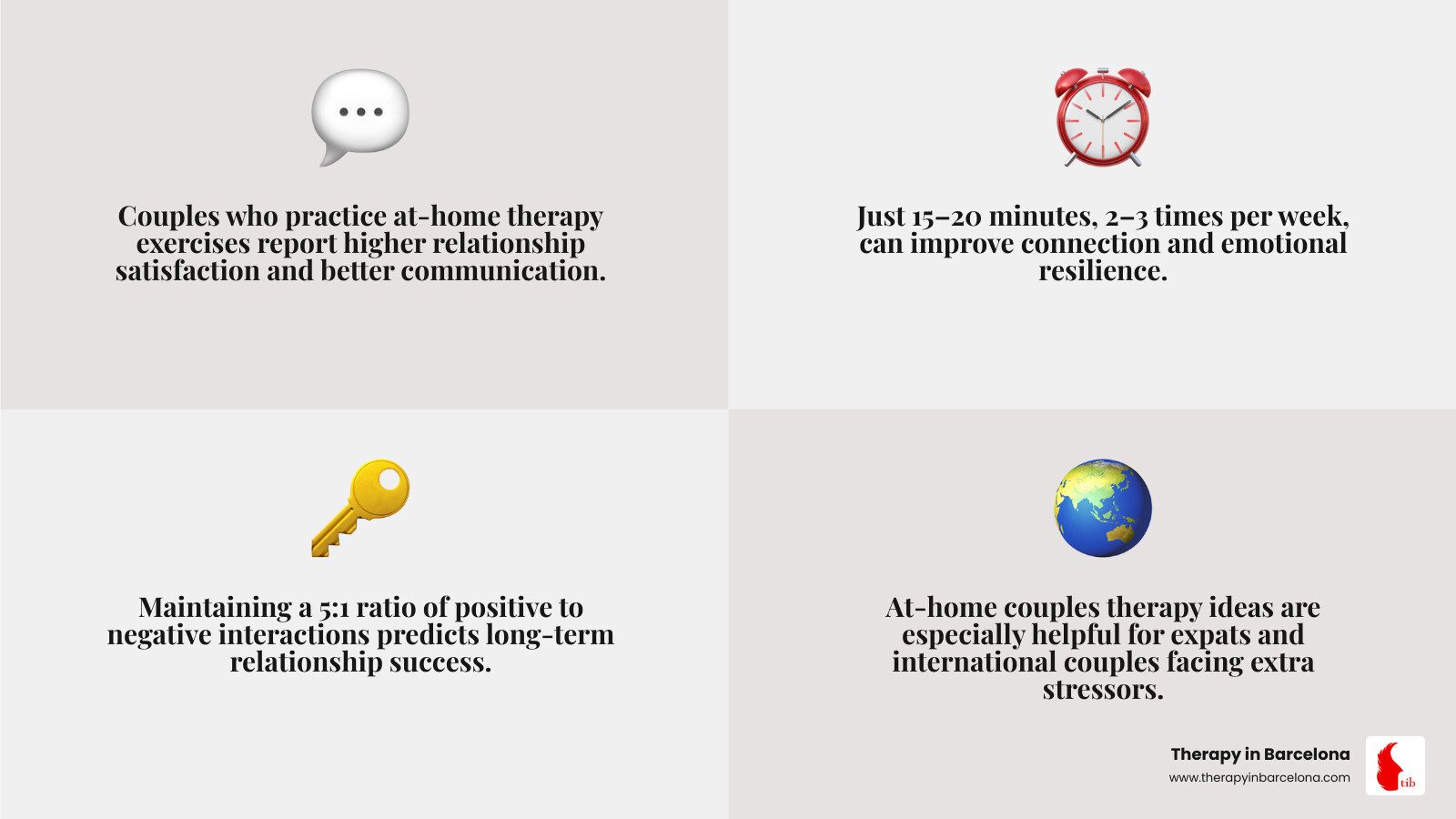
The benefits are clear. These activities help you maintain what Gottman calls a 5:1 ratio of positive to negative interactions – a key predictor of relationship longevity. They’re particularly valuable for internationals in Barcelona who may face additional stressors from cultural adaptation, language barriers, and being far from family support systems.
Here’s what makes these exercises effective: They’re grounded in decades of relationship research, require minimal time commitment (15-20 minutes, 2-3 times per week), and can be done anywhere. Many couples find they create new patterns of connection that extend far beyond the exercises themselves.
Of course, at-home activities work best when both partners participate willingly. If you’re facing persistent communication breakdowns, trust violations, or major life transitions, professional support may be more appropriate.
The Foundation: Evidence-Based Couples Therapy at Home Ideas
When you search for couples therapy at home ideas, it pays to lean on proven science rather than random hacks. Few researchers have influenced relationship work as much as Dr John Gottman, whose four decades of studies with more than 3,000 couples produced the Sound Relationship House. It lists nine daily habits that keep love solid:
- Build Love Maps
- Nurture Fondness & Admiration
- Turn Towards Each Other
- Accept Influence
- Solve Solvable Problems
- Overcome Gridlock
- Create Shared Meaning
- Manage Conflict
- Make Dreams Come True
Couples who practise these habits preserve the 5:1 ratio of positive to negative moments that Gottman found in lasting relationships.
Building Love Maps: Understand Each Other’s Inner Worlds
A Love Map is your mental guide to your partner’s hopes, worries and everyday details. Updating it regularly strengthens resilience.
Time required: 15 minutes
Difficulty: Easy
Materials: Free Gottman Card Decks app / Google Play
Open the Love Maps deck, take turns asking questions, and listen without judgement. Even long-term partners are surprised by what surfaces—a hidden career fear or a new dream. For more guidance, explore couples therapy topics.
Nurturing Fondness and Admiration
The daily Appreciation Exchange acts like a bank account: each specific thank-you is a deposit; criticism is a withdrawal. Share three detailed appreciations—focus on actions and character traits. For instance, “I appreciated how you noticed my stressful day and cooked my favourite pasta.” Regular gratitude measurably boosts relationship satisfaction, as shown in research.

Enhancing Communication and Conflict Resolution
Healthy couples don’t dodge conflict—they learn to handle it well. Multiple studies show that respectful communication predicts longer, happier relationships, while harsh talk erodes trust.
Key principles to try today:
- Use “I” statements: “I feel… about… and I’d like….”
- Listen to understand, not to reply.
- Validate feelings before problem-solving.
- Pause when emotions spike.
- Critique behaviours, not character.
“I” language alone reduces blow-ups, according to research. For prompts that spark honest dialogue, see these essential couples counselling questions.
The Stress-Reducing Conversation
Set aside 20 distraction-free minutes. One partner speaks for 10 minutes about stresses outside the relationship while the other listens, asks gentle questions and validates. Swap roles. This simple habit, supported by research, prevents outside worries from contaminating your bond.
Addressing Conflict with a Gentle Start-Up
Gottman’s “Four Horsemen” (criticism, contempt, defensiveness, stonewalling) often appear in the first few minutes of an argument. Swap them for a Gentle Start-Up:
“I feel [emotion] about [situation], and I need [specific request].”
Example: “I feel overwhelmed with the housework, and I need us to share chores more evenly.” This wording invites cooperation. After a disagreement, the Aftermath of a Fight Guide can help you repair and move on.
Deepening Emotional and Physical Intimacy
Intimacy isn’t just about physical closeness – it’s about truly knowing and connecting with your partner on every level. These couples therapy at home ideas help partners bridge the gap between surface-level interactions and genuine emotional connection, creating the foundation for lasting love.

Many couples find that whilst they love each other deeply, they sometimes struggle to express those feelings in ways their partner can truly receive. This is especially common for expats who may be dealing with the stress of adapting to a new culture whilst maintaining their relationship.
For couples seeking to explore intimacy more deeply, couples compass: a self-help guide to sex therapy offers additional resources and guidance for navigating physical and emotional connection.
Expanding Emotional Vocabulary
How often do you find yourself saying “I’m fine” when you’re actually feeling something much more complex? Most of us learned a basic emotional vocabulary in childhood that doesn’t serve us well in adult relationships. When we can’t accurately describe our inner world, our partners can’t truly understand us.
The Emotion Word Game transforms this limitation into an opportunity for deeper connection. Instead of settling for vague descriptions like “good” or “bad,” couples learn to paint detailed pictures of their emotional experiences.
Here’s how it works: Each day, both partners commit to using three specific emotion words when sharing about their experiences. Rather than saying “I had a good day,” you might say “I felt curious about the new project at work, grateful for your support this morning, and slightly anxious about the presentation tomorrow.”
This practice creates remarkable intimacy because it allows your partner to step into your emotional world. When you share that you felt “melancholy” rather than just “sad,” you’re giving your partner a much clearer window into your experience.
If you struggle to find precise words for your emotions, the Atlas of Emotions offers a beautiful, interactive way to explore the full spectrum of human feelings.
Understanding Love Languages
Dr. Gary Chapman’s research on love languages has revolutionised how couples understand each other’s needs. The insight is simple yet profound: we all have different ways of expressing and receiving love, and understanding your partner’s love language can dramatically improve your relationship satisfaction.
Research shows that couples who understand and implement love languages report significantly higher relationship satisfaction.
The five love languages are Words of Affirmation (verbal expressions of love), Quality Time (focused attention), Receiving Gifts (thoughtful presents), Acts of Service (helpful actions), and Physical Touch (appropriate physical contact).
The magic happens when you start speaking your partner’s primary love language, even if it’s not your own. If your partner thrives on Acts of Service, doing the washing up without being asked speaks volumes more than expensive gifts.
To find your love languages, take this online quiz together. But don’t stop there – observe what makes your partner’s face light up, notice what they naturally do to show love, and experiment with different approaches.
The Power of Physical Affection
Physical touch is far more than just a prelude to intimacy – it’s a fundamental human need that directly impacts relationship satisfaction. Research shows that physical affection correlates strongly with relationship happiness, yet it’s often the first thing to disappear when life gets busy or stressful.
Dr. John Gottman’s 6-second kiss might sound simple, but it’s remarkably effective. The Gottman Institute advocates for this technique because six seconds is long enough to create a moment of genuine connection whilst being brief enough to incorporate throughout your day.
Think about it: a quick peck goodbye feels routine, but a six-second kiss requires you to pause, focus on each other, and create a moment of intimacy. It’s just long enough to be passionate whilst also serving as a gentle interruption to daily stresses.
But physical affection extends far beyond kissing. Extended cuddle time – even ten minutes of focused cuddling without distractions – can release oxytocin, the “bonding hormone” that strengthens emotional connection. Hand-holding during walks or whilst watching television, gentle touches on the shoulder or back throughout the day, and proper hugs that last at least twenty seconds all contribute to feelings of closeness and security.
The key insight is that consistency matters more than intensity. Small, regular gestures of physical affection often have more impact than occasional grand romantic gestures. Physical affection works because it communicates love in a language that bypasses words entirely.
When At-Home Ideas Pave the Way for Professional Support
Think of DIY exercises as routine maintenance. Sometimes, though, you need a mechanic. Couples who seek help early enjoy better outcomes, notes research.
Consider professional therapy if you notice:
- Circular, unresolved arguments
- Breaches of trust
- Growing emotional distance
- Major transitions or mental-health struggles
- Any form of abuse (seek help immediately)
Therapy works: about 70–75 % of couples in EFT move from distress to recovery within a dozen sessions. Online options are equally effective; videoconference therapy boosts satisfaction and mental health, a boon for Barcelona’s mobile international community.
Therapy in Barcelona offers in-person and secure online sessions with multilingual, expat-savvy therapists. Learn more about evaluating couples counselling or explore our online therapy services.
Frequently Asked Questions about Couples Therapy at Home Ideas
How often should we practise these ideas?
Start with 15–20 minutes two or three times a week. Quick daily habits like a five-minute appreciation exchange keep you connected, while weekly deep-dives such as Love Maps or stress-reducing chats help you stay in tune. Consistency matters more than intensity.
My partner isn’t keen—what can I do?
Resistance is normal. Begin with something light, like the Love Maps game, and model the behaviour yourself. Ask, “Would you try one quick exercise with me this week?” Explain that the tools are evidence-based and meant to make life easier, not to criticise. Patience plus a dash of fun often win people over.
Can these activities replace professional therapy?
They’re excellent for prevention and maintenance, but not a substitute when issues run deep—repeated conflict loops, betrayals, mental-health concerns or abuse. Many couples combine at-home practice with brief professional guidance for the best of both worlds. If you’re unsure, book a free findy call to discuss your situation.
Conclusion: Your Next Step Toward a Stronger Connection
Lasting love isn’t built on grand gestures—it grows from small, consistent moments of care. The exercises in this guide are quick, research-backed and easy to weave into busy expatriate lives in Barcelona, Madrid, Alicante or beyond. Pick one idea today and notice the difference.
If you decide you need extra support, reaching out is a sign of commitment, not failure. Leigh Matthews—Australian psychologist, long-time Barcelona resident and founder of Therapy in Barcelona—has assembled a multicultural team ready to match you with the therapist who best fits your needs, online or in our Eixample office.
Ready to explore professional help? Book your free discovery call and let’s take the next step together.
Living abroad as an expat in Spain can be an exhilarating experience, filled with cultural immersion, adventure, and personal growth. However, when faced with the challenging reality of divorce, navigating the legal and emotional aspects can become even more complex. In this blog post by Leigh Matthews, Australian Registered Psychologist and Director of Therapy in Barcelona, we will explore some key insights and strategies to help expats manage divorce in Spain, ensuring a smoother transition during this challenging period.