


Why Client-Therapist Relationship Ethics Matter

Client-therapist relationship ethics are professional standards that protect your safety and privacy in therapy. They define what therapists can and cannot do, keeping the relationship focused on your well-being.
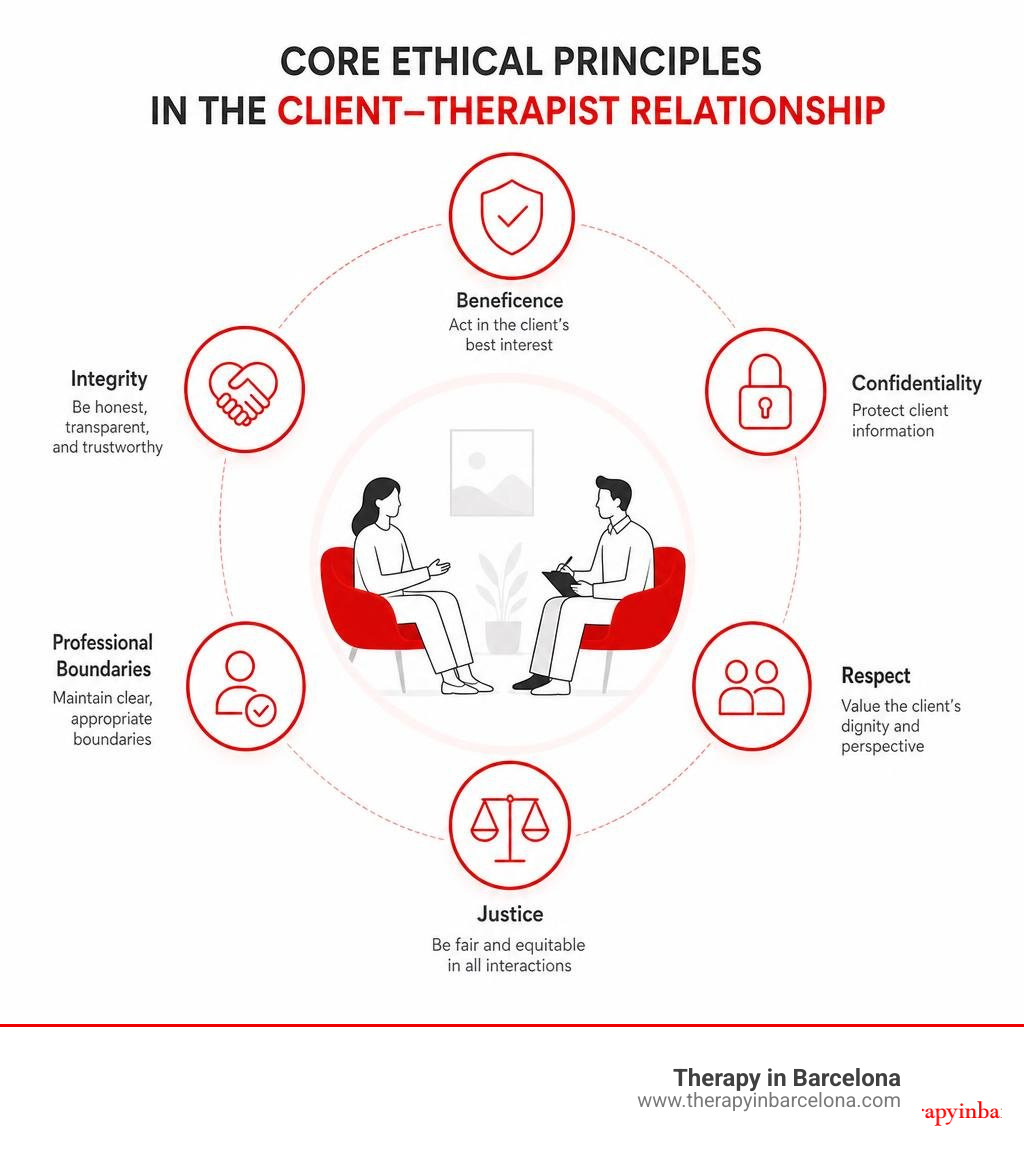
Core ethical principles in therapy:
- Confidentiality – Your information stays private (with rare legal exceptions).
- Informed consent – You understand what therapy involves before you start.
- Professional boundaries – Your therapist will not have other relationships with you (friendship, romance, business).
- Autonomy – You make your own choices; therapy supports, not directs.
- No harm – Your therapist works to help, never to exploit.
Living abroad in Spain—whether in Barcelona, Valencia, or Málaga—can make finding the right therapist feel daunting. When you are adjusting to a new culture or feeling isolated, you need to trust that your therapist will put your needs first. Understanding the ethical framework of therapy helps you know what to expect and spot when something feels wrong.
This guide explains the essential ethical rules that protect you. You will learn what boundaries exist, why they matter, and how to find ethical care that respects your cultural context. If you are living abroad and feeling vulnerable, these standards help ensure your therapist keeps the focus on your well-being, safety, and autonomy.
The Foundation: Understanding the Therapeutic Relationship and Its Boundaries
The bond you build with your therapist, called the therapeutic alliance, is at the heart of effective therapy. It is a professional relationship built on trust, care, and honesty. Clear boundaries help keep that relationship safe, respectful, and focused on your well-being.
Why is there a power imbalance in therapy?
The therapeutic relationship naturally involves a power imbalance. Your therapist has professional expertise and learns your deepest thoughts and vulnerabilities. You, the client, are often in a vulnerable state, seeking help. This inequality is a normal part of the healing process, but it means you cannot give truly equal consent to a friendship or romantic relationship with your therapist.
Ethical guidelines exist to manage this imbalance, protecting you from exploitation and keeping the focus on your well-being. A therapist has a duty to act in your best interest, and any relationship outside of therapy risks compromising this.
What is the role of informed consent?
Informed consent is more than just a form you sign. It is an ongoing conversation that makes you an active partner in your care. Your therapist should clearly explain:
- The nature and expected course of therapy (e.g., CBT or ACT).
- Fees and billing practices.
- The limits of confidentiality (when they might need to break it, such as for risk of harm).
- The estimated length and frequency of sessions.
- Your right to end therapy at any time.
This process ensures you can make autonomous decisions about your treatment, fostering trust and transparency. You can find more information about Consent in Therapy on our website.
How does the therapeutic alliance complicate post-therapy relationships?
The closeness and trust that make therapy effective can create a strong emotional bond. When therapy ends, these feelings do not just disappear. The power dynamics and emotional patterns established in therapy can linger, which can lead to role confusion if a friendship were to begin.
The goal of therapy is to foster your independence. Transitioning to a different type of relationship could undermine your therapeutic gains and hinder your personal growth. This is why clear ethical guidelines are so vital. For more context, you can read about what the therapy process looks like.
Navigating Multiple Relationships and Friendships
A ‘multiple relationship’ or ‘dual relationship’ happens when a therapist and client have another connection outside of therapy, like being friends or part of the same social group in Barcelona or Valencia. Here’s why these are usually avoided.

What is a ‘multiple relationship’ and why is it a concern?
A ‘multiple relationship’ occurs when a therapist is in a professional role with you and, at the same time, is in another role, such as a friend, business partner, or even a relative. These relationships are an ethical concern because they can impair the therapist’s objectivity, create a conflict of interest, and increase the risk of exploitation.
The APA’s ethics code states that multiple relationships should be avoided if they could harm the client or compromise the therapist’s effectiveness. While some unavoidable dual relationships can occur in small expat communities, therapists must manage these situations with extreme caution to prevent harm.
Can I be friends with my former therapist?
This is a common question. While professional attitudes have softened over time regarding non-sexual friendships with former clients, it is not a simple ‘yes’. The core concern remains the potential for harm due to lingering power dynamics from the therapeutic relationship.
Post-therapy friendships can create confusion, as the client may find it hard to separate the therapist’s professional role from a casual friendship. The therapist still holds deeply personal knowledge, which can keep the power imbalance alive.
Though no longer strictly prohibited, ethical therapists will carefully assess the potential for harm before entering such a relationship. The burden of ensuring no exploitation occurs falls entirely on the therapist, and many choose to avoid these friendships to protect the client’s well-being.
What should a therapist consider before starting a post-therapy friendship?
Before considering a friendship with a former client, an ethical therapist must weigh several factors to ensure the client’s well-being is never at risk. These include:
- Time elapsed since therapy ended: A significant waiting period helps diminish the power dynamic.
- Nature of the therapy: Brief, solution-focused therapy has a different impact than years of intensive work on deeply personal issues.
- Client’s current mental health: The therapist must consider if the client is still in a vulnerable position.
- Risk of harm: The primary consideration is whether the friendship could reactivate old issues, create confusion, or lead to exploitation.
The therapist’s first responsibility is always to the client’s welfare. This often involves consulting with supervisors to ensure objectivity before making any decision.
The Uncrossable Line: Sexual Relationships and Client-Therapist Relationship Ethics
Ethical codes from all major professional bodies, like the APA and ACA, are clear: sexual relationships with current clients are forbidden. This is one of the most universal rules in mental health care, designed to protect clients from the significant harm caused by such exploitation.
What are the rules for sexual relationships with current and former clients?
The rules regarding sexual relationships are absolute for current clients and extremely strict for former clients.
With Current Clients: Sexual intimacy with current clients is unequivocally prohibited, as stated in the APA Ethics Code (APA, 2010). This ban extends to relatives or significant others of current clients. Therapists are also forbidden from ending therapy simply to pursue a sexual relationship.
With Former Clients: The APA ethics guidelines prohibit sexual relationships for at least two years after therapy ends. Even then, it is not a green light. The therapist must show there was no exploitation, which is very difficult. These relationships are strongly discouraged.
Sexual relationships with therapists can cause serious emotional harm, feelings of betrayal, and lasting trauma, which is why this boundary is treated as one of the strictest in therapy ethics.
How should therapists ethically manage attraction to a client?
It is human for a therapist to feel attracted to a client, but their professional duty is to manage these feelings ethically, not act on them. An ethical therapist will:
- Acknowledge the feelings internally without acting on them.
- Seek confidential supervision or consultation with a peer to process these feelings and maintain objectivity.
- Reinforce professional boundaries to keep the focus on the client’s well-being.
- If the attraction interferes with their ability to provide effective care, they must refer the client to another qualified professional.
These steps ensure the therapist’s personal feelings do not compromise the safety and integrity of the therapeutic process.
Key Differences: Ethics for Current vs. Former Clients
Here is a summary of the key ethical differences for current versus former clients:
Sexual Contact
- Current Clients: Never allowed. It is an absolute prohibition.
- Former Clients: Prohibited for at least two years (APA) or five years (ACA). Even after, it is rarely permissible and the therapist must prove no exploitation occurred.
Friendship
- Current Clients: Not allowed, as it creates a multiple relationship.
- Former Clients: Generally discouraged. While some therapists consider it ethical under certain conditions, the therapist must ensure it causes no harm.
Business Relationships
- Current Clients: Not allowed. This is a clear conflict of interest.
- Former Clients: Highly discouraged and only permissible after a significant time lapse if there is no risk of exploitation.
Social Interactions (e.g., inviting to a party)
- Current Clients: Not allowed, as it blurs professional boundaries.
- Former Clients: Generally discouraged for the same reasons as friendship.
Client Rights, Therapist Responsibilities, and Finding Ethical Care
As a client, you have rights. Knowing them helps you take an active role in your care and spot when a boundary has been crossed.
What are my rights as a client?
In therapy, you are an active participant with rights designed to ensure your safety and autonomy. Your key rights include:
- Right to safety: A therapeutic environment free from any form of exploitation or harm.
- Right to informed consent: To be fully informed about your therapy before and during the process.
- Right to confidentiality: Your personal information is private, with few legal exceptions that should be explained to you.
- Right to ask questions: About the therapy process, your therapist’s approach, or any concerns you have.
- Right to professional care: To receive care from a competent, qualified professional.
- Right to end therapy: You can stop therapy at any time.
If something feels off, it is important to trust your instincts and address your concerns. You can explore the hallmarks of a good therapist to understand what to expect.
What happens if a therapist violates ethical guidelines?
Ethical violations are taken very seriously. Consequences for the therapist can include:
- Complaints to a professional regulatory body: A client can file a complaint, which can lead to sanctions.
- Licence suspension or revocation: For serious violations like sexual misconduct, a therapist can lose their licence to practise.
- Civil lawsuits: Clients harmed by unethical conduct can sue for damages.
- Criminal charges: In some places, sexual contact with a client is a criminal offence.
These measures hold professionals accountable and protect the public.
How do I find an ethical therapist as an expat?
Finding an ethical therapist as an expat in Spain requires careful consideration. Here are your main options:
- Public Health System in Spain: This option is free or low-cost, but wait times can be long, and services may not be offered in English or be culturally sensitive to expat issues.
- Large Online Platforms: These offer convenience but can feel impersonal. The matching process may not connect you with a therapist who truly understands the nuances of expat life in cities like Madrid or Barcelona, and their data privacy policies can be unclear.
- Local Private Practices: Quality and cultural sensitivity can vary widely. Finding one that speaks your language and understands your context can be a challenge.
At Therapy in Barcelona, we focus on providing specialised support to the international community. We offer bespoke, personalised matching with psychology-trained, expat therapists who have lived abroad themselves. This commitment to cultural and linguistic sensitivity ensures you feel seen and heard.
We provide strictly confidential care, adhering to the highest privacy standards, and never sell client data. Our services are available in English and other languages (including German, French, and Spanish) both online worldwide (including the USA and Canada) and in-person at our offices in Barcelona. For more information, please visit Our Services.
Frequently Asked Questions about Client-Therapist Relationship Ethics
What should I do if my therapist initiates a non-professional relationship?
If your therapist suggests a friendship, business proposal, or anything outside the therapeutic frame, this is a red flag and a breach of client therapist relationship ethics. It is the therapist’s job to maintain boundaries.
Here’s what you can do:
- Trust your instincts. If it feels wrong, it probably is.
- State your discomfort. You can tell your therapist you wish to keep the relationship professional.
- Consider ending therapy. If the therapist persists or your trust is broken, you have the right to terminate sessions.
- Seek consultation or report it. If you feel exploited or harmed, consider reporting the behaviour to the therapist’s professional regulatory body.
How do cultural norms influence these ethical rules?
While core principles like “do no harm” are universal, cultural norms can influence how some boundaries are perceived (e.g., gift-giving). However, professional ethics codes establish clear, non-negotiable standards, especially regarding dual relationships and sexual contact, to protect clients regardless of cultural background.
A culturally sensitive therapist will respect your background while upholding the highest professional standards. For expats in cities like Barcelona or Madrid, this understanding is vital for navigating cultural differences while maintaining clear boundaries.
Can I give my therapist a gift?
Gift-giving is a nuanced boundary issue. While a small, symbolic gift at the end of therapy might be acceptable, therapists must be cautious. They consider cultural norms, the potential impact on the therapeutic relationship, and whether accepting it could blur professional lines.
In many cases, a therapist might gently decline a gift, explaining that your progress is the most valuable outcome. A heartfelt “thank you” or a simple card is often the most appropriate way to express gratitude.
Comparison: Your Options for Therapy in Spain
Finding mental health support as an expat in Spain can present unique challenges. Here’s a comparison of your main options, highlighting how Therapy in Barcelona stands out:
Public Health System
- Pros: Free or very low-cost, accessible across Spain (e.g., in Barcelona, Sevilla, Zaragoza).
- Cons: Often involves long wait times for appointments, services may not be available in English, and culturally sensitive care tailored to expat experiences can be limited.
Large Online Platforms
- Pros: Convenient and accessible from anywhere in the world (including Gran Canaria for digital nomads), a wide range of therapists.
- Cons: Can feel impersonal, therapist matching may not account for the specific nuances of expat life, and privacy practices might vary (e.g., data sharing concerns).
Local Private Practices
- Pros: Can offer personalised care and potentially a good fit if you find the right therapist in your city (e.g., Málaga, Alicante).
- Cons: Quality and cultural sensitivity vary greatly, finding an English-speaking therapist familiar with expat issues can be difficult, and services might not be specifically designed for internationals.
- Pros:
- Personalised matching: We carefully match you with psychology-trained, expat therapists who understand your unique challenges. We don’t just match a client with the next available professional.
- Culturally sensitive care: Our team comprises expats themselves, bringing a deep understanding of cultural adjustment, language barriers, and other challenges of living abroad.
- Confidential and professional: We adhere to the highest ethical standards, ensuring strict privacy (we never sell client data) and a safe therapeutic environment.
- Flexible access: We offer online therapy worldwide (including USA and Canada) and in-person sessions in our central Barcelona office.
- Trusted expertise: Established since 2011, our team of highly qualified therapists uses evidence-based practices like CBT, ACT, and IFS.
- Cons: We are a private-pay service, though some therapists offer sliding scale fees.
Conclusion
Ethical guidelines in therapy are not just rules—they create a safe space for you to be open and do the real work of healing. Boundaries are the bedrock of trust, allowing you to be vulnerable without fear of exploitation or confusion.
For internationals and expats in Barcelona, Valencia, Málaga, or anywhere else, understanding these client therapist relationship ethics is key. It empowers you to find care that is not only effective but also respectful of your journey. At Therapy in Barcelona, our commitment is to provide this level of ethical, compassionate, and culturally aware support.
If you are an international living abroad and want support from a team that puts ethics and cultural awareness first, we are here to help. If you would like support, book a Free Discovery Call to start your journey with a therapist who understands. We offer online therapy worldwide, including the USA and Canada, and in-person sessions in Barcelona.
