


Why Client-Therapist Matching Is the Secret to Better Therapy Outcomes

Client-therapist matching is the process of pairing a person seeking therapy with a therapist whose training, communication style, personality, and cultural understanding align with that person’s specific needs — and research consistently shows it is one of the most powerful predictors of whether therapy actually works.
Here is a quick summary of what the evidence tells us:
- The therapeutic alliance matters most. Across different therapy modalities, the quality of the relationship between client and therapist accounts for a significant portion of positive therapy outcomes.
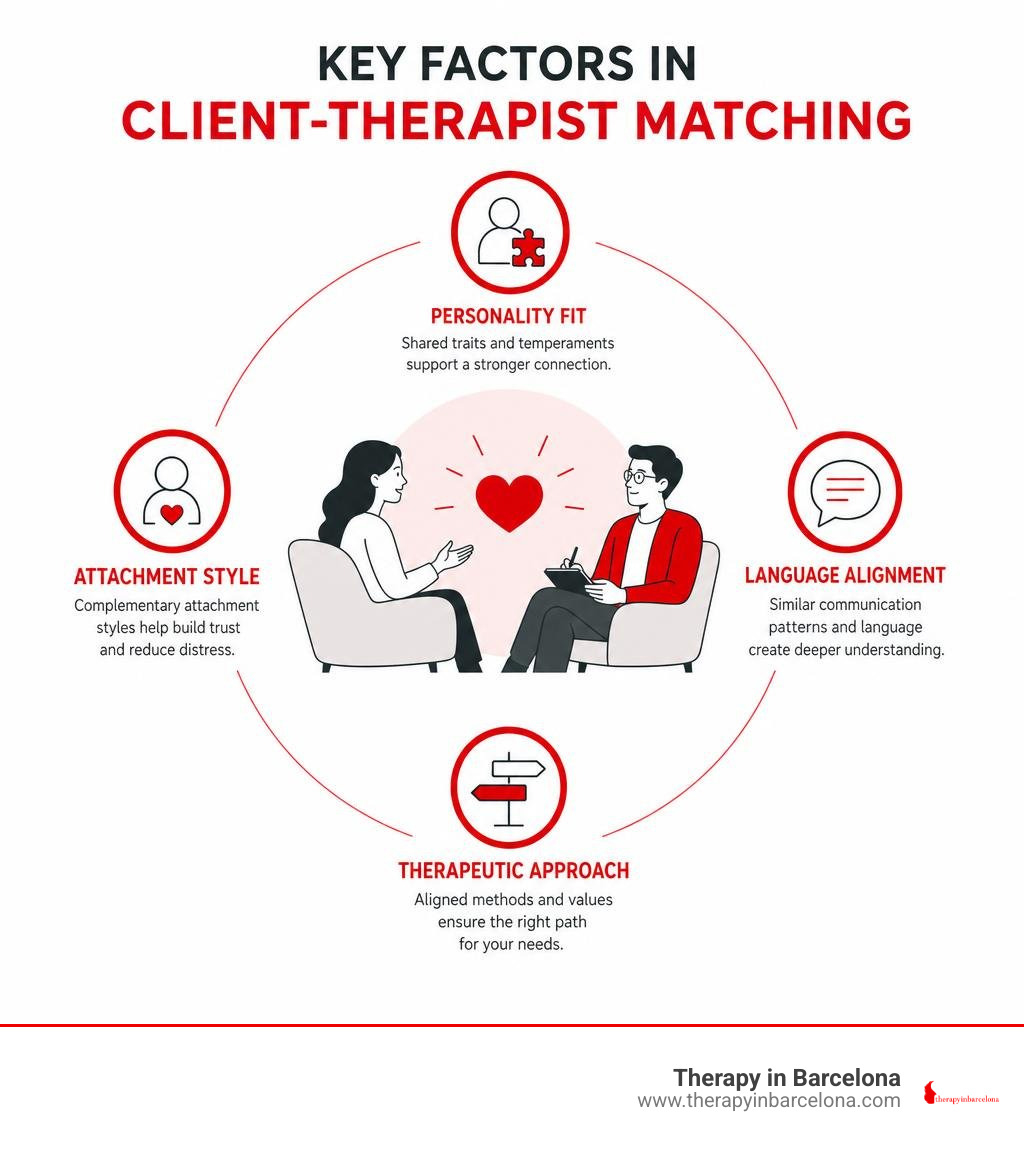
- Personality fit is measurable. Studies show that when clients and therapists share similar levels of conscientiousness and neuroticism, clients experience greater progress by the end of treatment.
- Linguistic alignment is a real signal. Early synchrony in how a client and therapist use everyday language — including words like pronouns and prepositions — can predict how much distress a client experiences after treatment ends.
- Attachment styles matter too. Pairing a client who has high attachment anxiety with a therapist who shares that same anxiety can actually increase distress rather than reduce it.
- Practical factors count. Language, cultural background, scheduling, and therapeutic approach all shape whether someone stays in therapy long enough to benefit.
Finding a therapist is, in theory, straightforward. There are directories, platforms, and recommendation lists. But finding the right therapist — someone who genuinely understands where you are coming from, communicates in a way that feels natural to you, and whose therapeutic approach fits your needs — is a different challenge entirely.
For someone like Emily — a fictional composite example representing common expat challenges rather than a real client — adjusting to life in Barcelona can feel especially daunting. She is already managing anxiety, loneliness, and the disorientation of living in a new culture. The last thing she needs is to spend months trying therapist after therapist, wondering why nothing seems to click.
This is not a niche problem. It is something that affects anyone who has ever sat in a therapy session and felt, quietly, that something was off — that the connection just wasn’t there, despite the therapist being perfectly qualified on paper.
What the research makes increasingly clear is that this “click” is not just a feeling. It is a measurable, therapeutically significant factor. And understanding it can save you time, money, and emotional energy — while meaningfully improving the outcomes of your therapy.
The Science Behind Client-Therapist Matching
In the field of psychotherapy, the quality of the bond between therapist and client is technically referred to as the therapeutic alliance. For decades, researchers have sought to understand what makes therapy successful. Is it the specific school of thought? The therapist’s years of experience? The length of the sessions?
The data points in a different direction. Study after study shows that the therapeutic alliance is one of the strongest predictors of positive therapy outcomes. A large meta-analysis on the alliance in adult psychotherapy found a consistent link between a stronger therapeutic alliance and better treatment outcomes across different approaches. It is not just about the techniques used, but about the collaborative relationship formed between two people. When a client feels safe, heard, and understood, they are far more likely to engage deeply with the therapeutic process and stay in treatment.
This is where client-therapist matching becomes essential. Historically, finding a professional was a matter of geographic convenience or simple availability. Today, we know that compatibility is highly structured. By looking at measurable human traits — such as personality structures, attachment patterns, and communication styles — we can predict and optimise the therapeutic match before the first session even begins.
Unconscious Alignment: The Role of Language Style Matching (LSM)
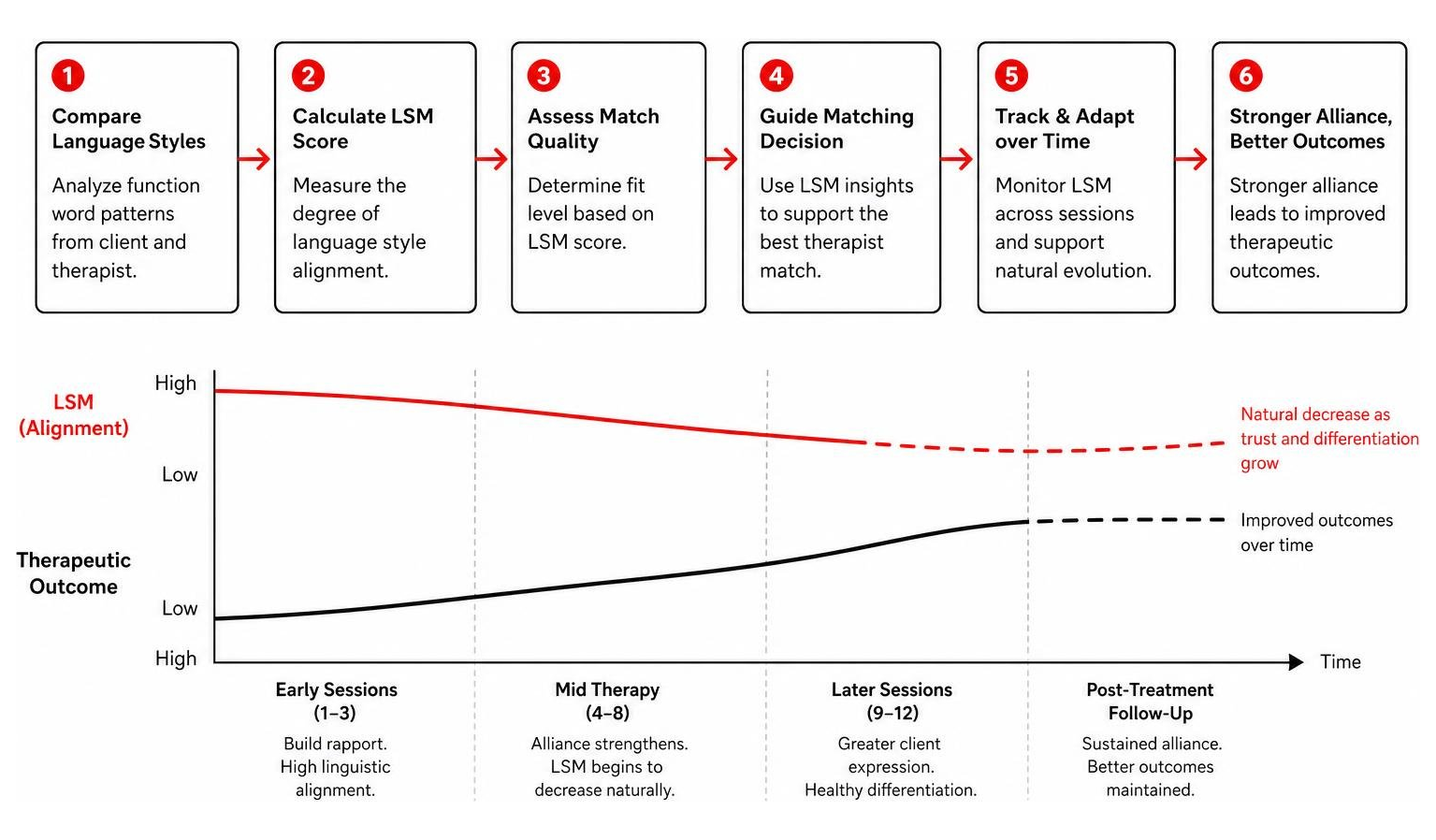
When we talk to someone, we do not just exchange information. We also unconsciously align our speaking styles. This phenomenon is called Language Style Matching (LSM). It does not look at what we say (the content), but rather how we say it.
Specifically, LSM measures how closely two people match in their use of “function words.” These are everyday, low-level words like pronouns (I, you, they), prepositions (in, on, under), conjunctions (and, but), and auxiliary verbs (is, have, will). Because we produce these words automatically and without conscious thought, they serve as a reliable, objective window into our psychological alignment.
Research into LSM within psychotherapy has yielded fascinating insights:
- Early alignment predicts better outcomes. A pilot study found that early LSM (the average of Sessions 1 and 3) accounted for a remarkable 77% of the variance in post-treatment distress. When clients and therapists had high linguistic alignment in their first few sessions, clients reported significantly lower levels of distress at the end of therapy ($\beta = -1.50, p = .03$), even when controlling for how distressed they were before starting.
- Linguistic synchrony shifts over time. Interestingly, language matching is not static. In a 12-session course of psychotherapy, LSM scores between therapist and client actually decreased significantly from Session 3 to Session 11 ($Z = -2.37, p = .018$).
This natural decrease suggests a healthy therapeutic evolution. In the initial sessions, both parties work hard to build rapport, leading to high linguistic mimicry. As trust is established and the therapeutic alliance solidifies, the need for mirror-like communication decreases. The client feels secure enough to express their unique voice, and the therapist steps back into a more differentiated, supportive role.
For international clients, this linguistic synchrony is particularly vital. Expressing deep emotional pain is difficult enough; doing so when your therapist does not pick up on your subtle phrasing, cultural references, or linguistic pacing makes it feel impossible. This is why language-based matching is a cornerstone of effective care.
Personality and Attachment: How Who We Are Shapes How We Heal
Our personality traits and relational histories act as the blueprint for how we connect with others. When we enter therapy, these blueprints interact directly with those of our therapist.
Using the widely accepted Big Five Inventory (which measures Openness, Conscientiousness, Extraversion, Agreeableness, and Neuroticism), researchers have studied how personality similarity affects therapy outcomes. The findings show that a “perfect match” is not about being identical in every way, but rather about specific, complementary alignments:
- Lower mutual neuroticism and higher mutual conscientiousness between patient and therapist are associated with a steady reduction in feelings of distress from the beginning to the end of short-term therapy. When both parties are relatively stable (low neuroticism) and structured, organised, and goal-oriented (high conscientiousness), the therapy progress is typically smoother and more effective.
Attachment styles — the internal working models we develop in childhood to navigate relationships — also play a major role in the therapeutic dynamic. These styles generally fall into secure, anxious, or avoidant categories. How they interact within the therapy room can make or break treatment:
- The risk of matching anxious attachment. Research indicates that when both the patient and the therapist have similar, high levels of attachment anxiety, it is associated with an increase in distress at the end of therapy.
If a client who fears abandonment is matched with a therapist who also struggles with relational anxiety, the relationship can become tangled in unspoken worries. Instead of providing a secure, steady anchor, the dynamic can inadvertently mirror the client’s past relational struggles.
This highlights why professional matching is so important. A good matching process does not simply pair people based on availability; it looks at these deep-seated traits to ensure the relationship remains a safe space for growth. For more details on navigating these dynamics, you can read about Choosing a therapist in Barcelona why and how.
Finding Your Fit: Practical Implications of Client-Therapist Matching
How Client-Therapist Matching Enhances the Therapeutic Alliance
A strong therapeutic alliance is not just a nice bonus; it is the engine of change. In cognitive behavioural therapy (CBT), for instance, the therapeutic alliance accounts for 23% to 57% of the total change in feelings of persistent sadness and low mood. When the relationship is strong, the treatment works.
For expats, the challenge of building this alliance is compounded by the stress of relocation. Moving to a new city — whether a bustling metropolitan hub like Madrid, a coastal community like Valencia or Alicante, or a sunny southern city like Málaga — often brings a sense of isolation. When an international resident seeks help, they need a professional who understands these specific challenges.
Take Emily — a fictional composite example representing common expat challenges rather than a real client. Having recently moved from the UK to Spain, Emily found herself overwhelmed by cultural fatigue and a lack of local support. When she first sought therapy, she felt disconnected from her counsellor, who did not understand the unique grief of leaving a familiar life behind.
Once she went through a structured matching process that paired her with an English-speaking therapist who was also an expat, everything changed. The shared understanding of living abroad allowed them to skip the explanations of “expat life” and go straight to the heart of her healing. To understand how to find this kind of fit, you can explore our guide on How to choose an English speaking therapist in Barcelona or read more about How do I choose the right therapist for my needs as an expatriate.
Navigating Your Options: Client-Therapist Matching vs. Traditional Directories
When looking for mental health support in Spain, you will generally find three primary avenues. Here is how they compare, keeping mobile readability in mind:
Public Health System Clinicians
The public healthcare system offers essential, low-cost services, but it is often burdened by long waiting lists and a lack of choice. For international residents, finding a professional who speaks fluent English or understands the expat experience in the public sector is incredibly rare.
Large Online Platforms
Many global platforms use automated algorithms or basic search filters to connect users with providers. While convenient, these platforms often treat matching as a logistical task (insurance and schedule) rather than a clinical one. They can also raise privacy concerns, as some operate on corporate subscription models that monetise user data.
Local General Directories
Directories allow you to scroll through hundreds of local profiles. While useful for browsing, this approach places the entire burden of vetting on the client. It often leads to “therapist shopping” — spending time and money on initial sessions only to realise the connection is not there.
Bespoke Client-Therapist Matching
This is the approach we champion at Therapy in Barcelona. Instead of leaving you to scroll through endless profiles or relying on a rigid algorithm, we use a human-led, clinically informed intake process. We assess your personality, goals, relational history, and cultural background to pair you with a therapist who is uniquely suited to you. This private-pay service prioritises high-quality, culturally sensitive care in your native language with strict privacy standards — meaning your personal information is never sold or shared, unlike corporate platforms, and you receive a bespoke therapist match tailored to your unique personality and goals.
Frequently Asked Questions About Therapist Matching
How does client-therapist matching actually work?
The process begins with an in-depth intake step. Rather than just asking for your postcode and insurance, a therapeutic survey or intake form gathers information about your primary concerns, your preferred style of therapy (such as structured and practical or open and exploratory), your personality traits, and your personal background.
At Therapy in Barcelona, our intake coordinators carefully review this information to find the best match within our team, rather than simply assigning you to the next available professional.
What happens if my matched therapist doesn’t feel like a good fit?
Even with the most thorough matching process, human relationships are complex. If you begin therapy and feel that the connection is not there, a professional service should make it easy and comfortable to request a rematch.
At our practice, we encourage open communication and offer complete flexibility. If a match does not feel right, we will work with you to transition to another therapist within our team, without any judgement or hassle.
Why is matching especially important for expats in Spain?
Living abroad introduces unique stressors, from navigating local bureaucracy to experiencing a shift in personal identity. If your therapist does not understand these dynamics, you may spend valuable session time explaining the context of your life rather than working on your mental health.
Whether you are living in Madrid, enjoying the coastal lifestyle of Alicante or Málaga, or working remotely from Las Palmas de Gran Canaria, having a therapist who understands both your native culture and the experience of living in Spain is vital for effective healing.
Finding Your Sanctuary Abroad
Therapy in Barcelona was founded in 2011 by Leigh Matthews, an Australian psychologist and expat who moved to the city in 2011. Having navigated the challenges of adapting to a new culture, an intercultural marriage, and raising a child abroad, Leigh recognised the profound need for an English-speaking mental health service that truly understood the international experience.
Today, Therapy in Barcelona is a trusted practice supporting expats, digital nomads, international students, and bicultural families across Spain and globally. Our team consists of highly qualified, psychology-trained professionals from diverse cultural backgrounds. We offer a wide range of evidence-based approaches, including CBT, ACT, Schema Therapy, Psychodynamic therapy, and Gottman Method couples counselling.
We provide face-to-face sessions at our central offices in Barcelona (Calle Paris 162-164) and online therapy to clients worldwide. We operate as a private-pay service, and some of our therapists offer sliding scale fees for those with financial need.
If you are ready to find a therapist who truly speaks your language and understands your journey, we are here to help.
If you’d like support, Book your Free Discovery Call with us today.
