


Understanding Self-Compassion in the Expatriate Experience

Defining Self-Kindness Versus Self-Pity and Self-Care
Living abroad often exposes a demanding internal voice. When a simple trip to the local post office ends in confusion or administrative delays derail plans, many internationals reflexively blame themselves. Developing self-compassion offers an alternative to this harsh self-criticism. Rather than judging personal perceived shortcomings, self-compassion involves active soothing, emotional acceptance, and recognising that difficulty is an inevitable part of being human.
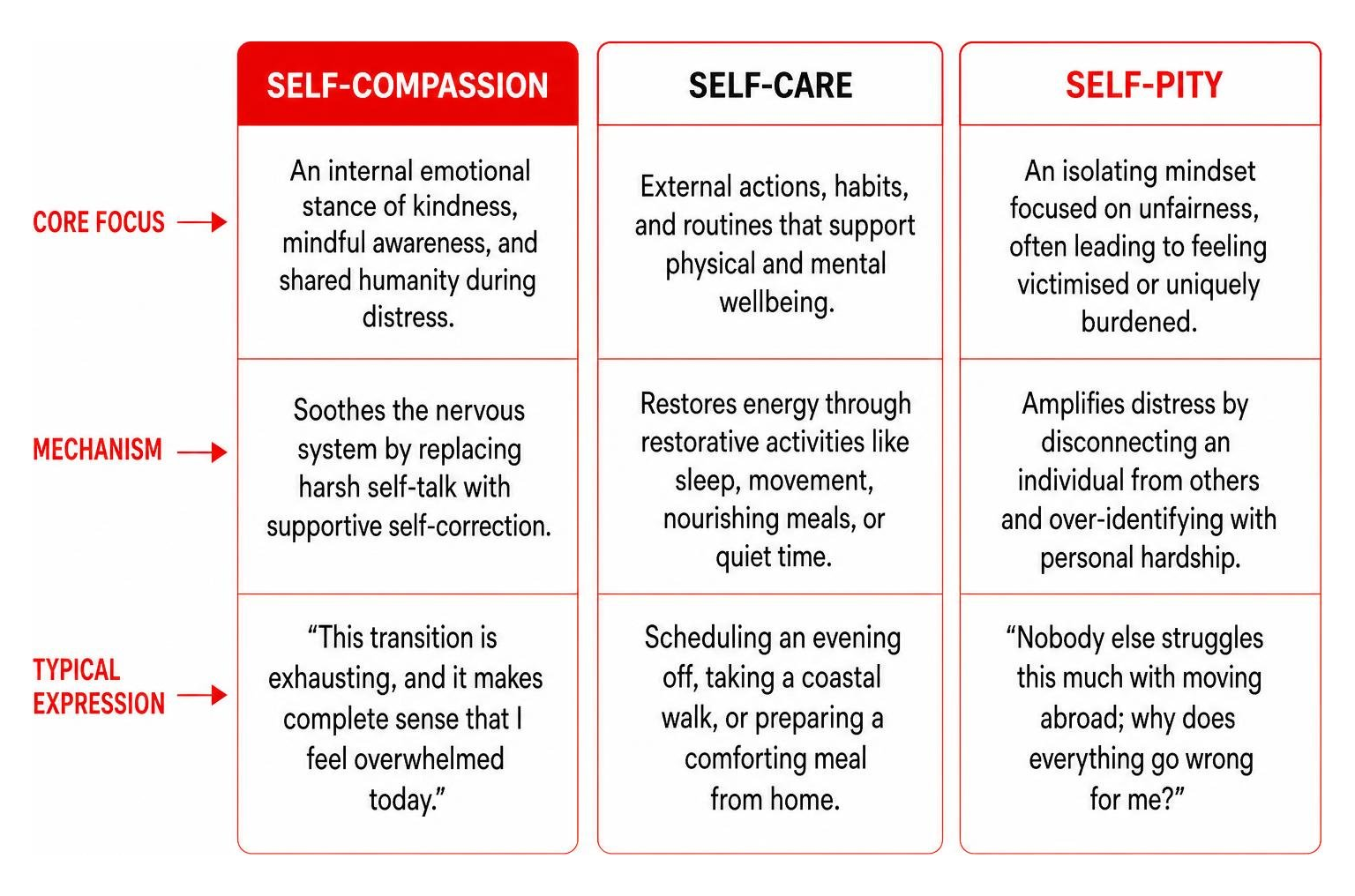
People frequently conflate self-compassion with self-care or self-pity, yet these concepts serve entirely different functions:
Self-Compassion
- Core Focus: An internal emotional stance of kindness, mindful awareness, and shared humanity during distress.
- Mechanism: Soothes the nervous system by replacing harsh self-talk with supportive self-correction.
- Typical Expression: Acknowledging, “This transition is exhausting, and it makes complete sense that I feel overwhelmed today.”
Self-Care
- Core Focus: External actions, habits, and routines that support physical and mental wellbeing.
- Mechanism: Restores energy through restorative activities like sleep, movement, nourishing meals, or quiet time.
- Typical Expression: Scheduling an evening off, taking a coastal walk, or preparing a comforting meal from home.
Self-Pity
- Core Focus: An isolating mindset focused on unfairness, often leading to feeling victimised or uniquely burdened.
- Mechanism: Amplifies distress by disconnecting an individual from others and over-identifying with personal hardship.
- Typical Expression: Believing, “Nobody else struggles this much with moving abroad; why does everything go wrong for me?”
Why Expat Self Compassion Therapy Is Vital for Globally Mobile Adults
Relocating across borders strips away familiar reference points. Many professionals, accompanying partners, and digital nomads hold themselves to unrealistic standards, expecting to establish new routines, build vibrant social circles, and master foreign administrative systems without a single wobble. This underlying perfectionism often leads straight to relocation burnout.
Engaging with expat self compassion therapy helps internationals renegotiate their expectations. By framing cultural adaptation as a gradual, non-linear journey, globally mobile adults can cultivate emotional resilience. Research shows that self-compassion reduces anxiety, persistent low mood, and stress while boosting psychological flexibility, giving internationals the internal foundation needed to thrive in unfamiliar settings. For a deeper understanding of the evidence base, Kristin Neff’s research on self-compassion offers a useful starting point.
Emotional Challenges Living Abroad and the Path to Healing
Addressing Expat Grief, Isolation, and Cultural Burnout
One of the most persistent difficulties internationals face is unacknowledged grief. Moving abroad involves saying goodbye to established communities, familiar cultural cues, and spontaneous visits with loved ones. For accompanying partners—often referred to as trailing spouses—this transition can also bring a sudden pause in career momentum and an unsettling loss of identity.
When daily tasks require high cognitive effort due to language barriers and unfamiliar social norms, the nervous system enters chronic overload. This state is not simple tiredness; it is a diffuse exhaustion where even socialising begins to feel like labour. Working through these layered emotions within individual therapy allows individuals to process isolation, establish restorative boundaries, and rebuild their sense of self.
Consider the fictional composite profile of Elena, a 34-year-old marketing strategist who relocated from Manchester to Valencia (a fictional composite example representing common expat challenges, not a real client). On paper, her life looked idyllic, yet she found herself paralysed by guilt whenever she felt homesick or tearful after basic supermarket interactions. Through tailored therapeutic support, Elena learned to validate her grief rather than scolding herself for being “ungrateful.” Recognising her exhaustion as a normal reaction to nervous system overload enabled her to pace her transition with patience.
Vulnerability and Self-Forgiveness Across Cross-Cultural Transitions
Adapting to a new country requires constant trial and error. Whether misinterpreting an email nuance at work, struggling with regional dialects, or battling administrative fatigue, making mistakes is unavoidable. Without self-forgiveness, these everyday blunders can trigger deep feelings of inadequacy.
- Embracing vulnerability as an unavoidable part of cross-cultural growth.
- Releasing perfectionism around local language fluency and social integration.
- Forgiving administrative missteps and unexpected bureaucratic delays.
- Creating internal psychological safety when external environments feel unpredictable.
When internationals treat their errors with patience, they transform moments of frustration into opportunities for connection and genuine bicultural integration.
Evidence-Based Approaches in Expat Self Compassion Therapy
Compassion Focused Therapy and Emotion Regulation Systems
Originally developed by British psychologist Paul Gilbert, Compassion Focused Therapy (CFT) integrates evolutionary psychology, neuroscience, and cognitive behavioural principles to address deep-seated shame and self-criticism. Gilbert’s model outlines three primary emotion-regulation systems:
- The Threat System: Designed for protection, triggering fight, flight, or freeze responses when facing danger or social exclusion.
- The Drive System: Focused on resource acquisition, achievement, and goal attainment.
- The Soothing System: Associated with peace, social safeness, contentment, and connection.
Many internationals operate with over-stimulated threat and drive systems. They push themselves to achieve, assimilate, and stay vigilant against cultural faux pas, leaving their soothing system offline. Through Compassionate Mind Training (CMT), individuals can learn practical exercises to activate this soothing circuitry. Internationals across Spain, whether connecting with Compassion Focused Therapy options in Alicante or accessing private care in Madrid, Málaga, and Barcelona, benefit from restoring balance to these regulatory systems.
Neurobiology, Memory Reconsolidation, and Somatic Integration
Self-compassion is fundamentally rooted in physiology. Chronic relocation stress and cultural displacement keep the sympathetic nervous system on high alert. Through neuroplasticity—the brain’s ability to reorganise its neural pathways—targeted therapy helps re-wire persistent self-critical responses into patterns of calm and self-acceptance.
Modalities like Eye Movement Desensitisation and Reprocessing (EMDR) and somatic grounding techniques support memory reconsolidation. When a past experience of humiliation or cultural rejection is recalled in a secure therapeutic environment and paired with calming, compassionate resources, the brain updates the emotional memory. Engaging the vagus nerve through deep breathing, vocal toning, and somatic tracking provides bottom-up regulation, allowing the body to feel genuinely safe in its new surroundings.
Practical Self-Compassion Techniques for Daily Expat Life
The Daily Self-Compassion Break and Mindful Grounding
Pioneered by researcher Kristin Neff, the Self-Compassion Break is a simple, three-step exercise that can be used whenever cultural stress peaks:
- Mindful Acknowledgment: Bring awareness to the present discomfort. Silently tell yourself, “This is a moment of stress,” or “This feels really hard right now.”
- Recognising Common Humanity: Remind yourself that difficulty is universal. Say, “Other internationals feel this way too,” or “Struggling is a normal part of moving abroad.”
- Offering Self-Kindness: Place a warm hand over your heart, chest, or belly. Offer yourself words of genuine support: “May I give myself the patience I need today,” or “May I be gentle with myself as I learn.”
This physical touch acts as a physiological anchor, signalling safety to the nervous system and interrupting the stress cycle.

Transforming Negative Self-Talk and Cultivating Gratitude Abroad
Shifting internal dialogue requires conscious practice. When self-critical thoughts emerge, use evidence-based reframing to respond like an encouraging inner ally rather than a harsh judge.
- Catch the Critic: Notice absolutist statements such as, “I’ve been here six months and still can’t speak fluently; I’m failing.”
- Examine the Evidence: Look at the objective reality. Have you learned how to navigate public transport, open a local bank account, and handle daily transactions?
- Reframe with Compassion: Transform the phrase into: “Learning a language takes years. I am making steady effort while managing a full-time job and a major life move.”
- Anchor in Micro-Gratitude: At the end of each day, write down three small, concrete moments of appreciation related to your current city—a sunny plaza, a kind barista, or a quiet moment in a local park.
Strengthening Expat Relationships and Navigating Shared Transitions
Cultivating Compassion in Intercultural and Mobile Partnerships
Relocating as a couple introduces complex interpersonal dynamics. Partners often adjust at different speeds, especially when one person relocates for work while the other leaves their established network behind. This imbalance can lead to unspoken resentment, communication breakdowns, and heightened stress.
Applying self-compassion allows partners to validate their own emotional experiences without projecting blame onto their significant other. Exploring these challenges in couples counselling helps partners build mutual empathy, untangle cultural misunderstandings, and establish shared values for their life abroad. When both individuals feel understood and supported, their partnership becomes a source of emotional stability rather than added pressure. For internationals in Valencia, Málaga, or Alicante, online sessions offer the same tailored support without the need to travel to Barcelona.
Mental Health Care Options for Internationals
When seeking mental health support abroad, internationals often weigh several pathways:
- Public Healthcare Systems: Public health clinics in Spain provide valuable, comprehensive medical care. However, accessing English-speaking practitioners can involve lengthy waiting lists and limited continuity of care.
- Large Aggregator Platforms: Massive online directories offer extensive rosters, but they often lack specialised screening for expat-specific cultural issues, and some use client data for corporate targeting.
- Bespoke International Practices: Specialised clinics focus exclusively on the globally mobile community, offering psychology-trained clinicians who understand the realities of cross-border transitions.
Therapy in Barcelona was established in 2011 by Leigh Matthews, an Australian Psychologist who has lived in Barcelona since 2011, is the founder of Therapy in Barcelona, and is experienced in supporting internationals. Having navigated the absence of culturally attuned, English-speaking therapy during her own initial move, Leigh Matthews built Therapy in Barcelona to provide dedicated psychological care tailored specifically to expatriates, working with adults, couples, teens, and families.
The practice ensures strict privacy with no data selling, alongside high-quality, private-pay care. Bespoke therapist matching pairs each client with a practitioner aligned with their specific background and language needs—offering services primarily in English, with therapists also offering sessions in Spanish, French, German, and other languages. While sessions are private-pay, select therapists offer sliding scale fees for those with financial need, which prospective clients are welcome to discuss during their initial inquiry. Internationals in Madrid, Sevilla, or Zaragoza can access the same expat-focused support through online therapy.
Frequently Asked Questions About Expat Self-Compassion
How does expat self compassion therapy differ from standard talk therapy?
Expat self-compassion therapy directly addresses the practical and emotional realities of international relocation. Rather than viewing stress solely through an individual psychological lens, it factors in cultural shock, language barriers, visa pressures, and systemic disorientation. Clinicians draw on their own lived international experience to offer nervous-system regulation tools and culturally sensitive interventions that standard talk therapy might overlook.
What should I do if practising self-compassion triggers grief or emotional resistance?
When individuals who have spent years relying on a harsh inner critic begin offering themselves kindness, they sometimes experience a sudden release of stored sorrow or unease. In psychological terms, this is known as “backdraft.” If this occurs, pace yourself gently. Reduce the intensity of the exercises, focus on simple physical grounding—such as feeling your feet on the floor—and work alongside a trauma-informed therapist who can help you titrate the practice safely.
How can digital nomads maintain self-compassion routines while constantly moving?
Digital nomads benefit from small, highly portable micro-practices that do not rely on a fixed environment. Establishing consistent morning check-ins, using sensory grounding techniques during transit days, and keeping realistic workloads while changing destinations help preserve nervous system balance. Viewing rest as an essential necessity rather than an indulgence allows remote workers to sustain long-term mobility without burnout.
Note: The support described in this guide is educational and therapeutic in nature and does not provide crisis intervention or diagnostic labelling. If you or someone you know is in acute distress in Spain, please contact emergency services on 112, call the Spanish Mental Health Helpline on 024, or reach out to your local emergency medical facility.
Finding Peace Wherever You Call Home
Thriving abroad does not require unrelenting perfection. It requires building a supportive, dependable relationship with yourself that remains steadfast through every relocation, cultural challenge, and life transition.

Whether you are navigating life in Barcelona, settling into dynamic hubs like Sevilla, Gran Canaria, or Zaragoza, or travelling as a remote professional, treating your struggles with kindness changes everything.
If you’d like support, book a Free Discovery Call for online therapy available worldwide, or in-person sessions at our Barcelona practice.
