


Why Anxiety Spreads Through Families (And What You Can Do About It)

Family therapy for anxiety treats the whole family system, not just the individual with distressing experiences. Because feelings of anxiety often develop within family dynamics, research shows family-based interventions are as effective as individual therapy, and sometimes better for long-term recovery.
Key benefits of family therapy for anxiety:
- Addresses root causes in family communication
- Reduces parental behaviours that maintain anxiety
- Teaches the whole family coping skills together
- Shows equal or better outcomes compared to individual CBT
- Lower relapse rates, especially for children and teens
When one family member experiences anxiety, there’s a high chance it runs in the family due to both genes and environment. While anxiety is one of the most common emotional challenges, most treatments still focus on the individual alone.
For expat families in Barcelona, challenges like cultural adjustment and distance from support networks can intensify feelings of anxiety. Family therapy can address these specific issues while strengthening your household connections.
As one study notes, *”Children commonly cohabit with caregivers who also have mental illness, increasing genetic and environmental risk”*. This isn’t about blame; it’s about understanding that anxiety makes sense within the family context, and healing can happen there too.
Instead of treating anxiety as an individual problem, family therapy examines the patterns and communication styles that might be keeping everyone stuck, offering a path forward for the entire family.
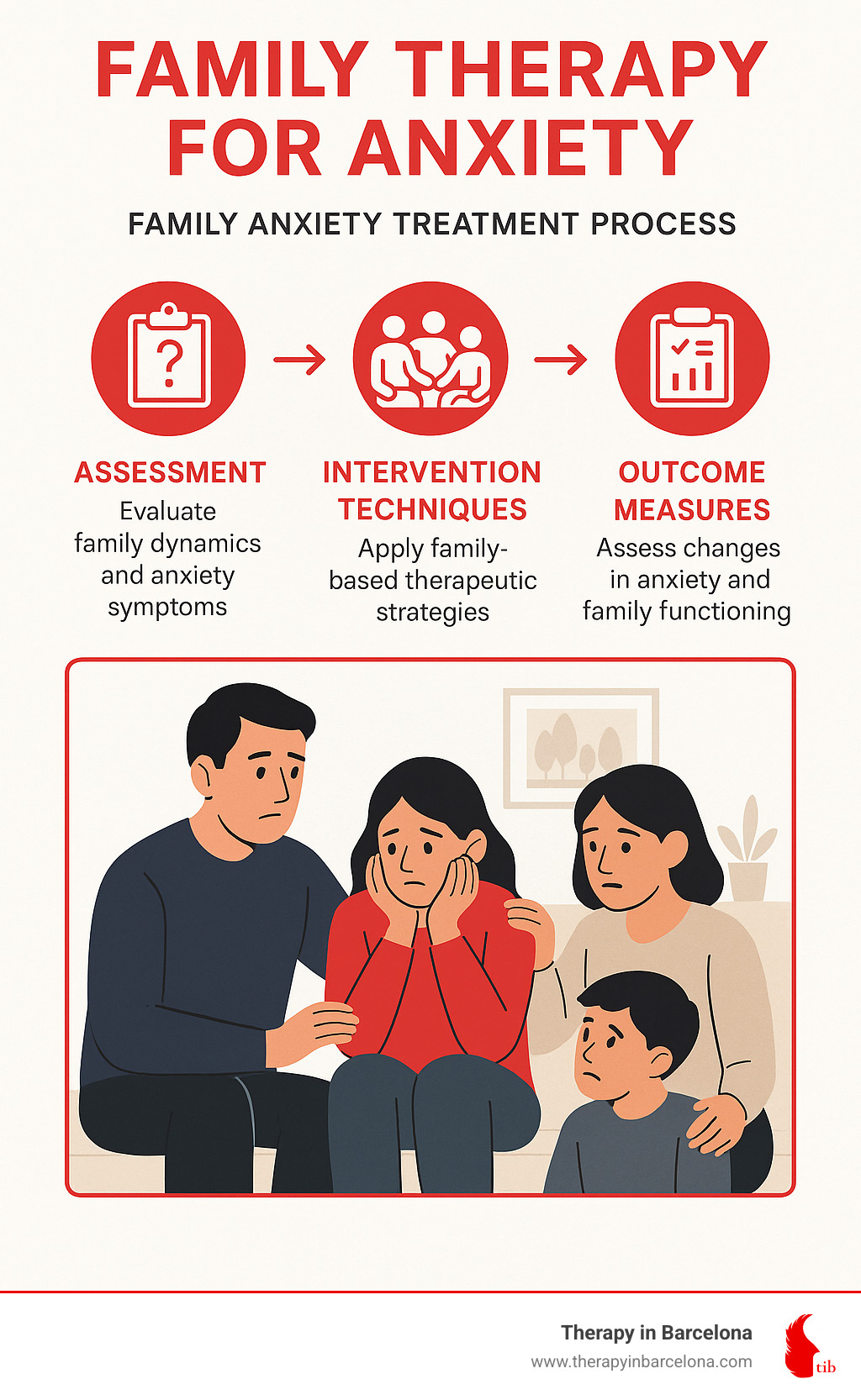
Why Family Dynamics Matter in Anxiety
Anxiety doesn’t just affect one person; it weaves itself into the family’s daily life. For expat families, stressors like cultural adjustment can make these dynamics even more complex. For example, a parent’s instinct to protect an anxious child by letting them stay home from school—a behaviour called parental accommodation—can accidentally reinforce the anxiety. The child learns that avoidance works, but never learns to cope.
The home’s emotional climate is also key. When communication is unclear or conflict is avoided, anxiety can thrive. Families that talk openly about stress, however, tend to build stronger emotional resilience.
Attachment & Emotion Regulation
The bond between children and caregivers, known as attachment, shapes how anxiety develops. A secure connection provides a “secure base,” allowing children to explore the world knowing they have a safe place to return. When this base feels unstable—due to moves, cultural stress, or parental anxiety—a child’s internal alarm system can become overactive. Attachment-based family therapy works to strengthen these bonds, helping parents become a reliable source of security so children can better regulate difficult feelings.
Caregiver Emotional Wellbeing Ripple Effects
When parents struggle with their own emotional wellbeing, it affects the entire household. Research confirms that children often live with caregivers who are also experiencing their own emotional difficulties, which highlights the need for integrated support for the whole family. This isn’t about blame. A parent with anxiety might become overprotective, while a parent feeling persistently down may have less emotional energy. This caregiver strain makes it harder for the family to cope. Family therapy addresses both child and parent wellbeing together, recognising that supporting the whole system leads to better outcomes for everyone.
Breaking the Intergenerational Loop
Anxiety often passes through generations, not just through genes but through learned behaviours. Children learn how to handle stress by watching their parents. If they see constant worry or avoidance, they absorb these patterns. This is called intergenerational transmission. Family therapy helps interrupt this cycle. Parents learn to model healthier responses and practise protective parenting by reducing accommodation and encouraging children to face challenges. The whole family works on better communication, which reduces the misunderstandings that fuel anxiety.
Family Therapy for Anxiety: Evidence & Outcomes
When seeking support for anxiety, it’s natural to ask what works. While individual cognitive-behavioural therapy (CBT) is a common choice for young people, a growing body of evidence shows family therapy for anxiety offers results that are just as good—and sometimes better for long-term change.
Reviews of randomised controlled trials (RCTs) find that family-focused treatments perform “better than no-treatment controls and as well as individual treatments in youth”. This means involving the whole family is at least as effective as working with the young person alone. There’s also “some evidence that family-based treatments may outperform individual therapies” for certain groups, such as young people with specific neurodevelopmental considerations. Most research focuses on youth, with fewer studies on family-based treatment for adults.
Why Choose Family Therapy for Anxiety over Solo Treatment?
Deciding on family therapy often comes down to its key benefits for lasting change:
- A holistic approach: Individual CBT helps a child manage their thoughts, but family therapy addresses the wider family system that may unintentionally maintain anxiety.
- Improved treatment response: While many youths benefit from CBT, a significant number don’t achieve full recovery. Family therapy can boost these rates by getting everyone working as a team.
- Longer-term gains and reduced relapse: By changing unhelpful family patterns and teaching everyone coping skills, family therapy builds a supportive home environment that helps progress stick.
- Addressing other challenges: Family therapy can support a child’s anxiety and a parent’s emotional wellbeing at the same time, leading to faster, more meaningful improvements for everyone.
Here’s a quick look at how family therapy and individual CBT often compare:
Primary Focus
- Individual CBT: This approach zeroes in on the child’s internal world – their thoughts, feelings, and specific behaviors related to anxiety. It’s about equipping the individual with tools to manage their own anxiety.
- Family Therapy: Instead of just the individual, family therapy looks at the bigger picture. It focuses on the entire family’s dynamics, communication patterns, and how the family system itself might be contributing to or maintaining anxiety.
Parental Involvement
- Individual CBT: Parents often play a supportive role, receiving psychoeducation about anxiety, learning how to support their child, or getting coaching on specific skills. Their direct emotional well-being isn’t usually the primary focus.
- Family Therapy: Parents are central and active participants. Their own emotional well-being, parenting behaviors, and how they interact with the child are directly addressed as part of the treatment process.
Treatment Goals
- Individual CBT: The main goal is to reduce the child’s immediate feelings of distress and anxiety symptoms.
- Family Therapy: Goals are broader. Beyond reducing the child’s distress, family therapy aims for improved overall family functioning, stronger relationships, and a more supportive home environment.
Sustainability of Gains
- Individual CBT: Long-term success often relies heavily on the child consistently applying the skills they’ve learned. If the family environment remains unchanged, there’s a potential for anxiety to resurface.
- Family Therapy: By addressing and changing the family environment itself, family therapy aims to create a sustainable support system that reduces the risk of relapse and supports long-term gains.
Addressing Multiple Challenges
- Individual CBT: This therapy typically focuses on the child’s specific anxiety challenges.
- Family Therapy: It has the unique ability to tackle multiple issues simultaneously. For instance, it can address a parent’s own emotional well-being or stress while also working on the child’s anxiety, especially in integrated models.
Overall Effectiveness
- Individual CBT: It’s a highly effective treatment for many young people struggling with anxiety.
- Family Therapy: Research shows it’s comparable to individual CBT in effectiveness. For certain groups, like young people with specific neurodevelopmental considerations, or for achieving longer-term positive outcomes, family therapy can even be superior.
Is Family Therapy for Anxiety Right for Your Expat Household?
For expat families in Barcelona, Valencia, or Málaga, the benefits of family therapy are especially relevant. The unique stresses of moving abroad can worsen anxiety.
At Therapy in Barcelona, we understand the expat journey. Our team, many of whom are expats, offers the cultural sensitivity needed when you’re far from home. We also provide multilingual options in English, German, French, Spanish, and more, so everyone can express themselves comfortably. Finally, we make therapy accessible through telehealth and in-person sessions, offering flexible scheduling to fit your busy life, whether you’re in Barcelona or anywhere else in Spain.
Core Models & DIY Techniques You Can Try at Home
Family therapy for anxiety isn’t a single approach but a toolkit with various models. A therapist will guide you, but understanding the basics of Structural, Strategic, and Attachment-based family therapy can clarify how change happens. Many principles can also be adapted into ‘DIY’ techniques to use at home.
Structural & Strategic Moves
Structural Family Therapy examines the invisible rules and patterns in your family. It focuses on strengthening the family hierarchy and creating clear boundary setting. For anxiety, this often means ensuring parents are a united team, guiding children to face fears rather than letting anxiety run the household.
Strategic Family Therapy is problem-focused, finding clever ways to interrupt unhelpful patterns. A therapist might identify a stuck problem-solving loop and suggest a new approach or ‘homework’ to shift how your family communicates and responds to worry.
Attachment-Based Exercises
Our emotional bonds are central to how we cope with anxiety. Attachment-based family therapy (ABFT) is especially helpful for teens, as it works to rebuild trust and strengthen the feeling of a ‘safe base’. The process involves exploring attachment history, having guided repair dialogues to heal past hurts, and helping parents become an emotional coach. This creates a secure family connection, which helps anxiety loosen its grip.
Everyday Anxiety Skills for Families
Your family can become a team in managing anxiety with simple, daily skills. These techniques, often inspired by CBT, empower everyone to build resilience.
- Graded Exposure: Instead of avoiding fears, work together on a ‘fear ladder’ to take small, brave steps. For a child anxious about speaking Spanish in Barcelona, this could start with saying ‘Hola’ to a shopkeeper and build from there.
- Challenge Anxious Thoughts: Use a shared thought record to identify anxious thoughts, question their accuracy, and find more balanced perspectives.
- Improve Communication: Use ‘I’ statements (‘I feel worried when…’) instead of ‘You’ statements to prevent defensiveness. Practise active listening to reduce misunderstandings.
- Contain Worry: Designate a 15-minute ‘worry time’ each day. This helps stop anxiety from taking over by giving it a specific, contained slot.
- Practise Mindfulness Together: Try simple box breathing (inhale for 4, hold for 4, exhale for 4, hold for 4) as a family to create a shared sense of calm.

Incorporating these techniques can help your family build a more supportive and resilient environment to manage anxiety together.
How to Get Started & Overcome Practical Barriers
Taking the first step toward family therapy for anxiety can feel daunting, especially for expat families. The good news is that most barriers are manageable with the right approach.
Finding the Right Clinician
Finding a therapist who understands anxiety and expat life is key. Look for a professional with training in family systems therapy and a family-system perspective—someone who looks at family patterns, not just an individual’s experiences. For expat families, cultural sensitivity is vital. Many therapists at Therapy in Barcelona are expats themselves and understand the challenges of cultural adjustment. Our personalised matching service helps find the right fit for you, taking the guesswork out of the process. You can also explore scientific research on therapist training to understand the importance of competencies.
Preparing Your Family for First Session
A little preparation can ease first-session nerves. Talk as a family about your goals, even simple ones like, “we want to feel less stressed.” Explain to younger members that therapy is a safe, blame-free space where everyone gets heard. Setting basic ground rules, like respectful listening, can also reduce anxiety about the unknown.

Sustaining Progress Between Sessions
Real change happens between sessions. View home practice as life practice—experiments with new communication or coping skills. Progress tracking, sometimes with formal measures, helps everyone stay motivated. After the main phase of therapy, booster sessions can help maintain momentum, which is especially useful for expat families facing ongoing adjustments.
Practical barriers like time coordination and cost are real. Therapy in Barcelona addresses this with flexible scheduling and online sessions available worldwide, making therapy accessible for busy families in Barcelona, Madrid, or anywhere else. We provide receipts for insurance reimbursement if your plan covers it. You can see our current fees on our website.
Frequently Asked Questions about Family Therapy & Anxiety
How many sessions does family therapy for anxiety usually take?
The timeline for family therapy for anxiety varies. Evidence-based approaches often recommend a course of 12-16 sessions to see significant change, though this is always custom to the family’s needs. Some families may need more time, particularly if anxiety is long-standing or if there are other challenges, such as a parent feeling persistently down or complex expat adjustment issues. Your therapist will create a custom plan and review progress with you. You’ll likely notice positive shifts along the way, as small changes can have a big impact on the whole family.
Can teenagers benefit if only parents attend sessions?
Yes. Approaches like the SPACE programme (Supportive Parenting for Anxious Childhood Emotions) focus on empowering parents. You learn to reduce accommodation behaviours (the ways we unintentionally enable anxiety) and respond in ways that build your child’s courage. The changes parents make at home can significantly reduce a teen’s anxiety, even if they refuse to attend. Often, reluctant teens become more open to joining once they see positive changes at home.
What if a family member refuses to participate?
This is a common concern. A skilled family therapist can start with whoever is willing to attend. Because family systems are interconnected, changes made by one or two members can create positive shifts for everyone. A therapist can also help explore the reasons for the resistance, which often stem from fear of blame. The goal is to improve the family system, and starting with willing participants is a powerful first step. In some cases, individual therapy may be recommended first.
Conclusion
Anxiety can feel like a heavy cloud over your home, but family therapy for anxiety offers a powerful way to find relief. By focusing on the whole family system—your communication, dynamics, and connections—it creates lasting change and builds collective resilience. It’s about empowering your entire family to become stronger, together.
For expat families in Barcelona and across Spain, finding support that understands your unique journey is vital. At Therapy in Barcelona, our team of qualified, psychology-trained therapists are also expats. We offer culturally sensitive, multilingual support both in-person at our Eixample office and online worldwide. Our personalised matching ensures you find the right therapist for your family’s needs.
If anxiety is making life harder for your family, a family-centred approach could be the support you need. To learn more and take the first step towards a calmer, more connected family life, explore our services.
