


Why Gottman Exercises for Couples Transform Relationships

Gottman exercises for couples are research-backed tools that can strengthen your relationship in just minutes a day. Based on Dr. John Gottman’s 40 years of research with over 3,000 couples (as detailed in studies on the empirical basis for the method), these simple practices help partners build deeper connection, manage conflict, and create lasting intimacy.
Quick Guide to Core Gottman Exercises:
- Love Maps: Learn your partner’s inner world.
- Fondness & Admiration: Express appreciation daily.
- Turning Towards: Respond positively to bids for connection.
- Gentle Start-Up: Begin difficult conversations without criticism.
- Stress-Reducing Conversation: Listen empathetically for 20 minutes daily.
- Rituals of Connection: Create meaningful traditions.
For expats navigating relationship challenges while adjusting to life abroad, these exercises offer practical ways to stay connected. The beauty of the Gottman Method lies in its simplicity—small, consistent actions that compound over time to build a resilient and satisfying partnership.

What is the Gottman Method? A Blueprint for a Stronger Relationship
Imagine having a roadmap that could predict your relationship’s success with over 90% accuracy (a finding from Gottman’s 1998 research). That’s what Drs. John and Julie Gottman created through four decades of groundbreaking research.
The Gottman Method is a scientifically-backed blueprint for building stronger, more resilient relationships. Born from studying over 3,000 couples in their famous “Love Lab,” it recognises that successful relationships are built like a house: with a strong friendship as the foundation, effective conflict management as the support beams, and shared meaning as the roof.
For expats navigating the stresses of life abroad, this structured approach offers comfort and clear principles to guide your relationship. The method provides concrete gottman exercises for couples that are evidence-based and can be implemented immediately. You can explore more about The Gottman Method and its scientific research.
The Sound Relationship House: The 7 Floors of a Healthy Partnership
The Sound Relationship House is the central framework of the Gottman Method, an emotional structure that shelters your relationship. Each floor represents a crucial element, building upon the one below it.
- Floor 1: Build Love Maps: Know your partner’s inner world—their hopes, fears, and dreams.
- Floor 2: Share Fondness & Admiration: Cultivate appreciation and respect, the antidote to contempt.
- Floor 3: Turn Towards: Respond positively to each other’s small bids for connection throughout the day.
- Floor 4: The Positive Perspective: These first three floors create a positive filter, giving each other the benefit of the doubt.
- Floor 5: Manage Conflict: Learn to handle disagreements constructively, distinguishing between solvable and perpetual problems.
- Floor 6: Make Life Dreams Come True: Support each other’s individual aspirations.
- Floor 7: Create Shared Meaning: Build a life together with shared rituals, values, and goals.
Why This Method Works: The Science of Love
The Gottman Method’s power comes from decades of meticulous research. In their “Love Lab,” researchers observed couples’ interactions, monitoring everything from heart rates to facial expressions, and tracked them for years.
This revealed a clear distinction between the “masters” and “disasters” of relationships. Masters consistently showed interest, responded to bids for connection, and managed conflict without negativity. Disasters fell into predictable negative patterns, identified as the “Four Horsemen”: criticism, contempt, defensiveness, and stonewalling.
These observable behaviours allowed researchers to predict relationship outcomes with remarkable accuracy. For expats, this research offers hope. By practising the specific behaviours that strengthen bonds, couples can not only survive the stresses of living abroad but emerge closer than before. Learn more about how at-home couples therapy ideas can transform your relationship.
Building the Foundation: Exercises for Friendship and Connection
Think of your relationship as having an emotional bank account. Every positive interaction is a deposit, and every negative one is a withdrawal. The secret to a thriving partnership is making far more deposits than withdrawals through what Dr. Gottman calls “small things often.”
These daily moments of connection build a strong friendship and create resilience, which is especially crucial for expat couples navigating the stresses of a new culture far from home. The exercises in this section help you build that foundation. For more inspiration, explore activities to do as a couple.
Principle 1: Build and Strengthen Your Love Maps
A Love Map is your mental atlas of your partner’s inner world—their hopes, dreams, fears, and stressors. Couples with detailed Love Maps are more resilient during tough times because they truly know each other. Building them is about genuine curiosity.

Ask open-ended questions that go beyond “How was your day?” Set aside time each week to update each other on what’s happening in your hearts and minds. Here are a few questions to get you started:
- What stresses are you facing right now?
- What is one of your fondest unrealised dreams?
- What makes you feel most competent?
- What personal improvements do you want to make in your life?
- Who is your greatest source of support (other than me)?
- What is one of your main worries at the moment?
As you both grow and change, especially as expats, there’s always more to find about the person you love.
Principle 2: Nurture Fondness and Admiration
Happy couples maintain at least five positive interactions for every negative one, a ratio finded through extensive research. This isn’t about fake positivity; it’s about genuinely cultivating appreciation for your partner. Fondness and admiration are powerful antidotes to contempt, one of the most destructive forces in a relationship.
- Use Verbal Affirmations: Be specific. Instead of a generic compliment, say, “I loved how patient you were with the landlord today.”
- Make Small Gestures: Bring them coffee, leave a loving note, or tackle a chore they dislike. These actions say, “I see you, and I value you.”
- Offer Physical Affection: A genuine hug, holding hands, or a quick shoulder squeeze reinforces your positive feelings.
Try the “I Appreciate” reflection: Think of your partner’s positive traits and recall specific incidents that illustrate them. Share one or two with your partner to refocus on the good, especially during rough patches.
Principle 3: Turn Towards Instead of Away
Every day, we make small attempts to connect, which Dr. Gottman calls “bids for connection.” How you respond—by turning towards with interest, turning away by ignoring, or turning against with irritation—shapes your entire relationship.
Turning towards doesn’t require grand gestures. It’s pausing what you’re doing to listen, responding with curiosity, or squeezing their hand back when they reach for yours. Create daily rituals to ensure you’re consistently connecting:
- Greeting and Goodbye Rituals: A warm hug or a six-second kiss can create a genuine moment of connection.
- Appreciation Time: Share one thing you’re grateful for about your partner each day.
- Technology-Free Zones: Put devices away during dinner or before bed to be fully present with each other.
These small, consistent practices are the essence of Gottman exercises for couples, keeping your emotional connection alive. For more ideas, explore these couples therapy activities.
A Guide to Gottman Exercises for Couples Navigating Conflict
Conflict is a normal part of any close relationship. The Gottman Method teaches you how to transform disagreements into opportunities for deeper understanding. What matters isn’t whether you argue, but how you steer those arguments together.
Dr. Gottman distinguishes between two types of conflict:
- Solvable problems: These have clear solutions (e.g., who does the dishes).
- Perpetual problems: These stem from fundamental differences and make up 69% of conflicts, according to Gottman’s research. They don’t need to be solved, just managed with compassion.
For expat couples, the stresses of life in a new country can amplify tensions. The key is approaching challenges with communication skills that foster a sense of “us against the problem.” For more insights, explore couples communication therapy.
Avoiding The Four Horsemen and Using Their Antidotes
The Gottmans identified four communication patterns that predict relationship disaster, calling them the “Four Horsemen of the Apocalypse.” Learning to recognise them is the first step to changing them.
- Criticism: Attacking your partner’s character. Antidote: Gentle Start-Up. Use “I” statements and make a positive request. “I feel overwhelmed when the kitchen is messy. Could we tidy up together?”
- Contempt: Sarcasm, eye-rolling, or conveying disgust. Antidote: Build a Culture of Appreciation. Actively focus on your partner’s positive qualities.
- Defensiveness: Blaming or making excuses. Antidote: Take Responsibility. Acknowledge your part, even if it’s small. “You’re right, I forgot to call.”
- Stonewalling: Withdrawing from the conversation. Antidote: Physiological Self-Soothing. Take a 20-minute break to calm down, then re-engage.
Find free resources for fighting right to help you practice these skills.
Effective Gottman Exercises for Couples in Conflict
- The Gentle Start-Up: How you begin a difficult conversation often determines its outcome. Use the formula: “I feel [emotion] about [situation], and I need [positive request].”
- The Aftermath of a Fight: After an argument has cooled, explore what happened without judgement. What went wrong? What could you do differently next time? This helps you learn from conflicts and develop repair attempts—gestures that halt negativity and reconnect you.
- Active Listening and Empathy: Truly hear your partner without interrupting. Empathy doesn’t mean you agree, but that you understand their feelings. “I can see why you’d feel that way” is a powerful phrase.
These tools are invaluable for expats managing extra stress. For more insights, see these essential couples counselling questions.
The Stress-Reducing Conversation
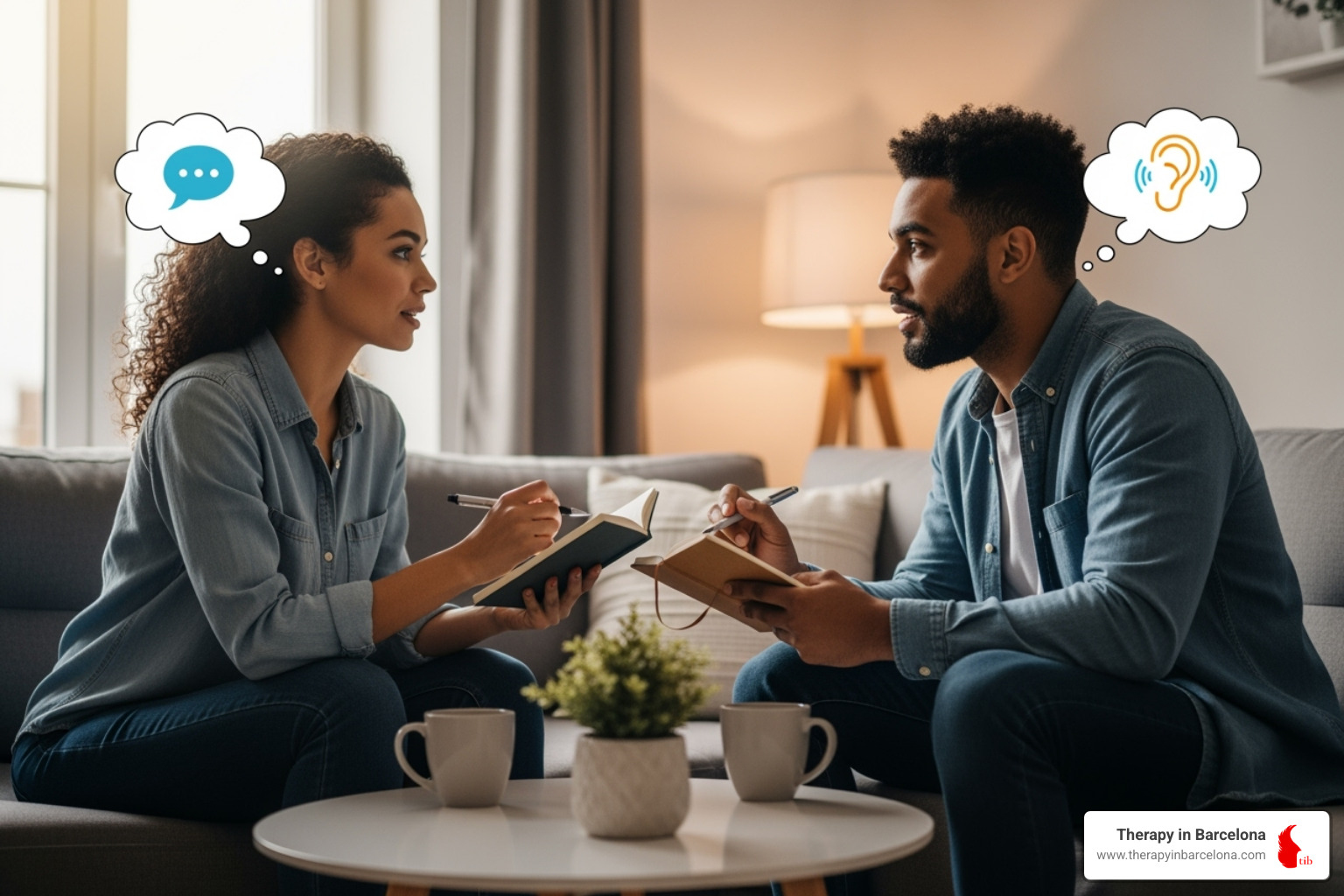
This daily 20-minute exercise prevents external stress from harming your relationship. Each partner gets 10 minutes to talk about stresses from outside the relationship, while the other listens without giving advice.
As the listener, your job is to:
- Show genuine interest.
- Communicate understanding.
- Take your partner’s side.
- Express affection and validate emotions.
This ritual builds resilience and intimacy, creating a safe harbour from life’s challenges. It’s particularly helpful for expats facing unique stressors. Learn more about identifying stress languages for international couples.
Creating a Shared Life: Exercises for Deeper Intimacy and Meaning
The most fulfilling relationships are about building something meaningful together. This is the top floor of the Sound Relationship House: creating shared meaning. For expat couples, a shared sense of values and dreams provides an anchor amidst the chaos of cultural adaptation.
This level of connection is about emotional intimacy—knowing and supporting each other’s deepest aspirations and building a future that reflects your shared values.
Creating Rituals of Connection
Rituals are intentional moments that reinforce your identity as a couple. They are relationship anchors that remind you of your connection, no matter what else is happening.
- Daily Check-ins: A few minutes over coffee to share hopes for the day.
- Weekly Date Nights: Dedicated time to connect, whether it’s a night out or a quiet evening at home with phones away.
- Holiday Traditions: Blend your cultural backgrounds to create something uniquely yours.
- Shared Hobbies: Create ongoing opportunities for joy and fun together, like exploring a new city or learning a language as a team.
Building a Shared Future Together
The highest level of the Sound Relationship House involves weaving your individual life dreams into a shared vision for the future. This isn’t about sacrificing personal goals, but about honouring both individual and collective dreams.
Start by discussing life goals openly. What are your aspirations for your career, family, and personal growth? For expats, this might include where you want to live long-term or how to maintain connections with home.
Consider creating a shared mission statement or a Shared Dreams Vision Board. Gather images and words that represent your collective future—a dream home, travel destinations, or family goals. This collaborative process of dreaming and planning builds a powerful sense of unity and purpose, turning individual challenges into shared problems to solve together. For more insights, explore these key topics in couples counselling.
When to Seek Professional Help
Gottman exercises for couples are powerful tools, but they aren’t a magic cure-all. Sometimes, relationships face challenges that require the guidance of a trained professional.
Consider seeking professional help if you’re experiencing:
- Persistent conflict: Arguments are frequent, intense, and rarely resolved.
- Emotional disconnection: A pervasive feeling of distance, loneliness, or indifference.
- Trust violations: Infidelity or dishonesty has created wounds that need skilled intervention to heal.
- Major life transitions: Moving abroad, having children, or job loss can overwhelm your usual coping strategies.
- Entrenched negative patterns: The Four Horsemen (criticism, contempt, defensiveness, stonewalling) have become your default communication style.
A trained Gottman Method therapist can provide personalised guidance, facilitate difficult conversations in a safe space, and help you apply these exercises most effectively. For more guidance, explore when it’s time for couples counselling.
A Note on Therapy Options for Expats in Spain
For expats in Barcelona, Madrid, or elsewhere in Spain, finding the right support can be challenging. Public health systems often have long waits and language barriers. Meanwhile, large, algorithm-driven online platforms can lack the personalised touch needed for a good therapeutic fit and may have data privacy policies that are not aligned with stricter European standards.
Therapy in Barcelona offers a different approach, designed for the international community by people who understand the expat journey. Founded by an Australian Psychologist who moved to Barcelona, our practice provides culturally sensitive support from therapists who are often expats themselves. We offer:
- Bespoke Therapist Matching: A qualified psychologist, not an algorithm, personally matches you with the right professional for your needs, often in your native language.
- Strict Privacy Standards: We adhere to rigorous European privacy laws, and your data is never sold.
- Flexible Sessions: We offer support both in-person at our Barcelona office (C/ de París, 162-164, 3o, 1a, 08036) and online for expats worldwide (excluding USA and Canada).
We provide more than just therapy in English; we provide therapy that understands the expat experience.
Frequently Asked Questions about Gottman Exercises
How often should we practise these exercises?
Consistency is more important than intensity. In his research, Dr. Gottman found that dedicating around six hours a week to your relationship can lead to remarkable improvements. This isn’t one long session, but small, consistent moments woven into your routine. It includes brief daily check-ins, a weekly date, and expressing affection and appreciation. The key is to start small and build momentum with practices that feel manageable for you.
What if my partner is resistant to trying these exercises?
It’s normal for one partner to be more enthusiastic than the other.
- Start with the fun stuff: The Love Maps game can feel more like a playful quiz than “work.”
- Share the why: Explain that these are research-backed methods to help couples feel more connected.
- Lead by example: Start incorporating practices like expressing more fondness or using gentle start-ups. Your partner may become more open after experiencing the positive changes firsthand.
If resistance persists, it might be a good time to consider professional guidance from a therapist who can introduce exercises in a supportive environment.
Are these exercises a substitute for professional couples therapy?
While Gottman exercises for couples are powerful, they are best seen as tools for strengthening healthy relationships and preventing minor issues from escalating. They are like regular exercise for your partnership.
However, they are not a substitute for therapy when dealing with significant challenges like chronic communication breakdowns, deep-seated trust violations, or entrenched negative patterns. A trained Gottman Method therapist provides a structured, neutral space to address complex dynamics and guide you through healing conversations that may be too emotionally charged to handle alone.
Conclusion
The journey through Gottman exercises for couples reveals a profound truth: lasting love is built on small, daily moments of kindness, understanding, and intention. Dr. John Gottman’s research provides a roadmap that transforms the mystery of love into actionable practices, reminding us that strong relationships aren’t about avoiding conflict, but navigating it with skill.
For expat couples, these tools are invaluable. When navigating the stresses of life abroad—from cultural adjustment to isolation—the Gottman Method provides a foundation to stay connected.
At Therapy in Barcelona, we have seen how these research-backed methods transform relationships. Our team of psychology-trained therapists, many of whom are expats themselves, understands both the Gottman Method and the unique challenges faced by internationals in Spain. We know that building a strong relationship while adapting to a new culture requires specialised, culturally sensitive support.
Seeking support for your relationship is an investment in your future together. Sometimes, the most loving thing you can do is ask for guidance from someone who understands both the science of relationships and the complexities of expat life.
Ready to build a stronger, more connected relationship? Explore our couples counselling services in Barcelona and find how our personalised approach can help you and your partner thrive.
