


Why Moving to Spain for Work Is Both Exciting and Complex

Moving to Spain for work is a dream for many internationals, drawn by sunny weather, rich culture, and a lifestyle that values balance. The reality, however, involves dealing with visa requirements, a competitive rental market, and a different workplace rhythm.
Take Alex, a 32-year-old software engineer from Canada who moved to Barcelona for a new job in tech. Alex is fictional, but their experience is common: excitement at the chance to live by the sea, then surprise at the paperwork, the language barrier, and the moments of loneliness after work. Stories like Alex’s mirror what many internationals feel in Barcelona, Madrid, Valencia, Málaga, and smaller hubs like Alicante or Sevilla.
If you’re looking for practical guidance, here’s what you need to know.
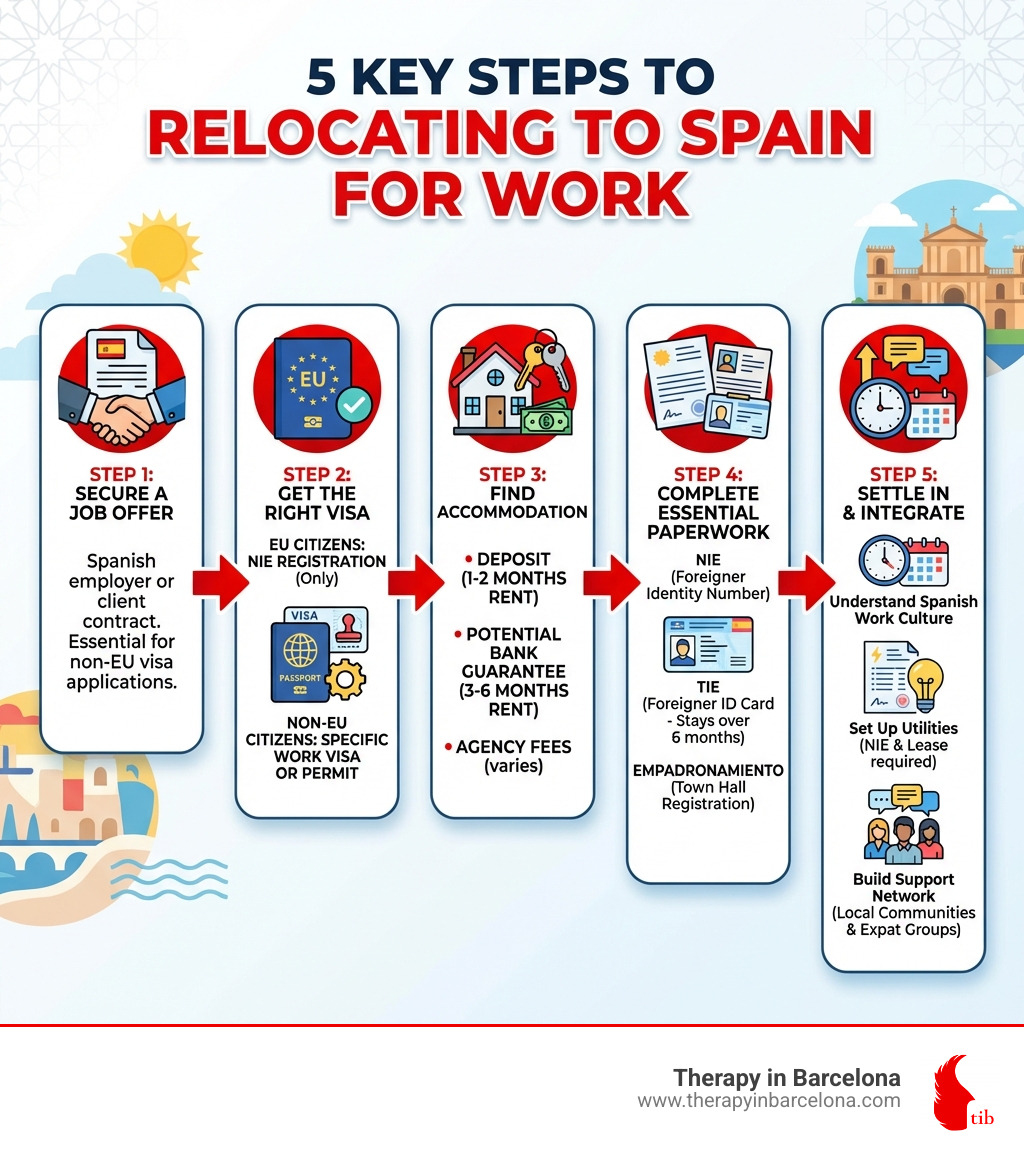
Essential Steps for Moving to Spain for Work:
- Secure a Job Offer – Most non-EU work visas require a formal offer from a Spanish employer.
- Get the Right Visa – EU/EEA citizens can work with fewer barriers; non-EU nationals need the right permit (start with A Practical Guide to Moving to Spain and Moving to Spain from the US: Your Step-by-Step Guide).
- Find Accommodation – Plan for deposits, agency fees, and sometimes extra guarantees while you search for a rental.
- Complete Essential Paperwork – Sorting your NIE and (if applicable) TIE is key to getting set up (details in NIE, TIE, CUE and Empadronamiento in Spain: Differences and Conditions).
- Settle In & Integrate – Learn workplace norms, handle practical setup, and build community support (more on Work-Life Balance).
The process is manageable but layered, with non-EU citizens facing more bureaucracy. Visa approvals can take one to three months. Once you arrive, landlords often require proof of employment and your NIE.
Beyond logistics, there’s the emotional side. Many internationals describe feeling “uprooted”: they have a job and a flat, but their identity, friendships, and routines feel unsettled. It’s common to move through stages that can resemble culture shock – from honeymoon phase, to frustration, to gradual adaptation.
This guide covers the practical steps—visas, housing, and paperwork—and explores Spanish work culture, the job market, and the support systems available to help you thrive in cities like Barcelona, Madrid, Valencia, or Málaga. It also points to where emotional and mental health support can fit in, whether that’s through public system clinicians, large online platforms, local Spanish practices, or expat-focused services like Therapy in Barcelona.
The Essential First Step: Understanding Spanish Work Visas and Permits
One of the first problems when considering moving to Spain for work is the visa and permit system. Requirements vary greatly depending on your nationality. For a broader overview, see A Practical Guide to Moving to Spain.
Do You Need a Visa? EU vs. Non-EU Citizens
This is the most important distinction.
- EU/EEA/Swiss Citizens: You have the right to free movement and do not need a work visa. However, you must register as a resident and get a Foreigner’s Identity Number (NIE) to live and work legally.
- Non-EU Citizens: You must get a valid work visa before arriving. This usually requires a job offer, as employers often need to prove no suitable EU candidate was available. For a guide specific to US citizens, see Moving to Spain from the US: Your Step-by-Step Guide.
Key Spanish Work Visas for Non-EU Nationals
Spain offers several work visas for different situations.
- Standard Employed Worker Visa (Autorización de Residencia y Trabajo por Cuenta Ajena): The most common route if you already have a job offer from a Spanish employer. In most cases, your employer starts the application, and it can be simpler when the role aligns with hard-to-fill positions.
- Self-Employed Visa (Autorización de Residencia y Trabajo por Cuenta Propia): Designed for freelancers and entrepreneurs. You’ll typically need a credible business plan, proof you can support yourself, and evidence you have the skills or experience to do the work. For a deeper dive, see A Comprehensive Guide to Self-Employment (Autónomos) in Spain and the Self-employed worker in Spain portal.
- Highly-Qualified Professional (HQP) Permit / EU Blue Card: A faster, more streamlined option for many skilled roles, usually tied to having higher qualifications and a strong job offer. The hiring company often manages much of the process. Learn more about being a Highly-qualified worker in Spain.
- Digital Nomad Visa: For non-EU citizens who work remotely for employers (or clients) outside Spain. You’ll generally need to show stable income, a clean criminal record, and private health coverage. Find out more with Spain’s Digital Nomad Visa: Live and Work Remotely in the Sun.
- Youth Mobility Visa: Available to citizens of certain countries (for example, Canadians aged 18-35) for a temporary stay that can include work, internships, and travel, often for up to 12 months.
The Application Journey: Documents, Costs, and Timelines
The application process requires patience and attention to detail.
- General Documentation: You’ll typically need a valid passport, a job offer (or a business plan if you’re applying as self-employed), proof of qualifications and/or professional experience, proof of funds, a criminal record certificate, a medical certificate, and private health insurance (where required).
- Application Process: In many cases, the employer handles the initial work authorisation step in Spain (or you obtain approval for your self-employed project). Once that’s in place, you submit your visa application through the Spanish Embassy/Consulate (or the relevant visa centre) in your country of legal residence.
- Visa Fees: Fees depend on the visa category and your nationality, and they can change. Budget anywhere from under EUR 100 to several hundred euros, and remember to account for extra costs like translations, legalisation/apostilles, and administrative processing.
- Application Timelines: A common official decision window is up to three months, but real-world timelines vary by consulate, season, and how complete your paperwork is. Apply as early as you reasonably can, especially if your start date is fixed.
- Worker Rights: A valid work permit generally gives you protections and access to rights similar to Spanish workers, including options for family reunification (where eligible) and a potential route to long-term residence after five years of continuous legal residency.
Setting Up Your New Life: Housing and Essential Paperwork
With your visa sorted, the next step in moving to Spain for work is finding a home and handling the essential administrative tasks.

Finding Your Home: The Spanish Rental Market
The rental market can be competitive in cities like Barcelona, Madrid, and Valencia.
- Rental Costs: Prices vary a lot by city and neighbourhood. Across Spain, the average monthly rent for a one-bedroom flat is around EUR 850 in a city centre and about EUR 680 outside the centre [Source: Numbeo, Cost of Living in Spain, https://www.numbeo.com/cost-of-living/country_result.jsp?country=Spain]. In major hubs like Madrid or Barcelona, a two-bedroom flat can run from EUR 1,000 to well over EUR 2,000.
- Rental Process and Payments: Budget for the “move-in stack” of payments: one month’s rent upfront plus a deposit (often one month’s rent, as set by law). If you rent through an agency, there may also be an agency fee. Some landlords ask for extra security if you’re new to Spain, such as a bank guarantee (aval bancario) covering several months’ rent, especially if you don’t have a Spanish payslip history.
- Required Documents: You’ll typically be asked for your NIE, visa or residence permit, and proof you can pay (an employment contract, recent payslips, or savings).
- Property Certificates: Check the home has a Certificate of Habitability (Cedula de Habitabilidad) and an Energy Certificate (Certificado de Eficiencia Energetica) so you know it’s legally habitable and you understand its energy rating.
The All-Important Paperwork: NIE, TIE, and Empadronamiento
These three documents are your key to life in Spain.
- NIE (Número de Identificación de Extranjero): Your unique tax ID number, needed for almost everything: working, opening a bank account, and signing contracts.
- TIE (Tarjeta de Identidad de Extranjero): A physical ID card for non-EU residents staying over six months, proving your legal residency status.
- Empadronamiento (Padrón Municipal): Your registration at your local town hall (Ayuntamiento). It’s required for accessing public services like healthcare and schools.
Learn more about NIE, TIE, CUE and Empadronamiento in Spain: Differences and Conditions.
Getting Connected: Setting Up Utilities
To set up electricity, water, gas, and internet, you will need your NIE, passport, Spanish bank details, and rental contract. The property’s Certificate of Habitability is also essential. Average monthly utility costs for a standard flat, including basic services, typically range from €100 to €200, depending on usage and location [Source: Numbeo, Cost of Living in Spain, https://www.numbeo.com/cost-of-living/country_result.jsp?country=Spain].
The Spanish Workplace: Jobs, Culture, and Conditions
Moving to Spain for work involves adapting to a new professional environment. Understanding the job market and workplace culture will help you integrate.

The Job Market for Expats: In-Demand Sectors
Opportunities for foreigners are concentrated in specific sectors.
- Top industries: Many expats find opportunities in IT and tech (especially in Barcelona and Madrid), tourism and hospitality (often strongest in coastal cities), healthcare, and education (English teaching is a common entry point). Engineering and finance can also be good bets, and qualified specialists may earn above the national average.
- Job search: Start with large platforms like InfoJobs, LinkedIn, and Glassdoor, then narrow down by city and sector. For a Barcelona-focused shortlist, see Finding a Job in Barcelona: Best Websites.
- Shortage Occupations List: Before you apply, check the official Profesiones de Difícil Cobertura list. If your role appears there, it can make the work-permit path more straightforward. You can find it here: Shortage Occupations List.
- Importance of Spanish: Some multinational teams operate in English, but Spanish is still a major advantage for interviews, workplace relationships, and everyday admin. More context here: The Language of Belonging: Navigating the Need to Speak the Local Language in Spain.
Understanding Spanish Work Culture and Conditions
The Spanish work culture may differ from what you’re used to.
- Working hours: Many roles run on a 40-hour week, but don’t be surprised if the day starts later than you’re used to. Longer midday breaks are common in some workplaces, which can push finish times into the evening.
- Pay expectations: Salaries vary a lot by city, industry, and seniority. In general, many newcomers find that pay can be lower than in parts of Northern Europe or the US, so it’s worth running the numbers on your likely take-home pay versus rent and other essentials.
- Holiday time: Paid time off is typically generous compared to many countries. Beyond annual leave, most employees also get a set of national and local public holidays.
- Workplace etiquette: Relationships matter. Taking time to connect, joining colleagues for a coffee, and showing warmth and respect in day-to-day interactions can make work feel smoother (and help you integrate faster).
- Work-life balance: Spain is widely associated with prioritising quality of life, with real cultural value placed on family time, rest, and social life. For practical ideas on protecting your personal time, see Work-Life Balance.
The Expat Experience: Pros, Cons, and Your Well-being when moving to spain for work
Moving to Spain for work is a major life change with both advantages and challenges. Understanding both sides can help you prepare, not just practically, but emotionally as well.
The Bright Side: The Pros of Working in Spain
- Work-life balance with real boundaries: The culture encourages enjoying life, which can make it easier to protect personal time.
- Climate and outdoors: Sunny weather across much of the country allows for an outdoor lifestyle, especially in coastal areas like Málaga, Alicante, or the Costa del Sol.
- Rich social culture: Spanish culture is warm and community-oriented, which can make it easier to build a social life over time.
- Relative affordability: Compared to many other Western European countries, Spain can be more affordable, especially outside Madrid and Barcelona in cities like Seville or Zaragoza.
- Travel opportunities: Spain is a great base for exploring Europe and its own diverse regions.
The Challenges: The Cons of moving to spain for work
- Bureaucracy: Administrative processes can be slow and confusing, which can be stressful when you are far from your usual support system.
- Lower salaries: Average salaries are generally lower than in countries like the UK, Germany, or the US.
- Job market competition: The job market can be competitive, particularly without fluent Spanish or local networks.
- Homesickness and isolation: The initial excitement can fade, leading to feelings of isolation or being “in between worlds” – not fully at home in Spain, but also changed when you visit your home country. For more insight, see The Hidden Challenges of Expats in Spain: Why Many Don’t Last.
This is where emotional support can help. Some expats in Barcelona, Madrid, Valencia, or Málaga turn to public system clinicians. Others use large online therapy platforms or local Spanish practices. These options can be helpful, especially if cost is a key factor or if you want care in Spanish.
At Therapy in Barcelona, we offer something a little different. We’re a trusted group practice in Spain, established in 2011 by Australian Psychologist Leigh Matthews, who has been in Barcelona since 2011 and has extensive experience supporting internationals. All our therapists are psychology-trained and offer their services as therapists in Spain. Many are expats themselves, and we place a strong focus on cultural sensitivity for internationals, Third Culture Kids, accompanying partners, and expat professionals.
We provide a personalised therapist-matching process because therapy is not one-size-fits-all. Our multilingual team works with adults, couples, teens, and families in English, and some of our therapists also speak languages such as German, French, Spanish, Afrikaans, Portuguese, Austrian-German, and Swiss-German. We offer a private-pay service with strict privacy and no data selling, and we work online with clients worldwide, including the USA and Canada, as well as face to face in our Barcelona office.
Different options suit different people. Public services and large platforms can be a good fit for some. For others, an expat-focused, culturally aware practice like ours feels more supportive.
Adapting to Spanish Culture: Beyond the Workplace
Successful integration means embracing local norms and also honouring your own background.
- Mealtimes and rhythm: Lunch is the main meal, often around 2:00 or 3:00 PM. Dinner is rarely before 9:00 PM, especially in bigger cities and coastal areas.
- Social etiquette: Greetings are often warm, sometimes involving two kisses on the cheeks. Using the informal “tú” is common once you know someone.
- Family importance: Family is central to Spanish life, and showing interest in family matters can help build connections.
- Patience and flexibility: A flexible mindset helps when things don’t run on a strict schedule, especially with paperwork.
If you notice yourself feeling flat, anxious, or unlike yourself for more than a few weeks, that’s a signal to reach out for support. You don’t need to be in crisis to benefit from talking with someone who understands expat life.
For more on this topic, refer to From Unpacking to Settling In: Navigate Your Country Move with Cultural Fluency.
Building Your Support System: Healthcare, Family, and Mental Health
When moving to Spain for work, a strong support system is essential. This includes understanding healthcare, schooling for children, and looking after your mental well-being as you adjust to a new culture.
Understanding the Spanish Healthcare System
Spain has a highly-regarded healthcare system with public and private options.
- Public Healthcare (Sistema Nacional de Salud – SNS): Available to legal residents contributing to social security. It’s largely free at the point of use and offers broad coverage, but waiting lists for non-urgent care can be long.
- Private Healthcare: Many expats choose private insurance for faster access to specialists and, in some cases, English-speaking staff. It is often a requirement for certain visas.
If you are based in cities like Barcelona, Madrid, Valencia, Málaga, or Alicante, you will usually find a mix of public and private providers, but the experience of getting referred, being understood in your language, and feeling seen in your expat context can vary.
Mental Health Support
Accessing mental health services can be a challenge. In the public system, you usually need a GP referral, and waiting lists can be long. Large online platforms can offer convenience and lower costs, while local Spanish practices often work well for people comfortable in Spanish and familiar with local culture.
Each of these options has strengths. Public services can be more affordable. Large platforms can be fast and accessible. Local practices may be ideal if you are already settled in Spain’s culture and language.
Therapy in Barcelona offers another option: culturally sensitive, multilingual therapy designed for internationals living in Spain. Our psychology-trained therapists support expats navigating relocation stress, culture shock, and the practical realities of settling in. Many have experience living abroad, so they understand the emotional side of starting over in cities like Barcelona, Madrid, Valencia, or Málaga.
You can see us in person in our Barcelona office, or online from anywhere in Spain or worldwide, including the USA and Canada. If you’d like support, you can book a Free Discovery Call to talk through what you are looking for and get matched with a therapist who feels right for you.
Evidence-based approaches like CBT, ACT, Schema Therapy, Systemic Therapy, and mindfulness-based or somatic approaches can be blended in a way that fits your background, values, and lived experience. For couples, methods such as the Gottman Method or Imago Relationship Therapy may be helpful. The key is collaboration: your therapist should explain options clearly and choose tools with you, not force you into a one-size-fits-all protocol.
If you are in crisis or having thoughts of harming yourself or someone else, therapy – especially private practice therapy – is not an emergency service. Please contact local emergency numbers, visit your nearest hospital, or use crisis lines in your country of residence.
Education Options for Expat Children
For families, Spain offers several schooling options:
- Public Schools (Colegios Públicos): Free, with instruction in Spanish and/or a regional language like Catalan. They can be excellent for immersion, though the shift in language and culture may feel intense at first for some children.
- Concertado Schools (Colegios Concertados): State-subsidised private schools, often with lower fees than fully private schools. They may blend traditional and more modern approaches.
- International Schools: Popular with expats in cities like Madrid, Barcelona, and Valencia, offering curricula in English (e.g., British, American, IB). Fees are significantly higher, but some families find the continuity of language and curriculum helps their children feel more stable.
Children growing up abroad can face unique questions about identity and belonging. Many parents in places like Barcelona, Málaga, or Alicante worry about whether their child feels “from anywhere”. For support, consider Therapy for Third Culture Kids: An Expert Roundup. Therapy can give children and teens a space to explore their mixed cultures, friendships, and emotions around moving.
Frequently Asked Questions about Moving to Spain for Work
What are the most in-demand jobs for foreigners in Spain?
The most in-demand jobs are in IT and Tech (software developers), Tourism and Hospitality, Healthcare (doctors, nurses), and Education (English teachers). Engineering and Finance also offer opportunities, mainly in Madrid and Barcelona.
How much money do I need to move to Spain for work?
This varies significantly by visa, lifestyle, and city. As a general guideline, it is wise to budget at least €3,000–€5,000 to cover initial costs such as visa applications, flights, a rental deposit (typically one to two months’ rent), and your first month’s rent. This figure is an estimate, and some visas, like the self-employed or non-lucrative visa, require proof of significantly more substantial funds.
Can I move to Spain without a job?
For non-EU citizens, it is difficult. Most work visas require a job offer before you apply. Exceptions include the Self-Employed Visa (with a business plan) or the Digital Nomad Visa. EU citizens can move to Spain and look for work after arriving.
Embracing Your New Chapter in Spain
Moving to Spain for work is a life-changing decision that promises a vibrant culture and a lifestyle that often prioritises well-being. The journey involves planning, patience with bureaucracy, and a willingness to adapt, whether you are based in Barcelona, Madrid, Valencia, Málaga, Alicante, or a smaller town.
The practicalities like visas, housing, and paperwork matter. So do the quiet moments: missing friends and family, wondering if you made the right choice, or feeling like you don’t quite belong yet. These reactions are common for internationals, Third Culture Kids, accompanying partners, and expat professionals.
There are several ways to find support: public system clinicians, large online platforms, and local practices across Spain. Each has its place, and the “right” choice depends on your needs, language, budget, and preferences.
At Therapy in Barcelona, we see clients online worldwide, including the USA and Canada, and in person at our office in Barcelona. If you’d like support with your move to Spain, your adjustment, or your relationships and emotional well-being, book a Free Discovery Call. Together, we can explore what you need and how therapy might help you feel more grounded in your new life.
For more on this, see Mental Health on the Move: A Guide to Expat Counseling.
