


Your American Dream in Spain: Why Thousands Are Making the Move

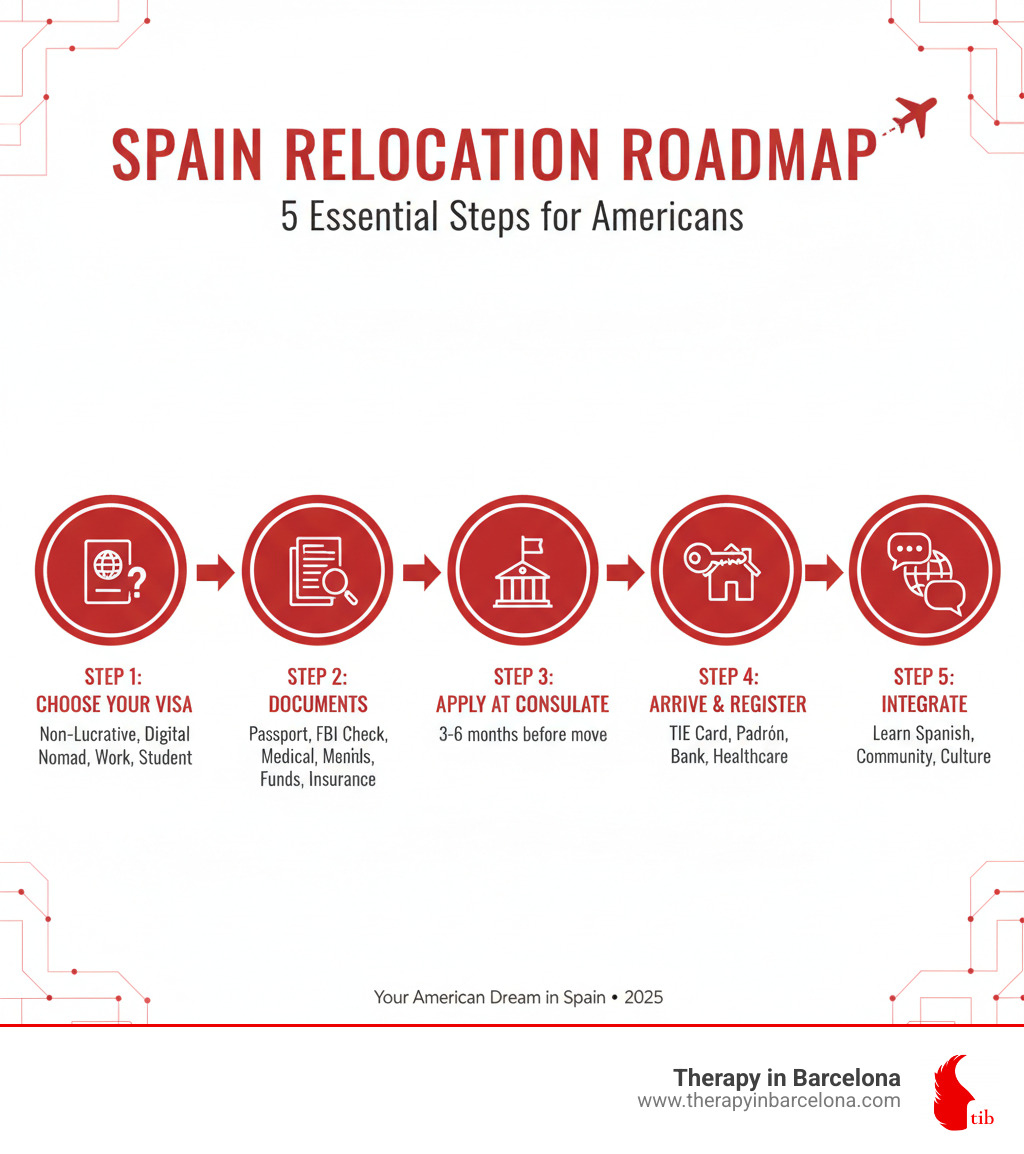
How to move to Spain as an American involves four key steps:
- Choose your visa type – Depending on your circumstances, this could be a Non-Lucrative, Digital Nomad, Work, or Student visa.
- Gather essential documents – You’ll need a valid passport, an apostilled FBI background check, a medical certificate, proof of funds, and private health insurance.
- Apply at the Spanish consulate – Submit your application in the US, typically 3-6 months before your intended move.
- Register upon arrival – In your first 30 days, get your TIE card, register on the padrón, open a bank account, and enrol in healthcare.
With over 36,000 US citizens registered as residents in 2023, according to Spain’s National Statistics Institute (INE), the appeal of Spain is clear. Americans are increasingly drawn to a country that offers an affordable, balanced life with excellent healthcare and strong community ties—qualities that can feel out of reach in the US. The cost of living is significantly lower, safety rankings are high, and the culture prioritises quality time away from work.
But moving to Spain is more than a practical exercise in logistics and paperwork. It involves understanding a new culture, learning a new language, and rebuilding your life. The bureaucracy can be tough and feelings of isolation are real. Understanding both the practical steps and the emotional journey is key to a successful transition, whether you’re a retiree, remote worker, or professional seeking a better work-life balance.
Why More Americans Are Choosing a Life in Spain
For a growing community of over 36,000 Americans, according to Spain’s National Statistics Institute (INE), life in Spain offers something increasingly elusive in the US: an affordable, balanced life where you can enjoy your time outside of work. Spain is a top destination for American expats in Europe, and the reasons become clear when you look at the quality of life.
The Cost of Living: Spain vs. The USA
The financial benefits are a major draw. Spain is 41% cheaper than the US without rent, and 52% cheaper when housing is included. Many American expats report spending significantly less overall.
- Housing: Rent is dramatically lower. A one-bedroom flat in Madrid’s city centre is around €800 monthly, while a similar apartment in a mid-sized US city could easily cost $1,500 or more.
- Daily Expenses: Groceries are more affordable, and dining out costs about 63% less, according to Numbeo. A three-course menu del día (lunch menu) with a drink often costs just €10-€15.
- Utilities & Transport: Basic utilities are cheaper than in the US, and a monthly public transport pass in most Spanish cities is about half the price of the US average.
A couple can live comfortably on $2,000-$3,000 a month in most Spanish cities, enjoying a quality of life that would require a much higher income in the States.
Safety and Wellbeing
Spain offers a tangible sense of security and a focus on health. The country ranks 23rd globally for safety in the 2023 Global Peace Index, far ahead of the US at 132nd. Violent crime is remarkably rare.
The universal healthcare system covers over 99% of residents, according to the Spanish Ministry of Health, and the quality of care is among the world’s best. For those working legally, it’s free at the point of use. Even for visa holders who initially need private insurance, the costs are a fraction of US premiums.
Perhaps most importantly, the Spanish culture values relationships, leisure, and work-life balance. Long lunch breaks and evening paseos (leisurely walks) are part of a lifestyle that prioritises wellbeing over productivity. For Americans feeling burnt out, this shift can be life-changing.
The Legal Roadmap: How to Move to Spain as an American
Understanding the Spanish bureaucracy is a key part of the move. For stays longer than 90 days, securing the right visa is your first major hurdle. Your choice will depend on your financial situation and whether you plan to work.
How to move to Spain as an American: Choosing Your Visa
- Non-Lucrative Visa: Ideal for retirees or those with passive income who won’t work in Spain. You must prove an annual income of at least €28,800 for one person, plus €7,200 for each additional family member. You can find official details on the Spanish government’s non-lucrative visa page.
- Digital Nomad Visa: For remote workers employed by companies outside Spain. You need to show a stable monthly income of at least €2,646 (200% of Spain’s minimum wage in 2024) and have a university degree or three years of professional experience. Freelancers can have Spanish clients, but this must not exceed 20% of their total business.
- Work Visa: This requires a job offer from a Spanish company, which usually must prove no EU citizen could fill the role. For those starting a business, the self-employment visa requires a solid business plan and sufficient funds.
- Student Visa: For full-time students. This visa allows for part-time work (up to 30 hours a week) with prior authorisation and can often be converted to a work permit after graduation.
Essential Paperwork for Your Application
Gathering your documents is a critical step. Always check the specific requirements of the Spanish consulate in your jurisdiction, but most applications will require the following:
- Completed national visa application form and a valid passport.
- A recent passport-style photo and proof of residence in the consular district.
- Proof of financial means, such as bank statements or income declarations.
- Comprehensive private health insurance with at least €30,000 in coverage, valid across the Schengen zone, with no co-payments or deductibles.
- An FBI background check issued within the last 90 days, legalised with an Apostille of The Hague.
- A medical certificate, also recent, stating you are free of serious public health diseases.
- Official Spanish translations by a sworn translator for all non-Spanish documents.
Start the application process at least three to six months before your planned move to allow for any delays.
Setting Up Your New Life: Practical First Steps in Spain

Once your visa is approved and you’ve arrived, the next challenge is Spanish bureaucracy. The first few weeks can feel overwhelming, but a clear plan makes it manageable.
Finding a Home: Renting and Buying Property
Most newcomers rent first to get a feel for different neighbourhoods. According to data from property portals, rental prices vary by city; for example, an 80-square-metre flat averages around €1,670 monthly in Madrid, €1,600 in Barcelona, €1,160 in Valencia, and under €800 in smaller cities like Granada. Start your search on portals like Idealista or Fotocasa. If you’re not confident in Spanish, a real estate agent (inmobiliaria) can be a great help.
Post-Arrival Essentials: Your First 30 Days
Your first month is for changing from a tourist into a legal resident. Prioritise these steps:
- Get your TIE card: Within 30 days of arrival, apply for your Tarjeta de Identidad de Extranjero (TIE) at the local immigration office. This is your official residency card.
- Register on the padrón: Register your address at the local town hall (ayuntamiento). This empadronamiento certificate is essential for accessing public services.
- Open a bank account: You’ll need your NIE number, passport, and TIE card. Major banks include BBVA and Santander, while online banks like N26 are popular with expats.
- Register for healthcare: If eligible, register at your local health centre (centro de salud) to get your public health card (tarjeta sanitaria) and access the public system.
Understanding Healthcare as an Expat
Spain’s healthcare system is excellent. The Spanish National Health System (SNS) provides universal coverage to legal residents who are employed or retired. For your initial visa, you’ll need private health insurance with comprehensive coverage (at least €30,000) and no co-payments (sin copago). Basic travel insurance is not sufficient.
Many expats maintain private insurance for faster access to specialists and more English-speaking doctors. While public mental health services, local private practices, and large online therapy platforms exist, they may not grasp the specific cultural challenges expats face.
At Therapy in Barcelona, our team of qualified, English-speaking therapists are expats themselves. We understand the stress of dealing with bureaucracy while feeling homesick. We offer a culturally sensitive approach, matching you with a professional who gets the nuances of adapting to life in Spain. Some of our therapists also speak German, French, Spanish, Afrikaans, Portuguese, Austrian-German and Swiss-German. You can learn more about our individual therapy services, and if you’d like support, book a Free Discovery Call.
Thriving, Not Just Surviving: Work, Taxes, and Cultural Adjustment

Once the initial paperwork is done, the real work of building a life begins. Long-term success in Spain means understanding your financial obligations, finding your place in the work culture, and adapting to a different rhythm of life.
Understanding Your Tax Obligations in Both Countries
Understanding two tax systems can be tricky. As a US citizen, you must file a US tax return on your worldwide income annually. However, a tax treaty between the US and Spain prevents double taxation. Mechanisms like the Foreign Earned Income Exclusion (FEIE) and the Foreign Tax Credit (FTC) can significantly reduce or eliminate your US tax bill. You’ll also need to report foreign financial accounts via FBAR and FATCA filings. For details, see the IRS guide for expats.
If you spend over 183 days a year in Spain, you become a tax resident and are taxed on your worldwide income. Spanish income tax rates are progressive, from 19% to 47%, as detailed by the Spanish Tax Agency. Some high earners may benefit from the Beckham Law, which offers a flat 24% tax rate on Spanish-sourced income for up to five years. Consulting a tax professional specialising in US expat taxes is highly recommended.
The Spanish Job Market and Work Culture
Finding work in Spain can be challenging, with unemployment higher than the EU average, according to Eurostat data. However, opportunities exist in sectors like IT, healthcare, engineering, and tourism. Fluency in Spanish is a major advantage. Job platforms like InfoJobs and LinkedIn are good places to start.
The work culture prioritises personal relationships and work-life balance over the more task-oriented American approach. This cultural shift can be a source of stress, sometimes impacting relationships. If you and your partner are struggling with the pressures of expat life, our specialised couples counselling can help you work through these challenges together.
How to move to Spain as an American: Managing the Emotional Journey
Moving abroad is a rollercoaster. The initial excitement can fade, giving way to frustration, isolation, or homesickness. Take Emily, a fictional composite example of a 34-year-old from the US who moved to Valencia. Like many expats, she expected an easy transition but found herself feeling lonely, struggling with the language and finding it hard to make deep connections.
While Spain has public mental health services, local private practices, and large online therapy platforms, they often lack a specific understanding of the expat experience. At Therapy in Barcelona, our team of qualified, English-speaking therapists are expats themselves. Founded in 2011 by Australian Psychologist Leigh Matthews, we offer a culturally sensitive approach and carefully match you with a professional who understands the nuances of adapting to life in Spain. We’re a trusted group practice providing high-quality private-pay care for adults, couples, teens and families. We draw on evidence-based approaches like CBT and ACT, and for couples we may use the Gottman Method. We keep your data private and do not sell it. We provide a safe space to work through these challenges, whether you’re in Barcelona, Madrid, or elsewhere. You can learn more about our dedicated team. This is a private-pay service, and some therapists offer sliding scale fees.
Your 12-Month Relocation Timeline
Planning your move to Spain is a marathon, not a sprint. A structured timeline helps manage the process. Here’s a guide to how to move to Spain as an American.
12-18 Months Before Your Move
- Research visa options (Non-Lucrative, Digital Nomad, etc.) to find your best fit.
- Explore potential cities like Madrid, Barcelona, Valencia, or Málaga.
- Start learning Spanish. Even basic skills make a huge difference.
- Begin saving and consult a US expat tax specialist.
6-9 Months Before Your Move
- Finalise your visa choice and review the specific requirements from your designated Spanish consulate.
- Start gathering foundational documents like birth and marriage certificates.
3-6 Months Before Your Move
- Submit your visa application to the Spanish consulate.
- Request your FBI background check and have it apostilled (it must be recent).
- Obtain your medical certificate.
- Secure a visa-compliant private health insurance policy (no co-payments).
1-3 Months Before Your Move
- Book your one-way flight and arrange short-term accommodation.
- If moving with pets, check all requirements on the Spanish Embassy website, including microchip, vaccinations, and health certificates.
- Arrange for international movers if shipping household goods.
- Set up an international money transfer service like Wise or Revolut.
Upon Arrival in Spain
In your first 30 days, complete these critical tasks:
- Apply for your TIE (Foreigner Identity Card).
- Register on the padrón at your local town hall.
- Open a Spanish bank account.
- Enrol in the public healthcare system if eligible.
Conclusion
Making the move to Spain as an American is a leap into a new way of living. It requires dealing with visa applications, paperwork, and a new culture, but the reward is the chance to build a richer, more balanced life in a country that values connection and community.
The practical steps are important, but so is the emotional journey. The initial excitement can give way to frustration or homesickness. While Spain offers public healthcare and other support systems, expats often need a space where someone truly understands the experience of rebuilding a life abroad.
At Therapy in Barcelona, our team of qualified, English-speaking therapists are expats themselves. We’ve been through the highs and lows and bring that understanding to every session. We offer both in-person sessions in Barcelona and online therapy worldwide, including to the USA and Canada. We carefully match you with a therapist who gets the nuances of expat life, because your experience deserves that level of care.
Book a Free Discovery Call to talk about how we can support you.
