


Why International Student Therapy Matters More Than Ever

International student therapy offers specialised mental health support designed to address the unique challenges faced by students studying abroad. Here’s what you need to know:
Quick Options for International Student Therapy:
- University counselling services – Often free but may have waitlists and session limits
- Private therapy practices – More personalised care with expat-specific expertise
- Online therapy – Convenient access to culturally sensitive therapists worldwide
- Crisis support – Immediate help through emergency services and helplines
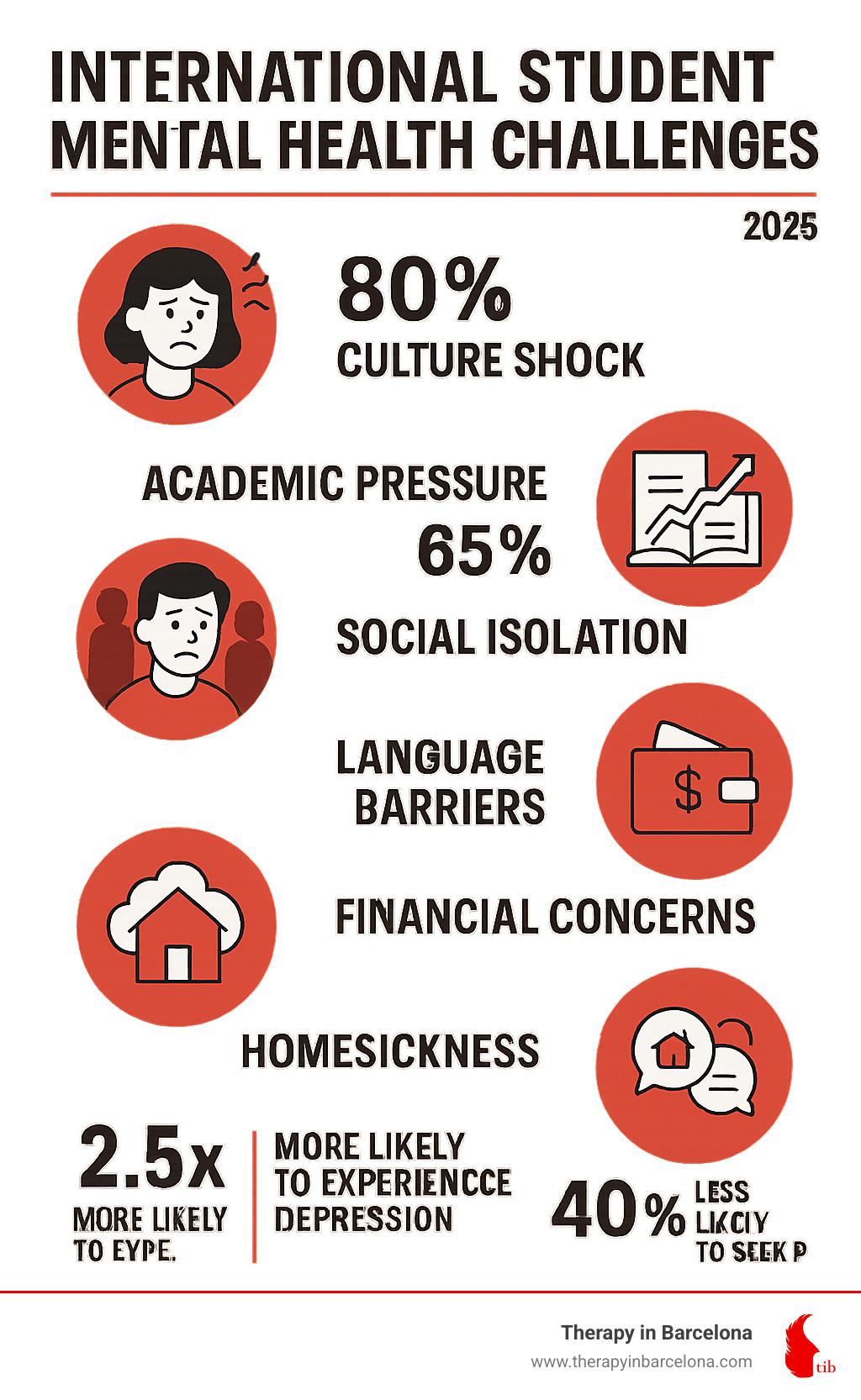
Moving to study in a new country brings excitement, but it also creates a perfect storm of stressors that can impact your mental health. Research shows international students are more likely to face challenges that affect their mental well-being due to cultural adaptation pressures, yet they’re less likely to seek professional help.
The challenges are real and varied. Culture shock can leave you feeling lost between your home identity and your new environment. Academic systems work differently, social connections feel harder to form, and financial pressures add another layer of stress. Language barriers can make expressing complex emotions feel impossible, while homesickness creates a constant ache for familiar places and faces.
These struggles aren’t a sign of weakness – they’re a natural response to major life changes. Whether you’re in Barcelona navigating Catalan culture, studying in Valencia’s vibrant academic scene, or adjusting to life in Madrid’s international community, seeking support shows strength and self-awareness.
This guide will help you understand your options, from university services to private therapy, and show you how to find the right support for your unique situation. You don’t have to face these challenges alone.
At Therapy in Barcelona, we work online with clients worldwide and offer face-to-face therapy in our Barcelona office.
We don’t provide crisis care. If you or someone else is in immediate danger in Spain, call 112, or contact local emergency services or a crisis helpline.
The Unique Pressures of Studying Abroad
Studying abroad is often painted as an idyllic adventure—and it certainly can be transformative. You gain incredible life skills, broaden your worldview, and forge global friendships. Yet beneath the Instagram-worthy moments and exciting new experiences lies a distinct set of pressures that can significantly impact your mental well-being.
Acculturative stress is a significant challenge international students face. This is the psychological toll of adapting to a new culture, which can manifest as confusion, feelings of worry, and frustration. It often comes hand-in-hand with culture shock—that disorienting feeling when everything you thought you knew about how the world works suddenly doesn’t apply anymore.
The initial excitement of your new adventure can quickly give way to feeling overwhelmed by the simplest tasks. Ordering coffee becomes a linguistic puzzle. University systems work differently than back home. Even making friends feels more complicated when you’re navigating unspoken social rules you don’t understand yet.
For a deeper understanding of how major life transitions affect your mental health, explore The Importance of Mental Health During Relocation.
Beyond cultural adjustment, academic pressure intensifies in ways you might not expect. You’re not just learning course material—you’re decoding an entirely new educational system with different expectations, grading methods, and teaching styles. For many international students, there’s also the weight of family expectations and financial investment riding on their academic success.
Financial concerns add another layer of constant stress. International students often face higher tuition fees, higher living expenses, and strict limitations on part-time work. The maths of stretching your budget becomes a daily worry that follows you from lecture halls to grocery stores.
Then there are the language barriers that go far deeper than vocabulary. Even if you’ve studied English for years, navigating complex academic discussions or expressing nuanced emotions in your non-native language can be exhausting. You might find yourself feeling like a different person in your second language—less witty, less articulate, less you.
Unfortunately, some international students also encounter systemic discrimination or unconscious bias. This can range from subtle microaggressions to more overt challenges that affect your sense of belonging and self-worth. These experiences add yet another layer of stress to an already challenging transition.
All these factors contribute to social isolation and intense homesickness. You might find yourself missing not just your family and friends, but the version of yourself that felt confident and understood back home. The familiar comforts—from your mum’s cooking to conversations that flow effortlessly—can feel impossibly far away.
If you’re studying in Spain, you might recognise these feelings in Homesickness in Barcelona, which explores how these emotions manifest in specific cultural contexts.
Research consistently shows that international students face a greater likelihood of challenges affecting their mental well-being due to these accumulated stresses. Forbes-Mewett and Sawyer’s 2019 study found that despite this increased vulnerability, international students remain significantly less likely to seek professional help—creating a troubling gap between need and access to support. This makes specialised international student therapy not just helpful, but essential for many.
Understanding Cultural Differences in Mental Health
One of the primary reasons international students hesitate to seek help lies in the vastly different cultural views on mental health and therapy. In many cultures, mental health simply isn’t discussed openly. Seeking professional help might be seen as a sign of weakness, a personal failure, or something that brings shame to your family.
The way psychological distress manifests also varies significantly across cultures. In some traditions, emotional pain shows up primarily through physical symptoms—headaches, stomach problems, or fatigue—rather than the emotional vocabulary that Western therapy often relies on. If you’ve grown up in a culture where you express distress through your body rather than words, traditional talk therapy might initially feel foreign.
Collectivist cultures often prioritise family and community over individual needs. In these contexts, seeking help outside the family circle can feel like betraying family privacy or suggesting that your support system has failed you. This contrasts sharply with the individualistic approach common in Western therapeutic settings.
There’s also the matter of shame and family perception. Many international students worry about what their families will think if they find therapy is needed. The concern isn’t just personal—it’s about protecting family honour and maintaining the image of success that often comes with the privilege of studying abroad.
This is why cultural sensitivity in therapy isn’t just nice to have—it’s essential. A therapist working with international students needs to understand these nuances, adapt their approach accordingly, and create a safe space where you feel respected and understood, not judged for your cultural background.
This sensitivity becomes even more crucial when working with Third Culture Kids, who have grown up among multiple cultural identities and may face unique challenges in expressing their complex experiences.
The Emotional Toll: An Avatar’s Story
Let me tell you about Alex, a fictional 20-year-old student from India studying engineering in Madrid. While Alex isn’t real, their story reflects the composite experiences of many international students navigating similar challenges.
Alex arrived in Madrid buzzing with excitement, dreaming of academic success and European adventures. The first few weeks felt like a whirlwind of new sights, sounds, and possibilities. But as the novelty wore off, reality set in with unexpected weight.
The rapid-fire Spanish conversations in their shared flat became a constant reminder of being an outsider, even though Alex spoke fluent English. They missed the comfort of their mother’s home-cooked meals and the easy camaraderie with friends back home who understood their jokes and cultural references without explanation.
Academic expectations proved different than anticipated. Despite Alex’s best efforts and strong academic background, they felt constantly behind—not because the material was too difficult, but because the entire system operated on unspoken rules they hadn’t learned yet.
Gradually, Alex began spending more time alone in their room, scrolling through social media and watching life unfold back home through their friends’ posts. The vibrant city outside their window started feeling overwhelming rather than exciting. They felt invisible in crowded lecture halls—a common experience among international students who often report higher levels of loneliness than their domestic peers.
Alex’s grades began to slip, and with them came a crushing sense of failure. “What would my parents think?” became a constant worry. “They sacrificed so much for me to be here.” The weight of family expectations mixed with personal disappointment created a perfect storm of worry and self-doubt.
Sleep became elusive despite exhaustion. Concentration in classes felt impossible. Alex knew something wasn’t right, but the idea of talking to a stranger about these struggles—especially someone who might not understand their cultural background—felt daunting and somehow like admitting defeat.
Alex’s story reminds us that the emotional toll of studying abroad is real, valid, and more common than many students realise. These feelings don’t reflect personal weakness—they’re natural responses to navigating profound life changes in unfamiliar territory.
Finding the Right Support: A Guide to International Student Therapy

When you’re struggling with the challenges of studying abroad, finding the right mental health support might feel overwhelming. But it doesn’t need to be another source of stress. Understanding your options is the first step towards getting the help you deserve.
International student therapy comes in several forms, each with distinct advantages. Your main options typically include university counselling services, private therapy practices, and online therapy platforms. The right choice depends on your specific needs, budget, and what feels most comfortable for you.
University Counselling vs. Private Therapy
Most universities offer mental health support through Student Counselling Centres. These services are often free or low-cost, which is particularly helpful when you’re managing tight finances. University counsellors can provide individual sessions, group therapy, stress management workshops, and peer support groups specifically designed for student life.
However, university services often come with waitlists, especially during exam periods or the start of term. You might face session limits – perhaps only six to eight sessions per semester. The support tends to be more generalist, focusing on common student concerns rather than the specific cultural challenges you face as an international student.
Private therapy practices offer a different experience entirely. While this is typically a private-pay service, many therapists understand financial constraints. Some offer sliding scale fees for those with demonstrated need – you can always ask about this during an initial consultation.
The benefits of private therapy include wider therapist choice, allowing you to find someone with specific expertise in cultural adjustment or homesickness. You’ll often get more flexible scheduling and bespoke therapist matching to ensure you connect with someone who truly understands your background.
At Therapy in Barcelona, you’ll work with psychology-trained therapists who are also expats. We’re a trusted group practice in Spain, established in 2011, and we support adults, couples, teens, and families. Our collaborative team shares knowledge and maintains high standards of care. The connection between you and your therapist matters most, so we take time for careful matching rather than simply pairing you with the next available professional. You can learn more about our approach at Therapy in Barcelona: How Therapy Works.
Acknowledging Alternatives
International students have various mental health support options available. Some seek help through public health systems in cities like Valencia or Málaga, which can be accessible and affordable. Others turn to large online platforms that offer wide therapist networks. You might also find local practices in cities like Sevilla or Alicante that serve the general population.
These alternatives can provide valuable support. However, they may not always offer the same expat-specific cultural sensitivity that specialised practices provide. Large platforms, while convenient, sometimes lack the personalised therapist matching that ensures deep understanding of your unique challenges as an international student. Privacy policies can also vary significantly. At Therapy in Barcelona, we’re committed to strict privacy with no data selling, offering a higher quality private-pay service focused specifically on your needs as an international.
Effective Therapeutic Approaches for International Students
For therapy to truly help international students, it must be culturally sensitive. This means adapting established therapeutic approaches like Cognitive Behavioural Therapy (CBT), Acceptance and Commitment Therapy (ACT), or Psychodynamic therapy to fit your cultural context and lived experience. We may also draw on Schema Therapy, Systemic, DBT (Dialectical Behaviour Therapy), and mindfulness-based approaches.
Your therapist’s background matters enormously. Expat therapists who have steered their own cultural adjustment journeys bring unique empathy and understanding. They don’t just intellectually grasp the challenges – they’ve felt them. This shared experience helps build the trust that’s essential for effective therapy.
As one client shared with us: “My therapist speaks perfect English, something that is very important for me, who feels super excluded from social life here, for not speaking Spanish. It was vital that she fully understands me.” Leigh Matthews, an Australian Psychologist in Barcelona since 2011, founder of Therapy in Barcelona and experienced in supporting internationals, understands this firsthand. She experienced the challenges of adapting to Catalan culture and looked for the kind of support she now provides to others.
Language accessibility can be transformative. Being able to express complex emotions in your native language – or at least in fluent English – removes a significant barrier to healing. At Therapy in Barcelona, we offer therapy in English, with some therapists also speaking German, French, Spanish, Afrikaans, Portuguese, Swedish, Austrian-German, and Swiss-German.
Our approach goes Beyond Borders: Effective Counseling Strategies for International Students, creating a safe space where you feel understood, respected, and empowered to steer your unique journey.
Online vs. In-Person Therapy: What’s Best for You?
The choice between online and in-person therapy often comes down to what makes you feel most comfortable and supported. Research suggests online therapy can be as effective as face-to-face sessions for common concerns like persistent worry and low mood.
Online therapy offers remarkable convenience and privacy. You can access support from your dorm room or apartment, which feels particularly valuable when you’re already dealing with unfamiliar environments. It provides accessibility worldwide and offers a wider choice of therapists. This is especially helpful if you’re studying in smaller cities like Alicante or Málaga, where English-speaking therapists with expat experience might be limited.
In-person therapy provides direct human connection and allows your therapist to pick up on non-verbal cues that might be missed online. Having a dedicated physical space for your therapy can feel grounding, especially when your living situation feels temporary or unstable. We offer face-to-face sessions in our Barcelona office.
Many students find that starting online helps them feel more comfortable and private, while others prefer the structure and connection of meeting face-to-face. At Therapy in Barcelona, we offer both options, allowing you to choose what works best for your situation. You can explore more about our Online Therapy services to see if this approach might suit you.
If you’d like support, book a Free Discovery Call. We see clients online worldwide and in person in our Barcelona office.
The most important factor isn’t whether you’re sitting across from your therapist or looking at them through a screen – it’s finding someone who understands your experience and can help you build the resilience and skills you need to thrive as an international student.
