


Why Mental Health Support Matters More Than Ever for Digital Nomads

Digital nomad counselling has become essential as location-independent work transforms how we live and work. Whether you’re battling isolation in a co-working space in Valencia or struggling with burnout whilst overlooking the Mediterranean, you’re not alone in needing mental health support that travels with you.
What is digital nomad counselling?
- Specialised therapy for location-independent professionals
- Online sessions that work across time zones and countries
- Therapists who understand the unique challenges of nomadic life
- Support for issues like cultural adjustment, isolation, and work-life boundaries
- Available as a private-pay service, with some therapists offering sliding scale fees
Common challenges digital nomad counselling addresses:
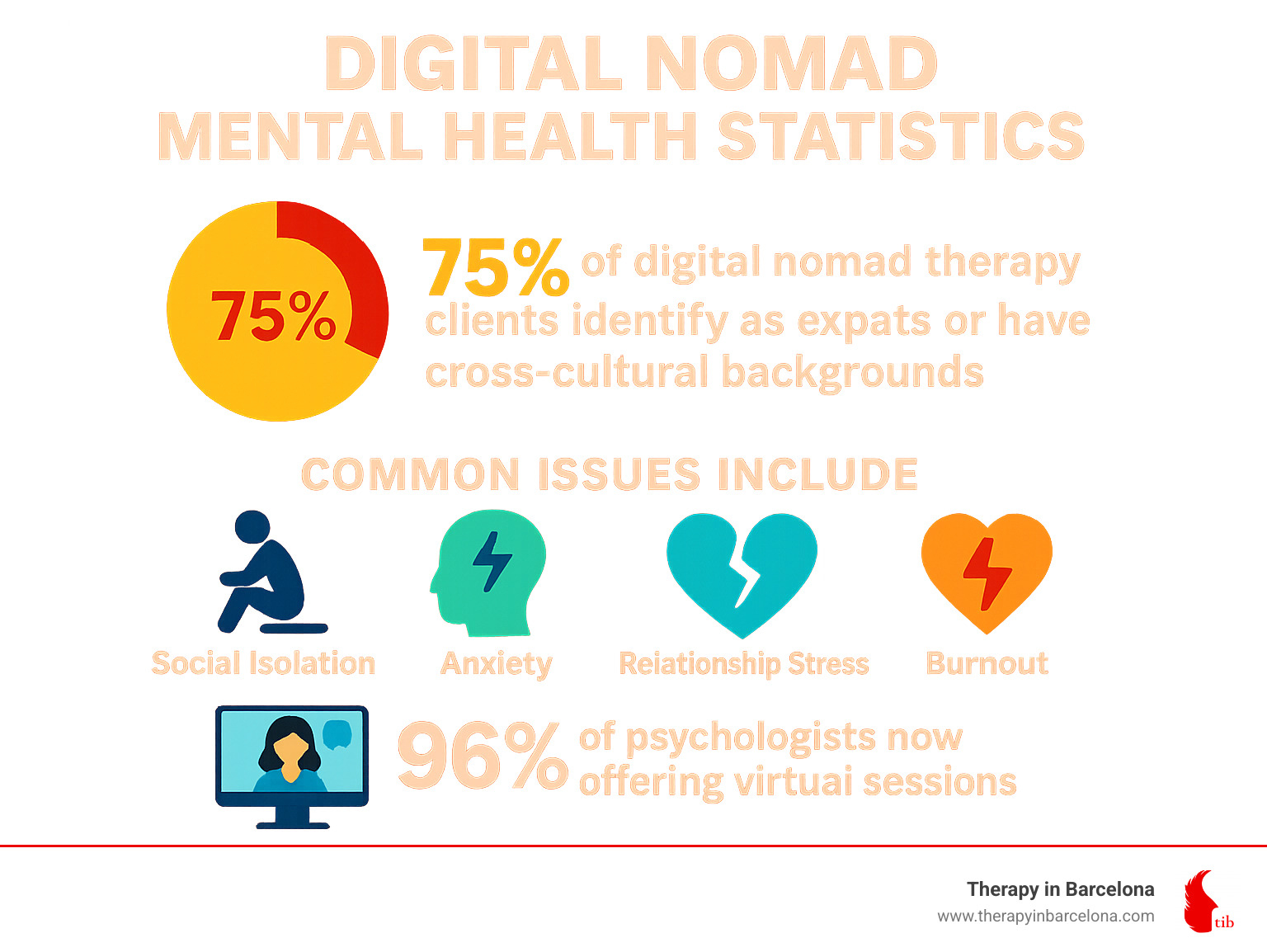
- Social isolation and loneliness
- Chronic anxiety from constant change
- Relationship stress from distance and lifestyle differences
- Identity confusion and feeling unsettled
- Burnout from blurred work-life boundaries
- Reverse culture shock when returning home
The statistics tell a compelling story. Research shows that 96% of psychologists now treat patients virtually, making professional support more accessible than ever. Yet many digital nomads struggle to find therapists who truly understand their lifestyle. The challenges go beyond typical travel stress – you’re dealing with the psychological impact of never feeling truly settled, the pressure to constantly appear successful on social media, and the complex grief of leaving behind familiar support systems.
As one digital nomad therapist notes, “Finding a therapist who can work with you whilst you travel the world” and understands “the pressures, hassles, and perplexities of a location-independent lifestyle can be darn near impossible.” This gap between need and understanding is exactly what specialised digital nomad counselling aims to bridge.
The nomadic lifestyle brings unique psychological challenges that traditional therapy models weren’t designed to address. You might find yourself in Barcelona one month and considering Málaga or the Canary Islands the next, making consistent local care nearly impossible. Digital nomad counselling offers continuity of care that travels with you, providing the stability your mental health needs even when your location constantly changes.
The Unique Mental Health Landscape of a Digital Nomad
The allure of the digital nomad lifestyle is undeniable: freedom, adventure, and the ability to work from anywhere with a good internet connection. Yet, beneath the glossy Instagram posts of beachside laptops and vibrant cityscapes, a more complex reality often unfolds. The constant change, lack of routine, and social isolation can contribute significantly to mental health challenges. Imagine the psychological toll of adjusting to new surroundings, languages, and cultures every few months, often without a stable local support network. It’s a unique blend of excitement and profound instability that can wear on even the most resilient individuals.
This continuous adaptation to new surroundings, people, cultures, and customs can exacerbate existing mental health issues or trigger new ones. The stress of learning to travel and work simultaneously, particularly if you lack strategies to manage emotions that arise from unfamiliar situations, can be overwhelming. As explored in our article, Digital Nomad Diaries: The Mental Health Journey, the journey is often more than just a physical relocation; it’s a profound mental and emotional one.
Beyond the daily stressors of new environments, digital nomads often grapple with financial uncertainty, especially if they are freelancers. Insecure income can be an extreme stressor. Relationship stress also looms large, whether it’s managing long-distance connections or the challenges of forming new bonds amidst constant movement. Then there’s the unique phenomenon of reverse culture shock upon returning home, where the familiar suddenly feels foreign, leading to symptoms like grief, sadness, and disconnection. One therapist experienced this after a trip to Europe, feeling overwhelmed by her possessions and disconnected from her home city, noting that many other digital nomads share similar experiences.

Common Challenges You Might Recognise
If you’re a digital nomad, you might recognise some of these struggles:
- Loneliness: Despite being surrounded by new people, profound loneliness can set in. The constant movement makes it difficult to form deep, lasting connections, leading to a sense of isolation and a longing for community. As one therapist highlighted, online therapy can help by providing a space to discuss these feelings and develop coping strategies for belonging when away from established networks.
- Anxiety: The perpetual uncertainty of nomad life – from finding accommodation and reliable internet to dealing with foreign bureaucracy and managing fluctuating income – can fuel chronic anxiety. Anxiety disorders affect nearly 30% of adults at some point in their lives, and the digital nomad lifestyle can amplify this. Therapy, especially Cognitive Behavioural Therapy (CBT), can help by interrupting and reframing worried thoughts and reducing avoidance behaviours.
- Burnout: The blurred lines between work and life, combined with the pressure to constantly explore new places, can quickly lead to exhaustion. The desire to “make the most” of every new location often means sacrificing rest and self-care.
- Identity Crisis: When your routine, community, and even your physical surroundings are constantly shifting, it can be challenging to maintain a consistent sense of self. “Who am I if I’m not defined by a place or a consistent social circle?” is a common question.
- Grief and Loss of Community: Leaving behind friends, family, and familiar support systems can be a significant source of grief. Each new move can feel like a mini-loss, especially when you’ve just started to feel settled.
- Feeling Unsettled: Even after years on the road, many nomads describe a persistent feeling of not being truly “home” anywhere. This lack of a stable base can impact mental well-being. Our article, Finding Balance as an International: Tips for Managing Stress and Anxiety Abroad, offers practical advice for managing this.
Why Your Experience is Valid
It’s easy to feel like your struggles are somehow less valid because you’re “living the dream.” Society often romanticises the digital nomad lifestyle, projecting an image of endless freedom and happiness. This creates an implicit pressure to always appear well, even when you’re privately battling high-functioning anxiety or the quiet despair of loneliness.
But your experience is incredibly valid. Expat life, whether you’re a long-term expatriate, a Third Culture Kid, or a perpetual digital nomad, comes with its own unique set of psychological demands. As Leigh Matthews, the Australian Psychologist and founder of Therapy in Barcelona, an expat herself, profoundly understands, cultural adaptation, language barriers, and the stresses of living away from home require immense resilience. The importance of mental health during relocation cannot be overstated, as discussed in The Importance of Mental Health During Relocation.
Recognising these challenges and allowing yourself self-compassion is the first step. Your journey is unique, and it’s perfectly normal to need support, even when your life looks like a holiday to others.
The Transformative Power of Digital Nomad Counselling
Traditional, location-dependent mental health resources often fall short for those on the move. Finding local professionals can be problematic due to shortages and long waiting times, and by the time an appointment is available, a nomad might have already moved on. Digital nomad counselling overcomes these geographical barriers, offering continuity of care, flexibility, and accessibility through online therapy.

The American Psychological Association (APA) found that 96% of psychologists now treat patients virtually. This widespread adoption means that online therapy is not just a temporary solution but a robust and effective mode of treatment. As Psychology Today reported, virtual therapy has proven highly beneficial, allowing you to benefit from regular sessions with the same trained and accredited therapist, regardless of your location. This consistent relationship provides a much-needed anchor in a life of constant change.
Beyond mere convenience, online digital nomad counselling offers a culturally sensitive approach. Many therapists who specialise in this area are expats or digital nomads themselves, bringing a shared understanding and lived experience to the therapeutic space. This allows for a deeper connection and an appreciation for the nuances of your unique journey.
Finding a Therapist Who Truly Understands
One of the greatest benefits of specialised digital nomad counselling is finding a therapist who “gets it.” This is crucial because, as one therapist put it, “It can be difficult to find a therapist who can work with you whilst you travel the world. And finding a therapist who understands the pressures, hassles, and perplexities of a location-independent lifestyle can be darn near impossible.”
Therapists with lived experience as expats or digital nomads can offer a non-judgmental space where you don’t need to explain the basics of your lifestyle. They understand the unique blend of freedom and isolation, the joy of discovery and the pangs of homesickness. This shared understanding fosters quicker rapport and a stronger therapeutic alliance, which is foundational to effective therapy. As our article, Roam Free, Heal Freely: A Digital Nomad’s Guide to Remote Therapy, highlights, the value of a consistent therapeutic relationship is immense, providing stability when everything else is in flux.
For instance, at Therapy in Barcelona, our team comprises highly qualified, English-speaking therapists from various cultural backgrounds, many of whom are expats themselves. This means they empathise with your unique struggles and recognise your strengths in adapting to a foreign culture. Leigh Matthews, our founder and Australian Psychologist who has been in Barcelona since 2011, established Therapy in Barcelona precisely because she recognised the profound need for culturally sensitive mental health services in English that truly understood the international experience.
How Online Therapy Works
Online therapy for digital nomads typically operates through secure video platforms, ensuring your sessions are confidential and private. Therapists are trained to use HIPAA-compliant (or equivalent national standard) platforms to protect your data and privacy, a point emphasised by many experienced online therapists.
Scheduling across time zones is a common consideration. Many digital nomad counsellors, understanding the flexibility their clients need, offer sessions at varied times, including evenings or weekends, to accommodate different time zones. This might mean your therapist in Barcelona is having their morning coffee while you’re unwinding after a day of exploring in Sevilla or Gran Canaria.
Creating a private space for your sessions, even when you’re constantly moving, is important. This might involve finding a quiet corner in a co-working space, a private room in a hostel, or simply ensuring your environment is free from distractions. As we detail in Therapy in Barcelona: How Therapy Works, the focus is always on creating a safe and confidential environment for your therapeutic journey. Some therapists may also offer asynchronous support, such as messaging, though live video sessions remain the cornerstone of online digital nomad counselling.
How to Choose the Right Online Therapist for You
Choosing the right online therapist is a crucial step in your mental health journey. It’s not just about finding someone available; it’s about finding the right fit for your unique needs and the complexities of your nomadic life. Look for therapists with appropriate qualifications, licensing, and specialisations that align with your concerns. A therapist who is well-versed in Acceptance and Commitment Therapy (ACT), Cognitive Behavioural Therapy (CBT), or even EMDR, for example, might offer specific tools that resonate with you.
Many practices, like Therapy in Barcelona, offer personalised matching services. This means they take the time to understand your specific needs before connecting you with a therapist who has the most appropriate training and experience. This bespoke approach increases the likelihood of a positive therapeutic outcome, as it moves beyond simply matching you with the next available professional. It’s why we encourage a Free Discovery Call – it’s a crucial first step in finding that ideal connection.
Key Considerations for Your Digital Nomad Counselling Provider
When seeking a digital nomad counselling provider, consider the following:
- Therapist’s Credentials and Licensing: Always ask about their training and qualifications. In the US, for instance, a master’s degree is typically required to be a therapist, whereas in some other countries, regulations can be less strict. You want someone highly qualified, as the mind is delicate and precious.
- Experience with Internationals and Digital Nomads: Do they truly understand the expat journey? Many therapists, like those at Therapy in Barcelona, are expats themselves, offering a deep understanding of cultural nuances and the challenges of living abroad.
- Language Proficiency: Ensure they can provide therapy in a language you are most comfortable with. Therapy in Barcelona offers services in English, with some therapists also speaking German, French, Spanish, Afrikaans, Portuguese, Swedish, Austrian-German, and Swiss-German.
- Questions to Ask a Potential Therapist:
- “What is your experience working with digital nomads or expats?”
- “How do you handle time zone differences for scheduling?”
- “What platforms do you use, and how do you ensure confidentiality?”
- “Are you familiar with the legal and ethical considerations of practising across different jurisdictions?” (More on this below.)
- “What is your therapeutic approach, and how do you tailor it to nomadic life?”
- Ethical Guidelines and Data Privacy: A reputable therapist will adhere to strict ethical guidelines and prioritise your data privacy, especially crucial in the online space. Enquire about their policies and the security of their platforms. At Therapy in Barcelona, we never sell your data.
The Financial Side: Pricing and Insurance
When it comes to the financial aspects of digital nomad counselling, it’s important to understand that most specialised services for this niche operate on a private-pay model. This means that, unlike some traditional in-person therapy, you typically pay directly for each session, and therapists may not accept insurance or offer superbills for reimbursement. For example, some therapists who offer coaching services rather than therapy, specifically state that insurance reimbursement is not possible.
While prices vary, it’s common for therapists in higher-income countries to charge around £80-£160 per hour, though this can vary widely. The good news is that many therapists understand the financial realities of nomadic life and may offer sliding scale fees for those with demonstrated financial need. It’s always worth enquiring about this during your initial consultation.
It’s also important to acknowledge alternatives. Large online platforms might offer lower prices, but they often lack the personalised matching and culturally sensitive expertise that specialised services, like Therapy in Barcelona, provide. Public healthcare systems, while potentially free, are often not equipped to handle the unique needs of a transient, international population, and wait times can be extensive.
The value of a specialised, private-pay service lies in the bespoke care it offers. You’re investing in a therapist who truly understands your unique context, provides continuity regardless of your location, and offers a level of cultural sensitivity that can be hard to find elsewhere. This custom approach often leads to more effective and meaningful therapeutic outcomes, making it a worthwhile investment in your mental well-being.
Getting Started on Your Therapeutic Journey
Taking the first step towards digital nomad counseling can feel daunting, but it’s a powerful act of self-care. Overcoming the stigma associated with mental health support is crucial; remember, this generation is taking mental health seriously in a way that previous generations never did. It’s no longer taboo to seek therapy; in fact, it’s a sign of strength and self-awareness.
Preparing for your first session can be helpful. Reflect on what you hope to gain from therapy, what challenges you’re currently facing, and any specific goals you have. Some clients find it useful to jot down notes or thoughts before their appointment. Setting clear goals with your therapist will help guide your journey and provide a roadmap for your growth.
For many internationals and digital nomads, seeking therapy is a compelling choice. Our article, 12 Compelling Reasons Internationals and Digital Nomads Should Consider Therapy, digs deeper into why this support is so vital.
Remember to weave self-care routines into your nomadic lifestyle. This might involve finding moments for mindfulness, engaging in physical activity, or simply giving yourself permission to have quiet time amidst your adventures. Whether you’re exploring the busy streets of Barcelona, the serene beaches of Málaga, or the vibrant culture of Gran Canaria, prioritising your mental well-being is key to a sustainable and fulfilling journey.
Frequently Asked Questions about Digital Nomad Counselling
Is online therapy as effective as meeting in person?
Research, including findings from the American Psychological Association, suggests that online therapy can be as effective as in-person sessions for a wide range of mental health concerns. The key factors for effectiveness are the therapeutic alliance (the bond between you and your therapist) and the client-therapist fit. If you feel comfortable, understood, and connected to your therapist, the medium often becomes secondary.
For digital nomads, the benefits of remote access – continuity of care, flexibility, and accessibility – often outweigh any perceived differences from in-person sessions. Some clients even find it easier to open up from the comfort and privacy of their chosen location. Hybrid models, where a client might see a therapist in person when stationary and then transition to online when on the move, are also becoming more common.
What if my internet connection is unstable?
This is a valid concern for any digital nomad. Experienced digital nomad counsellors understand this reality and often have backup plans. These might include:
- Therapist Flexibility: They may be able to switch to a phone call if video quality drops.
- Backup Plans: Discuss with your therapist what happens if the connection fails – do you try to reconnect, reschedule, or switch to a different communication method?
- Phone Sessions: For periods of less reliable internet, some therapists can conduct sessions entirely by phone.
- Asynchronous Communication Options: While not a substitute for live sessions, some therapists might offer limited email or messaging support between calls.
- Choosing Accommodation Wisely: When possible, prioritise accommodation with strong, reliable Wi-Fi. Many co-working spaces also offer stable connections for sessions.
How do I know if a therapist can legally work with me?
This is one of the most complex aspects of digital nomad counselling due to varying jurisdictional laws. Therapists typically must be licensed in the state or country where their client is physically located at the time of the session, or where the therapist is located, depending on specific regulations. However, many therapists licensed in their home country can continue to work with clients who remain in that same country, even if the therapist is temporarily abroad.
A reputable digital nomad counsellor will be transparent about their licensing and the scope of their practice. They should explain the legal and ethical considerations in their informed consent process. It is crucial to work with established practices, like Therapy in Barcelona, who navigate these complexities and ensure compliance. They can advise you on the specifics of their ability to provide services based on your current location and their licensing. Always ask direct questions about this to ensure you are receiving legal and ethical care.
Your Partner in Wellbeing, Wherever You Roam
The digital nomad lifestyle, with all its excitement and challenges, is here to stay. And with it, the recognition that mental health is not a luxury, but foundational to a sustainable and fulfilling nomadic life. You don’t have to navigate these challenges alone. Support is accessible, and it can travel with you, adapting to your unique journey.
Therapy in Barcelona is a trusted practice in Spain, established in 2011. We’re a group practice of highly qualified, psychology-trained therapists who work with adults, couples, teens and families. We provide culturally sensitive support for internationals, including digital nomads, wherever they roam.
Here’s how we work: we see clients online worldwide and we also offer face-to-face therapy sessions in our Barcelona office. Our personalised matching helps you find a therapist who fits your needs, background and schedule.
If you’d like support, book a Free Discovery Call.
