


Finding the Right Therapist: Your Mental Health Compass

If you’re looking to find a therapist, here’s a quick guide to get you started:
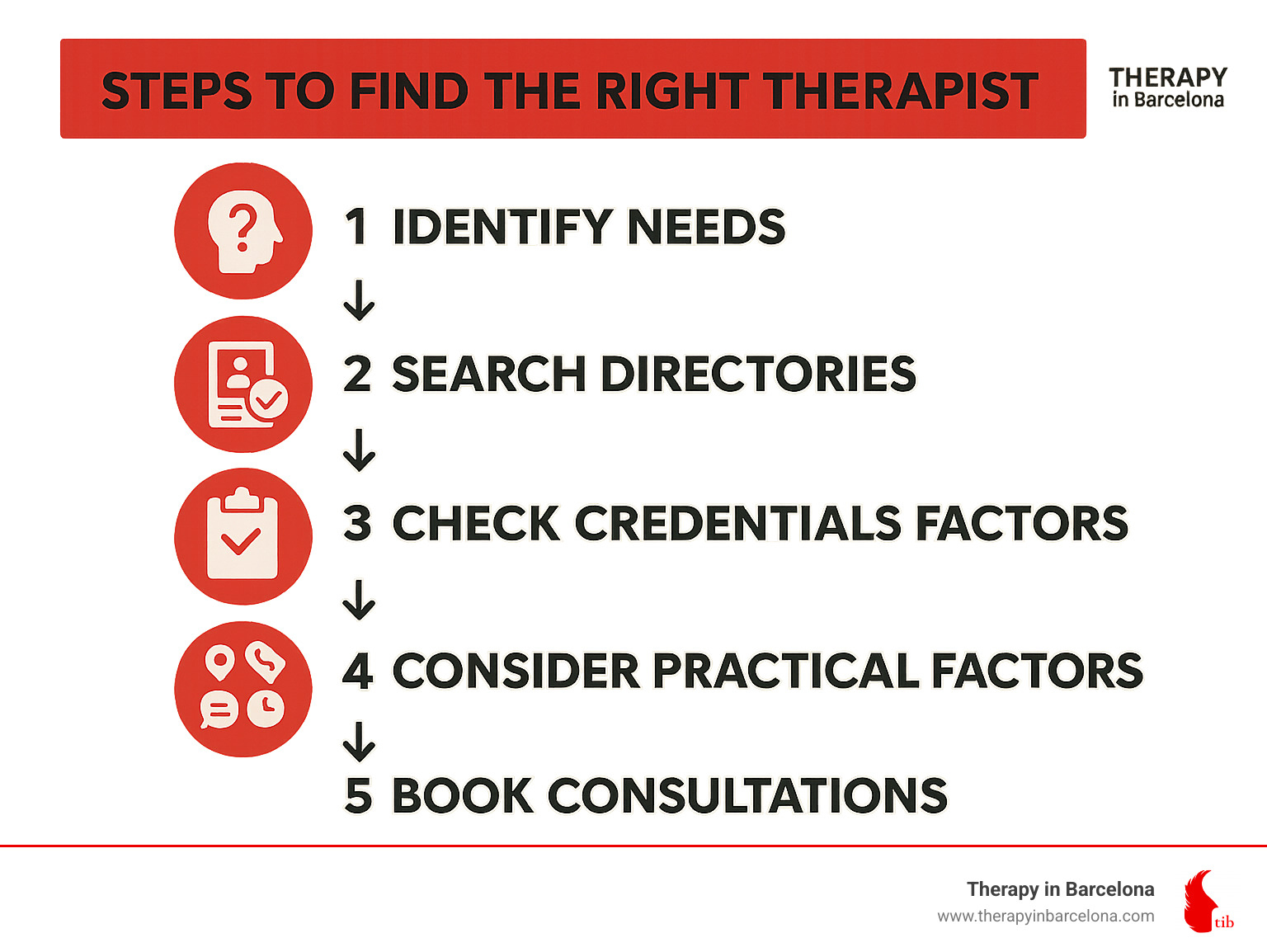
- Identify your needs (anxiety, depression, relationship issues, cultural adjustment)
- Search therapist directories (Psychology Today, GoodTherapy, or local platforms) or reach out to Therapy in Barcelona
- Check credentials and specializations
- Consider practical factors (location, language, cost, availability)
- Book initial consultation with a therapist to find the right fit (be prepared to change if the chemistry isn’t right after a few sessions)
Finding the right therapist can feel overwhelming, especially when you’re already dealing with emotional challenges. Whether you’ve recently moved to Barcelona or you’ve been living abroad for years, navigating mental health support in a foreign country adds another layer of complexity.
The journey to find a therapist who truly understands your unique circumstances is deeply personal. Research consistently shows that the relationship between you and your therapist—what professionals call the “therapeutic alliance”—is the single most important factor in successful outcomes, even more important than the specific therapy approach used.
For internationals like Emily, a 34-year-old expat struggling with anxiety after moving to Barcelona, finding someone who understands the nuances of expat life can make all the difference. “I felt lost trying to explain my feelings of displacement to someone who had never lived abroad,” she shares. “Finding a therapist who understood the expat experience was like finally being seen.”
At Therapy in Barcelona, we understand that your search for support is unique. Our collaborators set their own prices, ranging from 70 to 95 Euros for individual therapy sessions and 90-115 Euros for couples therapy sessions. Once you’re matched with a therapist, we’ll provide their specific fees and payment preferences.
Taking that first step to reach out is often the hardest part—but it’s also the most courageous. The right therapeutic relationship can be transformative, providing you with tools to steer life’s challenges with greater resilience and self-understanding.
Why the “Right Fit” Matters for Mental Health
The connection you establish when you find a therapist isn’t just nice to have—it’s essential for healing. Research published in the National Library of Medicine reveals something remarkable: the therapeutic alliance—that special bond between you and your therapist—accounts for about 30% of positive therapy outcomes. This makes it the single most important factor in successful therapy, even more significant than the specific techniques used.
For those of us living internationally, this connection takes on even deeper importance. The expat experience brings unique challenges that someone who’s never lived abroad might struggle to fully understand. Cultural adjustments, language barriers, shifts in identity, and the grief of leaving familiar support networks behind all require a special kind of understanding.
Leigh Matthews, the Australian Psychologist who founded Therapy in Barcelona in 2011, experienced this firsthand: “When I first moved to Barcelona, I looked for an English-speaking therapist who could understand my situation as a foreigner navigating a major adjustment. Finding none, I realized how crucial culturally-sensitive support is for expats.”
This insight is precisely why Therapy in Barcelona focuses on matching clients with therapists who aren’t just professionally qualified but are expats themselves. This shared experience creates a foundation of understanding that can dramatically accelerate your healing journey.
A strong therapeutic alliance provides you with:
- A genuinely safe space to explore uncomfortable emotions
- Cultural sensitivity to your specific expat challenges
- Trust that allows for real vulnerability and growth
- Validation of your unique cross-cultural experiences
- Approaches that respect your background and personal goals

Signs It’s Time to Find a Therapist
Recognizing when you might benefit from professional support is an important first step. Here are common indicators that it might be time to find a therapist:
Major life transitions often trigger the need for extra support. Moving countries, changing jobs, ending relationships, or starting new ones can all create emotional upheaval that’s challenging to steer alone.
Persistent emotional distress that lasts for more than a few weeks is your mind’s way of signaling that something needs attention. This might show up as anxiety, sadness, or feeling constantly overwhelmed.
Cultural adjustment struggles are particularly common for internationals. Feeling disconnected from your surroundings or experiencing prolonged culture shock can be isolating and confusing.
Relationship difficulties that don’t improve despite your best efforts—whether with partners, family members, or colleagues—often benefit from professional guidance.
Changes in daily functioning like disruptions to your sleep, appetite, energy levels, or concentration can signal that your mental wellbeing needs support.
Isolation or loneliness is especially common for expats who find themselves far from established support networks and familiar social cues.
Identity questions often surface when living in a new cultural context. Who am I in this new place? How do I maintain my sense of self while adapting?
Work-life balance challenges can intensify abroad, where cultural expectations around work may differ significantly from what you’re used to.
Unresolved past issues sometimes resurface unexpectedly when you’re navigating new environments and stressors.
For expats, these challenges often overlap and intensify each other. What might be manageable at home can feel overwhelming when you’re navigating it in a foreign language or unfamiliar cultural context.
As one client at Therapy in Barcelona shared: “I didn’t realize how much my anxiety was linked to constantly navigating unfamiliar situations. Having a therapist who understood this specific stress was life-changing.”
It’s worth remembering that seeking therapy isn’t just for crisis situations—it’s also valuable for personal growth, self-findy, and preventative mental health care. Sometimes the best time to find a therapist is before you feel you absolutely need one.
Know Your Options: Professionals & Approaches
When you begin to find a therapist, you’ll encounter various types of mental health professionals and therapeutic approaches. Understanding these differences helps you make an informed choice about what might work best for your specific needs.

Key Differences Between Therapists, Psychologists, Counsellors, and Psychiatrists
Navigating mental health professionals can feel like learning a new language. Let’s break down these roles to help you find a therapist who’s right for you.
Psychologists typically have doctoral degrees (Ph.D., Psy.D.) with extensive training in assessment and therapeutic techniques. Think of them as mental health detectives – they can diagnose conditions but cannot prescribe medication in most countries, including Spain. Their deep training often makes them ideal for complex psychological issues that require specialized approaches.
Psychiatrists wear two hats – they’re medical doctors who specialize in mental health. Their medical background allows them to prescribe medication, which can be essential for certain conditions. While some offer therapy, many focus primarily on medication management. For expats in Barcelona, finding an English-speaking psychiatrist often requires a referral from your GP or therapist.
Counsellors are like skilled guides for life’s journeys, typically with master’s-level training. They excel at helping people steer specific challenges, relationships, or adjustments with solution-focused approaches. Their work tends to be more present-oriented and practical.
The term therapist is broader, encompassing professionals from various backgrounds who provide talk therapy. In Spain, it’s worth noting that this term isn’t as strictly regulated as in some countries, so verifying credentials is particularly important.
Social Workers with clinical training offer a unique blend of psychological support and practical assistance. They’re especially valuable for expats learning to steer Spanish healthcare and social services – think of them as combining emotional support with system navigation skills.
At Therapy in Barcelona, we ensure all team members are psychology-trained professionals with qualifications from their native countries, giving you peace of mind about the quality of care regardless of their specific title.
Therapy Types 101—Which One Fits You?
Finding the right therapeutic approach is a bit like finding the perfect pair of shoes – what works wonderfully for one person might not be the best fit for another. Here’s a guide to help you find a therapist whose approach resonates with your needs:
Cognitive Behavioral Therapy (CBT) works like a mental toolkit for renovating unhelpful thought patterns. It’s structured, goal-oriented, and particularly effective for anxiety and depression. If you appreciate practical strategies and measurable progress, CBT might be your match.
Acceptance and Commitment Therapy (ACT) blends mindfulness with values-based action. Rather than fighting difficult thoughts and feelings, ACT helps you make peace with them while still moving toward what matters to you. This can be especially helpful for expats navigating the emotional rollercoaster of cultural adjustments.
Internal Family Systems (IFS) offers a fascinating perspective, viewing your mind as containing many sub-personalities or “parts.” This approach helps you understand and integrate different aspects of yourself – particularly useful when experiencing identity shifts common in expat life.
Psychodynamic Therapy is like archaeological work for your emotional life, exploring how past experiences influence current patterns. This can help expats understand how their background shapes their experience abroad, offering valuable insights into recurring challenges.
Mindfulness-Based Approaches incorporate meditation and present-moment awareness to reduce stress and build emotional regulation skills – valuable tools when navigating unfamiliar environments where your usual coping mechanisms might be disrupted.
Solution-Focused Brief Therapy (SFBT) takes a refreshingly direct approach, concentrating on solutions rather than problems. If you’re looking for relatively quick results with a focus on your strengths and resources, this might appeal to you.
Creative Expressive Arts therapy uses artistic processes like drawing, writing, or movement to explore emotions and experiences. This can be particularly helpful when language barriers exist or when words alone don’t capture your experience.
Many therapists at Therapy in Barcelona use an integrative approach, blending techniques from different modalities to create a personalized approach that adapts to your unique situation. This flexibility allows them to meet you where you are and adjust as your needs evolve – particularly important for expats whose circumstances and challenges may shift over time.
How to Find a Therapist (Step-by-Step)
Finding the right therapist can feel like searching for a needle in a haystack, especially when you’re already feeling overwhelmed. As an expat, this search comes with extra layers of complexity – language barriers, cultural differences, and unique adjustment challenges. Let’s break down the process of how to find a therapist into manageable steps that will help you connect with the right support.
1. Clarify Your Needs Before You “find a therapist”
Before diving into directories or making calls, take a moment to reflect on what you’re truly looking for:
What’s bringing you to therapy right now? Maybe you’re struggling with the loneliness of expat life, feeling anxious about your career path, or noticing relationship patterns that no longer serve you. Being specific about your concerns helps narrow your search.
For Marta, an Italian expat in Barcelona, clarifying her needs was transformative: “I initially thought I just needed help with work stress, but when I sat down to reflect, I realized I was really struggling with my sense of identity after three years abroad.”
Consider what qualities matter to you in a therapist. Would you prefer someone of a specific gender? Someone older or closer to your age? A therapist who shares your cultural background or has lived abroad themselves?
For many internationals, language is crucial. While you might manage daily life in Spanish or Catalan, discussing emotional topics often feels most natural in your mother tongue. At Therapy in Barcelona, we recognize this need and offer sessions in English and several other languages.
Also consider practical factors like your schedule availability, budget constraints, and whether you prefer in-person or online sessions. Each of these elements will help guide your search.
2. Tools & Places to “find a therapist” Near You
Once you’ve clarified what you’re looking for, it’s time to start your search:
Specialized expat directories like Therapy in Barcelona are specifically designed for the international community, making them an excellent starting point. These services understand the unique challenges of expat life and often pre-screen therapists for cultural sensitivity.
General therapist directories such as Psychology Today, GoodTherapy, and TherapyRoute allow you to filter by language, specialties, and location. Most include detailed therapist profiles with photos, approaches, and sometimes even video introductions.
Expat community groups can be goldmines of personal recommendations. Facebook groups like “Expats in Barcelona” or platforms like InterNations often have threads where members share their experiences with local therapists.
Word-of-mouth referrals from friends or colleagues who’ve had positive therapy experiences can be particularly valuable. A simple “Do you know any good English-speaking therapists?” can open doors to trusted professionals.
When using online directories, take advantage of specific search filters for language, specialties, and location. Many therapists now offer online sessions, which expands your options beyond your immediate location – especially helpful if you’re in a smaller city with fewer international professionals.
3. Vetting Credentials and Specializations
Once you’ve identified potential therapists, it’s important to verify their qualifications:
Check professional credentials – Look for recognized degrees in psychology, counseling, or related fields.
Verify specialized training in areas relevant to your needs, whether that’s trauma, anxiety, couples therapy, or expat adjustment issues.
Consider their experience with internationals – A therapist who understands the unique challenges of living abroad, or who has experienced it themselves, brings valuable insight to your sessions.
At Therapy in Barcelona, all our therapists undergo thorough vetting to ensure they meet professional standards and have the specific skills to work with the international community. We believe this extra step is essential for creating successful therapeutic relationships.
4. First Contact & Findy Calls
When reaching out to potential therapists, clarity and specificity help set the stage for a good match:
Be specific about your needs in your initial message. A simple email might read: “I’m an American expat who’s been in Barcelona for two years. I’m looking for support with anxiety that’s become more intense since moving abroad. I’d prefer someone who understands the challenges of living away from home.”
Ask about practical matters like availability, waiting times, session frequency, fees, and payment options. Many therapists offer sliding scale rates for those with financial constraints.
Request a brief consultation call. Most therapists offer a free 15-20 minute chat to assess whether they might be a good fit for your needs. This gives you both a chance to gauge comfort and compatibility before committing to a full session. At Therapy in Barcelona our Intake Coordinators offer a chat to help match you to the best therapist on our team for you.
During this initial conversation, trust your instincts. Do you feel heard? Does the therapist seem to understand your concerns? Do you feel comfortable with their communication style? These early impressions matter.
5. The First Session—What to Expect
Your first full session is typically an assessment where the therapist will gather information about your current concerns and relevant history. They’ll discuss confidentiality and practice policies, explore your goals for therapy, and begin to develop a treatment plan.
This is also your opportunity to assess whether you feel comfortable with the therapist. While discussing difficult topics might feel uncomfortable, you should still sense a basic level of safety and respect in the room.
Pay attention to:
- How at ease you feel sharing personal information
- Whether you feel heard and understood
- If the therapist’s communication style works for you
- Your initial impression of trust and rapport
One client shared: “I was nervous about my first session, but my therapist’s warmth put me at ease right away. She asked thoughtful questions that helped me articulate things I hadn’t been able to put into words before.”
Finding the right therapist sometimes takes time. It’s perfectly okay to try sessions with a couple of different professionals before deciding who feels like the best fit for your journey.

The search to find a therapist is an investment in yourself. By taking these thoughtful steps, you’re more likely to connect with someone who can truly support your mental health journey as you steer the beautiful but sometimes challenging experience of living abroad.
Making the Match: Evaluating Fit & Staying Flexible
Finding the right match when you find a therapist is similar to developing any important relationship—it takes time and attention. Research shows that the quality of the therapeutic relationship is the strongest predictor of positive outcomes, even more important than the specific therapeutic approach used.
After your first few sessions, ask yourself:
- Do I feel respected and understood by this therapist?
- Can I be honest about my thoughts and feelings?
- Does the therapist seem to understand my cultural background and expatriate experience?
- Am I learning new insights or developing useful skills?
- Do I leave sessions feeling heard, even if the content was challenging?
A client at Therapy in Barcelona shared: “I knew I found the right therapist when I could explain my complicated feelings about my home country without having to justify or explain the cultural context first. She just got it.”
It’s important to give the relationship time to develop—many people report that it takes 3-4 sessions to begin feeling comfortable. However, if after several sessions you don’t feel a connection forming, it’s perfectly acceptable to discuss this with your therapist or consider trying someone else.
Red Flags & When to Move On
While adjustment periods are normal, certain signs suggest you might need to find a different therapist:
- Feeling consistently judged or misunderstood
- The therapist talking more than listening
- Inappropriate self-disclosure from the therapist
- Boundary violations or ethical concerns
- Feeling pressured to continue therapy when you’re unsure
- No sense of progress or direction after several months
- Cultural insensitivity or dismissal of expatriate-specific challenges
As one Therapy in Barcelona client noted: “I initially stayed with a therapist who didn’t seem to understand my cultural background because I didn’t want to start over. When I finally switched to someone with expatriate experience, the difference was immediate and profound.”
If you decide to switch therapists, you don’t need to provide extensive explanations. A simple “I’ve appreciated our work together, but I’ve decided to explore other options” is sufficient. A good therapist will respect your decision and may even offer referrals.
Maximizing Your Therapy Journey
Once you’ve found a good match, these practices can help you get the most from therapy:
- Be honest and open: The more transparent you are, the more effective therapy can be
- Complete between-session work: Practice skills or reflections suggested by your therapist
- Track your progress: Keep notes on insights, changes, or questions between sessions
- Provide feedback: Let your therapist know what’s helpful and what isn’t
- Be patient with the process: Meaningful change takes time
Many clients find it helpful to keep a therapy journal to record thoughts between sessions and track their progress over time.
Money Matters: Cost, Insurance & Affordable Paths
When you find a therapist, understanding the financial side is just as important as finding the right therapeutic match. Let’s talk honestly about costs and options to help you make sustainable choices for your mental health journey.

Typical Costs and Payment Structures
“How much will this cost?” is often one of the first questions people ask when seeking therapy. In Barcelona, like most places, therapy is an investment in your wellbeing:
At Therapy in Barcelona, individual sessions range from €70-95, while couples therapy ranges from €90-115. This reflects the standard range in Barcelona, where private practice therapists typically charge between €60-120 per session.
Most sessions last 50-60 minutes, and weekly meetings are usually recommended at the beginning. As you progress, many therapists will suggest transitioning to bi-weekly sessions.
“I was worried about the ongoing cost,” shares one client, “but my therapist helped me create a plan where we met weekly for the first two months, then shifted to every other week as I developed more coping skills. This made therapy much more sustainable for me.”
Don’t be shy about discussing finances with potential therapists. Many offer sliding scale options based on your income, though these spots are limited and fill quickly. It’s always worth asking if this is a possibility if cost is a concern.
Navigating Insurance
For expats in Spain, understanding your insurance coverage options can feel like solving a puzzle:
Public healthcare through Sistema Nacional de Salud does cover basic mental health services, but be prepared for potentially long waiting lists and limited English-speaking providers.
Private Spanish insurance plans like Sanitas or Adeslas often include some mental health coverage, but typically come with session limits or referral requirements. One client notes, “My Spanish insurance covered 12 sessions per year, which gave me a good foundation before I decided to continue paying out-of-pocket.”
International health insurance plans frequently offer better mental health coverage for expats. If you have international insurance, check your policy details for:
- Pre-authorization requirements before starting therapy
- Session limits per year or condition
- Diagnosis requirements for coverage
- In-network vs. out-of-network reimbursement rates
At Therapy in Barcelona, therapists can provide detailed receipts for potential reimbursement from international insurance plans, though they typically don’t bill insurance companies directly.
Therapy in Barcelona is a private therapy service which ensures full confidentiality. This means you must first pay in full for your session then submit your invoice to your insurance company.
Your therapist can provide you with invoices if you would like to seek reimbursement from your insurer for your sessions. We do not guarantee reimbursement.
We recommend you talk to your insurer about your level of coverage and the possibility of reimbursement before making an appointment.
It is important to note that all therapists are psychology-trained but offer their services as therapists here in Spain so they are unable to provide you with a collegiate number.
A note on privacy: When using insurance, diagnosis codes become part of your medical record. Some clients prefer to pay privately to maintain complete confidentiality about their mental health care.
Budget-Friendly Alternatives
If traditional one-on-one therapy doesn’t fit your budget right now, you have options:
Group therapy offers powerful support at a lower price point while providing valuable community connection—something especially meaningful for expats who may feel isolated.
University training clinics sometimes offer services provided by supervised psychology students at reduced rates. The trade-off is usually less experienced therapists, but supervision ensures quality care.
Flexible scheduling can make therapy more affordable. “When I couldn’t afford weekly sessions,” shares a Therapy in Barcelona client, “my therapist and I agreed on meeting every other week, with specific exercises for me to work on between sessions.”
Digital resources like mental health apps can supplement other care, though they’re not replacements for therapy. Apps for meditation, mood tracking, or skill-building can provide support between sessions.
Investing in mental health often pays dividends in other areas of life—improved work performance, better relationships, reduced medical costs related to stress, and improved decision-making abilities. As one client put it: “Therapy seemed expensive until I realized how much I was spending trying to cope in unhealthy ways. Now I see it as essential self-care, like going to the dentist or doctor.”
Finding affordable mental health care takes some creativity and persistence, but support is available at various price points. The most important thing is taking that first step toward getting the help you deserve.
Frequently Asked Questions about Finding a Therapist
How do I know if a therapist is licensed and qualified?
When you set out to find a therapist, checking credentials should be at the top of your list. If you’re considering an international therapist, don’t hesitate to ask about their home country licensing and their qualifications to practice.
One of the reassuring aspects of working with Therapy in Barcelona is that this verification step is already taken care of for you. Every professional on the team has been thoroughly vetted, with psychology training and qualifications from their native countries confirmed before they join the practice.
As one client shared, “The peace of mind that came from knowing Therapy in Barcelona had already checked everyone’s credentials was wonderful – it was one less thing to worry about when I was already feeling overwhelmed.”
What questions should I ask in a first call or email?
That first contact when you find a therapist sets the stage for your entire therapeutic relationship. Consider asking these thoughtful questions to gauge whether you might work well together:
“What experience do you have working with expats?” This helps assess whether they truly understand the unique challenges of international living.
“How would you approach the issues I’ve mentioned?” Their answer gives insight into their therapeutic style and whether it resonates with you.
“What languages do you work in, and how comfortable are you discussing complex emotional topics in English?” For many of us, expressing deep emotions happens most naturally in our native language. Be wary of therapist who say they work in English but are not really fluent. At Therapy in Barcelona 100% of our therapists speak fluent English, even the non-native speakers, as this is our group practice primary language.
Questions about practical matters matter too – fees, sliding scale options, cancellation policies, and whether they offer both online and in-person sessions can help you determine if the logistics will work for your situation.
One client noted, “I was nervous about that first email, but having a list of questions prepared helped me feel more in control of the process.”
What if I don’t feel comfortable after a few sessions?
Finding the right therapeutic match sometimes takes time, but persistent discomfort after several sessions often signals something isn’t clicking. If you’ve given it 3-4 sessions and still feel uneasy, you have several options:
Talk directly with your therapist about your concerns. Good therapists welcome this feedback and may be able to adjust their approach to better suit your needs. At Therapy in Barcelona, we know this can feel uncomfortable for some people, especially if communication challenges are your reason for coming to therapy, so we also send a first session survey. This survey opens the door for you to let us know how the fit is with your therapist, and if you let us know it’s not the right match, we can then take steps to find you a new therapist, no problem.
Reflect on the source of your discomfort. Is it because the therapy is challenging you in productive ways, or is there something about the relationship itself that doesn’t feel right?
Trust your instincts. If something feels persistently off despite giving it a fair chance, it’s perfectly acceptable – and often beneficial – to look for a different therapist.
“I worried I was being too picky,” shared one Therapy in Barcelona client, “but when I finally switched therapists, I realized how much better the fit could be. My new therapist’s style matched what I needed, and progress came much more naturally.”
How can I prepare for my first therapy session?
Making the most of that initial session helps set a strong foundation for your therapy journey. Consider these preparations:
Take time to reflect on your goals – what specifically do you hope to achieve through therapy? Jotting down the main issues you want to address can help ensure you don’t forget important points when nerves kick in. Our intake form at Therapy in Barcelona helps you to clarify all this well before your session and we only share this information with your selected therapist.
Think about relevant background information that might help your therapist understand your situation better, and prepare any questions you have about their approach or the therapy process.
For practical matters, confirm the location or online platform details, and aim to arrive a few minutes early to settle yourself before the session begins.
If you’re meeting online, test your technology beforehand and find a private, quiet space where you won’t be interrupted. Nothing disrupts a meaningful conversation like technical glitches or unexpected interruptions!
Is online therapy as effective as in-person therapy?
The research is clear – for many conditions, online therapy can be just as effective as face-to-face sessions. For expats in particular, online therapy offers some distinct advantages:
Access to native-language therapists regardless of where you’re located means you can work with someone who truly speaks your emotional language.
The convenience and flexibility with scheduling makes it easier to maintain consistent therapy even with travel or changing work demands.
Eliminating travel time can make therapy more accessible, especially for busy professionals or parents.
The comfort of your own space sometimes helps people feel more at ease discussing difficult topics.

That said, some people find the in-person connection more engaging, and certain therapeutic approaches may work better face-to-face. At Therapy in Barcelona, you don’t have to choose one or the other permanently – both options are available, allowing you to select what works best for your unique situation and preferences.
One client who initially resisted online therapy shared: “I was skeptical about connecting through a screen, but after trying it, I found I actually opened up more quickly than I might have in person. The slight distance somehow made it easier to discuss difficult topics.”
Conclusion
The journey to find a therapist who truly understands your unique expatriate experience is both personal and deeply meaningful. While it might take some time to find the right match, connecting with someone who offers culturally-sensitive, personalized support can truly transform your life abroad.
At Therapy in Barcelona, we understand that taking that first step is often the hardest part. Our practice was founded by Australian Psychologist Leigh Matthews after her own experience seeking support as an expat in Barcelona. When she couldn’t find an English-speaking therapist who understood the complexities of adapting to a new culture, she created the service she wished had existed for herself.
As one client beautifully expressed: “Finding a therapist who understood the complexity of being caught between two cultures made all the difference. For the first time, I didn’t have to explain or justify my experience—I could just focus on healing.”
Whether you’re navigating cultural adjustment, relationship challenges, anxiety, depression, or simply seeking growth and self-understanding, the right therapeutic relationship creates a foundation for meaningful change. This connection isn’t just about credentials or techniques—it’s about finding someone who truly sees you, understands your unique expatriate journey, and creates a space where you feel safe to explore your challenges.
Give yourself permission to be selective and patient in your search. Trust your instincts about the connection you feel with potential therapists, and remember that it’s perfectly okay to try more than one before finding your ideal match. The right fit is absolutely worth finding.
If you’re ready to begin your journey with Therapy in Barcelona, you can book a free discovery call or complete our intake form to be matched with a therapist who meets your specific needs and preferences.
Taking care of your mental health isn’t a luxury—it’s an essential part of thriving in your international life. You deserve support that honors both where you’ve come from and where you are now. Our team of international, psychology-trained professionals brings both professional expertise and personal understanding of the expatriate journey, ready to walk alongside you as you steer the unique challenges and opportunities of life abroad.
