


Why Finding the Right Therapist Near You Matters More Than You Think

Find therapy near me is one of the most searched phrases in mental health today — and for good reason. Whether you’re dealing with anxiety, a difficult life transition, or the particular weight of living far from home, knowing where to start can feel overwhelming.
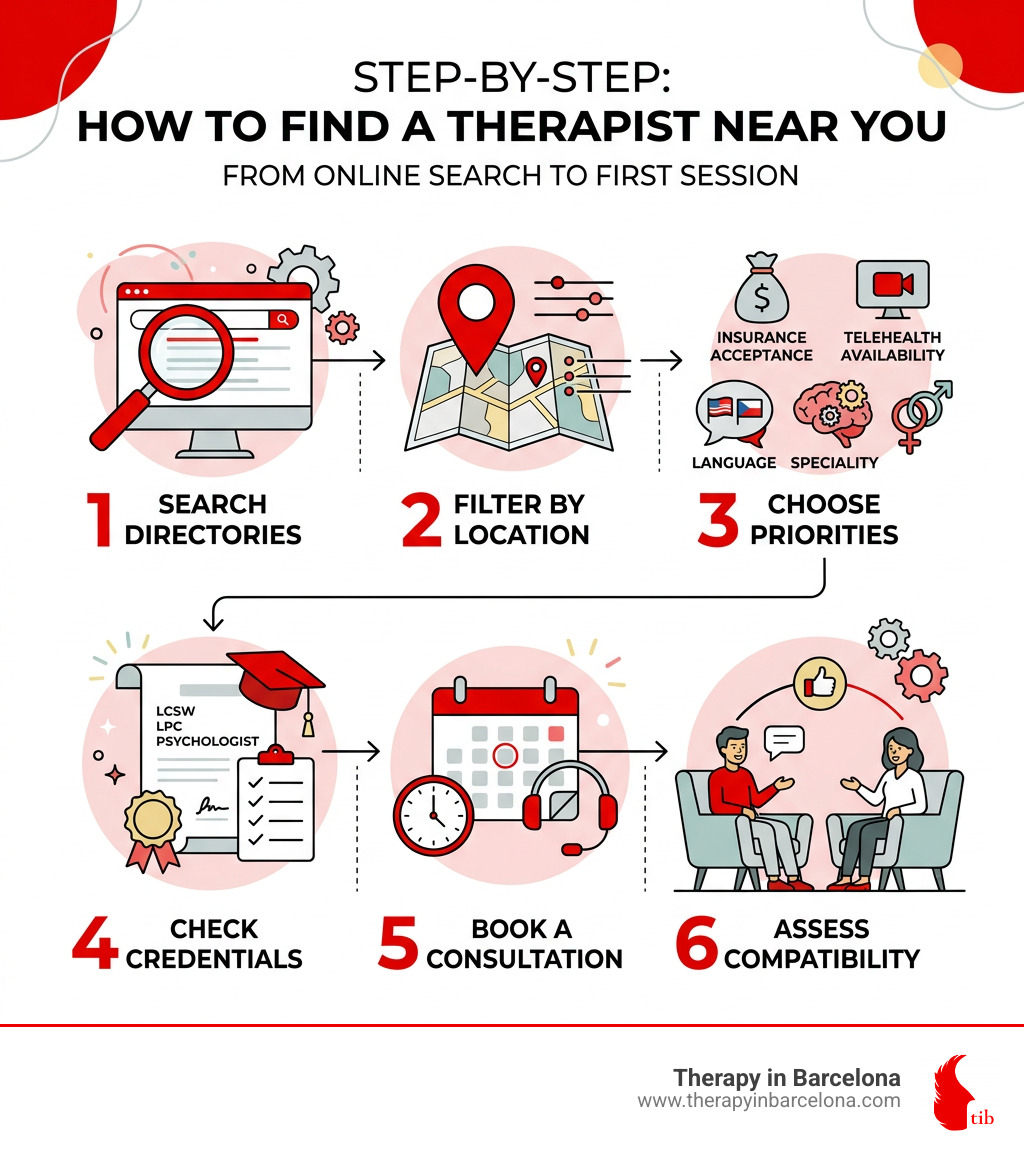
Here’s a quick overview of how to find a therapist near you:
- Search an online directory such as Psychology Today, GoodTherapy, or a platform specialising in your location (for example, Barcelona or Spain).
- Filter by location using your city, postcode, or state to find providers licensed to work with you.
- Choose your priorities — insurance acceptance, telehealth availability, language, speciality, or therapist gender.
- Check credentials — look for licensed psychologists, clinical social workers, LPCs, or LCSWs with relevant experience.
- Book a consultation — many therapists offer a short introductory call to assess fit before committing.
- Assess compatibility — the quality of the therapeutic relationship is one of the strongest predictors of a good outcome.
Finding support is not just about geography. It’s about finding someone who genuinely understands your context. For expats and internationals in Barcelona, Valencia, Madrid, or elsewhere in Spain, that context includes language, cultural adjustment, and the specific pressures of building a life far from home.
The good news? With the right tools and a clear sense of what to look for, the process is far more manageable than it first appears. This guide walks you through every step.
How to Effectively Find Therapy Near Me

When you start looking for mental health support, the sheer number of options can feel like a maze. To effectively find a therapist, you need to use tools that narrow down the search based on your specific needs. There is no “one size fits all” in mental health, so the goal is to find a specialist who resonates with your personality and your struggles.
Common search methods include using large-scale online directories, checking professional association listings, or seeking out local group practices that specialise in your demographic. Many people start with a broad search, but the most successful outcomes happen when you refine that search early on. For more detailed advice, you can explore this guide to finding the right therapist near you.
Finding Therapy Near Me Using Online Directories
Online directories are the most common starting point. Some platforms allow you to cast a wide net and then use filters to narrow it down.
When using these sites, you can filter by:
- Issues: Such as ADHD, depression, addiction, or OCD.
- Insurance: To see who is in-network.
- Therapy Type: Such as CBT, EMDR, or psychodynamic therapy.
- Language: Essential for expats who need to communicate in their native tongue.
Directories are also excellent for finding verified, licensed professionals. However, be aware that many directories are massive. You might find hundreds of listings in a city like Madrid or Barcelona, which is why having a clear set of priorities is vital. If you are feeling stuck, you might find more clarity in this guide to finding the right therapist near you.
The Importance of Location and Licensing
Geography is more than just a matter of travel time. In therapy, location is tied to licensing. Most therapists are only legally allowed to practice in the state or country where they are licensed. This applies to both in-person and online sessions.
When you search by zip code or city, you ensure that the provider is legally authorised to treat you. This is especially relevant if you are looking for therapy and counselling services near you while living in Spain. Whether you are in a major hub like Valencia or a smaller coastal town like Marbella, your therapist must comply with local regulations.
Understanding Provider Types and Treatment Modalities
Not all mental health professionals do the same thing. Understanding the “alphabet soup” of credentials can help you choose the right level of care.
- Psychiatrists: Medical doctors who can prescribe medication. They often focus on the biological aspects of mental health.
- Psychologists: Highly trained professionals (often with a PhD or PsyD) who provide talk therapy and psychological testing.
- Clinical Social Workers and Counsellors: Licensed professionals who provide therapy and often focus on the social and environmental factors affecting your well-being.
Research consistently shows that the “therapeutic alliance”-the relationship between you and your therapist-is a more significant predictor of success than the specific type of therapy used. You need a match that feels safe and collaborative. For a clear overview of the evidence, see the American Psychological Association on the therapeutic relationship.
Common Concerns and Evidence-Based Approaches
When you search to find therapy near me, you likely have a specific concern in mind. Different issues often respond best to specific “modalities” or styles of therapy:
- Anxiety and Depression: Often treated with Cognitive Behavioural Therapy (CBT) or Acceptance and Commitment Therapy (ACT).
- Trauma and PTSD: Often addressed through EMDR (Eye Movement Desensitisation and Reprocessing) or Somatic Experiencing.
- Relationship Issues: May involve the Gottman Method or Imago Relationship Therapy.
Knowing what you need helps you use the right filters. For a deeper look at these styles, check out the art of choosing a therapist.
Specialised Care for Different Life Stages
Therapy needs change as we age. A child struggling with school in a new country needs a different approach than a digital nomad in Malaga dealing with burnout.
- Child and Adolescent Therapy: Uses age-appropriate techniques like play therapy.
- Couples Counselling: Focuses on communication loops and bicultural challenges.
- Geriatric Care: Addresses issues like isolation and grief.
- Trauma-Informed Care: Ensures the therapist understands how past experiences shape present reactions.
You can learn more about how these specialities work by visiting our therapy services page.
Navigating Costs, Insurance, and Accessibility
Budget is a practical reality of seeking help. In Spain, therapy can be accessed through various financial routes.
- Self-Pay: Rates typically range from €100 to €150 per session in private practice. While this is an investment, it often allows for more specialised, high-quality care without the waitlists.
- Insurance: Many private insurance providers cover part of the cost. You should always check your “out-of-network” benefits, as some plans allow you to see a private therapist and get reimbursed.
- Sliding Scale: Some practices, including Therapy in Barcelona, offer sliding scale fees for those with genuine financial need. It is always worth asking a prospective therapist if they offer this.
Telehealth vs In-Person Sessions
Telehealth has made it much easier to find therapy near me, even if “near” means a different city.
- Accessibility: You can access specialists who might not live in your town.
- Convenience: No commute, which is great for busy professionals in Madrid or parents in Sevilla.
- Effectiveness: Research shows online therapy is just as effective as in-person for most conditions.
To see how this works in practice, read more about online therapy options.
Finding Low-Cost and Free Resources
If private therapy is out of reach, there are other paths:
- Support Groups: Often free or low-cost, providing community support for specific issues like grief or addiction.
- University Programmes: Sometimes offer low-cost sessions with supervised students-in-training.
- Public Health Clinics: Available through the Spanish national health system (CatSalut in Catalonia), though wait times can be significant.
Choosing Between Public, Corporate, and Private Care
When searching for a therapist, you will generally encounter three main systems. Each has its pros and cons.
The Public Health System
In Spain, the public system provides mental health care at no direct cost.
- Pros: Free at the point of use.
- Cons: Extremely long waitlists, limited choice of therapist, and often a “generalist” approach that may not account for the specific needs of internationals.
Large Corporate Platforms
Platforms use algorithms to match you with providers.
- Pros: Quick matching, often subscription-based.
- Cons: High therapist turnover, less personalised care, and concerns about how your personal data is handled or sold. These models can sometimes feel a bit like a “therapy factory” rather than a human connection.
Local Private Practices
Private practices, like Therapy in Barcelona, focus on quality over quantity.
- Pros: Bespoke matching, strict privacy, and highly experienced specialists.
- Cons: Higher cost (private-pay), but this reflects the level of training and the time dedicated to each client.
The Expat Perspective: Finding a Culturally Sensitive Match
For the international community, the search to find therapy near me has an extra layer of complexity. It isn’t just about finding a therapist; it’s about finding one who speaks your language and understands your life.
Many expats look settled from the outside but still feel deeply alone after a move. Even when work and daily life seem fine on paper, isolation, homesickness, and culture shock can build quietly. A local therapist may be helpful, but if language differences or cultural misunderstandings take up most of the session, it can be harder to get to the real work. This is a common challenge for people living abroad.
How to Find Therapy Near Me as an Expat
At Therapy in Barcelona, we specialise in this exact gap. Founded in 2011 by Leigh Matthews—an Australian Psychologist, in Barcelona since 2011, founder of Therapy in Barcelona, and experienced in supporting internationals—our practice is built for internationals.
We provide multilingual care (English, French, German, Spanish, and more) and ensure every therapist on our team is also an expat. This shared experience means we don’t just hear your words; we understand the “messiness” of moving countries, intercultural relationships, and the stress of being away from home. You can read more about our expat-focused therapy here.
Beyond Barcelona: Support Across Spain
While our physical office is in the heart of Barcelona’s Eixample district, we support internationals across the country and worldwide, including the USA and Canada, through online sessions. Whether you are in the tech hubs of Madrid or Málaga, the sunny streets of Alicante, the cultural heart of Sevilla, or the digital nomad communities of Gran Canaria, you can find a therapist who understands your journey. Explore our diverse team of therapists to find your match.
Frequently Asked Questions about Finding Therapy
How do I know if a therapist is a good fit for me?
Fit is about feeling safe, heard, and challenged in a healthy way. After your first session or discovery call, ask yourself: Did I feel judged? Did they seem to understand my goals? Do I feel comfortable being honest with them? If the answer is no, it’s okay to keep looking.
Does my insurance cover out-of-network therapy?
Many private plans in Spain (and international plans) offer reimbursement for private therapy. You usually pay the therapist directly and then submit the invoice to your insurer. Always call your provider first to ask about their “reimbursement for private psychology” policy.
What is the difference between a psychologist and a psychiatrist?
A psychologist focuses on talk therapy and behavioral changes to help you heal. A psychiatrist is a medical doctor who primarily manages mental health through medication. Many people find that a combination of both is the most effective approach.
Conclusion
The journey to find therapy is a courageous first step toward a more fulfilling life. Whether you are navigating the streets of Barcelona or settling into a new life in Valencia, you don’t have to do it alone.
Finding the right therapeutic alliance is about more than just a search result; it’s about finding a sanctuary where you can be yourself. At Therapy in Barcelona, we take the time to gather information and match you with the therapist who best fits your personality and needs—because your mental health deserves more than an algorithm.
If you’d like support, book a Free Discovery Call. We are here to help you navigate the complexities of expat life and find your way back to yourself. Our online sessions are available worldwide, including in the USA and Canada.
