


When Love Gets Lost in Translation

Overcoming communication barriers in an intercultural relationship is one of the most common — and most quietly painful — challenges expat couples face. You love each other. That part is clear. But somewhere between what one of you means and what the other hears, something gets lost.
To quickly address what helps most:
- Use plain, simple language — avoid idioms, slang, and assumptions about shared meaning
- Listen actively — focus fully on your partner before forming a response
- Name your feelings and needs clearly — say what you mean, not what you assume they should understand
- Be aware of cultural communication styles — some cultures are direct; others rely on implication and context
- Choose the right moment and channel — a serious conversation deserves face-to-face attention, not a rushed text
- Seek feedback — ask “Does that make sense?” rather than assuming understanding
- Get support when needed — a therapist experienced in intercultural relationships can help you both find common ground
These steps matter because poor communication can cause real damage. The same patterns that create misunderstandings in everyday life can have even greater emotional consequences in intimate relationships.
For expats in Barcelona, Valencia, or Málaga, the challenge is especially layered. You may be navigating a new language, adjusting to a different cultural rhythm, and managing the stress of life abroad — all while trying to stay connected to the person you love. That is a lot to hold.
Many couples find that arguments escalate not because of what is said, but because of how it is interpreted. One partner may see quietness as indifference, while the other experiences directness as criticism. Neither is necessarily wrong—they are simply communicating from different cultural scripts.
This guide will help you understand those scripts — and rewrite them together.
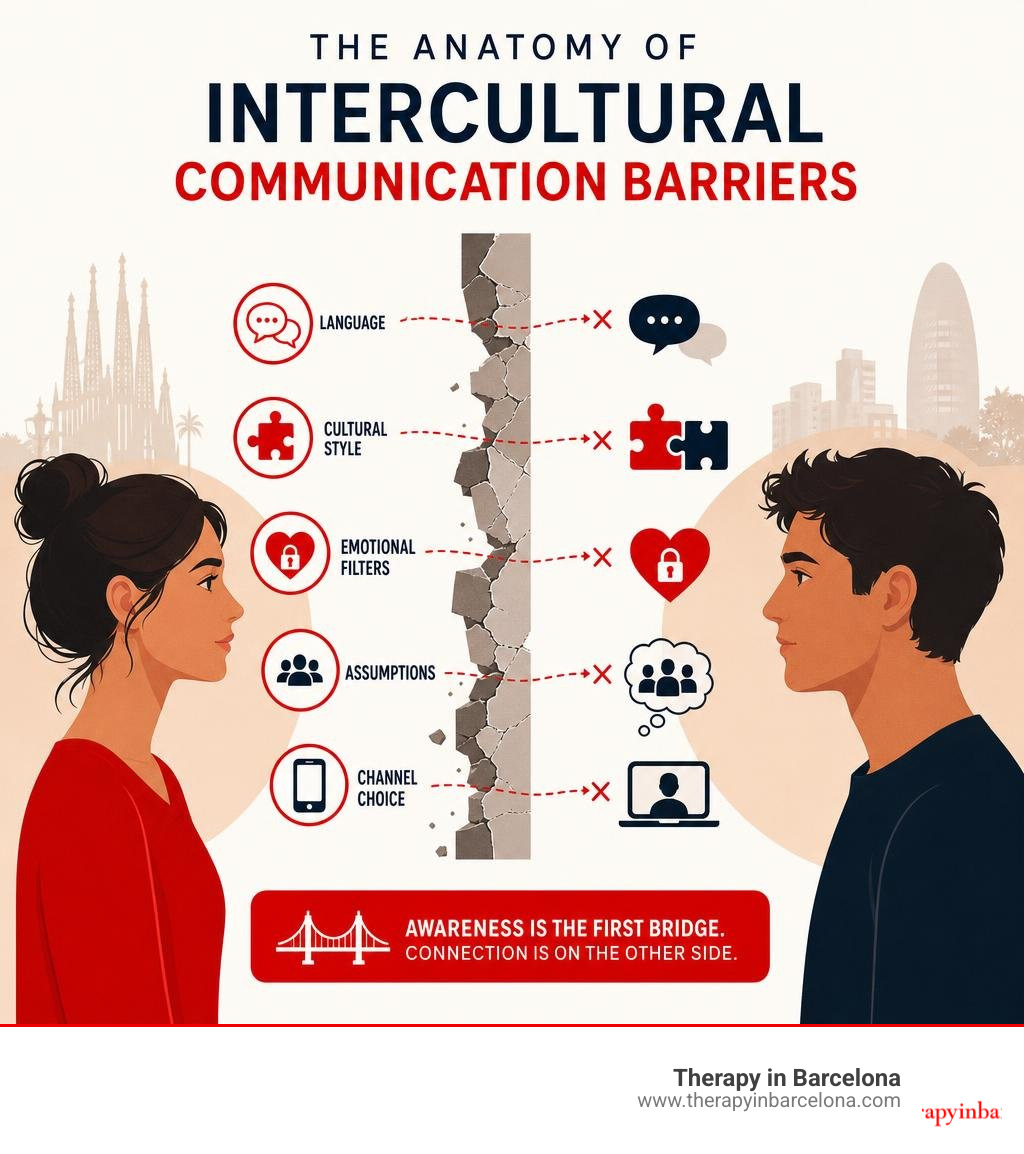
Understanding the Barriers in Intercultural Relationships
When we think about communication, we often focus on the words we speak. But words are only a small part of how we connect. In intercultural couples, several distinct types of barriers can disrupt even the most loving intentions.
Language and Semantic Barriers
A language barrier is not just about not knowing a word. It is about how we understand the meaning of words. Semantics refers to the meaning behind our language. In a bilingual relationship, one partner is almost always communicating in their non-native language.
This can lead to significant foreign language anxiety. It is tiring to constantly translate your thoughts before speaking. When you are tired, angry, or stressed, your ability to find the right words drops. You might use a word that sounds too harsh, or fail to express the subtle nuance of your feelings.
For practical tips on how teams and individuals manage these linguistic gaps, you can read about 7 tips for overcoming language barriers to communication | Nulab. Language is deeply tied to how we see ourselves, which we explore in our guide on How Language Shapes Your Cultural Identity.
Cultural and Psychological Barriers
We grow up learning unspoken rules about how to behave, how to express anger, and how to show affection. These rules form our cultural identity. When two people from different backgrounds move in together, these unspoken rules clash.
Psychological barriers also play a massive role. If you are feeling homesick, isolated, or anxious about your career in a new city like Madrid or Alicante, your emotional reserve is low. You are more likely to misinterpret your partner’s comments as attacks. Your own internal state acts as a filter, distorting the messages you receive.
Physical and Organisational Barriers
In a relationship context, physical barriers might include long-distance phases, busy work schedules, or even the layout of your home.
Organisational barriers refer to how you structure your life together. Who manages the bills? How do you divide household tasks? If there is no clear structure or agreement on these daily realities, resentment builds, making healthy communication even harder.
Practical Strategies to Overcome Communication Barriers in Love

To overcome communication barriers, you need practical, daily habits that build safety and clarity. Here are the most effective strategies you can start using today.
1. Simplify Your Language and Avoid Jargon
When speaking with a partner who does not share your native tongue, keep your sentences short and clear. Avoid regional slang, idioms, or complex metaphors. Speak at a moderate pace, and use clear, direct words.
This is not about “dumbing down” your thoughts. It is about prioritising connection over performance. You can read more about these foundational steps in this guide on How Can Communication Barriers Be Overcome? – Practical Strategies | WordSCR.
2. Practice Emotional Control and Patience
When an argument starts, your heart rate rises, and your brain enters a “fight or flight” mode. In this state, your ability to think clearly and choose respectful words is compromised.
If you feel your emotions taking over, ask for a brief pause. Say, “I want to talk about this, but I am feeling too overwhelmed right now. Can we take fifteen minutes to calm down and then try again?” This keeps you from saying things you will regret and allows you to approach the issue with patience and respect.
3. Choose the Right Communication Channel
Not all conversations belong on WhatsApp or email. Written messages lack tone of voice, facial expressions, and body language — which make up to 60% to 80% of how we interpret communication.
- Use written messages for simple logistics, like shopping lists or scheduling.
- Use face-to-face conversations for emotional topics, disagreements, or long-term planning.
If you must discuss something difficult while apart, choose a video call over a text message so you can still read each other’s non-verbal cues. For more on managing these dynamics, see our resource on Bridging the Gap: How to Thrive with Cultural Differences in Your Relationship.
Deepening Connection Through Active Listening and Constructive Feedback
Active listening is the cornerstone of resolving misunderstandings. Instead of planning your response while your partner is speaking, focus fully on understanding their perspective before replying.
Techniques for Active Listening
- Paraphrase and Repeat: After your partner speaks, repeat back what you heard in your own words. “It sounds like you are saying you feel lonely when I work late. Is that right?” This gives them a chance to clarify if you misunderstood.
- Use Open-Ended Questions: Avoid questions that can be answered with a simple “yes” or “no”. Instead, ask questions that invite deeper reflection. Learn more about this technique in our guide on Mastering the Art of Open-Ended Questions in Counseling.
- Watch Non-Verbal Cues: Pay attention to eye contact, posture, and tone of voice. If your partner says “I’m fine” but has their arms crossed and is looking away, their body language is telling a different story.
The Power of “I” Statements
When we are upset, we often start sentences with “You” — as in, “You never help around the house” or “You are always late.” This immediately makes the other person defensive.
Instead, use “I” statements to focus on your own experience and needs. For example:
- Instead of: “You are ignoring me.”
- Try: “I feel lonely when we sit together but don’t talk, because I need to feel connected to you.”
This simple shift reduces blame and invites your partner to support you rather than defend themselves. You can find a detailed breakdown of this tool in our article on How and When to Use I Statements.
How to Overcome Communication Barriers Using Nonviolent Communication
Nonviolent Communication (NVC) is a powerful three-step framework designed to help couples connect compassionately, even during intense disagreements. It helps you move away from judgment and toward mutual understanding.
Step 1: Observe Without Judgment
Stick to the concrete facts of what happened, rather than your evaluation or interpretation of it.
- Judgment: “You are always on your phone because you don’t care about me.”
- Observation: “I noticed you looked at your phone three times while I was telling you about my day.”
Step 2: Identify and Express Feelings and Needs
Connect your observation to how you feel and what you need. Avoid using words that imply the other person did something to you (like “I feel rejected”). Focus on core emotions.
- Expression: “I feel sad and disconnected because I need to feel valued and heard right now.”
Step 3: Make a Clear, Positive Request
Ask for a specific, actionable behavior that would help meet your need. Frame it positively — tell your partner what you want them to do, rather than what you want them to stop doing.
- Request: “Would you be willing to put your phone in the other room for the next ten minutes so we can talk?”
By using these steps, you build a style of Assertive Communication that respects both your partner’s boundaries and your own.
How to Overcome Communication Barriers in Multilingual Environments
Living as an expat in Spain — whether in a bustling hub like Barcelona or Madrid, or a coastal city like Valencia, Málaga, or Marbella — brings unique linguistic pressures. When you are also trying to learn the local language, Spanish family gatherings or social events can trigger intense foreign language anxiety.
If you are the expat partner, you might feel excluded when your partner speaks rapidly with their local friends or family. If you are the local partner, you might feel caught in the middle, constantly translating and trying to keep everyone happy.
To navigate this without exhausting yourselves:
- Set boundaries in advance: Agree on a signal for when the expat partner is feeling overwhelmed and needs a break from the local language.
- Create bilingual spaces: Dedicate specific times of day or activities to practicing each other’s languages, keeping the pressure low and the focus on playfulness.
- Acknowledge the emotional toll: Understand that learning a language is not just an intellectual task; it is an emotional journey of belonging.
For deeper insights into this experience, read our guide on Navigating Language Barriers and Foreign Language Anxiety: A Neuroscience-Informed Guide for Expats or explore The Language of Belonging: Navigating the Need to Speak the Local Language in Spain.
Navigating Conflict and Rebuilding Trust Across Cultures

When conflict happens, cultural differences in communication styles can make resolution feel impossible. One of the most important concepts to understand here is the difference between high-context and low-context communication.
High-Context vs. Low-Context Communication
Different cultures have different expectations about how much meaning is carried by the actual words spoken versus the context surrounding them.
Low-Context Communication
- Typical Cultures: Germany, the UK, the Netherlands, the US.
- Style: Direct, explicit, and precise.
- Belief: “Say what you mean and mean what you say.” If something is not stated, it is assumed not to exist.
- Risk: Can seem blunt, rude, or aggressive to high-context communicators.
High-Context Communication
- Typical Cultures: Spain, Italy, Japan, Latin American countries.
- Style: Indirect, subtle, and heavily reliant on non-verbal cues, tone, and shared history.
- Belief: “Read between the lines.” Direct confrontation is avoided to protect the relationship and maintain harmony.
- Risk: Can seem vague, evasive, or passive-aggressive to low-context communicators.
If a low-context partner demands a direct answer (“Do you want to go to this party or not?”), a high-context partner might reply indirectly (“Well, it’s quite far, and we have an early start tomorrow…”). The low-context partner hears this as a list of facts, while the high-context partner is actually saying “No, I don’t want to go.”
Recognising these differences helps you stop taking your partner’s communication style personally. For strategies on how to bridge this gap, read Conflict to Connection: Strategies for Intercultural Resolution.
The Influence of Past Traumas
Arguments are rarely just about the immediate issue. They often trigger old wounds or past experiences, causing partners to react to what the conflict represents rather than what is actually happening.
Recognising when an argument is rooted in the past is vital for rebuilding trust. When you notice yourself or your partner having an intense emotional reaction that seems out of proportion to the situation, pause and ask: “What is this really about?”
Working through these patterns is a central part of couples therapy. You can read more about how this works in From Misunderstandings to Meaningful Conversations: A Guide to Couples Communication Therapy.
Frequently Asked Questions about Intercultural Communication
What are the most common communication barriers in intercultural relationships?
The most common barriers include language differences, contrasting cultural communication styles (such as direct vs. indirect communication), differing expectations around gender roles and family obligations, and the psychological stress of relocation and homesickness, which reduces an expat’s emotional resilience.
How can we improve communication without making everything oversimplified?
Improving communication is about clarity, not oversimplification. You can discuss complex, deep ideas by using clear language, avoiding local idioms, and checking for understanding. Think of it as translating your thoughts into their cleanest form so your partner can truly meet you there.
When should an intercultural couple seek professional therapy?
You should consider professional therapy if you find yourselves stuck in the same painful argument loops, if resentment is building, or if language and cultural barriers are making you feel lonely within your relationship. Seeking support early can prevent these patterns from damaging your bond.
Conclusion
Learning to overcome communication barriers is not a quick fix; it is an ongoing practice of patience, curiosity, and love. By choosing to see your differences as opportunities for growth rather than obstacles, you can build a relationship that is deeply resilient and culturally rich.
If you are struggling to find common ground, you do not have to navigate this journey alone.
Your Options for Support in Spain
When looking for help to improve your relationship communication, you have several paths:
- The Public Health System: In Spain, public mental health services are available, but wait times can be long, and it is highly unlikely you will be matched with a therapist who speaks fluent English or understands the specific emotional landscape of expat life.
- Large Online Platforms: These services offer convenience, but they often lack personalised matching, experience high therapist turnover, and may sell your data. They rarely have deep, local knowledge of the expat experience in Spain.
- Local generalist practices: While helpful, they may not have specialised training in intercultural couples therapy or the unique challenges of relocating and adapting to a foreign country.
- Therapy in Barcelona: We offer a private, personalised service specialising in the international community. Our psychology-trained therapists provide culturally sensitive, evidence-based care, carefully matched to your individual needs.
Our team provides therapy in English, as well as other languages including German, French, Spanish, Afrikaans, Portuguese, Austrian-German, and Swiss-German.
We offer face-to-face sessions at our warm, welcoming offices in the heart of Barcelona’s Eixample district, as well as online therapy for expats worldwide, including those living in Valencia, Málaga, Madrid, Alicante, Sevilla, Marbella, Gran Canaria, and Zaragoza.
While we are a private-pay service, some of our therapists offer sliding scale fees for those with financial need — please inquire about this.
To take the first step toward a clearer, more connected relationship, read our guide on how communication therapy works at Talk It Out: Your Guide to Communication Therapy.
If you’d like support, book a Free Discovery Call today.
