


Why Effective Communication Strategies Shape Every Part of Your Life

Effective communication strategies are the practical skills and habits that help you express yourself clearly, listen with genuine attention, and connect with others — at work, at home, and everywhere in between. If you are looking for a quick overview, here is what the evidence consistently points to:
The most effective communication strategies, at a glance:
- Listen actively — give your full attention, pause before responding, and paraphrase what you heard
- Manage your emotions first — name what you are feeling internally before you speak, especially in tense moments
- Be clear and concise — lead with your main point and cut what does not serve it
- Watch your nonverbal cues — your posture, tone, and facial expressions often say more than your words
- Choose the right medium — sensitive conversations need richness (face-to-face or video); quick updates can be async
- Adapt to your audience — adjust your language, tone, and style depending on who you are speaking to
- Build psychological safety — in teams and relationships, people only communicate honestly when they feel safe doing so
These are not soft skills in the background. They are central to how careers grow, relationships survive, and teams function. Yet despite these stakes, most of us were never actually taught how to do it well.
The gap between sending a message and creating real understanding is where things go wrong. Misread texts, unclear meetings, and difficult conversations often come down to missing skills and mismatched habits—not bad intentions.
This matters even more when you are living across cultures. For expats living in Barcelona, Valencia, or elsewhere in Spain, everyday communication comes with an added layer of complexity — different norms, language gaps, and the quiet exhaustion of always having to translate yourself, literally and figuratively.
The good news is that communication is a learnable skill. Visible gains can appear within six to twelve weeks of around fifteen minutes of daily, deliberate practice. You do not need to overhaul your personality. You just need a few well-chosen strategies and the consistency to use them.
This guide covers the full picture — from active listening and emotional intelligence to cross-cultural communication, digital etiquette, and relationship dynamics — so you can find what is most relevant to your life and start there.
The Core Pillars of Effective Communication Strategies
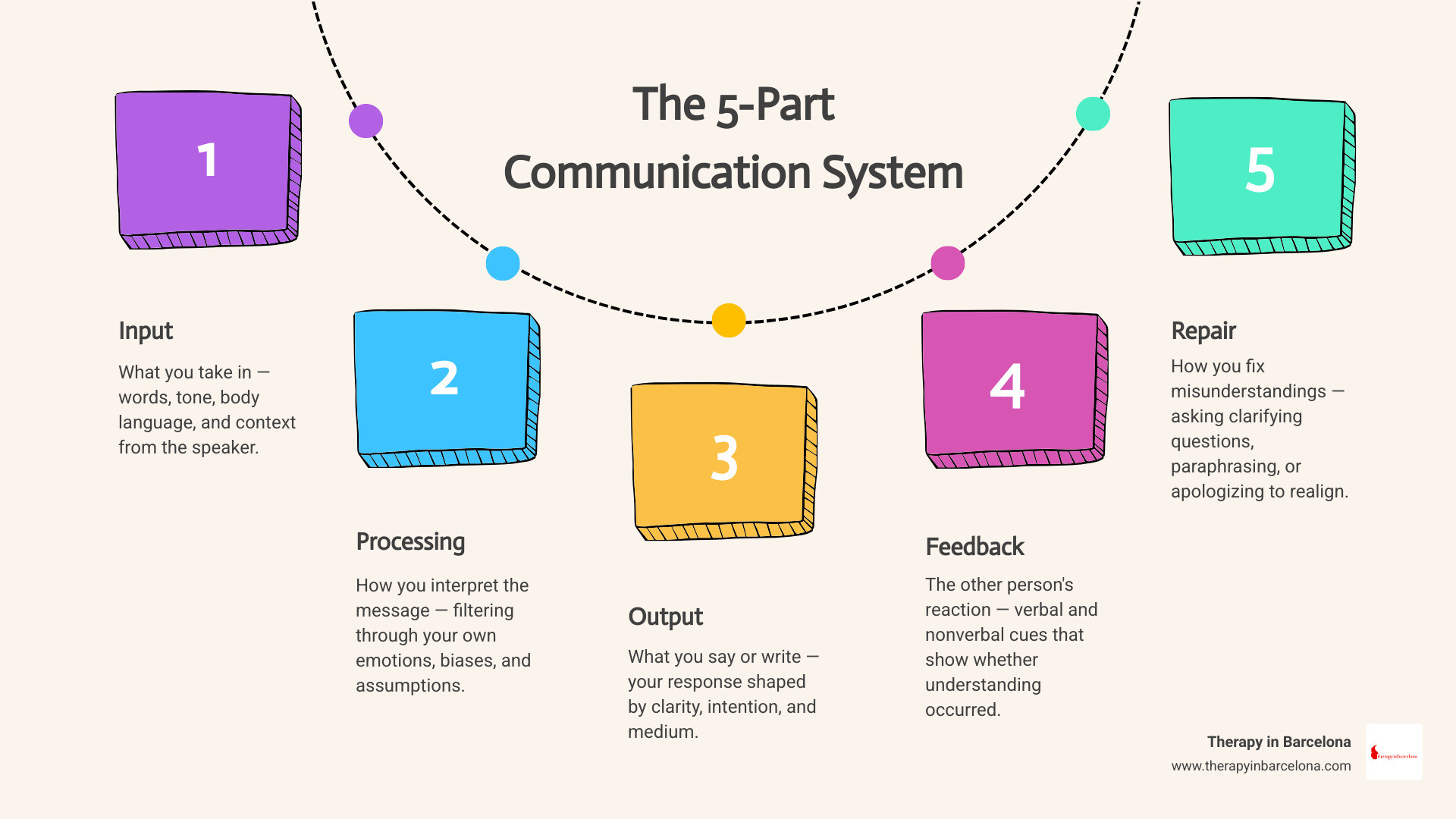
Better communication starts with understanding how it works. It is a five-part system: input, processing, output, feedback, and repair.

When you look at communication this way, you realise that sending information is not the same as creating usable understanding. Truly effective communication strategies balance three key areas: verbal clarity, written precision, and nonverbal alignment.
- Verbal Clarity: Many professionals talk too much because they figure out their point while speaking. Use the PREP framework: state your Point, give a Reason, provide an Example, then restate your Point. It keeps communication clear and structured.
- Written Precision: Written messages lack the warmth of your voice. Check the tone before sending, pause when frustrated, and keep messages brief with clear bullet points.
- Nonverbal Alignment: Nonverbal cues often carry more weight than the spoken word. If your facial expressions or body language conflict with your words, people will almost always believe your nonverbal signals.
Mastering Active Listening as One of Your Effective Communication Strategies
Active listening is perhaps the single highest-return skill in your toolkit. In many conversations, we easily miss key parts of what the other person is saying because our minds are busy preparing our next argument, or we zone out entirely.
To change this, you can use a set of physical and verbal tools designed to show the other person they are truly heard:
- The SOLER Posture: The SOLER framework means sitting Squarely, adopting an Open posture, Leaning in, maintaining comfortable Eye contact, and staying Relaxed. It signals that you are fully present.
- The Two-Second Pause: When the other person stops talking, wait two seconds before replying. This prevents interruptions, gives them space to think, and helps you respond thoughtfully.
- Paraphrasing and Probing: Instead of giving advice, reflect back what you heard and ask open-ended questions using “what” or “how” rather than “why.”
This level of presence is just as vital at home as it is in the office. If you want to explore how these skills apply to your personal life, you can read more about Mastering Active Listening in Couples Therapy.
Developing Emotional Intelligence and Assertiveness
Effective communication starts with understanding and managing your own emotions. When we feel threatened, criticised, or stressed, emotional flooding can take over, making constructive dialogue difficult.
To stay grounded, practise naming your emotions silently in the moment. Internally saying, “I am feeling defensive right now,” helps activate your prefrontal cortex, taking the edge off your immediate survival response.
Once you are calm, you can practise Assertive Communication. Assertiveness is the healthy middle ground between passivity (staying silent and letting resentment build) and aggression (forcing your point at the expense of others).
A great way to practise assertiveness is by learning How and When to Use I-Statements. Instead of saying, “You always ignore my emails and make my job harder,” reframe it to: “I feel stressed when I don’t receive the project updates on Monday, because I need that data to finish my report on time.”
This shifts the focus from blaming the other person to expressing your actual needs, which naturally lowers defensiveness.
For more insights on structuring your professional interactions, you can read about the 8 Ways You Can Improve Your Communication Skills to help build a more collaborative environment.
Overcoming Barriers to Connection in a Digital and Diverse World
Modern life is fast, digital, and highly international. This introduces unique barriers to connection, such as digital miscommunication, information overload, and cultural differences.
When we communicate primarily through text-based tools, we lose the “media richness” of face-to-face interaction. Without tone of voice or facial expressions, our brains tend to fill in the blanks with negative assumptions. Furthermore, the perceived distance of digital screens can make people more likely to escalate conflicts.
Implementing Effective Communication Strategies Across Cultures and Mediums
Overcoming these barriers requires a high degree of adaptability. This is especially true for the international community living in Spain’s vibrant hubs, from Madrid and Barcelona to Valencia and Málaga.
To see how this plays out in real life, consider a fictional composite example of a UK expat who moved to Valencia for a new job. While she loved the sunny lifestyle, she struggled with loneliness and cultural adjustment.
At work, her direct British communication style was sometimes misread as cold, while the more expressive local style felt overwhelming. She felt isolated and struggled to build deep connections in both her professional and personal life.
For expats, communication is not just about vocabulary; it is about learning to read a new set of cultural rules. This is where tools like The Intercultural Compass become invaluable. By understanding that different cultures have different baselines for directness, silence, and emotional expression, you can learn to adapt your style without losing your authentic self.
When conflicts do arise across cultural lines, you can use specific techniques to move from Conflict to Connection. This involves avoiding local idioms that do not translate well, checking your assumptions, and focusing on shared goals rather than cultural differences.
To deepen your understanding of these dynamics, you can explore the Strategies in Communication: Your Guide to Better… resources which offer structured paths for managing complex interpersonal environments.
Managing Remote Work and Digital Etiquette
With remote and hybrid work becoming the norm, team communication can easily become chaotic. Many teams make the mistake of overloading a single chat channel or defaulting to endless video meetings.
To build a healthier digital workspace, consider these practical standards:
- Match the Channel to the Message: Use video or face-to-face meetings for sensitive or complex conversations. Use email or project boards for updates, simple questions, and non-urgent tasks.
- Establish Clear Standards: Do not assume everyone knows how to use digital tools. Create explicit guidelines on expected response times, when to use group chats versus direct messages, and how to write clear, actionable subject lines.
- Write with Clarity and Brevity: When assigning tasks, use the “what, why, by when, from whom” pattern. This simple structure eliminates vague instructions and ensures everyone is aligned.
- Follow Up with Written Summaries: After a live call, post a brief, searchable summary of the key decisions and agreed next steps in a shared channel. This preserves a single source of truth for the team.
For detailed frameworks on structuring team interactions, you can consult the guide on Effective Communication Strategies for Teams (2026).
Strengthening Relationship Dynamics: From Conflict to Connection
Healthy communication is the absolute foundation of any long-term relationship. Yet, many couples find themselves stuck in repetitive, painful argument loops.
Often, these arguments are not actually about the laundry or the dishes. They are echoes of deeper, unmet emotional needs or past traumas. When we avoid conflict to keep the peace, we actually allow resentment to grow quietly in the background.
To break these cycles, couples must learn the art of healthy conflict resolution. This involves catching disagreements early, learning to take therapeutic pauses when emotions run high, and Setting Boundaries that protect both partners’ well-being.
By practising these skills, you can unlock The Secret Sauce to Effective Couple Communication.
Moving Beyond Love Languages to Evidence-Based Maintenance
While the concept of “love languages” is highly popular, partners are generally happiest when love is expressed consistently in any form. What matters most is taking active responsibility to make your partner feel valued word through consistent, everyday actions.
There are several key dimensions of relationship maintenance that help couples stay connected:
- Sharing Tasks: This goes beyond dividing household chores. It means representing yourselves as a unified team, managing administrative burdens together, and supporting each other’s daily responsibilities.
- Attitudinal Positivity: Approaching your partner with warmth, optimism, and cooperative energy, rather than default criticism or cynicism.
- Openness: Creating a safe, non-judgmental space to discuss sensitive topics, including finances, future dreams, and intimacy.
- Social Networks: Respecting each other’s autonomy to maintain separate friendships and hobbies, which helps sustain healthy desire and energy within the relationship.
If you are looking for practical ways to strengthen these areas, you can try these How to Build Trust in Your Relationship exercises designed to foster deeper connection and security.
Applying Nonviolent Communication (NVC) in Daily Life
Nonviolent Communication (NVC), developed by Marshall Rosenberg, is a highly effective framework for de-escalating tension and expressing difficult feelings without triggering defensiveness.
The process involves three simple steps:
- Observe Without Judgment: State the observable facts without interpretations or labels. For example, say, “When I saw you looking at your phone while I was speaking…” instead of, “You never listen to me.”
- Identify and Express Feelings and Needs: Connect those facts to how you feel and what you need. “I felt hurt and lonely because I was looking for connection and support.”
- Make a Clear, Positive Request: Formulate a specific, actionable, and positive request rather than a demand. “Would you be open to putting your phone away for ten minutes so we can talk?”
By shifting the conversation from blame to vulnerability, NVC makes it much easier for your partner to hear your heart and respond with empathy.
Choosing the Right Support: How Therapy in Barcelona Compares to Alternatives
If you are struggling to build these skills on your own, seeking professional support can make a profound difference. However, it is important to understand your options so you can choose the path that best fits your needs.
- Public Health System This is an accessible option for local care. However, Spain’s public system often has long waiting lists, limited sessions, and few specialised English-speaking therapists who understand expat challenges.
- Large Online Platforms These platforms offer convenient access but may lack personalised matching, have high therapist turnover, and raise data privacy concerns.
- Local Private Practices Many local practices in Spain offer excellent clinical care. However, they may not have deep expertise in the specific challenges faced by the international community, such as cultural adjustment, isolation, bicultural relationship dynamics, or living as a Third Culture Kid.
- Therapy in Barcelona Established in 2011, we specialise in supporting the English-speaking international community. We never sell your data or use automated matching—instead, we personally match you with the right psychology-trained expat therapist for personalised, culturally sensitive care.
Frequently Asked Questions About Communication
How long does it take to noticeably improve communication skills?
With consistent, deliberate practice, you can begin to see early improvements within two weeks. However, it typically takes six to twelve weeks of around fifteen minutes of daily practice to build new habits and see automatic, lasting behavioural changes.
This is because your brain needs time to build new neural pathways and replace old, reactive habits with structured frameworks like active listening and I-statements.
What is the single fastest way to become a better communicator?
The fastest “cheat code” is a two-second pause before responding. It reduces reactivity and gives you time to choose a thoughtful response instead of reacting defensively.
How do I handle a conversation when I get emotionally flooded?
When you feel your heart racing or muscles tensing, you may be experiencing emotional flooding. Name the emotion, take a slow breath, and ask for a ten-minute break. Use grounding techniques to calm your nervous system before returning to the conversation.
Taking the Next Step with Your Communication
Effective communication is a learnable skill that takes patience, self-awareness, and practice. Whether at work, across cultures, or in relationships, these strategies can help you build stronger connections.
At Therapy in Barcelona, we understand that life abroad can be beautiful, messy, and challenging. Founded in 2011 by Australian psychologist and 14-year expat Leigh Matthews, our practice provides culturally sensitive mental health care rooted in compassion, authenticity, and professional excellence.
Our international, collaborative team of psychology-trained expat therapists offers multilingual therapy (including English, German, French, Spanish, and more) tailored to the unique journeys of adults, couples, teens, and families.
We offer both in-person sessions at our welcoming office in the heart of Barcelona’s Eixample district and online therapy to internationals worldwide.
As a private-pay service, we are committed to providing the highest standard of personalised care, with some of our therapists offering sliding scale fees to support those with financial need.
If you’d like support on your journey toward better communication and personal growth, book a Free Discovery Call today.
